


An electrical room is a room or dedicated space used to house electrical equipment such as switchboards, panelboards, motor control equipment, disconnects, transformers, or similar distribution equipment.
For electricians, this topic matters because people often ask two different questions as if they are the same:
Study smarter with VoltageLab
Built for electricians, apprentices, and electrical engineers who want faster practice and better exam prep.
⭐️ Join thousands of electricians upgrading their skills
- What clearances and access rules apply to electrical equipment in a room?
- When does the room itself have to be fire-rated?
Those are related questions, but they do not come from one single rule. If you are working in the field, you need to separate equipment space requirements from building and fire-resistance requirements.
What counts as an electrical room?
In practice, electricians usually call it an electrical room when the space is dedicated mainly to electrical distribution or service equipment.
Common examples include rooms containing:
- service equipment
- switchboards and switchgear
- panelboards
- feeders and distribution equipment
- transformers
- electrical control equipment
The room may be large and purpose-built, or it may be a smaller dedicated space inside a commercial or multifamily project. What matters is not the label on the door. What matters is the type of equipment installed and the code requirements that apply to that equipment and occupancy.
What the NEC requires and what it does not
The NEC is heavily involved in equipment installation, working clearances, dedicated space, and access, but it does not simply say every electrical room must be fire-rated.
That is where many online explanations go off track.
Pass your electrical exam the first time
Practice real NEC exam questions with full code-referenced explanations and progress tracking — built for journeyman, master and apprentice exam prep.
Thousands of NEC practice questions with code-referenced answers
From an electrician’s standpoint, the NEC usually drives questions like:
- Is there enough working space in front of the equipment?
- Is the width sufficient?
- Is headroom adequate?
- Is the space being used for storage?
- Is there dedicated electrical space above the equipment?
- Is the equipment readily accessible?
Those are the rules that often determine whether the room works for the installation.
Working space and access rules electricians should check
1. Working space in front of equipment
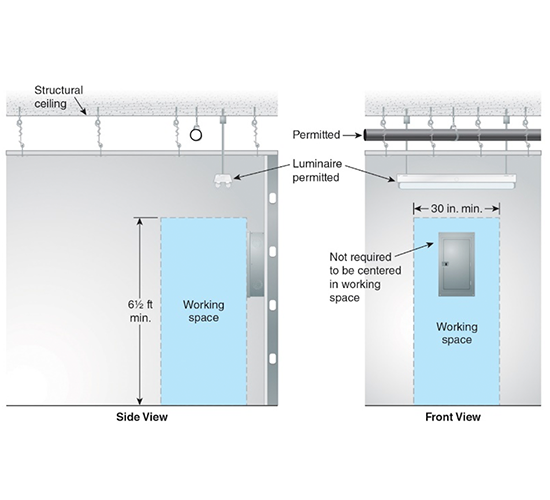
For many common installations, NEC 110.26 is one of the first rules to review.
That means checking:
- required depth in front of the equipment
- minimum width of the working space
- required headroom
- whether doors can open at least
90 degrees - whether the required working space is clear
If the room is too tight, full of storage, or blocked by piping or other equipment, the problem may not be “the room is too small” in a general sense. The problem may be that the required electrical working space is not there.
2. Dedicated electrical space
For indoor installations, NEC 110.26(E) also matters. Electricians should check whether foreign systems like:
- ductwork
- leak protection piping
- plumbing
- unrelated mechanical systems
are being routed through the dedicated electrical space above the equipment.
That is a common issue in real projects, especially when multiple trades are crowding the same room.
3. Access and egress
Large equipment can trigger additional entrance and egress-door requirements under NEC 110.26(C). This is especially important in rooms containing larger switchgear or equipment likely to require service while energized.
That means electricians should not just think about front clearance. They should also think about:
- how a worker enters the room
- whether doors open in the required direction where applicable
- whether the room layout creates a problem during servicing
When does an electrical room need to be rated?
This is the part most people want answered with one sentence, but that is not how the code works.
An electrical room may need a fire-resistance rating based on:
Study smarter with VoltageLab
Built for electricians, apprentices, and electrical engineers who want faster practice and better exam prep.
⭐️ Join thousands of electricians upgrading their skills
- the building code adopted in that jurisdiction
- the occupancy type
- the type and size of equipment
- whether the room contains service equipment or emergency system equipment
- whether the room is associated with standby power, energy storage, fire pumps, or similar systems
- local amendments and utility requirements
In other words, room rating requirements often come from the building code, fire code, utility rules, or local amendments, not from a single general NEC sentence that applies to every electrical room.
Situations where ratings are often discussed
Electricians commonly run into room-rating questions with:
- service equipment rooms
- transformer rooms
- fire pump rooms
- generator or emergency power rooms
- battery or energy storage rooms
- multifamily and commercial building service areas
So if someone asks, “Does this electrical room need to be rated?” the correct electrician answer is usually:
Check the adopted building code, fire code, project drawings, and local AHJ requirements.
Why California questions come up so often
Searches like california when are electrical rooms required to be rated are common because California projects often involve stricter coordination between:
- electrical plans
- building code review
- fire/life safety review
- utility and local jurisdiction requirements
California electricians and contractors also deal with frequent local amendments and more plan-driven enforcement in many jurisdictions. That is why a question that sounds like a simple NEC issue often turns into a building-code and AHJ issue.
The practical takeaway is this:
- the NEC handles the equipment installation side
- room rating questions often sit in the building/fire code layer
- California projects make that distinction show up more often in real life
Common field mistakes
Assuming every electrical room must be rated
That is not automatically true.
Assuming the NEC alone answers the room-rating question
Often it does not. You may need the building code, fire code, or AHJ interpretation.
Focusing only on room size
A room can still fail if:
- working space is blocked
- storage is placed in front of equipment
- dedicated space is violated
- access to large equipment is not compliant
Letting other trades fill the room
Mechanical, plumbing, and storage conflicts are one of the fastest ways to turn a compliant-looking electrical room into a bad installation.
Ignoring project drawings
For rated-room questions, approved plans matter. Field assumptions are not enough.
Final takeaway
An electrical room is not defined only by its name. What matters is the equipment inside it and the rules that apply to that equipment.
For electricians, the smartest way to approach the room is to break the issue into two parts:
- Electrical installation requirements
- working space
- dedicated space
- access
- clearances
- equipment layout
- Room construction requirements
- whether the room must be rated
- whether special wall, ceiling, or door assemblies apply
- what the adopted building code and AHJ require
That approach keeps you from chasing the wrong rule and helps you answer the jobsite question correctly.
FAQ
What is considered an electrical room?
An electrical room is a room or dedicated space used mainly for electrical equipment such as service gear, switchboards, panelboards, transformers, or distribution equipment.
Does the NEC require every electrical room to be fire-rated?
No. Fire-resistance rating requirements usually depend on the adopted building code, fire code, project design, and local AHJ requirements.
What NEC rule matters most in an electrical room?
For many installations, NEC 110.26 is one of the most important because it covers working space around electrical equipment.
Can electrical rooms be used for storage?
Required working space around electrical equipment cannot be used for storage.
Why do people ask so often whether electrical rooms must be rated in California?
Because California projects often involve stricter plan review, local amendments, and closer coordination between electrical and building/fire code requirements.
If you want to keep reviewing code-focused electrician topics like electrical rooms, clearances, and equipment spaces, the VoltageLab app gives you a practical way to study with topic-based questions, explanations, and progress tracking.
Sources
- NFPA article on electrical room basics
- NFPA article on electrical room basics part 2
- OSHA 1910.303 general electrical requirements
- NFPA 70 working-space and dedicated-space reference materials
FREE PRACTICE TOOL
Think you'd pass this on a real exam?
Test what you just read with instant-feedback quizzes built around real code questions — not generic trivia.
5
Code standards
10,000+
Active learners
100%
Free to start
Instant explanations on every answer, right or wrong
NEC, BS7671, AS/NZS, CEC, and DIN VDE covered
Bite-sized quizzes you can finish in 5 minutes
No signup required to try your first quiz
No account needed · Takes less than 2 minutes