


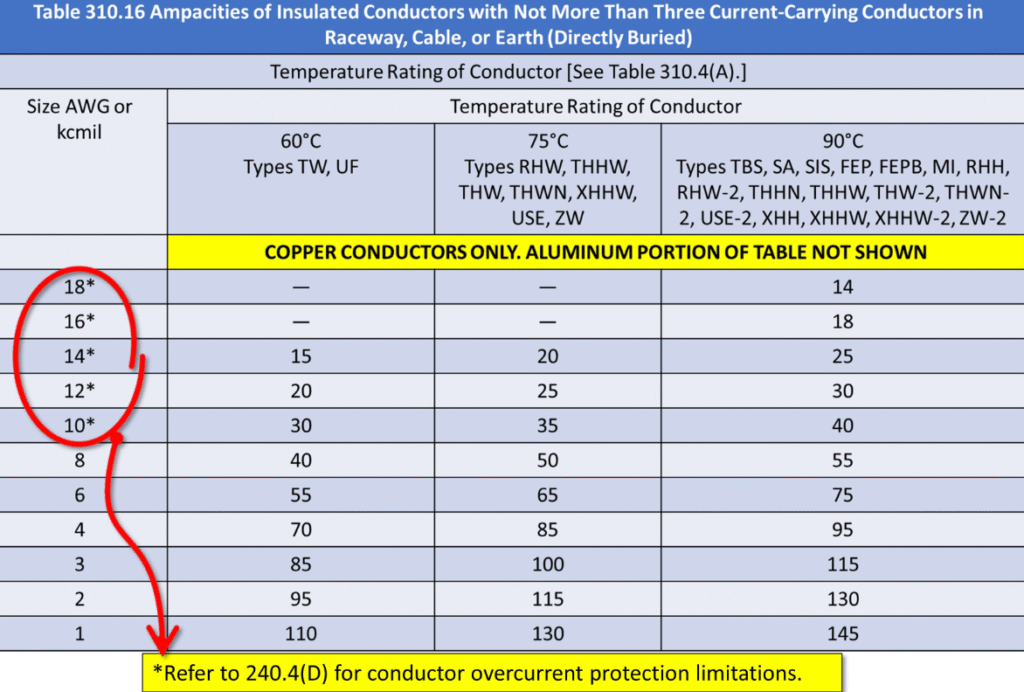
Purpose
NEC Table 310.16 provides the allowable ampacity (current-carrying capacity) of insulated conductors rated 0 – 2000 volts.
It is one of the most used tables in the NEC — helping electricians size wires safely based on insulation type, temperature rating, and installation conditions.
Study smarter with VoltageLab
Built for electricians, apprentices, and electrical engineers who want faster practice and better exam prep.
⭐️ Join thousands of electricians upgrading their skills
Understanding the Table
Ampacity depends on several factors:
- Conductor Material – Copper carries more current than aluminum for the same size.
- Insulation Temperature Rating – Common ratings:
- 60 °C (140 °F) for older cables or NM-B.
- 75 °C (167 °F) for THW, XHHW.
- 90 °C (194 °F) for THHN, THWN-2, XHHW-2.
- Ambient Temperature – Table values assume 30 °C (86 °F). Apply correction factors if ambient temperature is higher or lower.
- Number of Conductors – If more than three current-carrying conductors are in a raceway or cable, apply adjustment factors from Table 310.15(C)(1).
- Voltage Drop – Recommended to keep total voltage drop within 3 % for branch circuits or feeders.
The Asterisk “*” in Table 310.16
Some conductor sizes (18 AWG – 10 AWG) are marked with an asterisk (*).
This refers to Section 240.4(D) — the “Small Conductor Rule.”
It limits overcurrent protection, not the ampacity itself.
- 14 AWG Cu → protected by 15 A max breaker or fuse
- 12 AWG Cu → protected by 20 A
- 10 AWG Cu → protected by 30 A
So while a 10 AWG THWN copper wire is rated 35 A per Table 310.16,
the overcurrent device cannot normally exceed 30 A as per 240.4(D).
Pass your electrical exam the first time
Practice real NEC exam questions with full code-referenced explanations and progress tracking — built for journeyman, master and apprentice exam prep.
Thousands of NEC practice questions with code-referenced answers
This distinction is crucial — ampacity defines what the wire can safely carry;
240.4(D) defines how it must be protected.
Example — Copper Conductors (75 °C Column)
| AWG Size | Ampacity (A) |
|---|---|
| 14 AWG | 20 A* |
| 12 AWG | 25 A* |
| 10 AWG | 35 A* |
| 8 AWG | 50 A |
| 6 AWG | 65 A |
| 4 AWG | 85 A |
| 2 AWG | 115 A |
| 1/0 AWG | 150 A |
| 2/0 AWG | 175 A |
| 3/0 AWG | 200 A |
| 4/0 AWG | 230 A |
*Overcurrent protection limits apply per 240.4(D)
⚙️ Key Takeaways
- Table 310.16 gives the base ampacity values for conductors.
- Section 240.4(D) limits breaker or fuse size for smaller conductors.
- Always apply temperature correction and conductor adjustment factors.
- Confirm equipment termination temperature rating (often 60 °C or 75 °C).
- Proper sizing ensures safety, efficiency, and code compliance.
FREE PRACTICE TOOL
Think you'd pass this on a real exam?
Test what you just read with instant-feedback quizzes built around real code questions — not generic trivia.
5
Code standards
10,000+
Active learners
100%
Free to start
Instant explanations on every answer, right or wrong
NEC, BS7671, AS/NZS, CEC, and DIN VDE covered
Bite-sized quizzes you can finish in 5 minutes
No signup required to try your first quiz
No account needed · Takes less than 2 minutes