

Wire Gauge (AWG) Chart for Electricians: Ampacity and Size
Wire gauge chart for copper and aluminum, 14 AWG to 500 kcmil: ampacity from NEC Table 310.16, diameter and resistance from Chapter 9 Table 8, and wire size by breaker.

What Size Wire for a 400-Amp Service? NEC Guide
400-amp service wire size from NEC Table 310.12: 400 kcmil copper or 600 kcmil aluminum, the 83 % rule, two-set Class 320 builds, and the non-dwelling answer.
100-Amp Sub-Panel Wire Size: NEC Feeder & Ground Sizing
A 100 amp sub panel needs 3 AWG copper or 1 AWG aluminum, a full-size neutral and an 8 AWG copper ground. NEC 215.2, Table 310.16 and 250.122 explained.
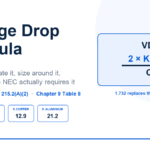
How to Calculate Voltage Drop: NEC Formula + Worked Examples
The voltage drop formula explained: VD = 2KIL/CM for single-phase, 1.732 for three-phase. Worked NEC examples, max run charts, and where 3% is mandatory.
8 AWG Wire Ampacity: 40 A or 50 A? NEC 310.16 Explained
8 AWG ampacity is 40 A, 50 A or 55 A depending on which column of NEC Table 310.16 you are allowed to read. Here is how to pick the right one, with the 8 THHN and NM cable rules.
What Size Wire for a 100-Amp Service? NEC Sizing Guide
What size wire for a 100 amp service: 4 AWG copper or 2 AWG aluminum per NEC Table 310.12(A). Why #4 copper works, the 83% rule, and where it does not apply.
60-Amp Sub-Panel: Wire Size, Loads & When It’s Enough (NEC)
60 amp sub panel wire size, EGC sizing, and whether a sub panel size of 60 amp is enough for your load. NEC Table 310.16, 215.3, 250.122 and 408.40 explained.
Minimum Circuit Ampacity (MCA) Explained for Electricians
Minimum circuit ampacity sizes your conductors, not your breaker. The NEC 440.32 and 440.33 formulas, MCA vs MOCP, and how to pick a wire from a nameplate MCA.
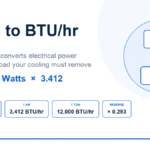
Watts to BTU/hr: Conversion Formula for Electrical Heat Load
Convert watts to BTU/hr by multiplying by 3.412142. Formula, conversion chart, tons of cooling, and how to work out which watts actually become heat.
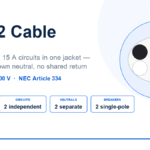
What Is 14-2-2 (Double-Neutral) Cable and When to Use It
14-2-2 cable holds two hots, two separate neutrals and a ground — two independent 15 A circuits in one jacket. Colours, derating, box fill and when to use it.
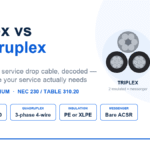
Triplex vs Quadruplex Service Cable Explained
Quadruplex has three insulated conductors plus a bare neutral messenger; triplex has two. Construction, ampacity, code names and the NEC rules that apply to each.
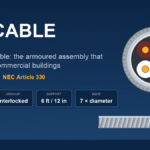
MC Cable (Metal-Clad) Explained: Types, Uses & NEC Rules
What MC cable is, the five types you will be handed on a job, ampacity from NEC Table 310.16, and exactly where Article 330 permits metal-clad cable — and where it does not.
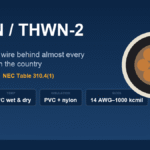
THHN / THWN-2 Wire Explained: Ratings, Uses & Where It’s Allowed
THHN wire meaning, THHN vs THWN vs THWN-2 ratings, ampacity from NEC Table 310.16, and exactly where the Code allows it. A field guide for electricians.
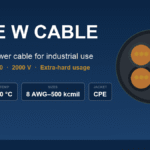
Type W Cable Explained: Portable Power Cable Ratings, Uses & NEC 400 Rules
Type W is a 2000 V portable power cable under NEC Article 400 — not a wet-location suffix. Ratings, construction, ampacity from Table 400.5(B), and where the Code permits and prohibits it.
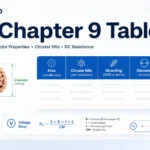
NEC Chapter 9 Table 8 Explained: Conductor Properties Guide
NEC Chapter 9 Table 8 lists each conductor's circular mils, stranding, diameter and DC resistance at 75°C. How to read it, key values and voltage drop examples.
NEC Table 310.16 Ampacity Chart: How to Read It (60/75/90°C)
NEC Table 310.16 ampacity chart: copper values, 60/75/90°C columns, 110.14(C) termination limits, and when to correct or adjust ampacity.
What Does NEC Stand For? Understanding the National Electrical Code
NEC stands for National Electrical Code.
In the electrical trade, the NEC is one of the most important code books you will use. NFPA describes...
Grounding Electrode Conductor (GEC) Sizing Questions on NEC Electrical Exams (Table 250.66)
Grounding electrode conductor (GEC) sizing questions are high-frequency on Journeyman exams because they test whether you can correctly use NEC Table 250.66—especially when the...