


Cell and Battery are fundamental components of modern electrical systems, powering everything from small electronic devices to large industrial machines. This article explores the key concepts of cells and batteries, including their types, differences, and practical applications. We will also delve into the distinctions between primary and secondary cells, the characteristics of ideal cell, and the importance of depolarizers in battery operation. By understanding these basics, you can gain a deeper insight into how these essential devices contribute to the functionality of various electrical circuits.
Quick Answer
Study smarter with VoltageLab
Built for electricians, apprentices, and electrical engineers who want faster practice and better exam prep.
⭐️ Join thousands of electricians upgrading their skills
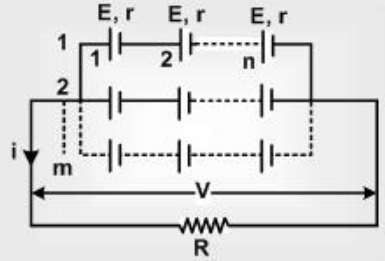
The difference between a cell and a battery: a cell is a single unit that converts chemical energy into electrical energy, while a battery is two or more cells connected together (in series for more voltage, or in parallel for more capacity).
Example: a 1.5 V AA is technically a single cell, while a 12 V car battery is six 2 V lead-acid cells in series.
Table: Cell vs battery at a glance
| Cell | Battery | |
|---|---|---|
| Definition | A single electrochemical unit | Two or more cells connected together |
| Voltage | Set by its chemistry: about 1.5 V alkaline, 1.2 V NiMH, 2 V lead-acid, 3.6-3.7 V lithium-ion | Sum of the cells in series, e.g. 9 V, 12 V, 48 V |
| Examples | AA, AAA, D, button cell, one 18650 cell | 12 V car battery (6 cells), 9 V battery (6 cells), laptop pack |
| Changing voltage or capacity | Fixed by the cell | Adjusted by series or parallel connection |
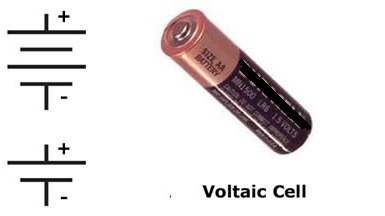
| Circuit symbol | One long line (+) and one short line (-) | Several long/short line pairs |
What is Cell and Battery?
Cell: An electric cell is a device used to generate electricity. It is a single unit that converts chemical energy into electrical energy, producing DC voltage.
Each cell has two terminals, one positive and one negative. The positive terminal is indicated by a long line and the negative terminal by a short line. Below is an illustration:
Battery: A battery is a combination of multiple electric cells connected together to increase or decrease current or to change voltage in an electric circuit.
Study smarter with VoltageLab
Built for electricians, apprentices, and electrical engineers who want faster practice and better exam prep.
Join thousands of electricians upgrading their skills
What are Primary and Secondary Cell?
Primary Cell: A primary cell is one that generates electrical current through a chemical reaction and cannot be recharged once it is discharged. Primary cells are of two types: 1) Single-liquid cells, 2) Double-liquid cells.
Single-liquid Cell: A single-liquid cell is an electric cell that contains only one active liquid substance or electrode. Examples include dry cells (used in TV remotes and various devices), bichromate cells, and Leclanché cells.
Secondary Cell: A secondary cell, also known as a storage cell, generates electrical current through a chemical reaction and can be recharged after being discharged. Examples include lead-acid cells, nickel-cadmium alkaline cells, etc.
What are the Differences Between Cell and Battery?
Cell
- A cell is an individual unit.
- The internal resistance of a cell cannot be changed by external electrical connections.
- It is not possible to obtain a voltage higher than the rated value from a cell.
Battery
- A battery consists of multiple cell.
- The effective resistance of a battery can be adjusted by external electrical connections.
- The voltage can be increased or decreased as required.
What is an Ideal Cell?
In circuit theory, an ideal cell is one with zero internal resistance, so its terminal voltage always equals its EMF (electromotive force) no matter how much current it supplies. Real cells have some internal resistance, so their terminal voltage drops under load.
The constant-EMF cells used as laboratory references are more precisely called standard cells, such as the Weston cell.
For example, we know that a common cell cannot supply electricity at a constant rate for an extended period. This is because their EMF gradually decreases with prolonged use.
However, in laboratories, it is necessary to use cells that do not experience a decrease in EMF for conducting electrical experiments. Such cells are known as ideal cells. They are primarily used for comparison with the EMF of other standard cells.
Common Differences Between Dry Cell and Wet Cell
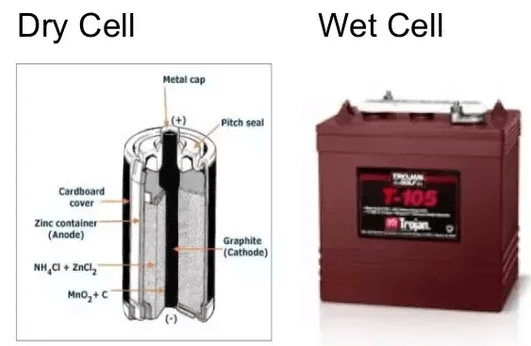
Dry Cell
- A paste is used instead of a liquid electrolyte.
- The container of the dry cell acts as the negative electrode.
- Electrolyte and water cannot be added to reuse the dry cell.
- It is small, lightweight, and can be placed in any position.
- If not used, it gets damaged over time.
Wet Cell
- A liquid electrolyte is used.
- Electrodes are placed inside the container.
- Electrolyte and water can be added to extend its use for a long time.
- It is large, heavy, and cannot be placed in any position.
- It can last for years if maintained, but a lead-acid wet cell sulfates and loses capacity if left discharged.
What is a Depolarizer? Why is Depolarization Used and How Can it Be Removed?
Depolarizer: A depolarizer is a substance used in primary cells to remove the hydrogen gas that collects at the positive electrode during discharge. That hydrogen layer would otherwise raise internal resistance and lower the voltage (polarization).
Manganese dioxide is commonly used as a depolarizer. Chromic acid, nitric acid, etc., are also used.
Generally, depolarization can be removed by three methods:
- Mechanical method
- Electrochemical method
- Chemical method
What is the difference between a cell and a battery?
A cell is a single unit that converts chemical energy into electrical energy, while a battery is a combination of multiple cells connected together to increase voltage or current.
What are the primary and secondary cells?
Primary cells are single-use cells that cannot be recharged after depletion, such as dry cells. Secondary cells, like lead-acid battery, can be recharged and used multiple times.
Study smarter with VoltageLab
Built for electricians, apprentices, and electrical engineers who want faster practice and better exam prep.
⭐️ Join thousands of electricians upgrading their skills
What is the purpose of a depolarizer in a cell?
A depolarizer is used to neutralize hydrogen that flows from the negative to the positive electrode in a cell, preventing polarization and ensuring efficient operation.
How do dry cells differ from wet cells?
Dry cells use a paste instead of a liquid electrolyte and are smaller, lighter, and more portable. Wet cells use a liquid electrolyte and are typically larger and heavier.
What is an ideal cell, and how is it used?
An ideal cell has zero internal resistance, so its terminal voltage always equals its EMF regardless of load. Laboratory reference cells with a very stable EMF, such as the Weston cell, are called standard cells.
Is an AA battery a cell or a battery?
Technically, a single AA is a cell: one electrochemical unit producing about 1.5 V (alkaline). In everyday language it is called a battery. A 9 V battery, by contrast, really is a battery, made of six small 1.5 V cells in series.
How many cells are in a 12V car battery?
Six. A lead-acid cell produces about 2 V, so six cells in series give a nominal 12 V (about 12.6 V when fully charged).
FREE PRACTICE TOOL
Think you'd pass this on a real exam?
Test what you just read with instant-feedback quizzes built around real code questions — not generic trivia.
5
Code standards
10,000+
Active learners
100%
Free to start
Instant explanations on every answer, right or wrong
NEC, BS7671, AS/NZS, CEC, and DIN VDE covered
Bite-sized quizzes you can finish in 5 minutes
No signup required to try your first quiz
No account needed · Takes less than 2 minutes