


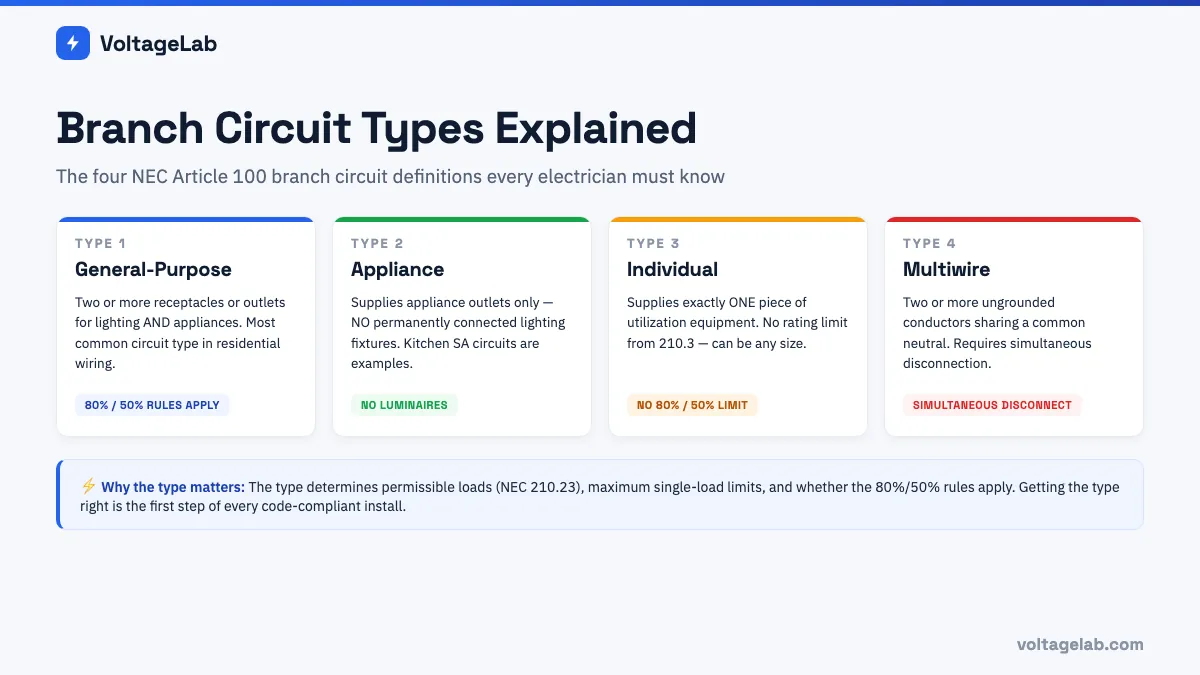
NEC Article 100 defines four distinct types of branch circuits, and the type determines what loads can be connected to the circuit, what size equipment is permitted, and what load limits apply under NEC 210.23. The distinction matters every time you plan a residential or commercial wiring installation — and it shows up on virtually every state licensing exam.
This guide covers all four branch circuit types in detail, the permissible load rules from NEC 210.23 that apply to each, the critical 80% and 50% load limits for general-purpose circuits, standard circuit ratings, the continuous load calculation requirement, and worked examples for each type.
Study smarter with VoltageLab
Built for electricians, apprentices, and electrical engineers who want faster practice and better exam prep.
⭐️ Join thousands of electricians upgrading their skills
- The four branch circuit types defined in NEC Article 100
- General-purpose branch circuits — NEC 210.23(A) permissible loads
- Appliance branch circuits — definition and key applications
- Individual branch circuits — when they are required and load rules
- Multiwire branch circuits — the requirements and the simultaneous disconnect rule
- Standard branch circuit ratings — NEC 210.3
- The 80% rule and the 50% rule explained with examples
- Continuous load rule — 125% sizing requirement
- Specific-purpose branch circuits — NEC Table 210.2
Definition: What Is a Branch Circuit?
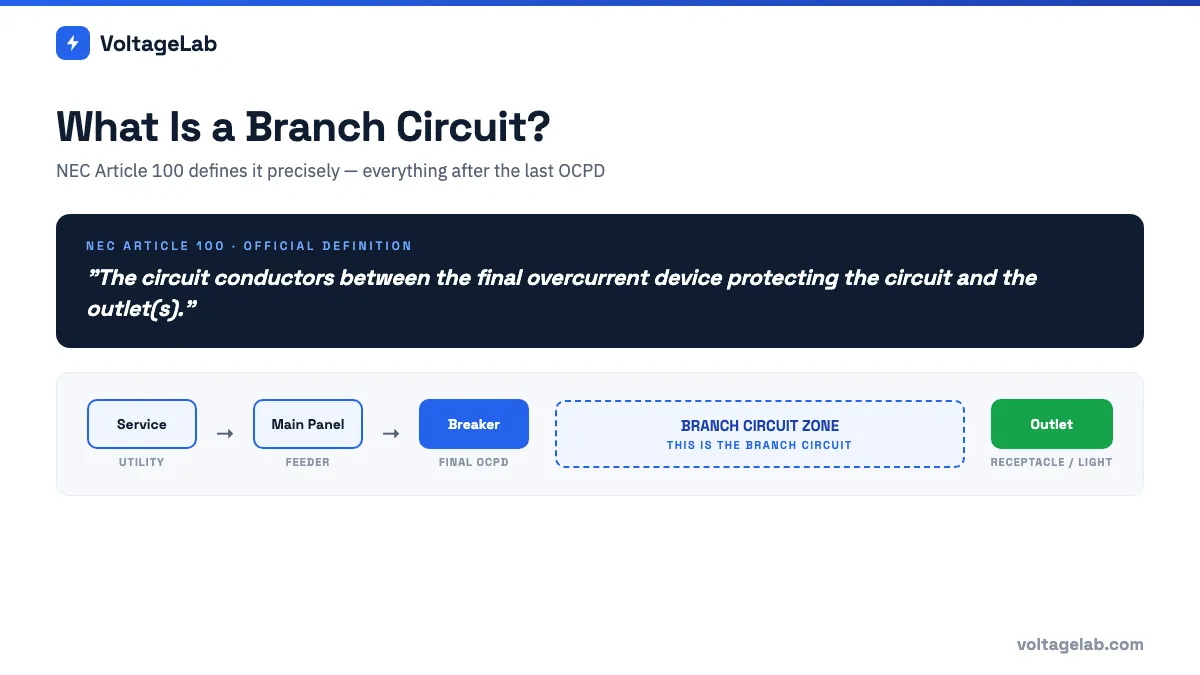
NEC Article 100 defines a branch circuit as: “The circuit conductors between the final overcurrent device protecting the circuit and the outlet(s).”
In plain terms: everything from the breaker (or last fuse) in the panel to the outlets, receptacles, luminaires, or hardwired equipment the circuit serves. The service entrance conductors, the feeder from the main panel to a sub-panel, and the sub-panel itself are not part of the branch circuit — the branch circuit begins at the last overcurrent protective device before the loads.
What “outlet” means in the NEC: In NEC terminology, an outlet is any point where current is taken from the wiring system to supply utilization equipment. This is broader than the common understanding — an outlet includes receptacle outlets (the plug-in points), lighting outlets, and hardwired equipment connections. A circuit breaker that feeds a water heater hardwired at the appliance serves a branch circuit with one outlet — just not a receptacle-type outlet.
The Four Branch Circuit Types
NEC Article 100 defines four types of branch circuits. These definitions are tested on licensing exams and govern which permissible load rules in NEC 210.23 apply to each circuit type.
Type 1 — General-Purpose Branch Circuit
Definition (NEC Article 100): A branch circuit that supplies two or more receptacles or outlets for lighting and appliances.
Plain English: A circuit that serves multiple loads — receptacles, luminaires, or a combination — throughout a room or area. This is by far the most common branch circuit type in residential and commercial wiring. The 15A and 20A circuits feeding living rooms, bedrooms, offices, and hallways are all general-purpose branch circuits.
Study smarter with VoltageLab
Built for electricians, apprentices, and electrical engineers who want faster practice and better exam prep.
Join thousands of electricians upgrading their skills
- Supplies two or more outlets — if it serves only one outlet, it is an individual branch circuit
- May supply lighting only, receptacles only, or a combination
- Rating: 15A or 20A for most residential applications (NEC 210.3 limits other-than-individual circuits to 15, 20, 30, 40, or 50A)
- Subject to the permissible load limits in NEC 210.23(A) — the 80% rule for cord-and-plug equipment and the 50% rule for fastened-in-place equipment
Type 2 — Appliance Branch Circuit
Definition (NEC Article 100): A branch circuit that supplies energy to one or more outlets to which appliances are to be connected; such circuits to have no permanent connected lighting fixtures not a part of an appliance.
Plain English: A circuit dedicated to appliance outlets — no permanently connected lighting fixtures. The two required small-appliance branch circuits in kitchen areas of a dwelling unit (NEC 210.11(C)(1)) are the most common examples. The laundry circuit is another.
- No permanently connected luminaires — if you add a hardwired under-cabinet light on the same circuit, it becomes a general-purpose circuit
- Can supply one appliance (individual-type) or multiple appliance outlets
- Kitchen small appliance circuits: minimum 20A, 120V (NEC 210.11(C)(1))
- May include receptacle outlets for connecting appliances
Type 3 — Individual Branch Circuit
Definition (NEC Article 100): A branch circuit that supplies only one piece of utilization equipment.
Plain English: A dedicated circuit serving exactly one load — one electric range, one water heater, one air conditioning unit, one EV charger.
- Supplies exactly one piece of utilization equipment
- No rating limitation from NEC 210.3 — individual branch circuits can be any rated size (15A, 20A, 30A, 40A, 50A, 60A, 100A, 200A, or any other rating required by the load)
- The 50% and 80% rules from 210.23(A) apply only to multi-outlet circuits, not individual circuits
- The load must not exceed the circuit rating, but a single piece of equipment may draw up to 100% of the circuit rating on a non-continuous basis (or up to 80% for continuous loads per NEC 210.20(A))
Type 4 — Multiwire Branch Circuit
Definition (NEC Article 100): A branch circuit that consists of two or more ungrounded conductors that have a voltage between them, and a grounded conductor that has equal voltage between it and each ungrounded conductor of the circuit, and that is connected to the neutral or grounded conductor of the system.
Plain English: Two phase conductors sharing a single neutral, creating two 120V circuits (or one 240V circuit) from a single set of conductors. A 12/3 NM cable supplying two receptacle circuits from a double-pole breaker is the classic residential example. The neutral carries only the unbalanced current between the two phases.
💡 Turn NEC Article 210 into practice questions
VoltageLab’s AI Quiz Generator creates unlimited exam-style questions on branch circuit types, the 80%/50% rules, and NEC 210.23 permissible loads — so you can drill these definitions until they stick.
Standard Branch Circuit Ratings — NEC 210.3
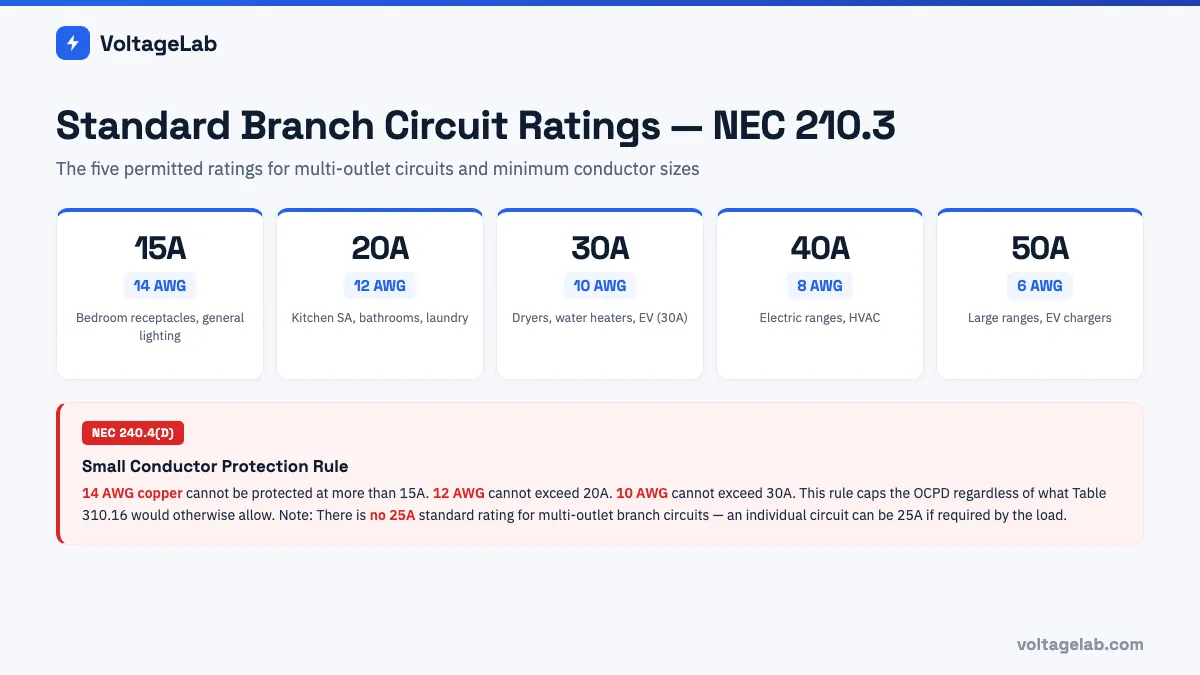
NEC 210.3 establishes the permitted ratings for branch circuits based on the ampere rating of the overcurrent protective device:
| Circuit Type | Permitted Ratings | Notes |
|---|---|---|
| General-purpose and appliance (other than individual) | 15A, 20A, 30A, 40A, 50A | No 25A branch circuit rating exists in the NEC for multi-outlet circuits. An individual circuit can be 25A if required by the load. |
| Individual branch circuits | Any ampere rating appropriate for the load | An individual circuit for a 60A oven, 100A sub-panel, or 200A service is common. No upper or lower limit restriction from 210.3. |
Minimum conductor sizes for each rating (NEC 210.19(A) and Table 310.16):
| Branch Circuit Rating | Minimum Copper Conductor (NEC 240.4(D)) | Common Application |
|---|---|---|
| 15A | 14 AWG | General lighting, bedroom receptacles |
| 20A | 12 AWG | Kitchen outlets, bathrooms, laundry, small appliance circuits |
| 30A | 10 AWG | Electric clothes dryers, water heaters, EV chargers (30A) |
| 40A | 8 AWG | Electric ranges, large HVAC units |
| 50A | 6 AWG | Large electric ranges, EV chargers (50A), large HVAC |
NEC 240.4(D) — the small conductor protection rule: 14 AWG copper cannot be protected at more than 15A. 12 AWG at more than 20A. 10 AWG at more than 30A. This rule caps the OCPD at these sizes regardless of what Table 310.16 would otherwise permit.
Study smarter with VoltageLab
Built for electricians, apprentices, and electrical engineers who want faster practice and better exam prep.
⭐️ Join thousands of electricians upgrading their skills
NEC 210.23 — Permissible Loads by Circuit Type
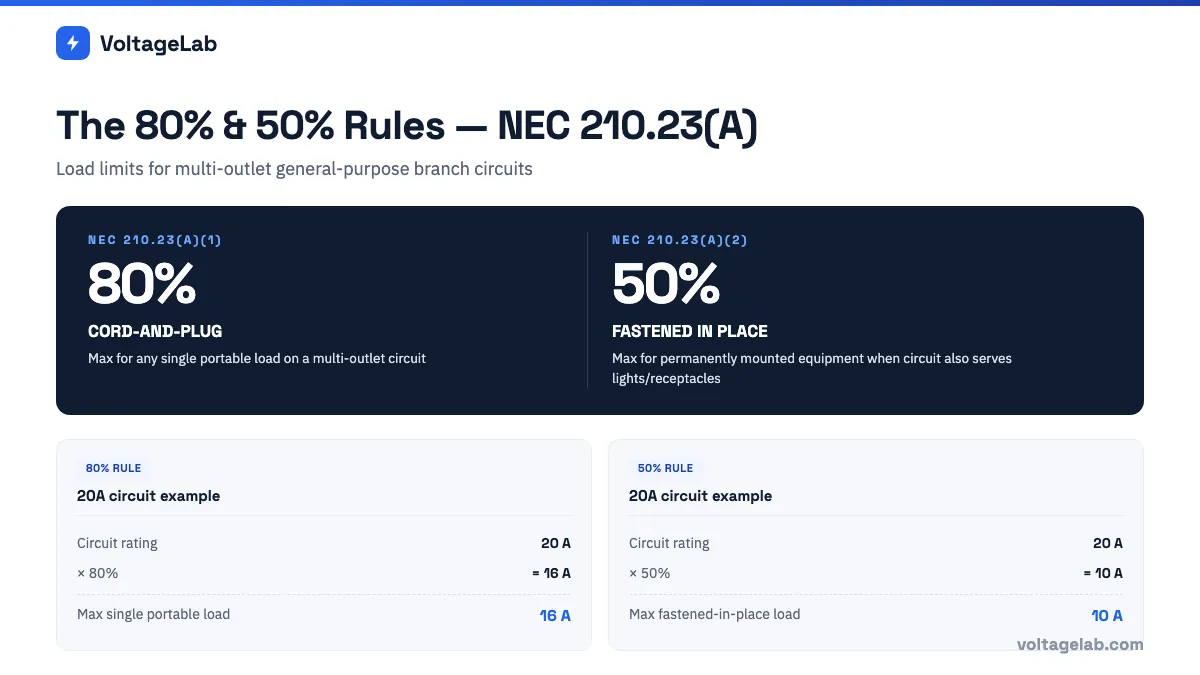
NEC 210.23 is the section that governs what loads are permitted on each circuit type. It also establishes the critical 80% and 50% limits.
The 80% Rule — Cord-and-Plug Connected Equipment (NEC 210.23(A)(1))
On a general-purpose branch circuit supplying two or more outlets, any single cord-and-plug connected piece of utilization equipment (that is not fastened in place) must not exceed 80% of the circuit rating.
Max single cord-and-plug load = Circuit rating × 80%
- 20A circuit: maximum single cord-and-plug load = 20 × 80% = 16A
- 15A circuit: maximum single cord-and-plug load = 15 × 80% = 12A
Example: A portable space heater rated at 12.5A (1,500W at 120V) is plugged into a 20A general-purpose circuit that also has other receptacles. Is this permitted? Yes — 12.5A is less than the 80% limit of 16A. If the heater were rated at 16.1A, it would exceed the 16A limit and would not be permitted on that multi-outlet circuit; it would need a dedicated individual circuit.
Why this rule exists: If a single load could draw 100% of the circuit rating, no power would be available for any other outlet on the circuit, and the circuit would operate continuously at or near its thermal limit. The 80% limit ensures that single large appliances do not monopolize multi-outlet circuits.
The 50% Rule — Fastened-in-Place Equipment (NEC 210.23(A)(2))
On a general-purpose branch circuit that also supplies lighting outlets or receptacles for portable appliances, fastened-in-place equipment (other than luminaires) must not exceed 50% of the circuit rating.
Max fastened-in-place load on a mixed circuit = Circuit rating × 50%
- 20A circuit with receptacles and/or lighting: maximum fastened-in-place load = 20 × 50% = 10A
- 15A circuit with receptacles and/or lighting: maximum fastened-in-place load = 15 × 50% = 7.5A
What is “fastened in place”: Equipment that is secured or anchored to a surface, a structure, or other equipment — not just plugged in and portable. Examples: a wall-mounted exhaust fan, a built-in microwave, a permanently mounted window air conditioner, a water cooler bolted to the wall, or a dishwasher mounted under the counter.
Why the limit is lower for fastened-in-place equipment: Permanently installed equipment runs at its rated load consistently, unlike portable appliances that are intermittently connected. The 50% limit reserves capacity for the lighting and receptacle loads on the same circuit that are expected to be used simultaneously.
Individual Branch Circuits — No 80% or 50% Limit (NEC 210.23(C))
Individual branch circuits may supply any load, subject only to the overall circuit rating — the 80% and 50% restrictions do not apply to individual circuits.
- A 50A individual branch circuit may supply a single electric range drawing 40A (80% of 50A) — acceptable for continuous operation since it is the only load on the circuit
- A 20A individual branch circuit supplying a single window air conditioner: the unit can draw up to 80% of 20A = 16A on a continuous basis (per NEC 210.20(A)), or up to 20A non-continuously
The Continuous Load Rule — NEC 210.20(A)
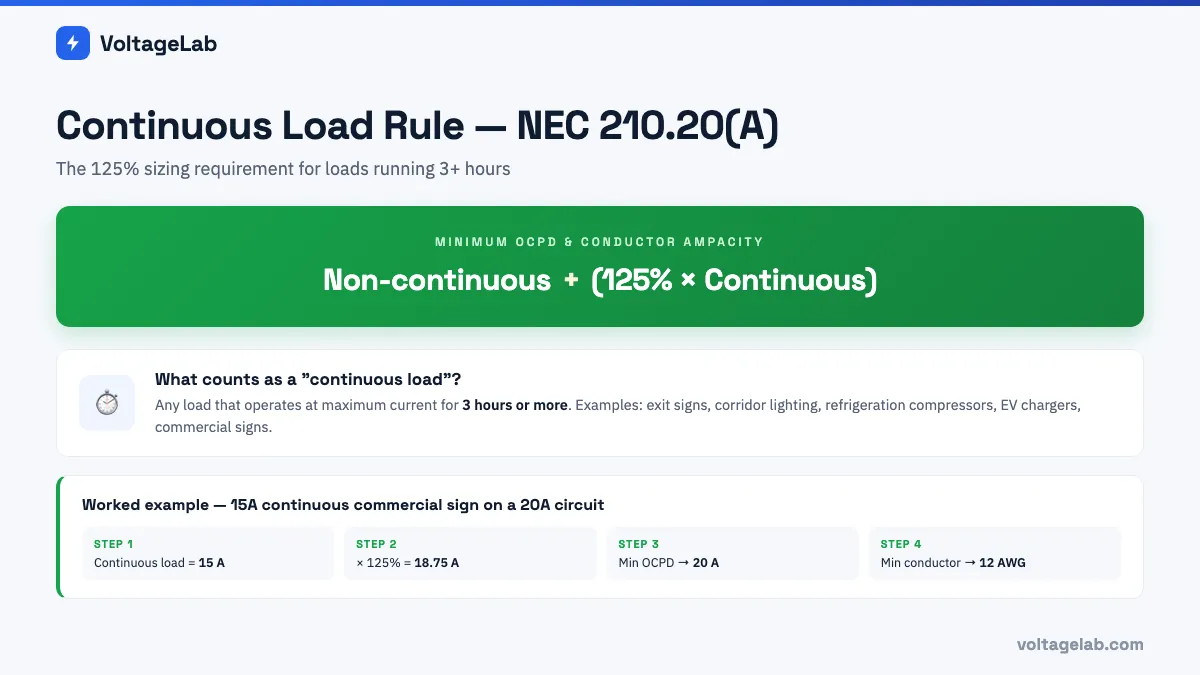
NEC 210.20(A) requires that the branch circuit overcurrent protective device rating (and the conductor ampacity) be at least equal to:
Non-continuous load + (125% × Continuous load)
A continuous load is any load that operates at maximum current for 3 hours or more. Examples: permanently illuminated exit signs, hotel corridor lighting that runs all night, commercial refrigeration compressors, EV chargers.
Example: A 20A branch circuit supplies a commercial sign that draws 15A continuously. What is the minimum OCPD and conductor ampacity?
- Required OCPD: 125% × 15A = 18.75A → next standard size = 20A OCPD
- Required conductor ampacity: 125% × 15A = 18.75A → select conductor with ≥18.75A ampacity = 12 AWG copper (20A)
The 20A breaker and 12 AWG conductor protect an 18.75A continuous load correctly — even though the circuit appears to be operating near its limit, the 125% requirement ensures the conductors and OCPD are not thermally stressed.
Multiwire Branch Circuit Requirements — NEC 210.4
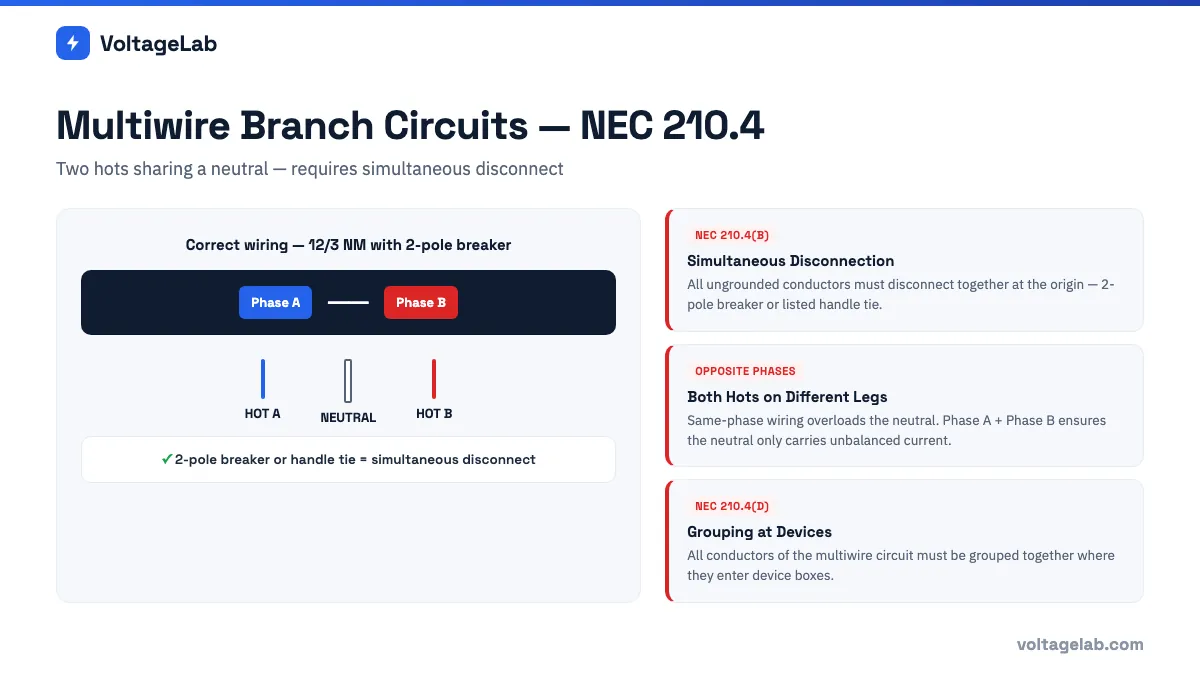
Multiwire branch circuits save conductor material but carry three specific requirements that are heavily tested and frequently violated in the field:
- Simultaneous disconnection (NEC 210.4(B)): All conductors of a multiwire branch circuit must be disconnected simultaneously at the origin of the circuit — requires a multi-pole breaker or breakers with a listed handle tie
- Opposite phases required: The two hot conductors must be from different phases (opposite legs). Both from the same phase leg creates a condition where the neutral carries the combined current of both circuits rather than just the unbalanced portion, overloading the neutral
- Grouping (NEC 210.4(D)): Where conductors enter device boxes, all conductors of the multiwire branch circuit supplying the devices must be grouped together
Specific-Purpose Branch Circuits — NEC Table 210.2
NEC 210.2 and Table 210.2 recognize that certain specific equipment requires its own article for branch circuit requirements. For these equipment types, Article 210 applies and the specific article amends or supplements it.
| Equipment Type | NEC Article That Supplements 210 |
|---|---|
| Air conditioning and refrigerating equipment | Article 440 |
| Cranes and hoists | Article 610 |
| Electric vehicle supply equipment (EV chargers) | Article 625 |
| Electric welders | Article 630 |
| Electroplating | Article 669 |
| Lighting systems — HID, fluorescent, LED | Article 411 |
| Motors, motor circuits | Article 430 |
| Signs and outline lighting | Article 600 |
| Swimming pools, hot tubs, spas | Article 680 |
| X-ray equipment | Article 517 |
For motor circuits specifically, Article 430 governs conductor sizing (FLC × 125%), OCPD sizing (FLC × 250% max for Design B motors), and overload protection — all of which supplement or modify the basic Article 210 rules. Motor branch circuits are among the most exam-tested specific-purpose circuits because of the difference between FLC (Table 430.248/430.250) used for sizing and nameplate FLA used for overload protection.
Worked Examples — Identifying and Applying Branch Circuit Rules
Example 1 — What Type Is This Circuit?
Circuit: A 20A breaker in a kitchen panel supplies two duplex receptacles on the kitchen countertop and one under-cabinet LED fixture (hardwired).
Type: General-purpose branch circuit — it supplies two or more outlets including a permanently connected lighting outlet (the LED fixture) and receptacle outlets. It is not an appliance branch circuit because it has a permanently connected luminaire.
Example 2 — Applying the 50% Rule
Circuit: A 20A general-purpose circuit supplies office receptacles and a wall-mounted coffee maker (fastened in place) rated at 12A. Is the coffee maker permitted?
Analysis: The 50% rule limits fastened-in-place equipment to 50% of the circuit rating = 20 × 50% = 10A maximum. The coffee maker is rated 12A, which exceeds the 10A limit.
Answer: ❌ Not permitted on this multi-outlet general-purpose circuit. It would need a dedicated individual branch circuit (20A minimum for a 12A load).
Example 3 — Individual Circuit Sizing
Circuit: An electric range with a nameplate rating of 40A at 240V needs a branch circuit. What is the minimum individual branch circuit rating?
Analysis: This is an individual branch circuit (one piece of equipment). NEC 210.19(A) requires the branch circuit rating to be not less than the load. For a 40A nameplate load, the minimum circuit is 40A with 8 AWG copper conductors. In practice, a 50A circuit is commonly installed for ranges to allow for full-power oven and stovetop operation simultaneously at 80% of 50A = 40A.
Example 4 — Multiwire Branch Circuit Disconnect
Circuit: Two 12 AWG hot conductors and one 12 AWG neutral serving a kitchen circuit from a 120/240V panel. One hot on Phase A, one on Phase B.
Requirements: NEC 210.4(B) requires simultaneous disconnection of both hot conductors at the origin. A two-pole breaker or two single-pole breakers with a listed handle tie is required. A single-pole breaker on each phase with no connection between them does not satisfy the simultaneous disconnection requirement.
Conclusion
The four branch circuit types — general-purpose, appliance, individual, and multiwire — each have distinct definitions and load rules that govern daily installation decisions and exam questions. Three rules to commit to memory:
- General-purpose circuit: no single load over 80% of circuit rating (cord-and-plug) and no fastened-in-place load over 50% of circuit rating on a circuit also serving luminaires or portable equipment
- Appliance circuit: no permanently connected luminaires — the moment you add a hardwired light, it becomes general-purpose
- Multiwire circuit: simultaneous disconnection required at the panel — two-pole breaker or listed handle tie, and both hots must be on opposite phases
For the complete guide to NEC Article 210 requirements including GFCI, AFCI, and receptacle spacing, see our article on NEC Article 210: What Is a Branch Circuit & How Is It Rated?. For the calculation types that use branch circuit types in load calculations, see Electrician Math 2026: Formulas, Calculations & Practice Problems.
📱 Ready to pass the journeyman exam?
VoltageLab gives you AI-generated practice questions on branch circuits, load calculations, and every NEC article on your exam — plus timed mock exams, flashcards, wiring guides, and an interactive circuit simulator. Free on iOS and Android.
Frequently Asked Questions
What are the four types of branch circuits in the NEC?
NEC Article 100 defines four branch circuit types: (1) General-purpose branch circuit — supplies two or more receptacles or outlets for lighting and appliances; (2) Appliance branch circuit — supplies one or more outlets for appliances, with no permanently connected lighting fixtures; (3) Individual branch circuit — supplies only one piece of utilization equipment; and (4) Multiwire branch circuit — two or more ungrounded conductors sharing a common neutral, with voltage between them and equal voltage from each to the neutral.
What is the 80% rule for branch circuits?
NEC 210.23(A)(1) limits any single cord-and-plug connected piece of utilization equipment (not fastened in place) to a maximum of 80% of the branch circuit rating when the circuit supplies two or more outlets. On a 20A circuit, no single portable load may exceed 16A (20 × 80%). On a 15A circuit, the maximum single portable load is 12A. This rule applies to general-purpose multi-outlet circuits — individual branch circuits are not subject to this 80% limit.
What is the difference between an appliance branch circuit and an individual branch circuit?
An appliance branch circuit supplies one or more outlets for appliances and may serve multiple appliance outlets — but no permanently connected luminaires. An individual branch circuit supplies exactly one piece of utilization equipment. A circuit feeding two kitchen appliance receptacles is an appliance branch circuit; a circuit feeding only the electric range (one load) is an individual branch circuit. An important distinction: individual branch circuits have no upper rating limit from NEC 210.3, while appliance and general-purpose circuits are limited to 15, 20, 30, 40, or 50 amperes.
Does the 50% fastened-in-place rule apply to individual branch circuits?
No. The 50% limit from NEC 210.23(A)(2) applies only to general-purpose branch circuits that supply a combination of fastened-in-place equipment and other outlets (lighting or receptacles for portable equipment). Individual branch circuits serve only one piece of equipment and are not subject to the 50% restriction — the load can use up to the full circuit ampacity (with the continuous load 125% requirement applied where applicable).
What does the simultaneous disconnection requirement mean for multiwire branch circuits?
NEC 210.4(B) requires that all ungrounded conductors of a multiwire branch circuit be disconnected simultaneously at the point of origin — typically at the panel. This means the two hot conductors of a multiwire circuit must be connected to a two-pole breaker (which opens both poles together) or to two single-pole breakers equipped with a listed handle tie. The requirement prevents a worker from de-energizing what appears to be a dead circuit while the other phase conductor of the multiwire circuit remains energized — a serious shock hazard.
FREE PRACTICE TOOL
Think you'd pass this on a real exam?
Test what you just read with instant-feedback quizzes built around real code questions — not generic trivia.
5
Code standards
10,000+
Active learners
100%
Free to start
Instant explanations on every answer, right or wrong
NEC, BS7671, AS/NZS, CEC, and DIN VDE covered
Bite-sized quizzes you can finish in 5 minutes
No signup required to try your first quiz
No account needed · Takes less than 2 minutes