


If you are looking up burial depth for underground wiring, NEC 300.5 is one of the first sections you need to know. It covers the minimum cover requirements for direct-buried conductors, cables, and raceways.
This matters in real electrical work because burial depth is not just a “dig it deep enough” issue. The required cover changes based on:
Study smarter with VoltageLab
Built for electricians, apprentices, and electrical engineers who want faster practice and better exam prep.
⭐️ Join thousands of electricians upgrading their skills
- the wiring method
- the location
- whether the wiring is under concrete
- whether the circuit is a qualifying residential branch circuit
- whether the installation is exposed to physical damage or special conditions
It is also a common exam-prep topic because electricians often remember one number and apply it everywhere. That is where mistakes happen.
What NEC 300.5 actually covers
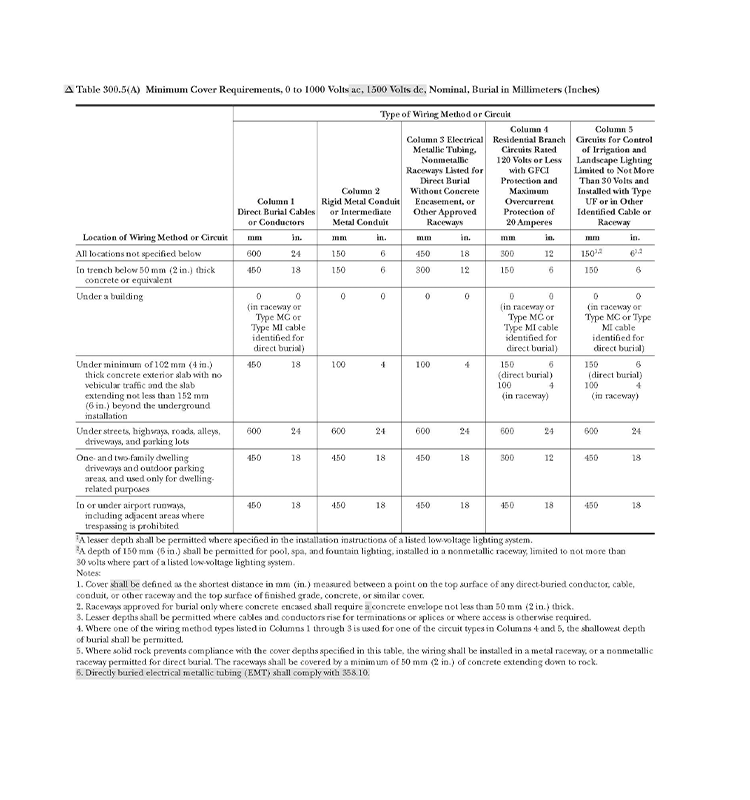
NEC 300.5 addresses underground installations for circuits 0 to 1000 volts ac and 1500 volts dc, including the minimum cover requirements in Table 300.5 and related rules for wet locations, warning ribbon, backfill, raceway sealing, and underground wiring under buildings.
In plain English, this section answers:
- how much soil or concrete cover is required above the wiring
- when burial depth changes
- what additional protection is required in certain underground installations
What “cover” means
This is the first thing to get clear.
In the NEC table notes, cover is the shortest distance measured from the top of the underground wiring method to the top surface of finished grade, concrete, or similar cover.
That means you are not measuring from the bottom of the trench. You are measuring from the top of the cable, conduit, or raceway to the finished surface above it.
That sounds basic, but it is one of the easiest field mistakes to make when trench depth and actual code-required cover get treated as the same thing.
How Table 300.5 works
Table 300.5 is not a one-size-fits-all burial chart.
You have to match:
- the location
- the wiring method or circuit type
The table separates common underground installations into categories like:
- direct-buried cables or conductors
- rigid metal conduit or intermediate metal conduit
- nonmetallic raceways listed for direct burial without concrete encasement, or other approved raceways
- certain qualifying residential branch circuits
- certain irrigation and landscape-lighting circuits
The practical lesson is simple: before picking a cover depth, make sure you know what is in the trench and where it is being installed.
Common cover depths electricians should know
These are the common numbers many electricians remember from Table 300.5:
24 inches
24 inches is a common minimum cover depth for direct-buried cables or conductors in standard trench conditions.
If someone asks for the “normal” underground direct-burial number, this is often the one they mean. But it is not universal.
18 inches
18 inches shows up often for:
- direct burial in some dwelling-related driveway and parking conditions
- nonmetallic raceways in standard trench conditions
- certain other underground conditions depending on the wiring method
This is one of the most common cover depths electricians see in residential and light commercial work.
12 inches
12 inches can apply in some reduced-depth situations, including certain qualifying residential branch circuits and some specific listed conditions in the table.
This is where people get into trouble, because they remember “12 inches is allowed” without checking whether the circuit actually qualifies.
Study smarter with VoltageLab
Built for electricians, apprentices, and electrical engineers who want faster practice and better exam prep.
⭐️ Join thousands of electricians upgrading their skills
6 inches
6 inches can apply for rigid metal conduit or intermediate metal conduit in some table conditions, and it can also apply in some reduced-cover situations for specific installations.
This does not mean every underground conduit run can be buried at 6 inches.
4 inches
4 inches can apply where wiring is installed under a qualifying concrete slab with no vehicular traffic and the slab extends beyond the underground installation as required by the table.
Again, that is a specific condition, not a general shortcut.
Conditions that change the burial depth
This is the real heart of NEC 300.5.
1. Wiring method matters
Direct-buried cable, PVC raceway, EMT, RMC, and IMC do not all get the same cover depth.
For example:
- direct burial often requires more cover
- metal raceways can qualify for shallower cover in some conditions
- nonmetallic raceways often fall somewhere in between
2. Location matters
Whether the installation is under:
- open ground
- a dwelling driveway
- a parking area
- a concrete slab with no vehicular traffic
can change the minimum cover requirement.
3. Circuit type matters
Table 300.5 includes reduced-depth allowances for some specific circuits, especially:
- certain
120-volt or lessresidential branch circuits - circuits with GFCI protection
- circuits with a maximum
20-ampereovercurrent device - certain irrigation and landscape-lighting circuits
If the circuit does not meet the listed conditions, the reduced depth does not apply.
Important NEC 300.5 rules beyond the table
Electricians should not stop reading at the burial-depth chart.
Underground installations are wet locations
NEC 300.5(B) says the interior of underground enclosures and raceways is considered a wet location.
That means the conductors and wiring methods have to be suitable for that condition. This is a big one in the field, because underground raceway does not stay “dry” just because it looks sealed.
Underground wiring under buildings
NEC 300.5(C) says underground cable and conductors installed under a building generally must be in a raceway, subject to limited exceptions.
That is a common exam-prep point because people think “buried is buried,” but wiring under a structure gets extra rules.
Warning ribbon for service conductors
NEC 300.5(D)(3) requires certain underground service conductors that are buried 18 inches or more below grade and not encased in concrete to be identified by a warning ribbon placed at least 12 inches above the underground installation.
That requirement is there for a reason: future digging is one of the biggest real-world risks to buried electrical lines.
Protection where subject to damage
NEC 300.5(D)(4) requires stronger raceway protection where the enclosure or raceway is subject to physical damage.
This is one of those rules that matters more on real jobs than in classroom summaries.
Backfill matters
NEC 300.5(F) says backfill containing large rocks, sharp materials, cinders, or corrosive material cannot be placed where it can damage the raceway or cable.
In plain English: trench depth alone does not make the job correct. Bad backfill can still damage the installation.
Raceway seals matter
NEC 300.5(G) requires raceways to be sealed or plugged where moisture may contact live parts, including where underground raceways enter buildings.
That is a practical issue electricians see all the time, especially where moisture or gases can migrate through underground raceways.
Common field mistakes
Using one burial number for every underground job
The biggest mistake is memorizing one number like 18 inches or 24 inches and applying it to every installation.
Forgetting the reduced-depth rules are conditional
A shallow burial allowance is not automatic. The circuit type, wiring method, and location have to match the table.
Treating underground raceway like a dry location
NEC 300.5 is clear: underground raceways are wet locations.
Ignoring warning ribbon requirements
This gets missed on underground service work more often than it should.
Measuring trench depth instead of actual cover
The code requirement is about cover, not just how deep the trench looked before backfill.
Final takeaway
NEC 300.5 is the section electricians use to determine minimum cover requirements for underground wiring. The right burial depth depends on the full installation condition, not just the fact that the wiring is underground.
If you want the practical rule, it is this:
- identify the wiring method
- identify the location
- check whether the circuit qualifies for any reduced-depth allowance
- read the rest of 300.5, not just the table
For exam prep and field work, that approach will keep you out of most burial-depth mistakes.
FAQ
What does NEC 300.5 cover?
It covers minimum cover requirements for underground wiring and related underground installation rules.
What is the normal burial depth for underground electrical wiring?
It depends on the wiring method and location. A common direct-burial depth is 24 inches, but other installations may require more or less.
Can underground electrical conduit be buried at 6 inches?
Sometimes, but only for certain wiring methods and conditions listed in Table 300.5. It is not a universal rule.
Does PVC conduit use the same cover depth as direct-buried cable?
No. The required cover can differ depending on the raceway type and installation condition.
Are underground raceways considered wet locations?
Yes. NEC 300.5(B) treats underground raceways and enclosures as wet locations.
Is warning tape required above underground electrical lines?
For some underground service conductors, yes. NEC 300.5(D)(3) includes a warning ribbon requirement.
If you want to keep practicing NEC topics like underground wiring cover rules, the VoltageLab app gives you a simple way to review NEC questions, study explanations, and track weak areas from your phone.