


Conduit Bending Guide: Offsets, Saddle Bends & 90s
How to bend conduit: the marks on a hand bender, offset multipliers and shrink, three-point and four-point saddle bends, stub-up 90s and the NEC 358.26 360-degree rule.

What Size Wire for a 400-Amp Service? NEC Guide
400-amp service wire size from NEC Table 310.12: 400 kcmil copper or 600 kcmil aluminum, the 83 % rule, two-set Class 320 builds, and the non-dwelling answer.
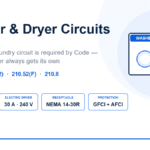
Dedicated Circuits for Washer & Dryer: NEC Requirements
The NEC requires a 20-amp laundry circuit with no other outlets, and an electric dryer needs its own 30-amp 240-volt circuit. Sizing, GFCI, AFCI and 14-30R rules.

Motor Circuit Protector (MCP) vs Circuit Breaker: Differences
A motor circuit protector trips on short circuits only — no overload protection. MCP vs circuit breaker differences, NEC 430.52 sizing, and where the Code allows it.
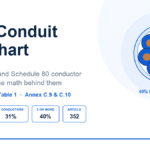
PVC Conduit Fill Chart: NEC Chapter 9 Limits for Schedule 40 & 80
PVC conduit fill chart for Schedule 40 and Schedule 80 with THHN. NEC Chapter 9 Table 1 percentages, Annex C counts, and the calculation for mixed wire sizes.
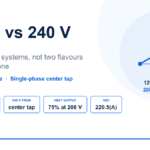
208 V vs 240 V: What’s the Difference and Why It Matters
208 V comes from a three-phase wye, 240 V from a center-tapped transformer. The real difference, the 75% heat rule, and running 240 V gear on 208 V.
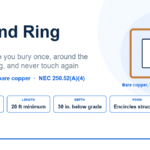
Ground Ring Electrode Explained: NEC 250.52(A)(4)
A ground ring is 20 ft of 2 AWG bare copper encircling the building, buried 30 in. deep. NEC 250.52(A)(4) and 250.53(F) requirements, GEC sizing and field traps.
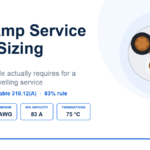
What Size Wire for a 100-Amp Service? NEC Sizing Guide
What size wire for a 100 amp service: 4 AWG copper or 2 AWG aluminum per NEC Table 310.12(A). Why #4 copper works, the 83% rule, and where it does not apply.
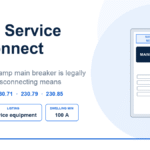
Can a 200 A Breaker Be Your Service Disconnect? NEC Rules
Can a 200A breaker be a service disconnect? What NEC 230.70, 230.71, 230.79 and 230.85 require of a 200 amp disconnect, plus conductor sizing from Table 310.12(A).
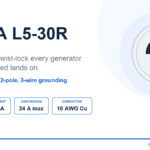
NEMA L5-30R Explained: Twist-Lock Receptacle Ratings & Wiring
NEMA L5-30R explained: 125V 30A twist-lock ratings, how to wire it, 10 AWG branch circuit sizing, GFCI rules, and how L5-30 differs from TT-30 and L14-30.
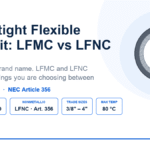
Liquid Tight vs Sealtite: LFMC vs LFNC Conduit Explained
Liquid tight vs sealtite explained: Sealtite is a brand, LFMC and LFNC are the two NEC wiring methods. Article 350 vs 356, fill, length limits and grounding.
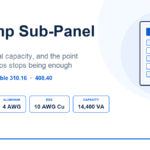
60-Amp Sub-Panel: Wire Size, Loads & When It’s Enough (NEC)
60 amp sub panel wire size, EGC sizing, and whether a sub panel size of 60 amp is enough for your load. NEC Table 310.16, 215.3, 250.122 and 408.40 explained.