


If you’ve ever stood next to a running generator, worked a shift at a power plant, or hit an exam question that mentions a “prime mover,” you’ve dealt with a turbine without necessarily calling it one. A turbine is the rotating machine that converts moving steam, combustion gas, wind, or water into mechanical shaft power — and the type of turbine a plant uses can swing its efficiency from around 33% to more than 64%. This guide breaks down what a turbine is, the four main types (steam, gas, wind, and water), how each one actually spins a shaft, and where you’ll find them running across the U.S. grid in 2026.
Quick Answer
A turbine is a rotating machine that converts the kinetic and thermal energy of a moving fluid — steam, combustion gas, wind, or water — into mechanical energy on a shaft. That shaft is coupled to an electrical generator. The four main types are steam, gas, wind, and hydro (water) turbines, each matched to a different energy source and efficiency range.
Study smarter with VoltageLab
Built for electricians, apprentices, and electrical engineers who want faster practice and better exam prep.
⭐️ Join thousands of electricians upgrading their skills
Key Takeaways
- A turbine converts fluid energy into mechanical shaft power — it doesn’t generate electricity by itself; a coupled generator does that through electromagnetic induction.
- Modern combined-cycle gas turbines have reached up to 64% efficiency, the highest of any thermal (heat-engine) turbine type — Mitsubishi Power’s JAC-series plant hit a Guinness World Record 63.08% in 2018.
- Water (hydro) turbines are the most efficient overall, typically converting 90-95% of available energy into mechanical power, since they aren’t limited by heat-engine thermodynamics.
- The U.S. grid runs all four types today: steam turbines in coal and nuclear plants, gas turbines in peaker and combined-cycle plants, wind turbines across more than 150 GW of installed capacity, and hydro turbines at facilities like Hoover Dam and Grand Coulee Dam.
What Is a Turbine? (Definition Explained)
A turbine is a rotating machine that converts the energy of a moving fluid into mechanical energy on a shaft. Engineers call it a “prime mover” because it’s the component that first sets the shaft in motion — everything downstream, including the generator, depends on it.
Turbines convert three possible forms of fluid energy: kinetic energy (a moving fluid’s velocity, as in wind or water turbines), potential energy (stored energy from elevation, as in a dam’s water head), and thermal energy (heat converted to pressure and velocity, as in steam and gas turbines). Inside the turbine, nozzles or guide vanes direct and accelerate the fluid onto a set of blades mounted on the rotating shaft. The fluid pushes — or drops pressure across — those blades, and the shaft spins.
On its own, a turbine only produces rotation. To make electricity, that shaft has to be coupled to a generator, which uses electromagnetic induction to turn mechanical rotation into current. See the full breakdown of how power moves from the generator through the U.S. transmission and distribution grid once it leaves the turbine-generator set.
Three types of fluids are used in it:
- Steam
- Gas
- Water
The turbine primarily acts as a prime mover that helps rotate the rotor of a generator and produce electricity. The turbine is the most critical mechanical machine, so it requires special care 🙂
Steam vs. Gas vs. Wind vs. Water Turbines — Comparison Table
All four turbine types do the same basic job — spin a shaft — but they use different fluids, reach very different efficiencies, and show up in different parts of the U.S. grid.
FREE PRACTICE TOOL
Think you'd pass this on a real exam?
Test what you just read with instant-feedback quizzes built around real code questions — not generic trivia.
5
Code standards
10,000+
Active learners
100%
Free to start
Instant explanations on every answer, right or wrong
NEC, BS7671, AS/NZS, CEC, and DIN VDE covered
Bite-sized quizzes you can finish in 5 minutes
No signup required to try your first quiz
No account needed · Takes less than 2 minutes
| Turbine Type | Energy Source | Typical Efficiency | Common U.S. Application | Typical Unit Capacity |
|---|---|---|---|---|
| Steam | High-pressure steam (Rankine cycle) | 33-40% standard; up to ~47% ultra-supercritical | Coal-fired & nuclear power plants | ~300 MW – 1,400+ MW per unit |
| Gas | Combustion of natural gas or liquid fuel (Brayton cycle) | 35-40% simple cycle; up to ~64% combined cycle | Peaker plants & combined-cycle plants | ~40 MW – 400+ MW per unit |
| Wind | Kinetic energy of moving air | 35-45% (Betz limit caps theoretical max at 59.3%) | Onshore & offshore wind farms | ~2-3 MW onshore; 12-14.7 MW offshore |
| Water (Hydro) | Kinetic + potential energy of falling/flowing water | 90-95% | Dams & run-of-river hydro plants | ~10 MW – 700+ MW per unit |
Table 1: Turbine type comparison by energy source, efficiency, and typical U.S. application. Figures rounded from EIA, DOE/LBNL, and public manufacturer data (2026); verify exact specs against current datasheets for procurement or exam use.
.
💡 Turn These Turbine Types Into a Study Deck
Don’t just read the comparison table once and forget it. VoltageLab’s AI Flashcard Generator turns any electrical topic — including this turbine breakdown — into a spaced-repetition study deck you can review on the go.
💡 Turn These Turbine Types Into a Study Deck
Don’t just read the comparison table once and forget it. VoltageLab’s AI Flashcard Generator turns any electrical topic — including this turbine breakdown — into a spaced-repetition study deck you can review on the go.
Thermal and Gas Turbine
A turbine is operated using superheated high-pressure steam, which converts thermal energy into mechanical energy. Its usage is widespread in modern times. It primarily comes in three types:
- Impulse Turbine
- Reaction Turbine
- A type of turbine combining both
Imagine you are playing carrom. Some pieces can be knocked directly by striking them, while others require the help of the carrom board’s sides. When you can knock pieces directly, that’s like an impulse turbine, and when they bounce off the sides, that’s a reaction turbine.
To clarify further: if the fluid hits the turbine’s plates directly, those turbines are called impulse turbines. When the fluid strikes the plates in a more zigzag manner and generates mechanical energy, those are called reaction turbines.
There are also other types of turbines, classified based on stages, pressure, and steam conditions.
Steam Turbines
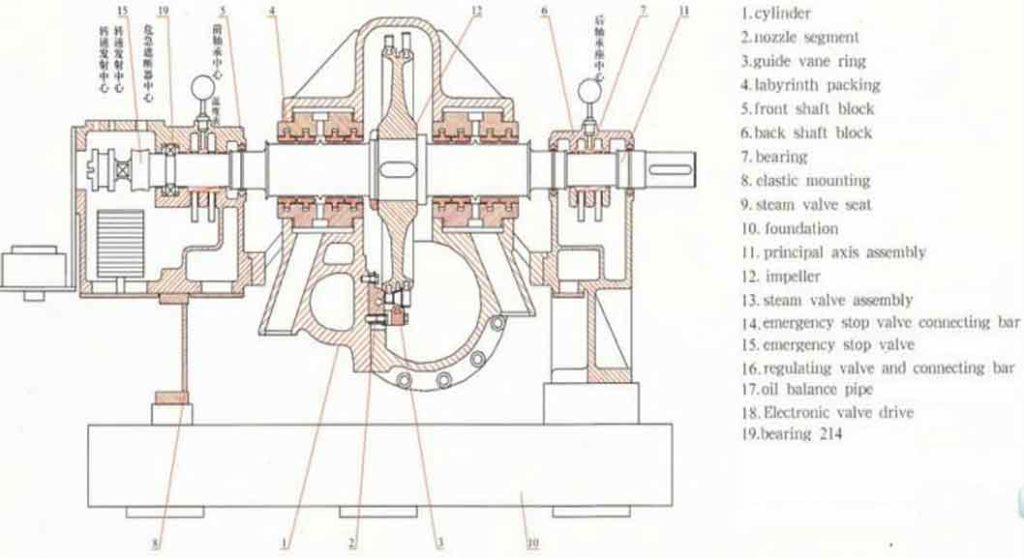
A steam turbine converts high-pressure, high-temperature steam into rotation using the Rankine cycle: a boiler heats water into steam, the steam expands through the turbine’s nozzles and blades, and the spent low-pressure steam is condensed back into water to repeat the cycle. Steam turbines run most of the world’s coal and nuclear power plants because both fuel sources work by boiling water — the reactor or furnace is just the heat source.
Real-world U.S. application: nuclear plants such as Georgia’s Vogtle units run steam turbine-generator sets rated in the 1,100-1,200 MW range per unit, while large coal-fired units commonly run 300-900 MW steam turbines. Nuclear supplies about 18% of total U.S. electricity generation, and coal a shrinking but still significant share — nearly all of it through steam turbines.
Gas Turbines
A gas turbine burns natural gas or a liquid fuel directly inside the machine (the Brayton cycle) rather than boiling water first. Compressed air mixes with fuel, ignites, and the resulting hot expanding gas spins the turbine blades directly. Because there’s no boiler to bring up to temperature, gas turbines start and ramp much faster than steam turbines — which is why utilities use them as “peaker” plants to cover sudden demand spikes.
Pairing a gas turbine with a second steam turbine that recovers its exhaust heat (a combined-cycle plant) is what pushes efficiency past the 60% mark. Mitsubishi Power’s J-series combined-cycle plant at Nishi-Nagoya, Japan set a certified Guinness World Record of 63.08% in 2018, and GE’s HA-class combined-cycle plants operate in the same range — figures that would have sounded impossible a generation ago.
Study smarter with VoltageLab
Built for electricians, apprentices, and electrical engineers who want faster practice and better exam prep.
⭐️ Join thousands of electricians upgrading their skills
Real-world U.S. application: natural gas-fired generation — most of it running through gas turbines — supplies roughly 40% of total U.S. electricity, the largest single fuel source on the grid, according to the U.S. Energy Information Administration. Major U.S. gas turbine manufacturers include GE Vernova and Siemens Energy, which builds gas turbines at its Charlotte, North Carolina energy campus.
Wind Turbines
A wind turbine converts the kinetic energy of moving air into rotation using aerodynamic blades instead of nozzles and a fluid casing, but the underlying principle — fluid energy spinning a shaft that drives a generator — is the same. Wind turbines can never convert 100% of the wind’s energy; physicist Albert Betz proved in 1919 that no wind turbine can capture more than 59.3% of the kinetic energy passing through its blades (the “Betz limit”). Real-world turbines land lower than that, typically converting 35-45% of available wind energy into electricity.
Real-world U.S. application: the U.S. has more than 150 GW of installed wind capacity, led by Texas, according to the American Clean Power Association. The average new onshore wind turbine installed in recent years has a nameplate capacity around 3 MW, per Lawrence Berkeley National Laboratory’s Wind Technologies Market Report — a huge jump from the sub-1 MW turbines common in the 1990s. GE Vernova’s Haliade-X offshore turbine, rated 12-14.7 MW, is one of the largest wind turbines in commercial use anywhere.
Water (Hydro) Turbines
A water (hydro) turbine converts the kinetic and potential energy of falling or flowing water into rotation, and it’s the most efficient turbine type by a wide margin — typically 90-95%, since it isn’t a heat engine and isn’t limited by the same thermodynamic ceiling as steam or gas turbines. There are three common designs: Francis turbines (the most widely used, a mixed-flow design suited to medium head and flow), Kaplan turbines (propeller-style, built for low head and high flow), and Pelton turbines (an impulse design that uses high-pressure jets, built for high head and low flow).
Real-world U.S. application: Hoover Dam runs 17 Francis turbines with a combined capacity of about 2,080 MW, according to the U.S. Bureau of Reclamation. Grand Coulee Dam in Washington state is the largest power plant of any type in the U.S., with a nameplate capacity of roughly 6,809 MW. Voith Hydro, GE, and Andritz are among the manufacturers that build and retrofit hydro turbines for U.S. dams.
How a Turbine Generates Electricity (Step-by-Step)
Every turbine type follows the same basic sequence to turn fluid energy into electrical power on the grid:
- Fluid enters the turbine. Pressurized steam, combustion gas, moving air, or falling water enters the turbine casing or reaches the blades.
- Nozzles or guide vanes accelerate the fluid. These components direct and speed up the fluid before it reaches the blades, maximizing the energy transfer.
- The fluid spins the blades. In an impulse turbine, the fluid strikes the blades directly and is deflected; in a reaction turbine, the pressure drops as the fluid passes across moving blades. Either way, the shaft starts to rotate.
- Bearings support the spinning shaft, carrying its load and reducing friction so it can rotate at thousands of RPM without excessive wear.
- The shaft turns the generator rotor. A direct coupling connects the turbine shaft to the generator’s rotor shaft.
- Electromagnetic induction creates current. As the rotor spins inside the generator’s stator windings, Faraday’s Law of induction generates alternating current — the same principle Michael Faraday demonstrated in 1831, covered in more depth in our full history of electricity.
- A governor and overspeed trip mechanism hold synchronous speed. The governor regulates fluid flow into the turbine to keep the shaft at a constant speed — typically 3,600 RPM for 60 Hz U.S. grid power — while the overspeed trip mechanism shuts off fluid flow automatically if the shaft ever spins dangerously fast.
- Power leaves through the grid. A step-up transformer raises the generator’s output voltage before it enters the transmission system.
Turbine Efficiency Explained
Turbine efficiency measures how much of the input energy actually becomes usable shaft power. Steam and gas turbines are heat engines, so they’re bound by the same second-law-of-thermodynamics ceiling every heat engine faces (the Carnot limit) — efficiency rises with the temperature difference between the hot inlet fluid and the cold exhaust. That’s why combined-cycle gas plants (which recycle exhaust heat into a second steam turbine) close the gap toward 64%, while a single simple-cycle gas turbine tops out closer to 35-40%.
Hydro turbines aren’t heat engines at all — there’s no combustion and no Carnot limit — which is exactly why they reach 90-95% efficiency, the highest of any turbine type. Wind turbines sit in the middle: capped by the Betz limit at 59.3% in theory, and landing around 35-45% in practice once you account for real blade design, drivetrain losses, and variable wind speeds.
U.S. Turbine Manufacturers & Capacity Stats [2026]
| Manufacturer | Turbine Type | Notable U.S. Product / Site |
|---|---|---|
| GE Vernova | Gas, steam, wind | HA-class gas turbines; Haliade-X offshore wind turbine (12-14.7 MW) |
| Siemens Energy | Gas, steam | Gas turbine manufacturing campus, Charlotte, NC |
| Mitsubishi Power Americas | Gas, steam | JAC-series gas turbines; Savannah, GA facility |
| Vestas | Wind | Onshore wind turbine manufacturing, Colorado |
| Voith Hydro / Andritz | Hydro | Turbine supply & upgrades for U.S. dams, including Hoover Dam retrofits |
Table 2: Major manufacturers supplying turbines to the U.S. market. Capacity figures are typical/representative — always confirm exact model specs with the manufacturer.
If your facility runs on-site generation or a co-located turbine plant and you need to size the service equipment downstream, run the numbers with our Residential Load Calculator before you finalize a panel or feeder size.
Turbine vs. Generator — What’s the Difference?
A turbine and a generator are two separate machines mounted on the same shaft, and the distinction trips up a lot of exam questions and job-site conversations. The turbine converts fluid energy — steam, combustion gas, wind, or water — into mechanical rotation. The generator takes that rotation and converts it into electrical current through electromagnetic induction. Neither one produces electricity by itself; you need both, coupled together, which is why plants refer to the pair as a “turbine-generator” or “turbogenerator” set.
💡 Ask the AI Coach to Walk You Through It
If a step in that sequence didn’t click, VoltageLab’s AI Study Coach can explain any part of it in plain English — governors, overspeed trips, the Rankine cycle, whatever’s blocking you — the same way it walks electricians through voltage drop and load calculations.
FREE PRACTICE TOOL
Think you'd pass this on a real exam?
Test what you just read with instant-feedback quizzes built around real code questions — not generic trivia.
5
Code standards
10,000+
Active learners
100%
Free to start
Instant explanations on every answer, right or wrong
NEC, BS7671, AS/NZS, CEC, and DIN VDE covered
Bite-sized quizzes you can finish in 5 minutes
No signup required to try your first quiz
No account needed · Takes less than 2 minutes