


A house built in 1955 gets new three-prong receptacles throughout, and the plug-in tester lights up “correct” at every one. The home inspector’s tester agrees. Then you pull a device to add a circuit and find a short white pigtail running from the silver screw to the green screw, and no ground wire anywhere in the box. That is a bootleg ground.
It is one of the most common hidden defects in older homes because it is easy to do and almost impossible to spot with the tools most people use. A three-light tester reads it as perfect. The danger only shows up when something else goes wrong — a loose neutral, a reversed connection — and then the metal case of whatever is plugged in can sit at 120 volts.
Study smarter with VoltageLab
Built for electricians, apprentices, and electrical engineers who want faster practice and better exam prep.
⭐️ Join thousands of electricians upgrading their skills
This guide covers what a bootleg ground is, how it differs from a true ground and an open ground, what happens to an appliance case under each fault, how to detect one, and the legal ways to fix it under NEC 406.4(D) and 250.130(C).
Quick Answer
A bootleg ground is a jumper from the neutral terminal to the grounding terminal of a receptacle on a circuit that has no equipment grounding conductor. It makes a two-wire circuit look grounded to a plug-in tester, but it is not a ground. It uses the neutral as the grounding path, which NEC 250.142(B) prohibits on the load side of the service disconnect.
It is dangerous because an open neutral or reversed polarity puts line voltage on the ground pin and every metal case plugged into it. To fix it, remove the jumper, then either run an equipment grounding conductor under 250.130(C), install GFCI protection marked “No Equipment Ground” under 406.4(D)(2), or go back to a two-prong receptacle.
Key Takeaways
- A bootleg ground ties the neutral to the ground terminal at the receptacle instead of providing a separate grounding conductor
- A standard three-light tester shows “correct wiring” on a bootleg ground — it cannot detect it
- If the neutral opens upstream, the ground pin and every connected metal case rise to line voltage
- NEC 250.142(B) and 250.24(A)(5) prohibit using the neutral for equipment grounding downstream of the service
- The legal fixes are an EGC under 250.130(C), GFCI protection under 406.4(D)(2), or a two-prong receptacle
- A GFCI fix protects people but does not give surge protectors or equipment a ground
- An honest open ground is safer than a bootleg ground, because it does not hide the problem
What a bootleg ground is
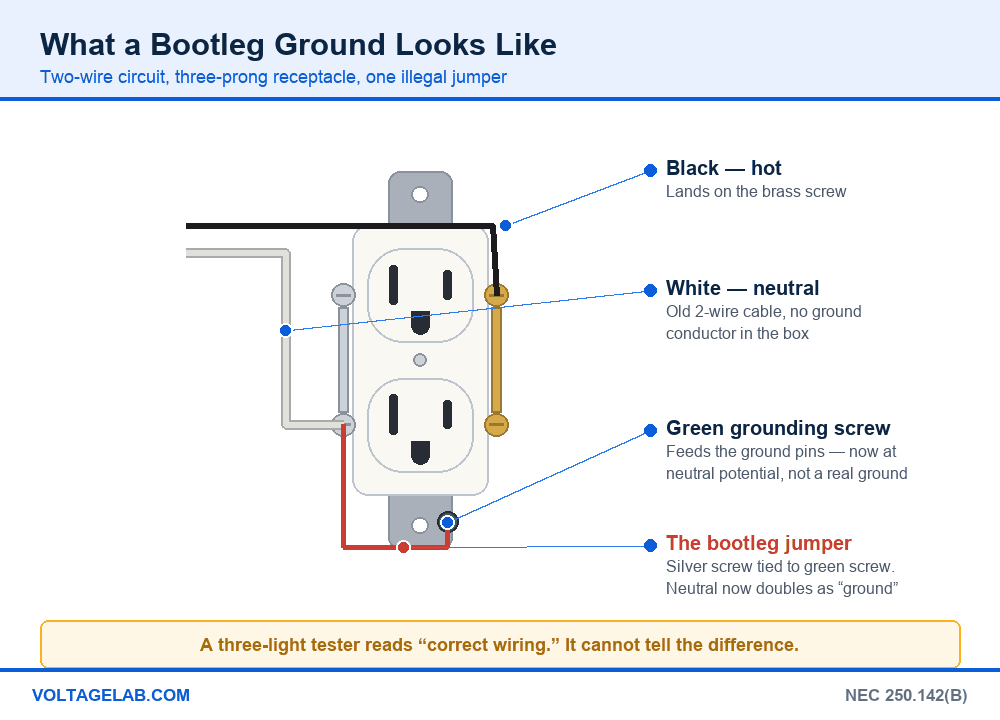
Older homes wired before the 1960s commonly used two-wire cable: one hot, one neutral, no equipment grounding conductor. Those circuits were built for two-prong receptacles. When someone wants three-prong receptacles without rewiring, the shortcut is a bootleg:
Study smarter with VoltageLab
Built for electricians, apprentices, and electrical engineers who want faster practice and better exam prep.
Join thousands of electricians upgrading their skills
- The black conductor lands on the brass terminal as normal.
- The white conductor lands on the silver terminal as normal.
- A short jumper runs from the silver terminal, or from the neutral splice, to the green grounding screw.
- The ground pins of the receptacle are now electrically the same as the neutral, right at the device.
The same thing turns up in other forms: a neutral bonded to a metal box in a subpanel, a neutral and ground twisted together in a junction box, or a light fixture’s ground lead tied to the white conductor. All of them use the neutral as a grounding conductor somewhere other than the service, and all of them have the same problem.
Why people do it
Two reasons. Three-prong plugs need somewhere to go, and a two-prong receptacle means a cheater adapter. And buyers, inspectors and insurers flag “open ground” on a tester report, while a bootleg ground passes that tester. The bootleg makes the report clean without making the house any safer.
Bootleg ground vs true ground vs open ground
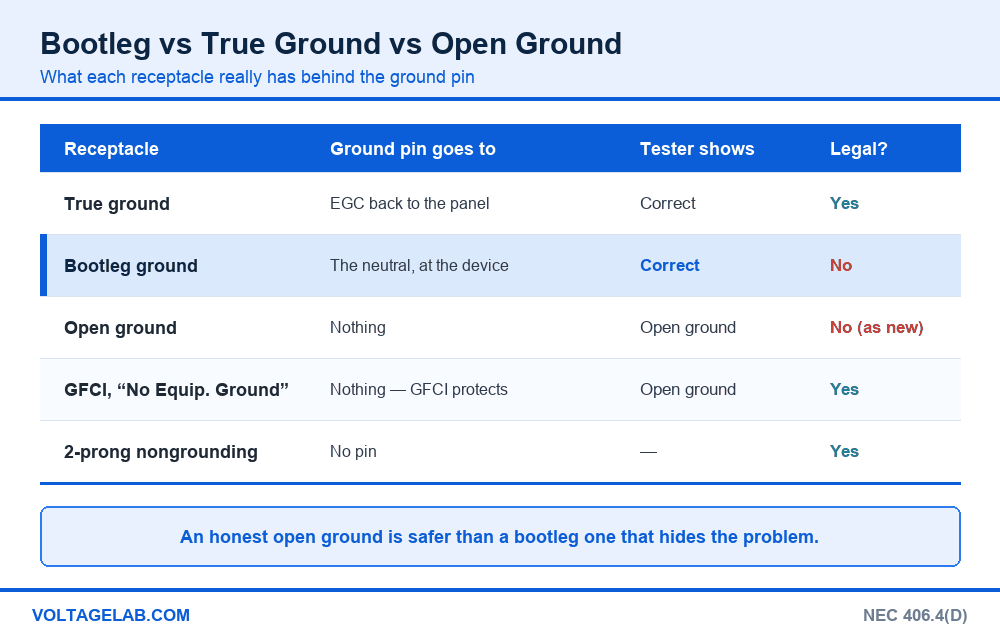
What matters is where the ground pin actually goes:
| Receptacle | Ground pin connects to | 3-light tester shows | Code-compliant? |
|---|---|---|---|
| True ground | An EGC back to the panel | Correct | Yes |
| Bootleg ground | The neutral, at the device | Correct — the problem | No — 250.142(B) |
| Open ground | Nothing | Open ground | No, unless GFCI-protected and marked |
| GFCI, “No Equipment Ground” | Nothing — the GFCI provides shock protection | Open ground | Yes — 406.4(D)(2) |
| Two-prong nongrounding | No ground pin | — | Yes — 406.4(D)(2)(a) |
The Code reason is simple. NEC 250.24(A)(5) says the grounded conductor may not be connected to normally non-current-carrying metal parts or equipment grounding conductors on the load side of the service disconnecting means, and 250.142(B) says the grounded conductor may not be used to ground equipment there. Neutral and ground meet at the service and nowhere else. Our overview of equipment grounding conductors covers what a real EGC has to be.
The bootleg behind a GFCI: a bootleg ground downstream of a GFCI quietly blinds it to faults on that equipment. When a hot conductor faults to a grounded metal case, the current returns through the jumper onto the neutral and back through the GFCI’s sensing coil. Out and back are still equal, so the GFCI sees no imbalance. Remove every jumper before you rely on a GFCI fix.
Why a bootleg ground is dangerous
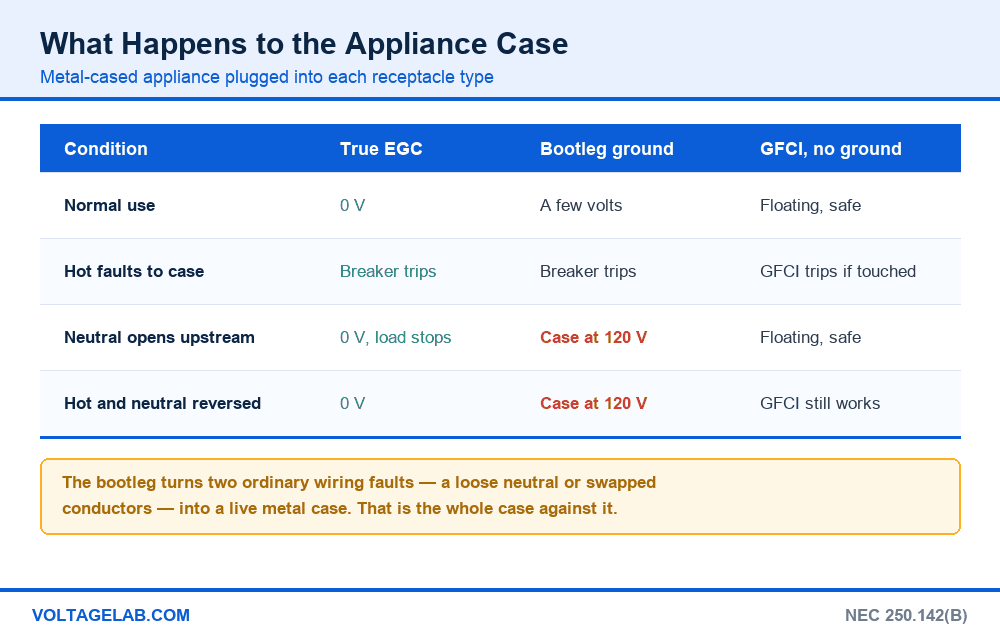
On a healthy circuit a bootleg ground looks harmless. The danger is in what it does when ordinary faults happen. Take a metal-cased appliance — a toaster, a washing machine, a power tool — plugged into each type of receptacle:
| Condition | True EGC | Bootleg ground | GFCI, no ground |
|---|---|---|---|
| Normal operation | Case at 0 V | Case at the neutral’s voltage drop, a few volts under load | Case not connected; no hazard |
| Hot conductor faults to the case | Fault current returns on the EGC; breaker trips | Fault current returns on the neutral; breaker trips, but an upstream GFCI cannot see it | Case is live until someone touches it, then the GFCI trips at 6 mA |
| Neutral opens upstream (loose splice, failed backstab) | Case stays at 0 V; the load just stops | Case rises to 120 V through the load itself | Case not connected; no hazard |
| Hot and neutral reversed at the receptacle | Case stays at 0 V; tester shows the reversal | Case at 120 V — the jumper ties the hot to the ground pin | GFCI still trips on a ground fault |
The open neutral row is the one that hurts people. Loose neutral connections are common in old wiring — backstabbed receptacles, tired wire nuts, aluminum branch circuits. With a bootleg in place, a failed neutral anywhere upstream lets current flow from the hot, through the appliance, onto the neutral side of the receptacle, through the jumper and onto the case. Nothing trips, because no current is flowing anywhere it should not until a person provides the path. Our guide to aluminum wiring in older homes explains why those connections fail.
How to detect a bootleg ground in four steps
Step 1 — know what the house was wired with. If the panel shows two-wire cable without a ground, cloth-covered cable, or old armored cable with no bonding strip, every three-prong receptacle that tests “correct” is suspect.
Step 2 — measure neutral-to-ground voltage under load. Put a known load, such as a 1,500-watt heater, on the circuit and measure between the neutral slot and the ground hole with a meter. A real EGC shows a volt or two, because the loaded neutral has voltage drop and the EGC does not. A bootleg reads essentially zero, because the two are the same conductor at that point.
Step 3 — use a loaded circuit analyzer. Higher-end receptacle analyzers apply a load and compare voltages, and several flag a “false ground” or bootleg directly. A basic three-light tester never will.
Step 4 — confirm visually. De-energize the circuit, verify it is dead, pull the receptacle and look for a jumper from the silver terminal or neutral splice to the green screw. That is the only test that settles it.
The one that catches everyone: a three-light tester does not measure whether a ground exists. It checks voltage between the slots. A bootleg ground puts the neutral on the ground pin, so hot-to-ground reads 120 V and neutral-to-ground reads zero — exactly what a correctly grounded receptacle shows. “Correct wiring” on that tester means only that nothing is reversed or open.
Study smarter with VoltageLab
Built for electricians, apprentices, and electrical engineers who want faster practice and better exam prep.
⭐️ Join thousands of electricians upgrading their skills
How to fix a bootleg ground — NEC 406.4(D) and 250.130(C)
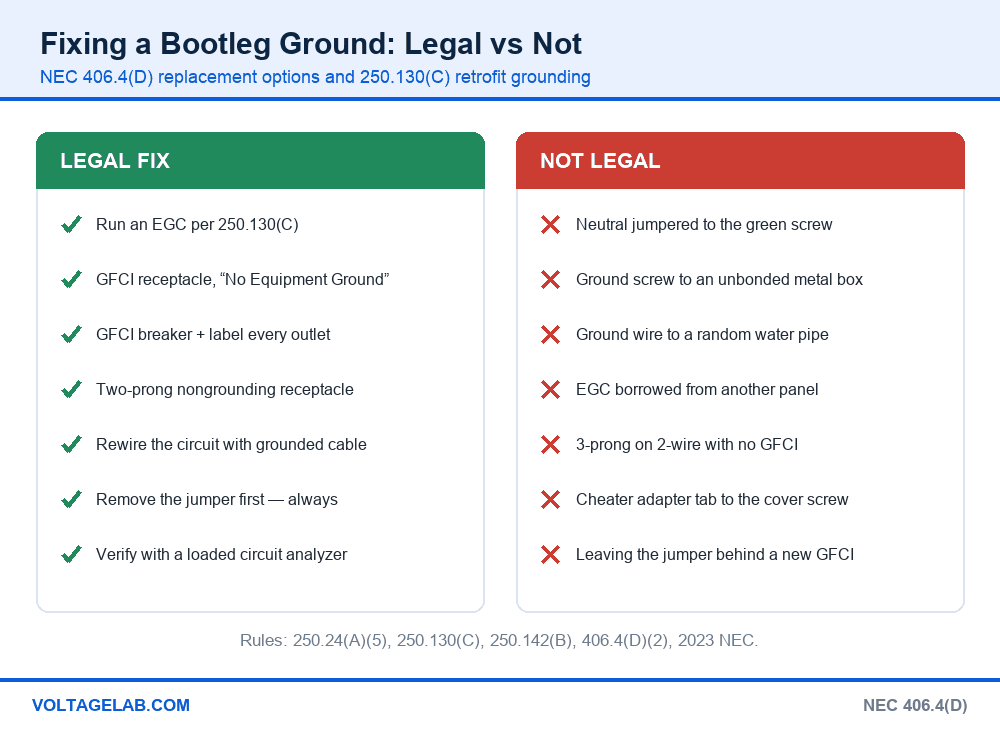
Every fix starts the same way: remove the jumper. Then pick one of the paths the Code recognizes for replacing a receptacle where no grounding means exists.
Legal fixes
- Run an equipment grounding conductor under 250.130(C), sized from Table 250.122, to an accessible point such as the grounding electrode system, the grounding electrode conductor, the equipment grounding terminal bar in the panel where the circuit originates, or an EGC of another branch circuit from that same panel
- Install a GFCI receptacle and mark it “No Equipment Ground,” under 406.4(D)(2)(b)
- Protect grounding-type receptacles from an upstream GFCI or GFCI breaker and mark each “GFCI Protected” and “No Equipment Ground,” under 406.4(D)(2)(c)
- Replace with a two-prong nongrounding receptacle, under 406.4(D)(2)(a)
- Rewire the circuit with cable that includes a grounding conductor
Not legal
- A jumper from neutral to the grounding terminal — the bootleg itself
- Connecting the green screw to a metal box that has no grounding path of its own
- Running a ground wire to whatever cold-water pipe is nearby, rather than a point listed in 250.130(C)
- Picking up a ground from a circuit fed by a different panel
- Installing a three-prong receptacle on a two-wire circuit with no GFCI protection
- Leaving the old jumper in place behind a new GFCI
One more rule applies to the GFCI path. 406.4(D)(2)(c) does not allow an equipment grounding conductor to be connected from the GFCI-type receptacle to any outlet it supplies. The ground terminals downstream stay unconnected. For the GFCI side of the job, see our guide to GFCI vs AFCI requirements, and test the finished device with our walkthrough on how to test a GFCI outlet.
Bootleg ground fixes compared
| Question | New EGC (250.130(C)) | GFCI receptacle | GFCI breaker | Two-prong receptacle |
|---|---|---|---|---|
| Protects people from shock | Yes, by clearing faults | Yes, at 6 mA | Yes, at 6 mA | No added protection |
| Surge protectors and electronics get a ground | Yes | No | No | No |
| Accepts three-prong plugs | Yes | Yes | Yes, with labels | No |
| Labor | Highest — fishing a new wire | Lowest | Low, at the panel | Lowest |
| Best for | Home offices, electronics, laundry | One room or a short run of outlets | Whole circuit in one move | Lamps and two-prong loads only |
For sizing the retrofit conductor, see NEC 250.122 equipment grounding conductor sizing. For the bigger picture of why the neutral and ground are kept apart, read our Article 250 overview and the explainer on grounding a conductor in electrical systems.
Learn receptacle grounding the right way
Grounded, grounding, bonding, EGC — the words are close and the rules are not. The Electrical & Electrician App (also on Android) has wiring lessons on receptacle grounding and Article 250 quizzes that cite the code section behind every answer. It is free to download.
Is a GFCI fix enough?
Pros
- Code-compliant shock protection without opening walls
- One device at the first outlet can cover the rest of the run
- Better shock protection than a ground wire alone, because it trips at 6 mA
Cons
- Surge protectors cannot divert to ground, so they do little
- Some equipment manufacturers require a true equipment ground
- Downstream outlets go dead on a trip, which confuses occupants without labels
Dealing with bootleg grounds in the field
Do
- Assume every three-prong receptacle on two-wire cable is suspect
- Check neutral-to-ground voltage under load before trusting a “correct” reading
- Remove every jumper on the circuit before adding GFCI protection
- Apply the “No Equipment Ground” and “GFCI Protected” labels
- Tighten or replace every neutral connection you open on old wiring
Avoid
- Trusting a three-light tester to clear a receptacle
- Bonding neutral and ground in a sub-panel or junction box
- Grounding to a random water pipe or a box with no grounding path
- Linking the ground terminals of GFCI-protected outlets together
- Telling a client a GFCI made the circuit “grounded”
Frequently asked questions
What is a bootleg ground?
A jumper from the neutral terminal to the grounding terminal of a receptacle on a circuit with no equipment grounding conductor. It makes the receptacle look grounded to a simple tester, but it uses the neutral as the ground, which NEC 250.142(B) prohibits.
Why is a bootleg ground dangerous?
If the neutral opens upstream or the hot and neutral are reversed, the ground pin and every metal case plugged into it can sit at 120 volts with nothing tripping. It also hides faults from an upstream GFCI.
Will a receptacle tester detect a bootleg ground?
A basic three-light tester will not; it shows “correct wiring.” Measuring neutral-to-ground voltage under load, or using a circuit analyzer with false-ground detection, will. Pulling the receptacle and looking is the definitive check.
Is a bootleg ground against code?
Yes. NEC 250.24(A)(5) and 250.142(B) prohibit connecting the grounded conductor to equipment grounding terminals on the load side of the service disconnect, and 406.4(D)(2) lists the only permitted ways to replace a receptacle where no ground exists.
Can I fix a bootleg ground with a GFCI?
Yes, after removing the jumper. Install a GFCI receptacle marked “No Equipment Ground,” or protect the outlets from an upstream GFCI and mark each “GFCI Protected” and “No Equipment Ground,” under 406.4(D)(2).
Is an open ground better than a bootleg ground?
It is safer. An open ground provides no grounding, but it does not put neutral voltage on the case or hide faults from a GFCI, and any tester will flag it so it gets fixed.
Where can I connect a new ground wire for an old receptacle?
NEC 250.130(C) permits the grounding electrode system, the grounding electrode conductor, the equipment grounding terminal bar in the enclosure where the circuit originates, or an equipment grounding conductor of another branch circuit from that same enclosure. Size it from Table 250.122.
The bottom line
A bootleg ground is a cosmetic fix that makes a two-wire circuit pass a cheap tester and nothing else. It is prohibited because it puts the neutral on the ground pin, and that turns a loose neutral or a reversed connection into a live metal case. The two things to remember are that the tester cannot see it, and that the jumper has to come out before any GFCI fix can do its job.
Remove the jumper, then run an equipment grounding conductor where equipment needs one and use GFCI protection everywhere else. For the full set of grounding and bonding rules behind those fixes, see our guide to NEC Article 250 grounding and bonding.
FREE PRACTICE TOOL
Think you'd pass this on a real exam?
Test what you just read with instant-feedback quizzes built around real code questions — not generic trivia.
5
Code standards
10,000+
Active learners
100%
Free to start
Instant explanations on every answer, right or wrong
NEC, BS7671, AS/NZS, CEC, and DIN VDE covered
Bite-sized quizzes you can finish in 5 minutes
No signup required to try your first quiz
No account needed · Takes less than 2 minutes