


GFCI and AFCI both trip circuits, but they protect against completely different hazards, respond to completely different electrical signatures, and the NEC requires them in completely different locations. Confusing one for the other — or treating them as interchangeable — leads to failed inspections on new construction and a false sense of safety on existing work.
This guide covers exactly what distinguishes GFCI from AFCI protection, the physics behind each device, every NEC 2023 required location for each, the 2023 code changes that expanded both requirements, and when you need both on the same circuit.
Study smarter with VoltageLab
Built for electricians, apprentices, and electrical engineers who want faster practice and better exam prep.
⭐️ Join thousands of electricians upgrading their skills
- GFCI prevents electric shock by detecting current leaking to an unintended path — NEC 210.8.
- AFCI prevents electrical fire by detecting dangerous arcing signatures in the wiring — NEC 210.12.
- Kitchens and laundry areas need both, on the same circuit, under the 2023 NEC.
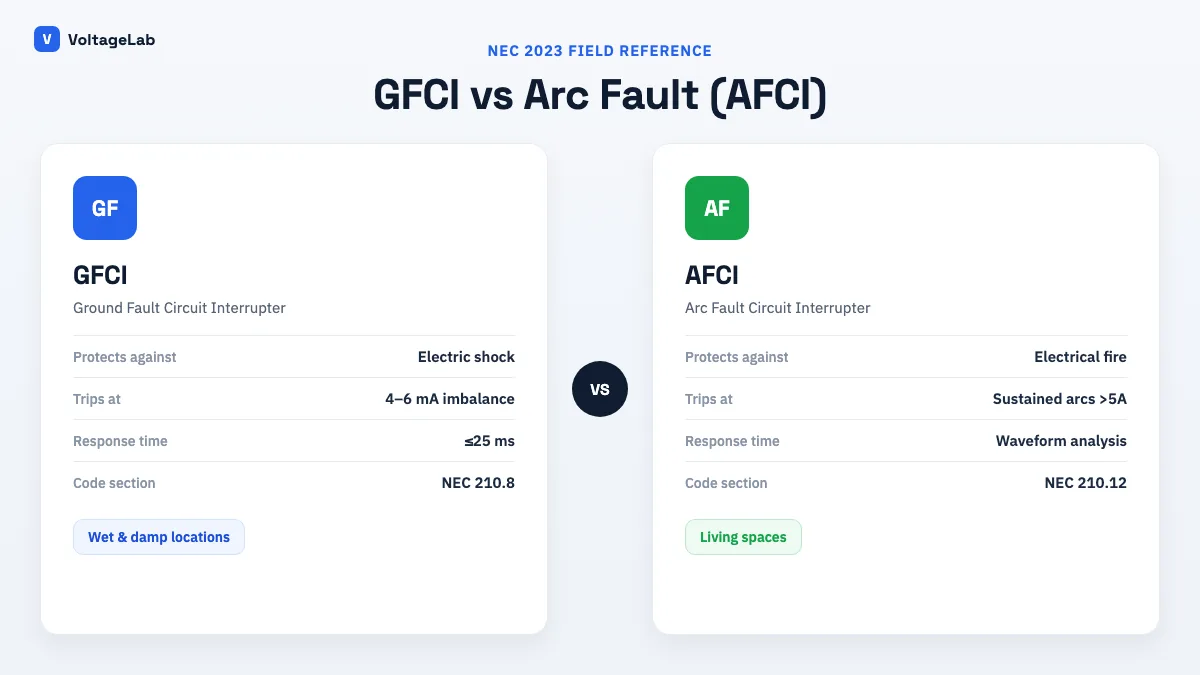
The Core Distinction — Two Different Hazards
| Feature | GFCI (Ground Fault Circuit Interrupter) | AFCI (Arc Fault Circuit Interrupter) |
|---|---|---|
| Hazard it prevents | Electric shock / electrocution | Electrical fire from arc faults in wiring |
| What it detects | Current leaking out of the circuit through an unintended path (including a person) | Dangerous arcing signatures in the wiring — both parallel and series arc faults |
| Trip threshold | Current imbalance of 4–6 milliamps (0.004–0.006A) | Sustained arcs above approximately 5A; must ignore normal arcs below 3A |
| Response time | ≤25 milliseconds at 6 mA | Must trip for sustained dangerous arcs; distinguished from benign arcs |
| Primary NEC section | NEC 210.8 | NEC 210.12 |
| Where required | Wet and damp locations, areas with shock risk | Living spaces — bedrooms, kitchens, hallways, and virtually all rooms in dwelling units |
| Applies to | Receptacles (and some hardwired appliances per 2023 NEC) | The entire branch circuit (outlets, devices, lighting — all loads on the circuit) |
| Common device forms | GFCI receptacle, GFCI circuit breaker, GFCI deadface device | Combination-type AFCI circuit breaker (required form for most applications) |
How GFCI Devices Work
A GFCI device continuously monitors the current on the hot conductor and compares it to the current returning on the neutral conductor. Under normal operation these are equal — all the current that flows out on the hot comes back on the neutral. The instant some current takes a different path — through a person who has touched a live conductor, through water, or through a fault in an appliance’s insulation — the hot and neutral currents become unequal.
When the imbalance reaches approximately 4–6 milliamps, the GFCI trips in 25 milliseconds or less. For context: 10 milliamps can cause loss of muscle control and prevent someone from releasing a live conductor; 100 milliamps can be fatal. The GFCI trips far below the lethal threshold, which is why it is required in locations where water contact is possible.
What GFCI does NOT do: A GFCI does not protect against overloads or short circuits — that is the circuit breaker’s job. It does not protect against a person contacting both conductors simultaneously (line-to-line contact). And it does not detect arc faults — an arcing fault can exist on a GFCI-protected circuit without tripping the GFCI.
How AFCI Devices Work
An arc fault is an unintended electrical discharge across a gap between conductors. It occurs when wire insulation is damaged by a nail, staple, pinched cable, frayed cord, or loose terminal connection. Arcs produce intense localized heat — enough to ignite surrounding combustibles — while often drawing less current than it takes to trip a standard circuit breaker. This makes arc faults a leading cause of residential electrical fires.
A combination-type AFCI breaker analyzes the waveform of the current in the circuit 40,000 or more times per second. It is programmed to recognize the electrical “signature” of a dangerous arc fault — an irregular, high-frequency electrical discharge — and distinguish it from the normal arcing that happens when a switch is toggled, a motor starts, or a vacuum cleaner brush sparks slightly. When a dangerous arc signature is detected and sustained, the breaker trips.
Series vs. parallel arc faults:
Pass your electrical exam the first time
Practice real NEC exam questions with full code-referenced explanations and progress tracking — built for journeyman, master and apprentice exam prep.
Thousands of NEC practice questions with code-referenced answers
- Parallel arc fault: A fault between the hot and neutral conductors, or between hot and ground — often draws enough current to trip a standard breaker. Most serious.
- Series arc fault: An interruption in a single conductor — like a broken wire with the two ends near each other. Draws much less current than a parallel fault, often not enough to trip a standard breaker. This is the type most likely to cause a fire without any protection device responding — and the main reason AFCI was developed.
What AFCI does NOT do: An AFCI does not protect against ground faults through a person in a wet location — that is the GFCI’s job. And while combination-type AFCI breakers provide both branch circuit and outlet circuit AFCI protection, they do not protect against all types of arcing that could occur in the system.
GFCI Requirements — NEC 210.8(A) Dwelling Units (2023)
NEC 210.8(A) requires GFCI protection for all 125-volt through 250-volt, single-phase, 15- and 20-ampere receptacles installed in the following locations in dwelling units. These must be in a readily accessible location.
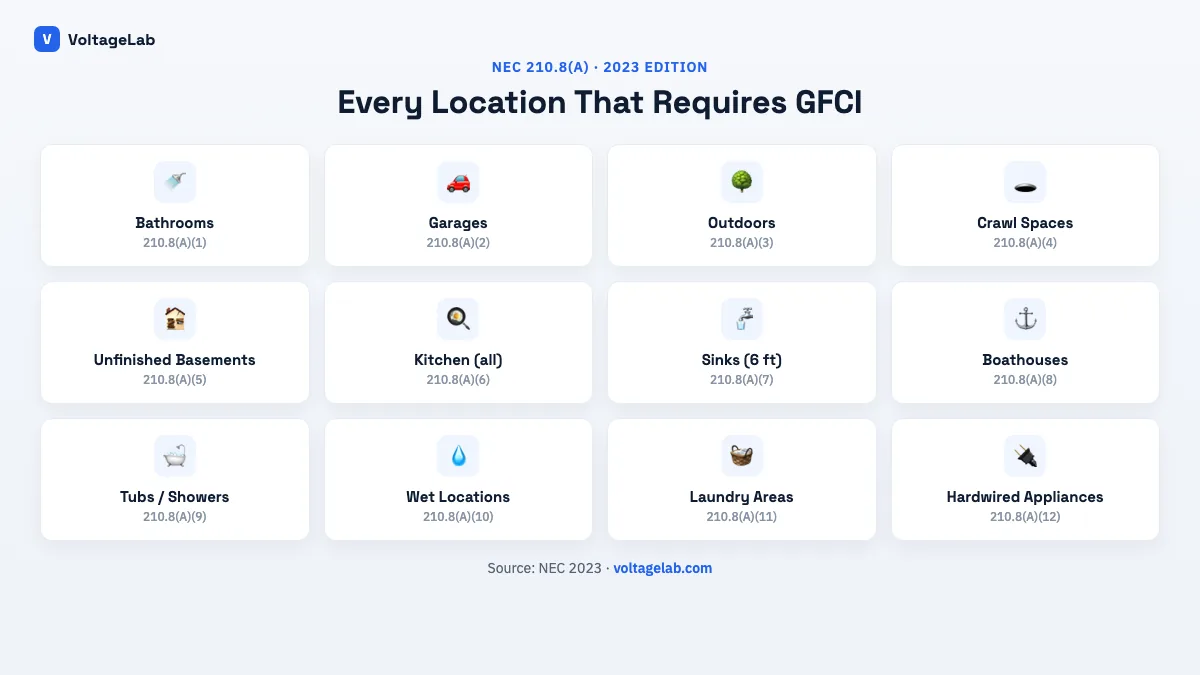
| Location | NEC 210.8(A) Item | Notes / 2023 Changes |
|---|---|---|
| Bathrooms | 210.8(A)(1) | All receptacles in the bathroom area — 2023 NEC expanded to cover all receptacles, not just those within 6 ft of a sink |
| Garages and accessory buildings | 210.8(A)(2) | All receptacles in garages and accessory buildings with floors at or below grade; includes detached garages |
| Outdoors | 210.8(A)(3) | All outdoor receptacles with direct grade access |
| Crawl spaces at or below grade | 210.8(A)(4) | All receptacles in crawl spaces |
| Unfinished basements | 210.8(A)(5) | All receptacles in unfinished basements (2020 NEC expanded this from just non-heating/lighting receptacles) |
| Kitchen | 210.8(A)(6) | 2023 NEC major change: GFCI now required for ALL kitchen receptacles, not just countertop receptacles. A receptacle on the kitchen wall below a counter that is more than 6 ft from a sink still requires GFCI in the 2023 NEC. |
| Sinks — within 6 feet | 210.8(A)(7) | Receptacles within 6 feet of the outside edge of a sink in all areas (laundry room sinks, utility sinks, etc.) |
| Boathouses | 210.8(A)(8) | All receptacles in boathouses |
| Bathtubs or shower stalls | 210.8(A)(9) | Receptacles within 6 feet of the outside edge of the bathtub or shower stall |
| Indoor damp or wet locations | 210.8(A)(10) | All receptacles in indoor damp or wet locations as defined in Article 100 |
| Laundry areas | 210.8(A)(11) | All receptacles in laundry areas — added in 2023 NEC |
| Specific appliances — ranges, ovens, dryers, cooktops, microwaves | 210.8(A)(12) | 2023 NEC major change: GFCI now required for hardwired electric ranges, wall ovens, counter-mounted cooktops, microwave ovens, and clothes dryers rated 150V or less to ground and ≤60A. This extends GFCI to hardwired appliances, not just receptacles. |
Key 2023 NEC Changes to GFCI Requirements
The 2023 NEC made two particularly significant expansions:
- All kitchen receptacles: Previous editions required GFCI only for kitchen countertop receptacles. The 2023 NEC requires GFCI for all receptacles in the kitchen — regardless of distance from the sink or whether they serve countertop areas. This includes receptacles on kitchen walls below counter height.
- Hardwired appliances: For the first time, GFCI is required for specific hardwired appliances (electric ranges, wall ovens, cooktops, microwaves, clothes dryers) rated at 150 volts or less to ground and not exceeding 60 amperes. This significantly expands the reach of GFCI protection beyond receptacle outlets.
2023 NEC removal: HVAC/outdoor equipment no longer requires GFCI protection under 210.8 in the 2023 edition — that requirement was removed from the previous code cycle.
💡 Keep every GFCI-required location straight, on any job.
Twelve locations, three of them changed in 2023 — that’s easy to miss on a walkthrough. VoltageLab’s AI Quiz Generator turns NEC 210.8 into unlimited practice questions so the kitchen, laundry, and appliance changes stick before an inspector catches them first.
GFCI Requirements — NEC 210.8(B) Other Than Dwelling Units
NEC 210.8(B) extends GFCI requirements to commercial and industrial locations. GFCI protection is required for 125-volt through 250-volt, 15- and 20-ampere receptacles in the following non-dwelling locations:
- Bathrooms
- Kitchens
- Rooftops
- Outdoors
- Sinks (within 6 ft)
- Indoor wet locations
- Locker rooms with associated showering facilities
- Garages, service bays, and similar areas
- Unfinished portions or areas of buildings or structures in use for storage or work areas
- Crawl spaces
- Unfinished basements
- Laundry areas
AFCI Requirements — NEC 210.12(A) Dwelling Units
NEC 210.12(A) requires AFCI protection for all 120-volt, single-phase, 15- and 20-ampere branch circuits supplying outlets or devices installed in the following areas of a dwelling unit. Note: AFCI applies to the entire branch circuit — not just to specific receptacle locations.
| Location | AFCI Required? |
|---|---|
| Kitchens and kitchenettes | ✅ Yes |
| Family rooms, dining rooms, living rooms | ✅ Yes |
| Parlors, libraries, dens | ✅ Yes |
| Bedrooms, sunrooms, recreation rooms | ✅ Yes |
| Closets, hallways, laundry areas | ✅ Yes |
| All other rooms or areas of a dwelling unit | ✅ Yes — virtually all habitable spaces |
| Bathrooms | ⚠️ Not explicitly listed — but see note below |
| Garages | ⚠️ Not explicitly listed in 210.12(A) |
| Outdoors | ❌ No — GFCI covers outdoor locations |
Practical note on bathrooms and garages: The 2023 NEC 210.12(A) requires AFCI for “all other rooms or areas” in addition to the specifically listed areas. Some inspectors and AHJs interpret this to include bathrooms and garages in new construction. Verify with your local AHJ. The NEC does not prohibit AFCI in bathrooms or garages — the listed requirements are minimums.
AFCI device form: For new construction, the AFCI protection must be provided by a listed combination-type AFCI device located at the origin of the branch circuit (typically the panelboard). A combination-type AFCI provides both branch circuit and outlet circuit protection — earlier “outlet branch circuit” type AFCIs do not meet the current requirement as the sole means of protection in new installations.
AFCI and existing wiring: Per NEC 210.12(A), when branch circuit wiring is modified, replaced, or extended in the areas listed above, the branch circuit must be AFCI-protected. This applies to existing buildings, not just new construction.
Study smarter with VoltageLab
Built for electricians, apprentices, and electrical engineers who want faster practice and better exam prep.
⭐️ Join thousands of electricians upgrading their skills
When Both GFCI and AFCI Are Required on the Same Circuit
There are locations where both the AFCI requirement (from 210.12) and the GFCI requirement (from 210.8) apply simultaneously. The most common is a kitchen circuit — which requires AFCI protection for the branch circuit (210.12(A)) AND GFCI protection for the receptacles (210.8(A)(6)).
How to satisfy both simultaneously: Three approaches:
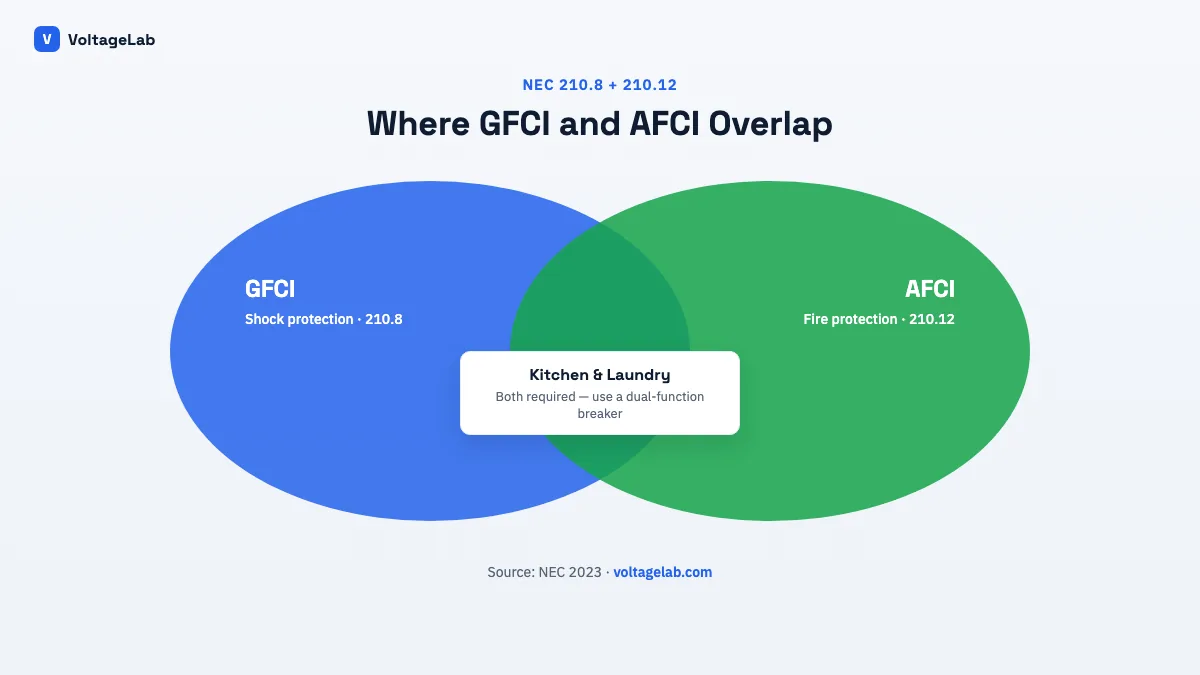
- Dual-function AFCI/GFCI breaker: A single breaker in the panel that provides both combination-type AFCI protection and GFCI protection for the entire circuit. This is the cleanest solution and the most commonly used on new kitchen construction. The breaker must be listed as providing both types of protection.
- AFCI breaker + GFCI receptacles: Install a combination-type AFCI breaker for the circuit’s arc fault protection, and GFCI receptacles at the required locations for shock protection. Both requirements are satisfied independently.
- AFCI breaker + GFCI breaker (avoid this): Two separate breakers for a single circuit — this is not a practical solution because a circuit only has one breaker position.
| Location | GFCI Required? | AFCI Required? | Solution |
|---|---|---|---|
| Kitchen | ✅ All receptacles | ✅ Branch circuit | Dual-function breaker or AFCI breaker + GFCI receptacles |
| Laundry area | ✅ All receptacles | ✅ Branch circuit | Dual-function breaker or AFCI breaker + GFCI receptacles |
| Bedroom | ❌ Not typically required | ✅ Branch circuit | Combination AFCI breaker only |
| Bathroom | ✅ All receptacles | ⚠️ AHJ-dependent | GFCI required; AFCI check with AHJ |
| Garage | ✅ All receptacles | ⚠️ AHJ-dependent | GFCI required; AFCI check with AHJ |
| Unfinished basement | ✅ All receptacles | ✅ If circuit serves habitable areas | Depends on circuit routing; dual-function if both required |
Device Forms — What Qualifies
GFCI Protection Methods
- GFCI receptacle: Most common for residential. Protects itself and any downstream receptacles connected to its load terminals. Does not protect the entire circuit — only what is downstream.
- GFCI circuit breaker: Protects the entire circuit. Required when GFCI protection must cover hardwired equipment (appliances, HVAC units) or when downstream GFCI receptacle routing is impractical.
- Deadface GFCI device: Listed GFCI device without a receptacle face — used where GFCI protection is needed but no receptacle outlet is required.
AFCI Protection Methods
- Combination-type AFCI circuit breaker: The standard for new construction. Provides protection for both branch circuit wiring (back to the panel) and outlet circuit wiring (between the panel and the outlets). Must be at the origin of the branch circuit — typically the panelboard.
- Listed AFCI outlet device: Permitted as an alternative to the AFCI breaker when the branch circuit wiring from the panel to the first outlet is protected by a metal conduit or equivalent, or in certain retrofit situations. Check the specific allowances in NEC 210.12(A) for when outlet-type AFCIs may be used.
Common GFCI and AFCI Inspection Failures
Missing GFCI on Kitchen Receptacles Beyond Countertop (2023 NEC)
One of the most commonly missed 2023 NEC changes: all kitchen receptacles require GFCI, not just countertop receptacles. Inspectors on 2023-code jobs will cite unreachable kitchen wall receptacles that are not GFCI-protected, even if they are far from any sink. See our guide to the kitchen island outlet code and GFCI placement rules for the receptacle-count and spacing side of this same kitchen.
Using Outlet-Branch-Circuit AFCI Instead of Combination-Type
Earlier-generation AFCI breakers were listed only as “outlet branch circuit” types and do not meet the 2023 NEC requirement for new construction. The current requirement is combination-type AFCI. Verify the listing label on any AFCI device before installation.
Installing GFCI Downstream of AFCI but Not Providing AFCI on the Full Circuit
A GFCI receptacle provides ground fault protection for that receptacle and anything downstream — but it does not provide AFCI protection. A circuit that requires both must have combination-type AFCI at the panelboard regardless of what GFCI devices are installed on the circuit. If you need a refresher on verifying a GFCI is actually functioning correctly in the field, see our GFCI testing guide.
Nuisance Tripping Misattributed to AFCI
Some appliances with brushed motors (vacuum cleaners, older power tools, hairdryers) produce electrical noise that can trigger AFCI breakers. This is a product compatibility issue, not a code violation. AFCI breakers are required to ignore normal switch arcing below 3A, but some older appliances produce signatures that the breaker cannot distinguish from dangerous arcs. Replace the AFCI with one from a different manufacturer, or upgrade the appliance.
Conclusion
GFCI and AFCI protect against fundamentally different hazards and are required in fundamentally different locations. Three rules for every new residential installation:
- GFCI = shock protection in wet or damp locations. Required for all receptacles in kitchens, bathrooms, garages, basements, laundry areas, outdoors, and near sinks. Also required for specific hardwired appliances in the 2023 NEC.
- AFCI = fire protection in living spaces. Required for all 120V, 15 and 20A branch circuits serving virtually all rooms in a dwelling unit. Must be combination-type at the panelboard.
- Kitchens and laundry areas need both. Use a dual-function AFCI/GFCI breaker — or an AFCI breaker at the panel plus GFCI receptacles at the required locations.
For the complete branch circuit requirements these devices protect, see our guides to NEC Article 210: What Is a Branch Circuit & How Is It Rated? and Multi-Wire Branch Circuits.
📱 The electrical reference and study app built for working electricians.
VoltageLab puts unlimited AI-generated NEC practice questions, Wiring Guides, an interactive circuit simulator, and flashcards in your pocket — so GFCI and AFCI requirements stop being something you have to re-check every job. Free on iOS and Android.
FAQ: GFCI vs Arc Fault (AFCI)
What is the difference between GFCI and AFCI protection?
GFCI (Ground Fault Circuit Interrupter) detects current leaking out of the circuit through an unintended path — such as a person in contact with a live conductor — and trips in milliseconds to prevent electrocution. It monitors the balance between hot and neutral current, tripping when the imbalance reaches 4–6 milliamps. AFCI (Arc Fault Circuit Interrupter) detects dangerous electrical arcing signatures in the wiring — caused by damaged insulation, frayed cords, or loose connections — that can ignite fires even at current levels too low to trip a standard breaker. GFCIs protect people from shock; AFCIs protect buildings from fire.
Where is GFCI required in a dwelling unit under the 2023 NEC?
NEC 210.8(A) requires GFCI for receptacles in: bathrooms, garages, outdoors, crawl spaces, unfinished basements, all kitchen receptacles (2023 expansion), within 6 feet of sinks, boathouses, within 6 feet of bathtubs/showers, indoor damp/wet locations, laundry areas, and for specific hardwired appliances including electric ranges, ovens, cooktops, microwaves, and dryers rated 150V or less to ground and ≤60A (new in 2023).
Where is AFCI required in a dwelling unit under the 2023 NEC?
NEC 210.12(A) requires AFCI protection for all 120V, 15 and 20A branch circuits supplying outlets or devices in kitchens, family rooms, dining rooms, living rooms, bedrooms, sunrooms, recreation rooms, closets, hallways, laundry areas, and all other rooms or areas of a dwelling unit. In practice, this covers virtually every room. AFCI must be provided by a listed combination-type AFCI device at the origin of the branch circuit, typically at the panelboard.
Do I need both GFCI and AFCI in a kitchen?
Yes. The 2023 NEC requires AFCI protection for kitchen branch circuits (NEC 210.12(A)) and GFCI protection for all kitchen receptacles (NEC 210.8(A)(6)). Both requirements apply simultaneously. The most common solution is a dual-function AFCI/GFCI circuit breaker, which provides both types of protection from a single device at the panelboard. Alternatively, you can use a combination-type AFCI breaker at the panel and GFCI receptacles at the required kitchen outlet locations.
What changed about GFCI requirements in the 2023 NEC?
The 2023 NEC made two major expansions. First, GFCI protection is now required for all kitchen receptacles — not just countertop receptacles as in previous editions. A kitchen wall receptacle that is far from any sink still requires GFCI. Second, GFCI is now required for specific hardwired appliances rated 150V or less to ground and ≤60A, including electric ranges, wall ovens, counter-mounted cooktops, microwave ovens, and clothes dryers. This extends GFCI beyond receptacle outlets to hardwired equipment for the first time. The 2023 NEC also removed the previous GFCI requirement for outdoor HVAC equipment.
FREE PRACTICE TOOL
Think you'd pass this on a real exam?
Test what you just read with instant-feedback quizzes built around real code questions — not generic trivia.
5
Code standards
10,000+
Active learners
100%
Free to start
Instant explanations on every answer, right or wrong
NEC, BS7671, AS/NZS, CEC, and DIN VDE covered
Bite-sized quizzes you can finish in 5 minutes
No signup required to try your first quiz
No account needed · Takes less than 2 minutes