



 Scan to install
Quick Answer
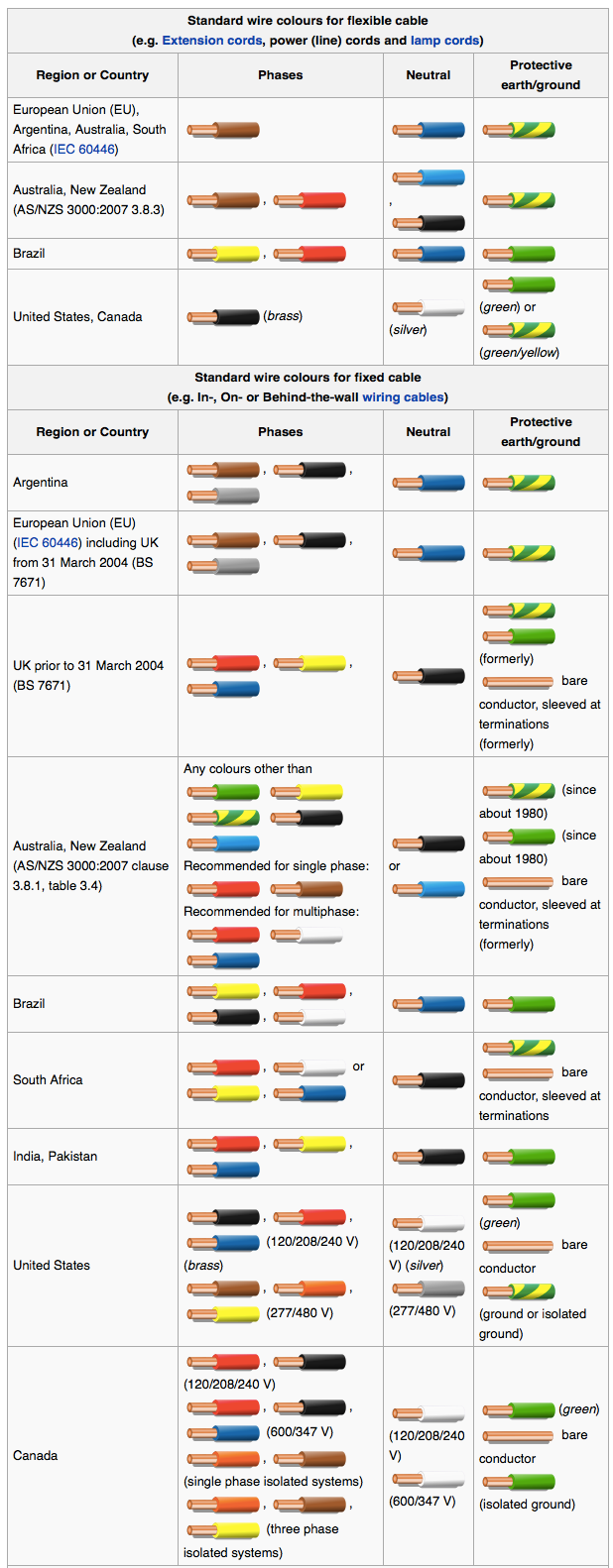
Electrical wiring color codes differ by country. In the US, the NEC only mandates white or grey for the neutral and bare copper, green or green-yellow for the ground. Hot conductors follow local practice: black, red and blue at 208 V three-phase, and brown, orange and yellow at 480 V.
IEC and the UK use brown, black and grey for L1, L2 and L3, blue for neutral and green-yellow for earth. Canada (CEC) uses red, black and blue for three-phase lines, white for neutral and green for ground. The tables below cover AC and DC for each region.
IEC (most of Europe) AC power circuit wiring color codes
| Function | label | Color, IEC | Color, old IEC |
|---|---|---|---|
| Protective earth | PE | green-yellow | green-yellow |
| Neutral | N | blue | blue |
| Line, single phase | L | brown | brown or black |
| Line, 3-phase | L1 | brown | brown or black |
| Line, 3-phase | L2 | black | brown or black |
| Line, 3-phase | L3 | grey | brown or black |
UK, AC: The United Kingdom now follows the IEC AC wiring color codes. Table below lists these along with the obsolete domestic color codes. For adding new colored wiring to existing old colored wiring see Cook.
UK AC power circuit wiring color codes
| Function | label | Color, IEC | Old UK color |
|---|---|---|---|
| Protective earth | PE | green-yellow | green-yellow |
| Neutral | N | blue | black |
| Line, single phase | L | brown | red |
| Line, 3-phase | L1 | brown | red |
| Line, 3-phase | L2 | black | yellow |
| Line, 3-phase | L3 | grey | blue |
US, AC:The US National Electrical Code only mandates white (or grey) for the neutral power conductor and bare copper, green, or green with yellow stripe for the protective ground. In principle any other colors except these may be used for the power conductors. The colors adopted as local practice are shown in Table below.
Black, red, and blue are used for 208 VAC three-phase; brown, orange and yellow are used for 480 VAC. Conductors larger than #6 AWG are only available in black and are color taped at the ends.
US AC power circuit wiring color codes
| Function | label | Color, common | Color, alternative |
|---|---|---|---|
| Protective ground | PG | bare, green, or green-yellow | green |
| Neutral | N | white | grey |
| Line, single phase | L | black or red (2nd hot) | |
| Line, 3-phase | L1 | black | brown |
| Line, 3-phase | L2 | red | orange |
| Line, 3-phase | L3 | blue | yellow |
Canada: Canadian wiring is governed by the CEC (Canadian Electric Code). See Table below. The protective ground is green or green with yellow stripe. The neutral is white, the hot (live or active) single phase wires are black , and red in the case of a second active. Three-phase lines are red, black, and blue.
Canada AC power circuit wiring color codes
| Function | label | Color, common |
|---|---|---|
| Protective ground | PG | green or green-yellow |
| Neutral | N | white |
| Line, single phase | L | black or red (2nd hot) |
| Line, 3-phase | L1 | red |
| Line, 3-phase | L2 | black |
| Line, 3-phase | L3 | blue |
IEC, DC: DC power installations, for example, solar power and computer data centers, use color coding which follows the AC standards. The IEC color standard for DC power cables is listed in Table below, adapted from Table 2, Cook.
IEC DC power circuit wiring color codes
| Function | label | Color |
|---|---|---|
| Protective earth | PE | green-yellow |
| 2-wire unearthed DC Power System | ||
| Positive | L+ | brown |
| Negative | L- | grey |
| 2-wire earthed DC Power System | ||
| Positive (of a negative earthed) circuit | L+ | brown |
| Negative (of a negative earthed) circuit | M | blue |
| Positive (of a positive earthed) circuit | M | blue |
| Negative (of a positive earthed) circuit | L- | grey |
| 3-wire earthed DC Power System | ||
| Positive | L+ | brown |
| Mid-wire | M | blue |
| Negative | L- | grey |
US DC power: The US National Electrical Code (for both AC and DC) mandates that the grounded neutral conductor of a power system be white or grey. The protective ground must be bare, green or green-yellow striped. Hot (active) wires may be any other colors except these. However, common practice (per local electrical inspectors) is for the first hot (live or active) wire to be black and the second hot to be red. The recommendations in Table below are by Wiles. He makes no recommendation for ungrounded power system colors. Usage of the ungrounded system is discouraged for safety. However, red (+) and black (-) follows the coloring of the grounded systems in the table.
US recommended DC power circuit wiring color codes
| Function | label | Color |
|---|---|---|
| Protective ground | PG | bare, green, or green-yellow |
| 2-wire ungrounded DC Power System | ||
| Positive | L+ | no recommendation (red) |
| Negative | L- | no recommendation (black) |
| 2-wire grounded DC Power System | ||
| Positive (of a negative grounded) circuit | L+ | red |
| Negative (of a negative grounded) circuit | N | white |
| Positive (of a positive grounded) circuit | N | white |
| Negative (of a positive grounded) circuit | L- | black |
| 3-wire grounded DC Power System | ||
| Positive | L+ | red |
| Mid-wire (center tap) | N | white |
| Negative | L- | black |
Wiring color codes FAQ
What color is the neutral wire?
White or grey in the US and Canada, and blue under the IEC and current UK codes. The US NEC mandates white or grey for the grounded neutral conductor.
What are the 3-phase wire colors in the US?
Common practice is black, red and blue (L1, L2, L3) for 208 V and brown, orange and yellow for 480 V. The NEC does not mandate these hot-conductor colors, so check your local practice.
What color is the ground wire?
Bare copper, green, or green with a yellow stripe in the US. Canada uses green or green-yellow, and IEC and the UK use green-yellow for protective earth.
What are the IEC wire colors?
Protective earth is green-yellow, neutral is blue, single-phase line is brown, and 3-phase lines are brown (L1), black (L2) and grey (L3).
What color is positive and negative in DC wiring?
In recommended US practice, positive is red, negative is black, and the neutral or center tap is white. Under IEC, positive (L+) is brown, negative (L-) is grey and the mid-wire (M) is blue.