


Kitchen island and peninsula receptacles trip up more electricians than almost any other rough-in detail — not because the rule is complicated, but because it changed twice in three code cycles and most job-site habits haven’t caught up. Here’s the confirmed 2026 NEC answer, including the GFCI requirement most guides on this topic still miss.
Verify before you rough in. NEC adoption dates vary by state and local jurisdiction — some AHJs still enforce the 2023 NEC or earlier. Confirm which edition your local inspector enforces before treating the 2026 NEC language below as final for your job.
Study smarter with VoltageLab
Built for electricians, apprentices, and electrical engineers who want faster practice and better exam prep.
⭐️ Join thousands of electricians upgrading their skills
Quick Answer
Kitchen island outlets are optional under the 2026 NEC, but if you skip them you must still rough in a path for a future receptacle (210.52(C)(2)). Every kitchen receptacle, island ones included, needs GFCI protection (210.8(A)(6)).
A receptacle can go in a listed assembly in the countertop or work surface, or on or above it up to 20 inches. It cannot go on the side of the base cabinets within 24 inches of the countertop edge (210.52(C)(4)), except in a drawer.
Governing NEC Section
210.52(C) — island & peninsula receptacle outlets
GFCI Requirement
210.8(A)(6) — every kitchen receptacle, not just countertop ones
Current NEC Edition
2026 NEC — confirmed, published edition
Study smarter with VoltageLab
Built for electricians, apprentices, and electrical engineers who want faster practice and better exam prep.
Join thousands of electricians upgrading their skills
Prohibited Zone
24 in. (610 mm) below countertop & adjacent walls — 210.52(C)(4)
If you are wiring kitchens in 2026, the first thing to know is this:
- the old pre-2023 rule is not the current baseline
- the 2023 NEC changed island and peninsula receptacle requirements
- the latest publicly available 2026 NEC draft keeps the newer approach and further refines where receptacles can and cannot be installed
- your inspector still enforces the locally adopted edition, not just the newest draft
Calculate it: Use the free Kitchen & Laundry Circuit Planner to plan the required kitchen and laundry small-appliance circuits under NEC 210.11(C).
Where the Kitchen Island Outlet Rule Lives in the NEC
The kitchen island outlet rule is governed by NEC 210.52(C), which covers receptacle outlets for countertops and work surfaces in dwelling-unit kitchens, pantries, breakfast rooms, and dining rooms.
Three subsections matter for island and peninsula work:
210.52(C)(4)— prohibited locations210.52(C)(2)— island and peninsular countertops/work surfaces210.52(C)(3)— receptacle outlet location
What changed in the 2023 NEC
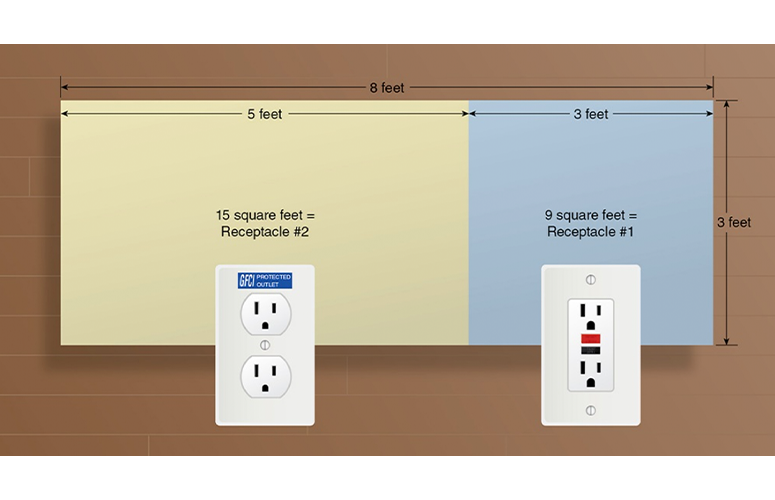
Before the 2023 cycle, electricians were used to a more direct requirement for receptacles serving island and peninsula countertop spaces.
The 2023 NEC dropped that mandate. Receptacles for island and peninsular countertops became optional — install one only if you choose to, and if you do, it must follow the location rules in 210.52(C)(3). This confused a lot of people into thinking island outlets disappeared entirely. They didn’t disappear — they became conditional, and a new requirement showed up in their place (see below).
What the 2026 NEC Says (Confirmed)
The 2026 NEC keeps the 2023 approach and adds one clarification: 210.52(C)(2) and (C)(3) now explicitly reference the new 210.52(C)(4) prohibited-location list. The core rule hasn’t reversed — it’s been tightened.
Under the 2026 NEC, if you install a receptacle for an island or peninsular countertop or work surface, it must comply with 210.52(C)(3) and avoid the prohibited zones in 210.52(C)(4). If you don’t install one, you still must provide for a future receptacle (covered in detail below) — the code never lets you simply skip the island entirely.
💡 Look up any NEC section in plain
Instead of memorizing which subsection covers what, describe the situation to VoltageLab — “receptacle on a kitchen island, no countertop mount” — and get the exact NEC article, section, and rule back instantly. No code book required.
Allowed receptacle locations under the latest draft approach
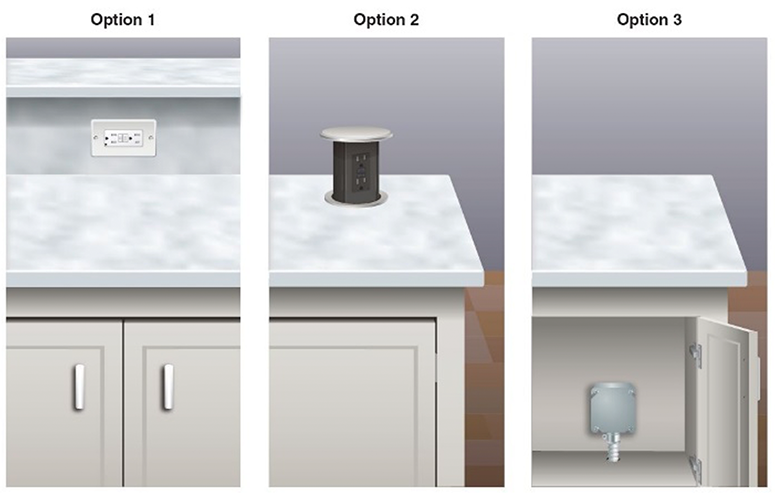
In the latest publicly available 2026 draft material, under 210.52(C)(3), a permitted receptacle for an island or peninsula countertop or work surface must be in one of these locations:
- In the work surface, using a listed assembly rated for that use
- On or above the countertop or work surface, not exceeding 20 inches (500 mm) above it
- In the countertop, using a listed receptacle outlet assembly rated for that use
Prohibited locations electricians need to watch
The latest draft materials are especially useful here.
Study smarter with VoltageLab
Built for electricians, apprentices, and electrical engineers who want faster practice and better exam prep.
⭐️ Join thousands of electricians upgrading their skills
The second-draft working output shows prohibited location language that says required and permitted receptacle outlets shall not be installed:
- on adjacent walls extending from the base cabinets within
610 mm (24 in.)horizontally and downward from the countertop/work-surface edge - beneath countertops within
610 mm (24 in.)of the countertop or work surface
There is also an exception for receptacle outlets installed in a drawer.
That means many of the old “just mount it on the side under the island top” installs are exactly what electricians need to re-check against the adopted code cycle.
Island vs peninsula receptacle rules
A kitchen island is a free-standing counter or work surface.
A peninsula is attached to another cabinet, wall, or counter and projects outward.
For current planning purposes, the NEC groups these together in 210.52(C)(2) as island and peninsular countertops and work surfaces.
So when you answer:
kitchen island outletsisland outlet codekitchen island receptacle code
you usually need to explain peninsula rules at the same time.
Do Kitchen Island Outlets Need GFCI Protection? (NEC 210.8(A)(6))
Yes — every 125-volt through 250-volt receptacle in a dwelling-unit kitchen must have GFCI protection under NEC 210.8(A)(6), including island and peninsula receptacles. This is not limited to countertop-surface outlets anymore.
Older code cycles limited the GFCI requirement to receptacles serving countertop surfaces. The 2023 NEC removed that qualifying phrase, and the 2026 NEC keeps the broader wording — meaning every kitchen receptacle needs GFCI protection now, from the refrigerator outlet to the one on the island, whether or not it’s within reach of the sink.
You can satisfy this with a GFCI breaker at the panel or a readily accessible GFCI receptacle protecting everything downstream. Either way, if a kitchen receptacle on your rough-in list isn’t GFCI protected, it fails — full stop, regardless of where in the kitchen it sits.
Use the GFCI & AFCI Requirement Checker to confirm every circuit on the job, not just the island, meets the current rule before rough-in inspection.
No Receptacle Installed? You Still Need a Future-Provision Path
If you skip the island or peninsula receptacle, NEC 210.52(C)(2) still requires you to rough in a wiring method — conduit, raceway, or cable — terminated in a covered junction box, so a receptacle can be added later without opening a finished wall or cabinet.
This is the part of the rule most field guides skip. “Optional receptacle” doesn’t mean “optional rough-in.” Coordinate this with the cabinet installer before the island is set — retrofitting a wiring path after countertops and cabinets are in place is expensive and often means cutting into finished surfaces.
NEC Kitchen Island Rules: 2020 vs. 2023 vs. 2026
| NEC Edition | Receptacle Requirement | GFCI Requirement |
|---|---|---|
| 2020 NEC | Mandatory formula: 1 receptacle for the first 9 sq ft, +1 per additional 18 sq ft of countertop | Required for countertop-surface receptacles only |
| 2023 NEC | Optional — if installed, follow 210.52(C)(3); if not, provide a future-provision wiring path | Required for all kitchen receptacles (210.8(A)(6) scope expanded) |
| 2026 NEC | Same as 2023, plus explicit prohibited-location list added at 210.52(C)(4) | Same as 2023 — all kitchen receptacles GFCI protected |
What Electricians Should Do in the Field
- Confirm which NEC edition the local jurisdiction has adopted — 2020, 2023, or 2026 — before you rough in.
- Don’t rely on the old cabinet-side placement habit; re-check the 210.52(C)(4) prohibited zones every time.
- Verify every kitchen receptacle, not just the island one, is GFCI protected under 210.8(A)(6).
- If you’re skipping the island receptacle, rough in the future-provision wiring method before the cabinets close up the wall.
- Coordinate early with cabinet plans, countertop details, and trim-out products so the receptacle location is locked in before rough-in, not during trim.
What About Outlet Height Above the Counter?
A permitted receptacle located on or above the countertop or work surface can’t exceed 20 inches (500 mm) above it. This is a ceiling, not a target — it doesn’t require a countertop-mounted receptacle everywhere, just caps how high one can go if you install one there.
Study every NEC topic like this one, in one app
VoltageLab gives you AI-generated practice questions, Watch and Quiz video lessons, and a personalized study plan built around NEC 2026 — covering 210.52(C), 210.8, and every other article you’ll see on the exam or the job site. Free to download.
FAQ
Are kitchen island outlets required under the 2026 NEC?
No, not as an automatic mandate. Under the 2026 NEC, a receptacle for an island or peninsular countertop is optional. If you don’t install one, you still must provide a future-provision wiring path per 210.52(C)(2) — you can’t simply omit it with no rough-in at all.
What NEC section covers kitchen island outlets?
The core rule is NEC 210.52(C), with 210.52(C)(2) covering island and peninsular countertops specifically, 210.52(C)(3) covering location, and 210.52(C)(4) covering prohibited locations.
Do kitchen island outlets need GFCI protection?
Yes. NEC 210.8(A)(6) requires GFCI protection for every 125–250 volt receptacle in a dwelling-unit kitchen, including island and peninsula receptacles — not just ones on a countertop surface.
Can I put a receptacle on the side of the island cabinet?
Only if it falls outside the prohibited zones in 210.52(C)(4): not on adjacent walls within 24 inches of the countertop edge, and not beneath the countertop within 24 inches of the edge. Most old cabinet-side installations fail this. An in-drawer receptacle is the one exception.
According to 210.52(C)(4), what is the minimum distance from the base cabinets on adjacent walls where a receptacle outlet is prohibited?
24 inches (610 mm). Under 210.52(C)(4), receptacle outlets are not permitted on adjacent walls extending from the base cabinets within 24 inches horizontally and downward from the countertop or work-surface edge, or beneath the countertop within 24 inches of the edge. The one exception is a receptacle installed in a drawer.
Can a receptacle be installed in the countertop or work surface itself?
Yes, if it’s a listed receptacle outlet assembly rated for countertop or work-surface installation.
How high can a receptacle be above the countertop?
Up to 20 inches (500 mm) above the countertop or work surface for a permitted on-or-above installation.
What if I skip the island receptacle entirely — is there still a rough-in requirement?
Yes. NEC 210.52(C)(2) requires a wiring method — conduit, raceway, or cable — terminated in a covered junction box at the island or peninsula, so a receptacle can be added later without tearing into finished cabinets or countertops.
Final Takeaway
- Kitchen island and peninsula receptacle rules changed in the 2023 NEC and carry forward, tightened, into the 2026 NEC.
- Receptacles are optional if installed correctly per 210.52(C)(3)/(C)(4) — but a future-provision wiring path is mandatory if you skip one.
- Every kitchen receptacle, island or not, now needs GFCI protection under 210.8(A)(6).
- Placement, prohibited zones, and GFCI scope are the three things that fail inspections. Verify all three before rough-in, not from memory.
Sources
- NFPA blog: Kitchen island and peninsula receptacle outlets and the NEC
- NFPA 2026 NEC first-draft working output, CMP-2
- NFPA 2026 NEC second-draft working output, CMP-2
FREE PRACTICE TOOL
Think you'd pass this on a real exam?
Test what you just read with instant-feedback quizzes built around real code questions — not generic trivia.
5
Code standards
10,000+
Active learners
100%
Free to start
Instant explanations on every answer, right or wrong
NEC, BS7671, AS/NZS, CEC, and DIN VDE covered
Bite-sized quizzes you can finish in 5 minutes
No signup required to try your first quiz
No account needed · Takes less than 2 minutes