


Open a 200-amp panel that somebody else wired and count the green wires. On a good day every one of them is 6 AWG. On a normal day you will find a 10 AWG ground landed on the bar next to a 3/0 feeder, because whoever pulled it sized the ground off the load they had in mind instead of the breaker sitting above it. The circuit works. It energises, it runs, nothing gets warm. It is also a violation, and it will stay invisible until the day a hot conductor finds the enclosure.
NEC 250.122 is the section that settles it, and it catches people out for a specific reason: it is the only grounding conductor in Article 250 sized from the overcurrent device. The grounding electrode conductor comes off the service conductor size. The main bonding jumper comes off the service conductor size. The equipment grounding conductor comes off the breaker — and if you carry the wrong mental model between them you will be wrong in both directions, sometimes on the same job.
Study smarter with VoltageLab
Built for electricians, apprentices, and electrical engineers who want faster practice and better exam prep.
⭐️ Join thousands of electricians upgrading their skills
This guide covers what Table 250.122 gives you, the four subsections that override it, how to upsize an EGC when the ungrounded conductors were increased for voltage drop, and the parallel-feeder mistake that fails more inspections than any other part of the section.
Quick Answer
NEC 250.122 sizes the equipment grounding conductor from the rating of the overcurrent protective device ahead of the circuit, not from the load and not from the size of the ungrounded conductors. Read the breaker or fuse rating down the left column of Table 250.122 and read across: 20 A gives 12 AWG copper, 60 A gives 10 AWG, 100 A gives 8 AWG, 200 A gives 6 AWG, 400 A gives 3 AWG.
Two qualifiers do most of the damage. The table is a minimum, and 250.122(B) makes you increase the EGC proportionally by circular mils whenever the ungrounded conductors were upsized for voltage drop. In the other direction, 250.122(A) says the EGC is never required to be larger than the circuit conductors it runs with.
Key Takeaways
- Table 250.122 is indexed by the rating of the overcurrent device, so a 6 AWG copper EGC belongs with a 200 A breaker whether the feeder is 3/0 or 300 kcmil.
- NEC 250.122(A) caps the requirement: an equipment grounding conductor is never required to be larger than the circuit conductors supplying the equipment.
- NEC 250.122(B) requires a wire-type EGC to be increased in circular mil area in the same proportion as the ungrounded conductors whenever those were upsized — for voltage drop, for future capacity, for any reason other than the ampacity corrections in 310.15(B) and 310.15(C).
- Parallel feeders need a full-size equipment grounding conductor in every raceway under 250.122(F); the required size is never divided between the raceways.
- Where one raceway carries several circuits, a single EGC sized for the largest overcurrent device in that raceway satisfies 250.122(C).
- The smallest equipment grounding conductor in Table 250.122 is 14 AWG copper, and 250.118 decides what is even permitted to serve as an EGC before 250.122 tells you how big the wire has to be.
- Aluminium equipment grounding conductors run one trade size larger than copper at every row of the table.
What NEC 250.122 is actually sizing
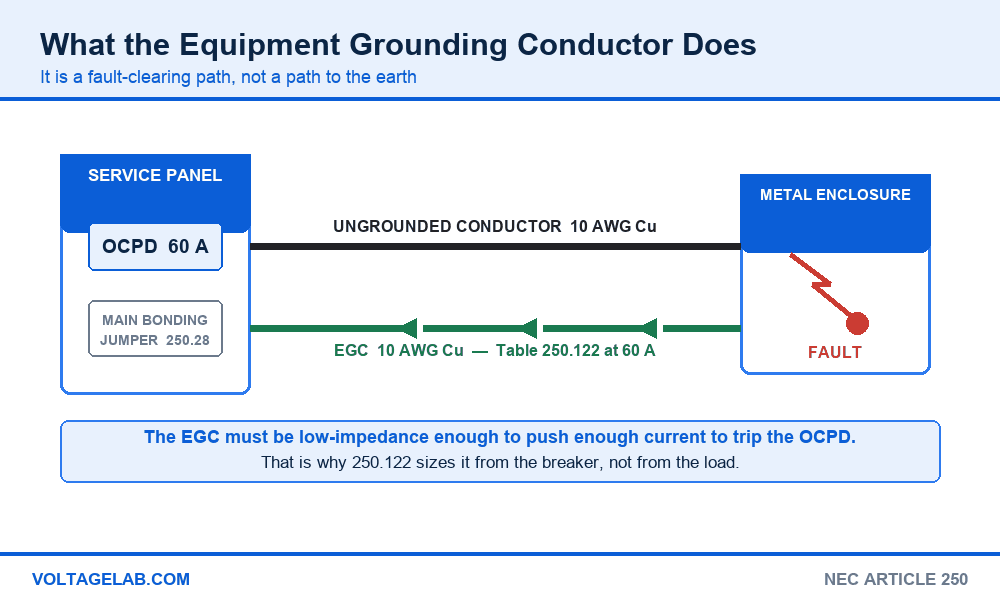
The equipment grounding conductor has one job during a fault and it has nothing to do with the earth. When an ungrounded conductor contacts a metal enclosure, the EGC is the return path that carries that fault current back to the source so the overcurrent device opens. Everything in 250.122 follows from that: the conductor has to survive the current that flows for as long as the breaker takes to clear, and the breaker is the thing that decides how much current that is and for how long.
Pass your electrical exam the first time
Practice real NEC exam questions with full code-referenced explanations and progress tracking — built for journeyman, master and apprentice exam prep.
Thousands of NEC practice questions with code-referenced answers
That is why the table is indexed by overcurrent device rating rather than by conductor size or connected load. A 100 A breaker will let a bolted fault run at hundreds or thousands of amps for a fraction of a second before it trips; a 400 A breaker sits on a system that will deliver more and is slower to react to it. The table is the Code’s judgement about the copper needed to survive each of those cases. Our overview of NEC Article 250 grounding and bonding puts this section in the context of the rest of the article.
Why the breaker sizes the ground wire and not the load
Sizing an EGC off the connected load is the single most common error in the field, and it is intuitive enough to survive a long career. A 15 A lighting load on a 200 A feeder does not need a 6 AWG ground to run — but the fault it can produce is a 200 A-breaker fault, not a 15 A one. The load never sees the fault current. The EGC does, and so does the breaker.
The corollary is the part people forget in the other direction. An EGC that is too small does not simply melt — it raises the impedance of the fault loop, which lowers the fault current, which delays the trip, which extends the time the enclosure sits energised at line potential with somebody’s hand on it. That is the failure mode 250.122 is written against, and it is why the section has no allowance for engineering judgement about the load.
EGC vs GEC vs bonding jumper — three conductors, three tables
Most 250.122 mistakes are really Article 250 mistakes: the wrong table applied to the right conductor. Four different green or bare conductors land on the same bar in a service panel, and only one of them is sized from the breaker.
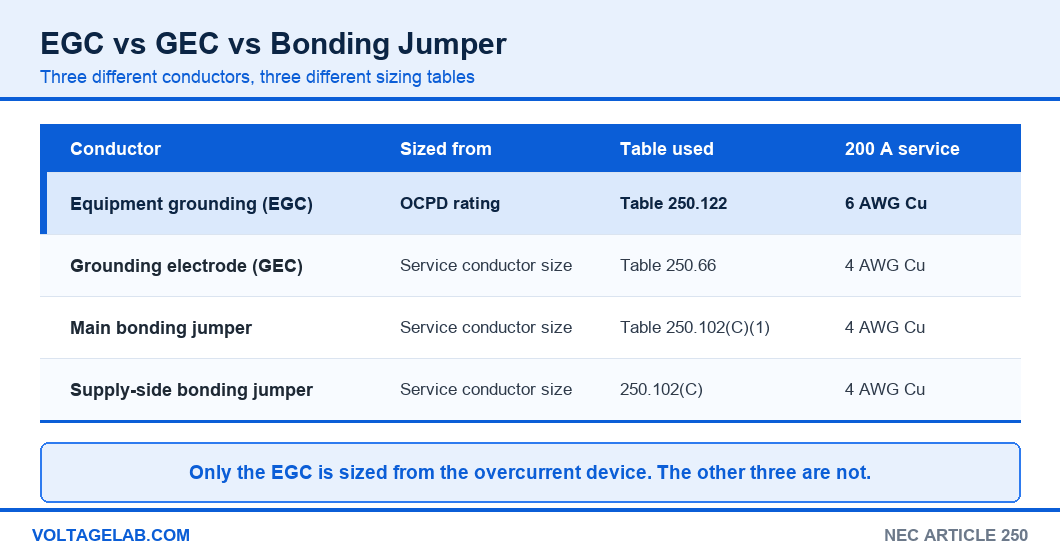
| Question | Equipment grounding conductor | Grounding electrode conductor | Main bonding jumper |
|---|---|---|---|
| Code section | 250.122 | 250.66 | 250.28(D) |
| Sized from | OCPD rating | Service conductor size | Service conductor size |
| Carries fault current | Yes — that is its job | No | Yes |
| Runs with the circuit | Always | No — goes to the electrode | No — inside the enclosure |
| Upsized with the phases | Yes — 250.122(B) | Table 250.66 already tracks it | Table 250.102(C)(1) tracks it |
If the distinction is still slippery, the sizing rules for the electrode conductor are laid out in Table 250.66 — grounding electrode conductor size, and the jumper families are covered in bonding jumpers: types, sizing and NEC rules.
The violation that fails inspections: splitting the EGC across parallel raceways. On a 400 A feeder run as two parallel sets, 250.122(F) requires a full-size equipment grounding conductor — 3 AWG copper — in each raceway. Not two 6 AWG grounds adding up to roughly one 3 AWG. If one raceway faults, the ground in that raceway carries the whole fault on its own, so each one has to be sized for the whole breaker.
How to size the EGC from NEC Table 250.122
The table itself is short and there is nothing to interpret in it. The left column is the rating of the overcurrent device the circuit is protected by, and the rule is “not exceeding” — a 40 A breaker uses the 60 A row, a 90 A breaker uses the 100 A row. Aluminium and copper-clad aluminium run one trade size larger than copper at every row.
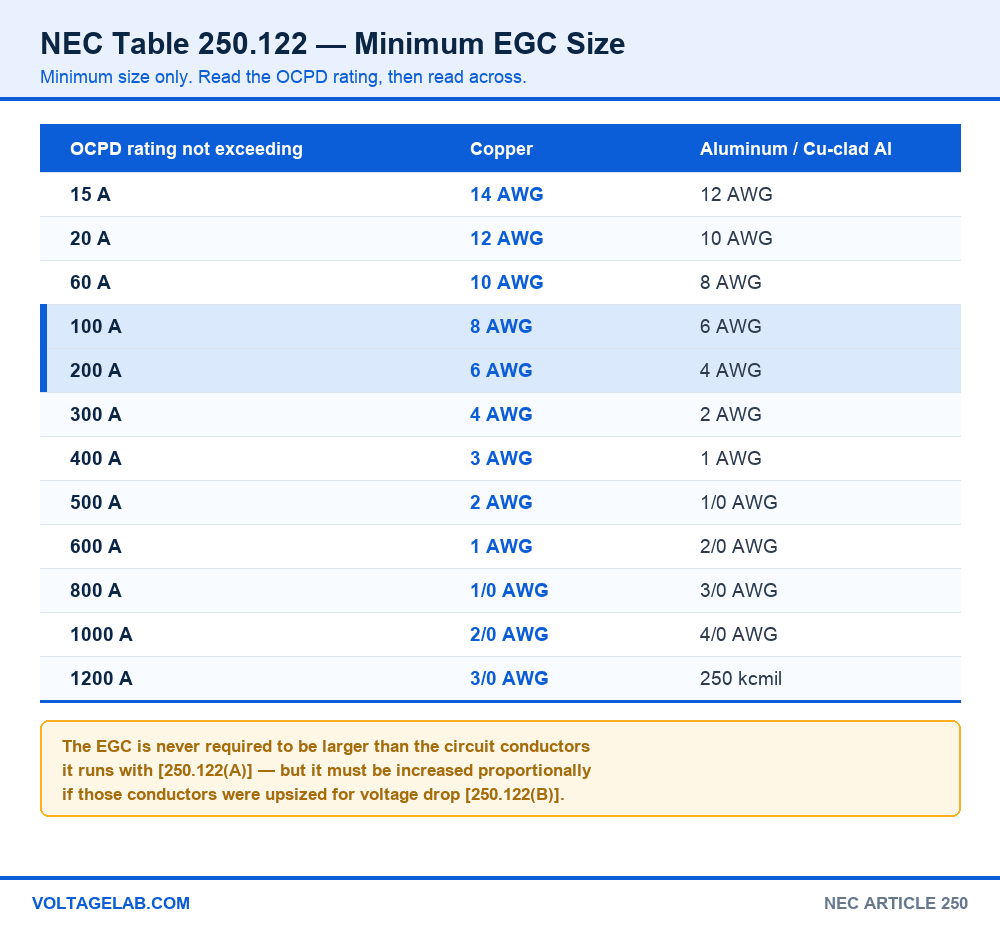
| OCPD rating not exceeding | Copper | Aluminum or copper-clad aluminum |
|---|---|---|
| 15 A | 14 AWG | 12 AWG |
| 20 A | 12 AWG | 10 AWG |
| 60 A | 10 AWG | 8 AWG |
| 100 A | 8 AWG | 6 AWG |
| 200 A | 6 AWG | 4 AWG |
| 300 A | 4 AWG | 2 AWG |
| 400 A | 3 AWG | 1 AWG |
| 500 A | 2 AWG | 1/0 AWG |
| 600 A | 1 AWG | 2/0 AWG |
| 800 A | 1/0 AWG | 3/0 AWG |
| 1000 A | 2/0 AWG | 4/0 AWG |
| 1200 A | 3/0 AWG | 250 kcmil |
| 1600 A | 4/0 AWG | 350 kcmil |
| 2000 A | 250 kcmil | 400 kcmil |
| 2500 A | 350 kcmil | 600 kcmil |
| 3000 A | 400 kcmil | 600 kcmil |
| 4000 A | 500 kcmil | 750 kcmil |
| 5000 A | 700 kcmil | 1250 kcmil |
| 6000 A | 800 kcmil | 1250 kcmil |
The five-step method
- Find the overcurrent device rating, not the load and not the conductor ampacity. For a tapped feeder, use the device ahead of the feeder on the supply side of the tap, per 250.122(G).
- Read down to the first row that the rating does not exceed, then across to your conductor material.
- Check 250.122(A). If the value you just read is larger than the circuit conductors themselves, stop — the EGC is not required to be larger than the conductors supplying the equipment.
- Check 250.122(B). If the ungrounded conductors were increased above the size their ampacity called for, scale the EGC up by the same circular mil ratio.
- Check the special case. Motor circuits fall under (D), parallel runs under (F), several circuits sharing a raceway under (C), flexible cord and fixture wire under (E).
Step 3 has a real-world case behind it. A 10 hp, 480-volt three-phase motor draws 14 A from Table 430.250, so the branch-circuit conductors at 125 percent are 12 AWG, while the short-circuit and ground-fault device may legally sit at 40 A. Table 250.122 reads 10 AWG at the 60 A row — but 250.122(A) caps it, and 12 AWG copper satisfies the Code because that is what the circuit conductors are.
The one that catches everyone: 250.122(B) does not apply to every upsize. It applies where the ungrounded conductors were increased beyond the size their ampacity required — for voltage drop, for future load, for a spec. It does not apply when you went up a size to satisfy the ambient temperature correction or the conduit fill adjustment in 310.15(B) and 310.15(C). Those conductors were not oversized; they were correctly sized for their conditions of use, and the EGC stays at the table value.
What may serve as an EGC — NEC 250.118
Before 250.122 tells you how big a wire has to be, 250.118 decides whether you need a wire at all. The NEC recognises a list of metal wiring methods as equipment grounding conductors in their own right, which is why a run of EMT with no green wire in it is not automatically a violation.
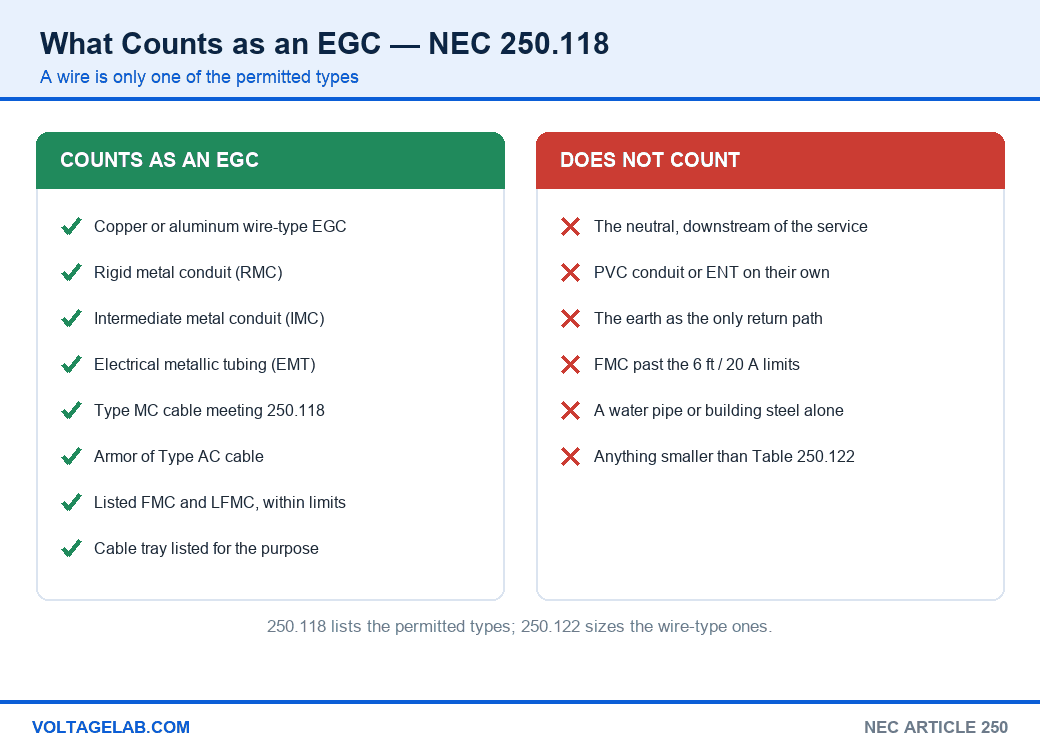
Recognised as an EGC
- A copper or aluminium wire-type conductor, bare, covered or insulated
- Rigid metal conduit, intermediate metal conduit and electrical metallic tubing
- The armour of Type AC cable, and Type MC cable of the constructions listed in 250.118
- Listed flexible metal conduit and liquidtight flexible metal conduit, within the trade size, overcurrent rating and 6-foot length limits stated in the section
- Metal cable tray, where it is listed and installed for the purpose
- Listed metal wireways and auxiliary gutters
Not recognised as an EGC
- The grounded (neutral) conductor, anywhere on the load side of the service disconnect
- PVC conduit, ENT or any other nonmetallic raceway on its own
- The earth itself — 250.4(A)(5) is explicit that the earth shall not serve as the effective ground-fault current path
- Flexible metal conduit beyond the length or overcurrent limits, or installed where flexibility is needed after installation
- Metal water piping or structural steel used as a substitute for the required EGC
- Any wire smaller than the size Table 250.122 calls for
Where a raceway serves as the EGC, the continuity of the metal path is the whole system, and that is what makes bushings, locknuts and concentric knockouts an inspection item rather than a detail. Our guide to grounding versus bonding bushings covers where each one is required.
Upsizing the EGC for voltage drop — a worked example
This is the calculation 250.122(B) is asking for, and it is arithmetic rather than judgement. Take a 200 A feeder on a long run. The ampacity calculation calls for 3/0 copper, but voltage drop over the distance pushes you to 250 kcmil.
Study smarter with VoltageLab
Built for electricians, apprentices, and electrical engineers who want faster practice and better exam prep.
⭐️ Join thousands of electricians upgrading their skills
- Base EGC from Table 250.122 at 200 A: 6 AWG copper, which is 26,240 circular mils in Chapter 9, Table 8.
- Circular mils of the required conductor: 3/0 copper is 167,800.
- Circular mils of the installed conductor: 250 kcmil is 250,000.
- Ratio: 250,000 ÷ 167,800 = 1.49.
- Required EGC area: 26,240 × 1.49 = 39,098 circular mils.
- Next conductor at or above that area: 4 AWG at 41,740 cmil. The EGC goes in as 4 AWG copper.
Note what the ratio is taken against. It is the size the ampacity calculation actually required — 3/0 — not the size Table 250.122 happens to list beside 200 A. Getting that denominator wrong is the usual source of a wrong answer on an exam and of an oversized ground in the field.
The four subsections that override the table
Table 250.122 answers the ordinary case. The rest of the section exists for the circuits that are not ordinary, and each subsection changes the input to the table rather than the table itself.
| Subsection | Applies to | What it changes |
|---|---|---|
| 250.122(A) | Every circuit | Sets the table as the minimum, and caps the EGC at the size of the circuit conductors. |
| 250.122(B) | Ungrounded conductors increased in size | Scales the EGC up by the same circular mil ratio. Does not apply to increases made for 310.15(B) or 310.15(C). |
| 250.122(C) | Several circuits in one raceway | One EGC may serve them all, sized for the largest overcurrent device in the raceway. |
| 250.122(D) | Motor circuits | Sized on the short-circuit and ground-fault device. Behind an instantaneous-trip breaker or MCP, use the maximum dual-element time-delay fuse 430.52(C)(1) would have permitted. |
| 250.122(E) | Flexible cord and fixture wire | Sets a floor of 18 AWG copper for cords with 10 AWG or smaller circuit conductors, and for fixture wire. |
| 250.122(F) | Conductors in parallel | A full-size EGC in every raceway or cable, each sized from the overcurrent device protecting the circuit. |
| 250.122(G) | Feeder taps | Sized on the device ahead of the feeder, but never required to exceed the tap conductors. |
If you are working through Article 250 in order, the companion pieces on this site cover the neighbouring rules: what the equipment grounding conductor is and where it lands, bare copper ground wire and where the Code allows it, and grounding an electrical panel to NEC requirements. For the ampacity side of the same feeder calculation, see NEC Table 310.16 explained.
Should you pull a wire EGC when the raceway already qualifies?
On a metal raceway job the Code will often let you skip the green wire entirely. Plenty of contractors pull one anyway, and the trade-off is worth stating plainly rather than treating as a house rule.
Pros of a wire EGC
- The ground path no longer depends on every coupling, locknut and setscrew staying tight for thirty years.
- A loose fitting or a corroded joint degrades the raceway path silently; a wire is inspectable and testable.
- Sensitive electronics and VFD installations generally want the low, predictable impedance of a dedicated conductor.
- Future raceway modifications by someone else cannot break a path that does not rely on the raceway.
Cons
- It counts against conduit fill and can push you to a larger trade size across the whole run.
- Copper and labour on a long or parallel run is real money for a path the Code already accepts.
Working with equipment grounding conductors in the field
Do
- Size from the breaker the moment you know it, before the wire goes on the truck.
- Write the circular mil ratio on the panel schedule whenever 250.122(B) applied, so the next person can see why the ground is oversized.
- Pull a full-size EGC into every raceway of a parallel set, without exception.
- Land grounds on the ground bar and neutrals on the neutral bar in every enclosure downstream of the service.
- Torque ground bar terminations to the listed value — a loose ground is an open ground under fault current.
Avoid
- Sizing the ground off the connected load or off the ungrounded conductor size.
- Dividing the required EGC between parallel raceways.
- Applying the 250.122(B) upsize after a 310.15(B) or 310.15(C) correction, where it does not belong.
- Using the neutral as a ground anywhere downstream of the service disconnect.
- Relying on flexible metal conduit as the EGC past its length and overcurrent limits.
Frequently asked questions
What size ground wire do I need for a 200 amp service?
For a 200 A overcurrent device, Table 250.122 requires 6 AWG copper or 4 AWG aluminium as the equipment grounding conductor. Do not confuse that with the grounding electrode conductor for a 200 A service, which is sized from Table 250.66 against the service conductors and is typically 4 AWG copper.
Is the EGC sized from the breaker or from the wire size?
From the breaker. NEC 250.122 indexes Table 250.122 by the rating of the overcurrent protective device. The ungrounded conductor size only enters the calculation through 250.122(B), when those conductors were deliberately increased beyond what their ampacity required.
Does the equipment grounding conductor have to be increased for voltage drop?
Yes. NEC 250.122(B) requires a wire-type EGC to be increased in circular mil area in the same proportion as the ungrounded conductors. Divide the installed conductor’s circular mils by the circular mils the ampacity calculation required, multiply the table EGC by that ratio, and go to the next standard size at or above the result.
Can the EGC ever be smaller than Table 250.122 says?
Only through 250.122(A), which states the EGC is not required to be larger than the circuit conductors supplying the equipment. That is not permission to undersize — it is a cap that comes into play on motor circuits and taps, where the overcurrent device is legitimately much larger than the conductors it protects.
How many equipment grounding conductors do parallel feeders need?
One full-size EGC in every raceway or cable of the parallel set, each sized from the overcurrent device protecting the circuit, per 250.122(F). The required size is never divided among the raceways, because a fault in any one raceway is carried entirely by the grounding conductor in that raceway.
What is the smallest equipment grounding conductor the NEC allows?
14 AWG copper is the smallest size in Table 250.122, matching a 15 A overcurrent device. The exception is 250.122(E), which permits 18 AWG copper as the EGC in flexible cords whose circuit conductors are 10 AWG or smaller, and in fixture wire.
Do I need a green wire if I am running EMT?
Not as a Code requirement. EMT is recognised as an equipment grounding conductor in 250.118, so a properly installed EMT system with listed fittings satisfies the requirement on its own. Many specifications and many contractors still require a wire EGC because the raceway path depends on every mechanical joint remaining tight.
Can one equipment grounding conductor serve several circuits in the same conduit?
Yes. NEC 250.122(C) permits a single EGC to serve multiple circuits sharing a raceway, provided it is sized from the largest overcurrent device protecting any circuit in that raceway. Three 20 A circuits and one 60 A circuit in one conduit need a single 10 AWG copper EGC, not four separate grounds.
The bottom line
NEC 250.122 earns its place in Article 250 by removing judgement from a decision that used to invite it. The equipment grounding conductor is the conductor that has to survive a fault long enough for the breaker to clear it, so the Code sizes it from the breaker and gives you a table with nineteen rows and no ambiguity in any of them. Read the overcurrent device rating, read across, and you have the minimum.
Two restraints are the ones that will actually cost you. 250.122(B) makes the EGC follow the ungrounded conductors up in circular mils whenever those were upsized for voltage drop — but not when they were upsized for an ampacity correction — and 250.122(F) requires a whole EGC in every raceway of a parallel run rather than a share of one. Get those two right and the rest of the section is a lookup. If you want the wider context for where that conductor terminates and why the neutral-to-ground bond exists at exactly one point in the system, start with NEC Article 250 explained.
FREE PRACTICE TOOL
Think you'd pass this on a real exam?
Test what you just read with instant-feedback quizzes built around real code questions — not generic trivia.
5
Code standards
10,000+
Active learners
100%
Free to start
Instant explanations on every answer, right or wrong
NEC, BS7671, AS/NZS, CEC, and DIN VDE covered
Bite-sized quizzes you can finish in 5 minutes
No signup required to try your first quiz
No account needed · Takes less than 2 minutes