


Walk any commercial job after the drywall goes up and you will hear it before you see it: the ratcheting scrape of interlocked armour being pulled across bar joists. MC cable — metal-clad cable — is what most commercial branch circuits in the United States are actually built from, and a crew can rough in a whole floor of it in the time it takes to bend and strap the equivalent in conduit.
The trouble is that MC looks self-explanatory. It is a finished assembly, it has a metal jacket, and it goes up fast, so people assume the armour does everything conduit does. It does not. The armour on standard interlocked MC is mechanical protection, not a ground path, and the rules that govern where you can run it sit in NEC Article 330 with a short list of hard limits that inspectors check on every job.
Study smarter with VoltageLab
Built for electricians, apprentices, and electrical engineers who want faster practice and better exam prep.
⭐️ Join thousands of electricians upgrading their skills
This guide covers what MC cable is made of, the five types you will actually be handed on a job, how to size it through NEC Table 310.16, exactly where 330.10 permits it and 330.12 forbids it, the support and bending rules, and how it compares with AC cable, NM cable and pipe.
Quick Answer
MC cable (Type MC, metal-clad) is a factory assembly of insulated circuit conductors enclosed in an armour of interlocking metal tape or a smooth or corrugated metallic sheath, covered by NEC Article 330. It is permitted for services, feeders and branch circuits, indoors and outdoors, exposed or concealed, and it is a complete wiring method — it does not need a raceway around it.
The catch is grounding. On standard interlocked-armour MC the armour is not an equipment grounding conductor; the cable must contain a wire-type EGC, and NEC 250.118 decides which constructions qualify. Support it every 6 ft and within 12 in of every box per 330.30, and keep the bend radius at seven times the cable diameter per 330.24.
Key Takeaways
- Type MC is a complete wiring method under NEC Article 330 and may be run without a raceway
- The interlocked armour on standard MC is mechanical protection only — the cable carries a wire-type equipment grounding conductor inside
- NEC 250.118 lists the MC constructions whose sheath may serve as an equipment grounding conductor, including MC-AP with its bare bonding wire and smooth or corrugated tube MC
- NEC 330.30 requires MC to be secured within 12 in of every box or fitting and supported at intervals not exceeding 6 ft
- NEC 330.24 sets the minimum bend radius for interlocked or corrugated MC at seven times the external cable diameter
- MC is permitted in wet locations only when the construction meets the moisture conditions in 330.10(A)(11), which normally means a PVC jacket over the armour
- NEC 330.12 prohibits MC where it is subject to physical damage or exposed to destructive corrosive conditions
What MC cable actually is
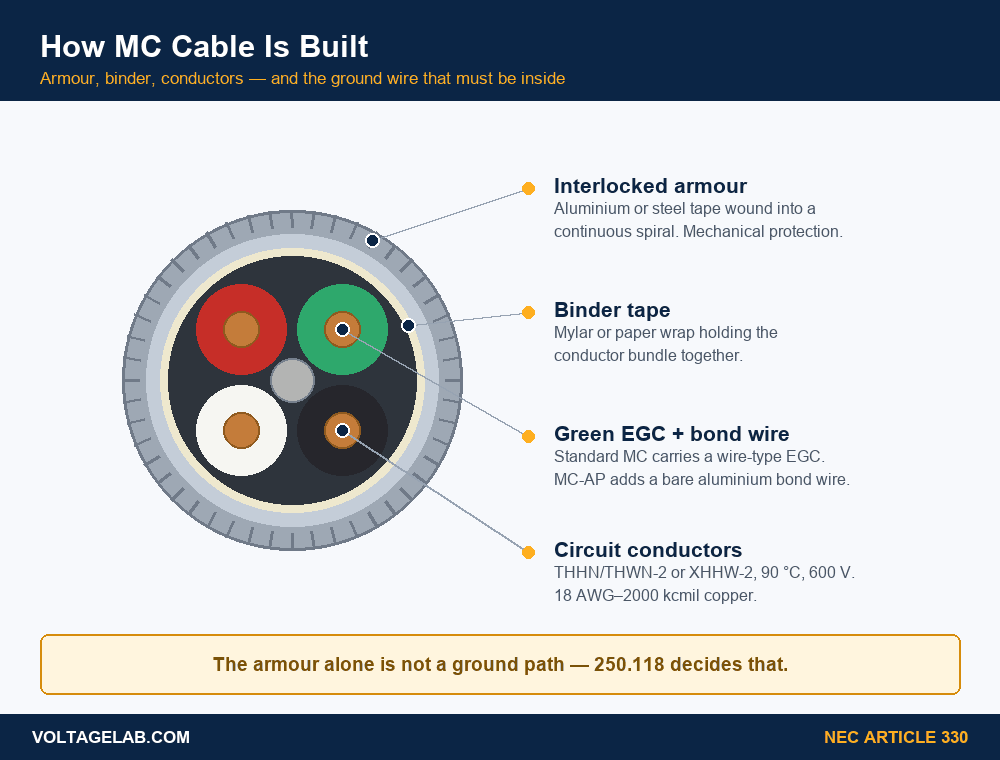
The NEC definition in 330.2 is worth reading literally: a factory assembly of one or more insulated circuit conductors, with or without optical fibre members, enclosed in an armour of interlocking metal tape or in a smooth or corrugated metallic sheath. Every word in that sentence does work later on. Build it up layer by layer:
Pass your electrical exam the first time
Practice real NEC exam questions with full code-referenced explanations and progress tracking — built for journeyman, master and apprentice exam prep.
Thousands of NEC practice questions with code-referenced answers
- Circuit conductors. Copper from 18 AWG through 2000 kcmil, or aluminium from 12 AWG through 2000 kcmil, per 330.104. In practice the insulation is THHN/THWN-2 or XHHW-2, rated 600 V and 90 °C.
- An equipment grounding conductor. On standard interlocked MC this is a green insulated wire sized from Table 250.122. It is a conductor like any other, and it is the reason the cable grounds anything at all.
- Binder tape. A mylar or paper wrap that holds the bundle in a round profile so the armour can be applied over it.
- The armour. Aluminium or galvanised steel tape wound into a continuous interlocking spiral, or on MC-HL and some large-size cable, a smooth or corrugated welded tube.
- An outer jacket, sometimes. A PVC jacket over the armour is what makes a cable suitable for wet locations and direct burial. Without it, you have a dry-location cable.
The spiral armour is what people notice, and it is genuinely useful: it takes abuse, it flexes around structure, and it lets you run a finished circuit through a building without a single coupling. What it does not do is carry fault current reliably. Interlocked tape is a series of mechanical laps, not a welded conduit, and the impedance of that path is neither low nor predictable.
What the letters mean
- MC — Metal-Clad, the Article 330 wiring method
- AP — All Purpose, armour plus a bare aluminium bonding conductor that together form the EGC
- HL — Hazardous Locations, a continuous corrugated or smooth welded sheath for classified areas
- HCF — Health Care Facilities, built for the redundant grounding path required by 517.13
- MCI-A — an aluminium-armour construction commonly used for instrumentation and control
Manufacturers add their own trade names on top of these, so read the printing on the jacket and the cable’s UL listing rather than the colour of the reel.
Types of MC cable you will actually be handed
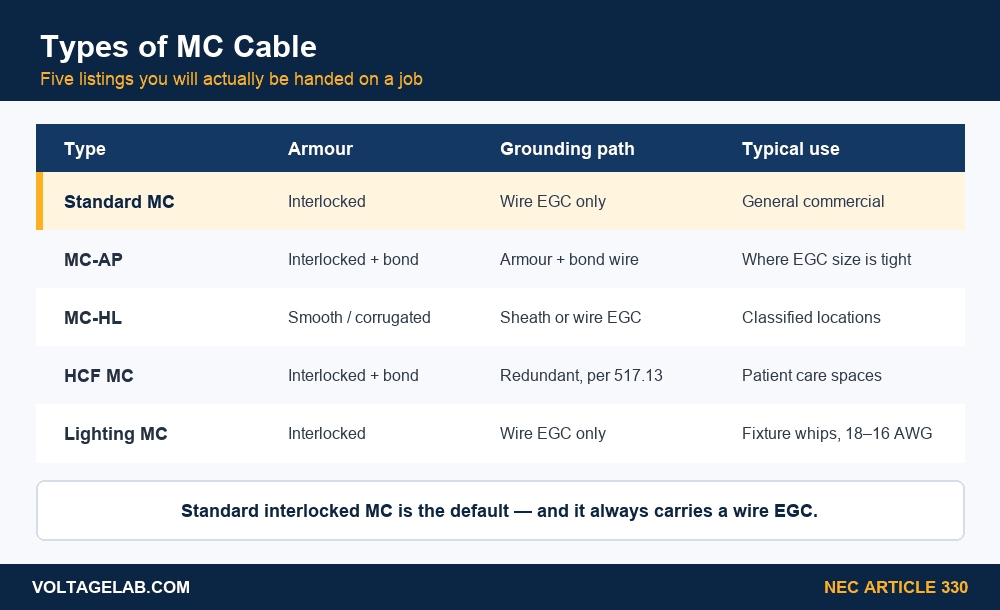
These are separate listings, not marketing variations. The grounding column is the one that changes how you wire the job:
| Type | Armour | Grounding path | Where it is used |
|---|---|---|---|
| Standard MC | Interlocked tape | Wire-type EGC only | General commercial branch circuits and feeders |
| MC-AP | Interlocked + bare bond wire | Armour combined with the bond wire | Where conduit fill or cable diameter is tight |
| MC-HL | Smooth or corrugated welded tube | Sheath, or a wire EGC | Classified locations per 501.10, 502.10 and 505.15 |
| HCF MC | Interlocked + bond wire | Redundant path required by 517.13 | Patient care spaces in health care facilities |
| Lighting MC | Interlocked tape | Wire-type EGC only | Fixture whips and lighting drops, 18–16 AWG |
Standard interlocked MC is the default on most commercial work, and it is the one people misread. If the reel says nothing more than “Type MC”, assume the armour is not your ground and the green wire inside is.
The grounding trap: the interlocked armour of standard Type MC is not an equipment grounding conductor. NEC 250.118 recognises MC as a ground-fault path only where the cable contains a wire-type EGC, where the armour is combined with a listed uninsulated bonding conductor (the MC-AP constructions), or where the cable has a listed smooth or corrugated metallic sheath. Landing an MC circuit on the armour alone, or cutting the green wire back because a fitting is crowded, leaves the equipment without an effective ground-fault current path — and it fails inspection.
This is the single biggest difference between MC and its older cousin AC cable. Type AC under Article 320 has an internal aluminium bonding strip that works with the armour so the armour is the ground path. MC has no such strip unless you bought MC-AP. Our overview of equipment grounding conductors covers what the Code expects that path to do.
MC cable ampacity — reading NEC Table 310.16
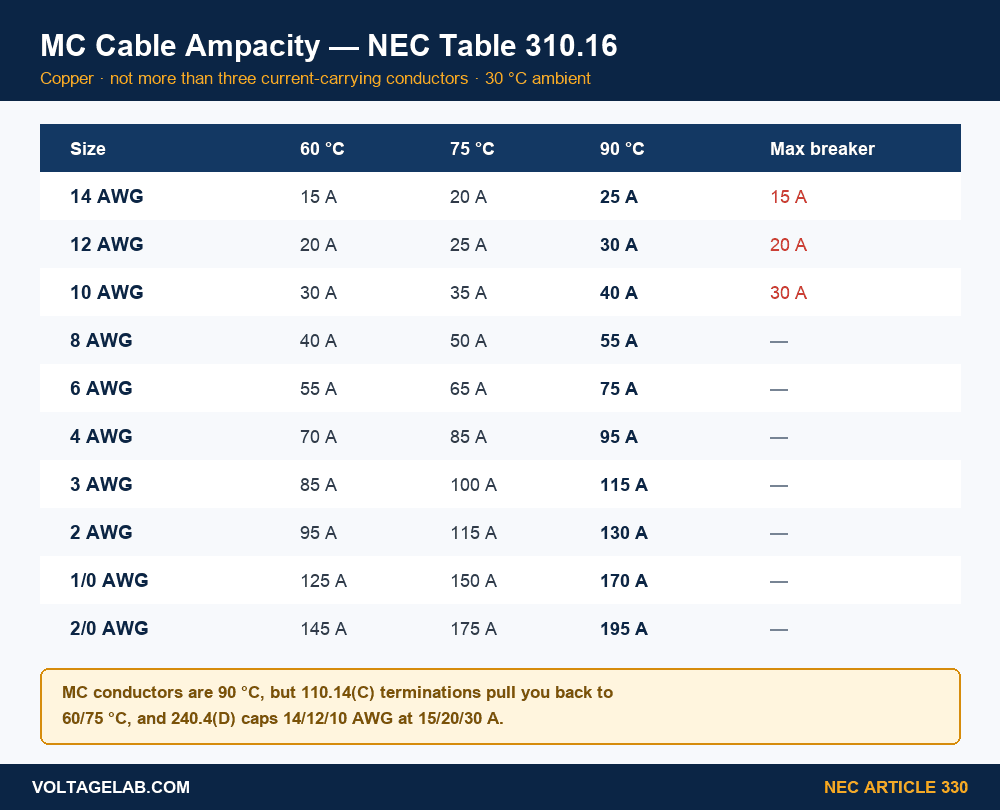
NEC 330.80 sends you to 310.14 for ampacity, which in practice means Table 310.16 — conductors in a raceway, cable or earth. The armour changes nothing about the numbers; what matters is the insulation rating of the conductors inside and the conditions the cable runs in. Our walkthrough of how to read NEC Table 310.16 covers the table itself in detail.
| Copper size | 60 °C | 75 °C | 90 °C | Max OCPD per 240.4(D) |
|---|---|---|---|---|
| 14 AWG | 15 A | 20 A | 25 A | 15 A |
| 12 AWG | 20 A | 25 A | 30 A | 20 A |
| 10 AWG | 30 A | 35 A | 40 A | 30 A |
| 8 AWG | 40 A | 50 A | 55 A | — |
| 6 AWG | 55 A | 65 A | 75 A | — |
| 4 AWG | 70 A | 85 A | 95 A | — |
| 3 AWG | 85 A | 100 A | 115 A | — |
| 2 AWG | 95 A | 115 A | 130 A | — |
| 1/0 AWG | 125 A | 150 A | 170 A | — |
| 2/0 AWG | 145 A | 175 A | 195 A | — |
A four-step method for sizing an MC run
Step 1 — start in the 90 °C column. MC conductors are 90 °C rated, so that column is your derating starting point. Confirm the insulation type printed on the conductors rather than assuming it.
Step 2 — correct for ambient. Apply the temperature correction factor from Table 310.15(B)(1) if the cable runs above or below 30 °C. Cable stacked on a roof or run through a boiler room is the usual case.
Step 3 — adjust for conductor count. A four-conductor or five-conductor MC with all conductors current-carrying takes the reduction in Table 310.15(B)(3)(a). This bites hardest when several MC cables are bundled together for more than 24 in without maintaining spacing, which is easy to do above a suspended ceiling.
Step 4 — check the terminations. NEC 110.14(C) limits you to the temperature rating of the lowest-rated termination in the circuit. For equipment rated 100 amps or less that is generally the 60 °C column unless the equipment and lugs are listed for 75 °C. Verify it on the equipment label; do not assume.
The one that catches everyone: a 12/2 MC whip shows 30 amps in the 90 °C column, but NEC 240.4(D) caps 12 AWG copper at a 20-amp overcurrent device no matter what the table says. The 90 °C figure exists so you have room to derate — it is never the breaker size. The same holds for 14 AWG at 15 A and 10 AWG at 30 A.
Study smarter with VoltageLab
Built for electricians, apprentices, and electrical engineers who want faster practice and better exam prep.
⭐️ Join thousands of electricians upgrading their skills
Where the NEC allows MC cable — 330.10 and 330.12
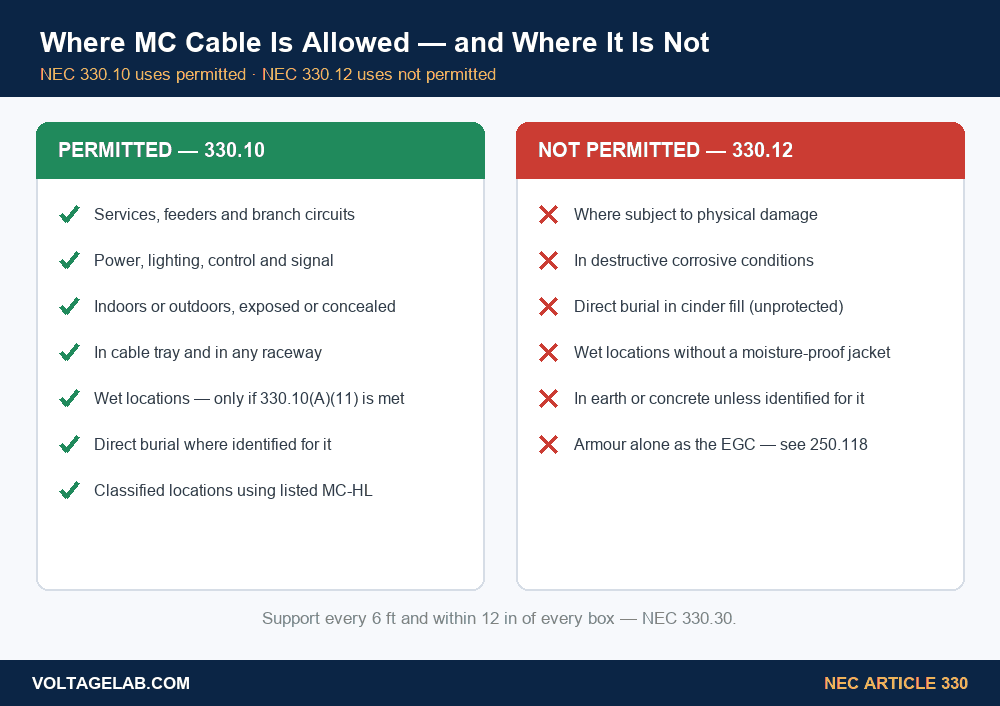
MC is one of the most permissive wiring methods in the Code. Article 330 lets it do almost everything conduit does, and the short list of prohibitions is where the real work is.
Uses permitted — NEC 330.10
- Services, feeders and branch circuits
- Power, lighting, control and signal circuits
- Indoors or outdoors, exposed or concealed
- Direct buried where the cable is identified for direct burial
- In cable tray, and inside any raceway
- As open runs of cable, and as aerial cable on a messenger
- In hazardous (classified) locations where 501.10, 502.10, 503.10, 505.15 or 506.15 permits it — normally as listed MC-HL
- In dry locations, and embedded in plaster or fished in air voids of masonry where not exposed to excessive moisture
- In wet locations, but only when the conditions of 330.10(A)(11) are met
That last one deserves unpacking. For a wet location the metallic covering has to be impervious to moisture, or there has to be a moisture-impervious jacket over the metallic sheath, or the insulated conductors under the metallic covering have to be listed for wet locations. In the aisle at the supply house that means a jacketed MC, not the bare interlocked cable you use for indoor branch circuits.
Uses not permitted — NEC 330.12
- Where the cable is subject to physical damage
- Where exposed to destructive corrosive conditions, unless protected by material suitable for the condition — this covers direct burial in earth or embedment in concrete, cinder fills, and areas with strong chlorides, caustic alkalis or chlorine vapours
- In wet locations without one of the three moisture provisions in 330.10(A)(11)
- As its own equipment grounding conductor unless the construction qualifies under 250.118
“Subject to physical damage” is the judgment call, and it is where inspectors and contractors disagree most. Exposed MC on a garage wall, below 8 ft in a stairwell, or crossing a loading dock will usually be called. The fix is the same one 300.4 uses everywhere: sleeve it in raceway, run it above the damage line, or protect it with a steel plate where it passes through framing.
Support, securing and bend radius
NEC 330.30 separates two ideas that get treated as one. Securing stops the cable moving; supporting carries its weight. MC must be supported and secured by staples, straps, hangers or fittings at intervals not exceeding 6 ft (1.8 m), and cables containing four or fewer conductors sized no larger than 10 AWG must be secured within 12 in (300 mm) of every box, cabinet, fitting or other termination.
330.30(D) gives you the three cases where MC may be run unsupported: fished between access points in finished buildings; not more than 6 ft from the last support for connections to luminaires or equipment within an accessible ceiling; and not more than 3 ft from the last support where flexibility is needed at a termination.
NEC 330.24 sets the bend radius. For interlocked-armour or corrugated-sheath MC the inner edge of any bend must be at least seven times the external diameter of the cable. Smooth-sheath cable is stricter: ten times the diameter up to 3/4 in, twelve times from 3/4 in to 1-1/2 in, and fifteen times above that. A kinked bend crushes the armour onto the conductors, and it is visible from across the room.
Fittings matter as much as the strapping. NEC 330.40 requires fittings used with MC to be listed and identified for the cable — an AC connector is not an MC connector, and a jacketed cable needs a fitting listed for the jacket. Where MC is run inside a raceway, the raceway must still be sized for the finished cable, which our guide to sizing conduits and raceways works through. If the run goes underground, NEC 300.5 minimum cover applies on top of everything in Article 330.
MC cable vs AC, NM and conduit
| Requirement | MC (Art. 330) | AC / BX (Art. 320) | NM / Romex (Art. 334) | EMT + THHN |
|---|---|---|---|---|
| Armour is the EGC | No, unless MC-AP | Yes | N/A | Yes, EMT qualifies |
| Wet locations | Yes, if jacketed | No, dry only | No | Yes, with THWN-2 |
| Permitted for services | Yes | No | No | Yes |
| Support interval | 6 ft / 12 in | 4½ ft / 12 in | 4½ ft / 12 in | 10 ft / 3 ft |
| Commercial buildings | Standard practice | Limited | Restricted by 334.12 | Standard practice |
| Rewire-friendly | No | No | No | Yes, pull new wire |
For the wider picture of insulation types and the standards behind them, see our overview of electrical cable types and standards. If your work involves the grounding side of an MC installation, bare copper ground wire sizing and bonding jumpers cover the conductors you land on the other end. For temporary and portable distribution rather than fixed armoured runs, Type W portable power cable is the Article 400 equivalent.
Is MC cable the right choice for your job?
Pros
- A complete wiring method — no conduit, couplings or pulling
- Roughs in far faster than pipe, which is most of the labour saving
- Permitted for services, feeders and branch circuits alike
- Metal armour gives real mechanical protection and RF shielding
- Available jacketed for wet locations and direct burial
- Flexes around structure where rigid raceway would need offsets
Cons
- Standard armour is not a ground path, and people forget it
- Nothing can be pulled through it later — a change means a new cable
- Costs more per foot than conductors in pipe on large feeders
- Damaged armour cannot be repaired; the run has to be replaced
Working with MC cable in the field
Do
- Cut the armour with a rotary MC cutter, not a hacksaw
- Fit an anti-short bushing and leave it visible in the fitting
- Use fittings listed and identified for MC, per 330.40
- Strap within 12 in of every box and every 6 ft along the run
- Keep bundled runs spaced, or derate for conductor count
Avoid
- Treating the interlocked armour as the equipment ground
- Bending tighter than seven times the cable diameter
- Running unjacketed MC outdoors or in damp underground work
- Leaving MC exposed where a cart or a ladder will hit it
- Sizing the breaker off the 90 °C column
Frequently asked questions
What does MC cable stand for?
Metal-Clad. Type MC is defined in NEC 330.2 as a factory assembly of one or more insulated circuit conductors enclosed in an armour of interlocking metal tape or in a smooth or corrugated metallic sheath.
Is MC cable armour an equipment grounding conductor?
Not on standard interlocked MC. NEC 250.118 recognises MC as a ground-fault path only where the cable contains a wire-type EGC, where the armour is combined with a listed uninsulated bonding conductor, or where the cable has a listed smooth or corrugated metallic sheath. Read the cable marking before you rely on the armour.
What is the difference between MC and AC cable?
Type AC under Article 320 has an internal bonding strip that makes the armour itself the grounding path, and it is limited to dry locations. Type MC under Article 330 carries a separate grounding conductor, may be used in wet locations when jacketed, and is permitted for services. AC is supported every 4½ ft; MC every 6 ft.
Can MC cable be used outside or buried?
Outdoors, yes — NEC 330.10 permits MC indoors or outdoors, exposed or concealed. For wet locations the cable has to satisfy 330.10(A)(11), which normally means a PVC jacket over the armour. Direct burial is permitted only where the cable is identified for direct burial, and 300.5 cover depths still apply.
How often does MC cable need to be supported?
Every 6 ft, and secured within 12 in of every box, cabinet, fitting or other cable termination where the cable has four or fewer conductors no larger than 10 AWG. NEC 330.30(D) allows unsupported lengths of up to 6 ft for luminaire connections in an accessible ceiling and up to 3 ft where flexibility is required.
What is the minimum bend radius for MC cable?
Seven times the external diameter for interlocked-armour or corrugated-sheath MC, per NEC 330.24. Smooth-sheath cable requires ten, twelve or fifteen times the diameter depending on size.
Is MC cable allowed in residential construction?
Yes. Article 330 places no dwelling restriction on MC, and it is often used in multifamily buildings and in garages or basements where NM cable would be subject to damage. Cost and habit are why most single-family work still uses NM.
What size conductors does MC cable come in?
NEC 330.104 permits copper from 18 AWG through 2000 kcmil and aluminium or copper-clad aluminium from 12 AWG through 2000 kcmil. The 18 and 16 AWG sizes are the lighting and control constructions; 12 AWG and 10 AWG are the everyday branch-circuit sizes.
The bottom line
MC cable earns its place because it is a finished wiring method that goes in fast and takes abuse. Article 330 lets it run almost anywhere conduit can, including services, wet locations when jacketed, and classified areas when it is the right MC-HL construction. That breadth is exactly why the two restraints matter: the armour on standard interlocked MC is not a ground path, and MC is not permitted where it is subject to physical damage or destructive corrosion.
Read the printing on the cable, confirm what 250.118 says about the construction in your hand, support it every 6 ft and within 12 in of the box, and keep the bends at seven diameters. For the code changes worth knowing in the current cycle, see our summary of what changed in the 2026 NEC.
FREE PRACTICE TOOL
Think you'd pass this on a real exam?
Test what you just read with instant-feedback quizzes built around real code questions — not generic trivia.
5
Code standards
10,000+
Active learners
100%
Free to start
Instant explanations on every answer, right or wrong
NEC, BS7671, AS/NZS, CEC, and DIN VDE covered
Bite-sized quizzes you can finish in 5 minutes
No signup required to try your first quiz
No account needed · Takes less than 2 minutes