


Bare copper ground wire is one of the most common conductors on any job site — running through conduit as an equipment grounding conductor (EGC), dropping from a service panel to the ground rods as a grounding electrode conductor (GEC), or encased in a footing as a Ufer ground. But “ground wire” is a loose, field term, and the NEC treats it with far more precision. Whether bare copper is permitted, required, or prohibited depends entirely on the application, the environment, and which NEC section governs the conductor you’re pulling.
This guide walks through every scenario where bare copper ground wire shows up in NEC work: the EGC identification rules (NEC 250.119), the permitted EGC types (NEC 250.118), EGC sizing from NEC Table 250.122, the voltage-drop upsizing rule (NEC 250.122(B)), the grounding electrode conductor rules (NEC 250.64), and the handful of environments where bare copper isn’t the right call. Get these right and you’ll never second-guess a ground wire on an inspection again.
Study smarter with VoltageLab
Built for electricians, apprentices, and electrical engineers who want faster practice and better exam prep.
⭐️ Join thousands of electricians upgrading their skills
Bare copper ground wire is fully NEC-compliant as an equipment grounding conductor (EGC) of any size — NEC 250.119 lists “bare” as an accepted identification method — and as a grounding electrode conductor (GEC). The catch is sizing: an EGC is sized from NEC Table 250.122 by the overcurrent device (OCPD) rating, while a GEC is sized from NEC Table 250.66 by the service/feeder conductor. They are different conductors with different rules — never size one by the other’s table.
Bare copper is required (not just allowed) for the concrete-encased “Ufer” electrode: at least 20 ft of bare copper no smaller than 4 AWG per NEC 250.52(A)(3). It’s a poor choice only in severely corrosive environments (NEC 250.120(C)) and must be protected where a GEC smaller than 6 AWG is exposed to damage.
What “Bare Copper Ground Wire” Means in NEC Terminology
In the field, “ground wire” refers loosely to any conductor doing a grounding or bonding job. In the NEC, two distinct conductors are commonly bare copper — and they’re sized and governed by completely different rules.
| Conductor | Function | Sized by | NEC section |
|---|---|---|---|
| Equipment Grounding Conductor (EGC) | Low-impedance fault-current return path from equipment back to the source OCPD — so faults clear fast | NEC Table 250.122 — by OCPD rating | 250.118, 250.119, 250.122 |
| Grounding Electrode Conductor (GEC) | Ties the grounded (neutral) conductor to earth via the electrode system — a voltage reference to ground | NEC Table 250.66 — by largest service/feeder conductor | 250.62, 250.64, 250.66 |

The critical distinction: the EGC and GEC serve different functions, are sized from different tables, and live in different NEC sections. Confusing them — or sizing one by the other’s rules — is a recurring field and exam error. This article covers both applications of bare copper. For the GEC side in depth, see our guide to grounding electrode conductor (GEC) sizing on the NEC exam.
NEC 250.119 — EGC Identification: When Bare Is Permitted
NEC 250.119 governs how wire-type equipment grounding conductors are identified. The size of the conductor changes what’s allowed.
EGCs 6 AWG and smaller must be identified by one of the following:
Pass your electrical exam the first time
Practice real NEC exam questions with full code-referenced explanations and progress tracking — built for journeyman, master and apprentice exam prep.
Thousands of NEC practice questions with code-referenced answers
- Continuous green color
- Continuous green with one or more yellow stripes
- Bare — no insulation at all
EGCs 4 AWG and larger may use any of the above, or be re-identified at the time of installation by stripping the insulation along the exposed length, coloring it green, or marking it with green tape or labels.
What this means for bare copper: bare copper is a fully compliant EGC identification for any size. A bare conductor in a cable, conduit, or raceway is instantly recognizable as the EGC with no marking needed. That’s exactly why residential NM cable (Romex) uses a bare copper EGC — it satisfies the identification rule and skips the cost of insulation and green coloring.
Bottom line: bare copper may serve as an EGC or GEC, but it may never be used as an ungrounded (hot) or grounded (neutral) conductor. Bare wire is restricted to grounding and bonding.
NEC 250.118 — The Permitted EGC Types
NEC 250.118 lists the EGC types the code permits. Bare copper wire is the first type listed — the most fundamental wire-type EGC — but many field installations rely on non-wire EGCs like metal raceway, so the full list matters.
| EGC type | Key conditions |
|---|---|
| Copper (or other corrosion-resistant) conductor — bare, covered, or insulated | The most common wire-type EGC. No size limit in 250.118 itself — sizing comes from Table 250.122. |
| Rigid metal conduit (RMC) / Intermediate metal conduit (IMC) | Metal raceway as EGC — all fittings listed and made up wrench-tight |
| Electrical metallic tubing (EMT) | Listed fittings required; compression fittings preferred for reliability |
| Listed flexible metal conduit (FMC) | OCPD ≤ 20 A; length ≤ 6 ft in the ground path; not in a hazardous location or subject to physical damage — NEC 250.118(5) |
| Listed liquidtight flexible metal conduit (LFMC) | OCPD ≤ 60 A for 3/8″ to 1-1/4″; length ≤ 6 ft; per NEC 250.118(6) |
| Cable armors, cable trays & listed devices | Type AC armor, Type MC (when listed as EGC), aluminum conduit, cable trays under specific conditions |
Key field implication: when metal conduit is the EGC, you don’t need to pull a separate bare copper wire for grounding. The raceway itself, with properly made-up fittings, is the EGC. Pulling a bare copper EGC in addition gives you redundant grounding — sometimes done for VFD circuits or critical systems — but it isn’t required for code compliance with a qualifying metal raceway.
💡 Turn this grounding rule into practice questions.
VoltageLab’s AI Quiz Generator creates unlimited exam-style questions on any NEC article — so you can drill EGC identification, the 250.118 permitted types, and Table 250.122 sizing until they’re automatic. Fresh questions with explanations, every time.
NEC Table 250.122 — How to Size a Bare Copper EGC
Wire-type EGCs are sized from NEC Table 250.122 by the rating of the overcurrent protective device (OCPD) protecting the circuit — not the circuit load and not the conductor ampacity. Enter the table with the OCPD amperes and read the minimum copper EGC.

| OCPD rating (A) | Min. copper EGC | Min. aluminum / Cu-clad EGC |
|---|---|---|
| 15 | 14 AWG | 12 AWG |
| 20 | 12 AWG | 10 AWG |
| 30–60 | 10 AWG | 8 AWG |
| 100 | 8 AWG | 6 AWG |
| 200 | 6 AWG | 4 AWG |
| 300 | 4 AWG | 2 AWG |
| 400 | 3 AWG | 1 AWG |
| 600 | 1 AWG | 2/0 AWG |
| 800 | 1/0 AWG | 3/0 AWG |
| 1,000 | 2/0 AWG | 4/0 AWG |
| 2,000 | 250 kcmil | 400 kcmil |
Sized by the OCPD, not the conductor: a 30 A circuit run in 10 AWG takes the 30 A row — 10 AWG copper EGC. If that same 30 A circuit is run in 8 AWG (upsized for voltage drop), the base EGC is still the 30 A row (10 AWG) — unless the upsizing rule in 250.122(B) kicks in (next section).
The EGC never has to beat the circuit conductors: Table 250.122 caps the EGC at the size of the ungrounded conductors. A 15 A circuit with 14 AWG phase conductors needs a 14 AWG EGC — you don’t jump to 12 AWG. Want the number without flipping pages? Run it through our equipment grounding conductor size calculator.
NEC 250.122(B) — The Voltage-Drop Upsizing Rule
When ungrounded (phase) conductors are increased in size for any reason — most often to fight voltage drop on a long run — NEC 250.122(B) requires the EGC to be increased proportionally, by the same ratio in circular mils:
Study smarter with VoltageLab
Built for electricians, apprentices, and electrical engineers who want faster practice and better exam prep.
⭐️ Join thousands of electricians upgrading their skills
New EGC (CM) = Table 250.122 base EGC (CM) × (upsized conductor CM ÷ code-minimum conductor CM)
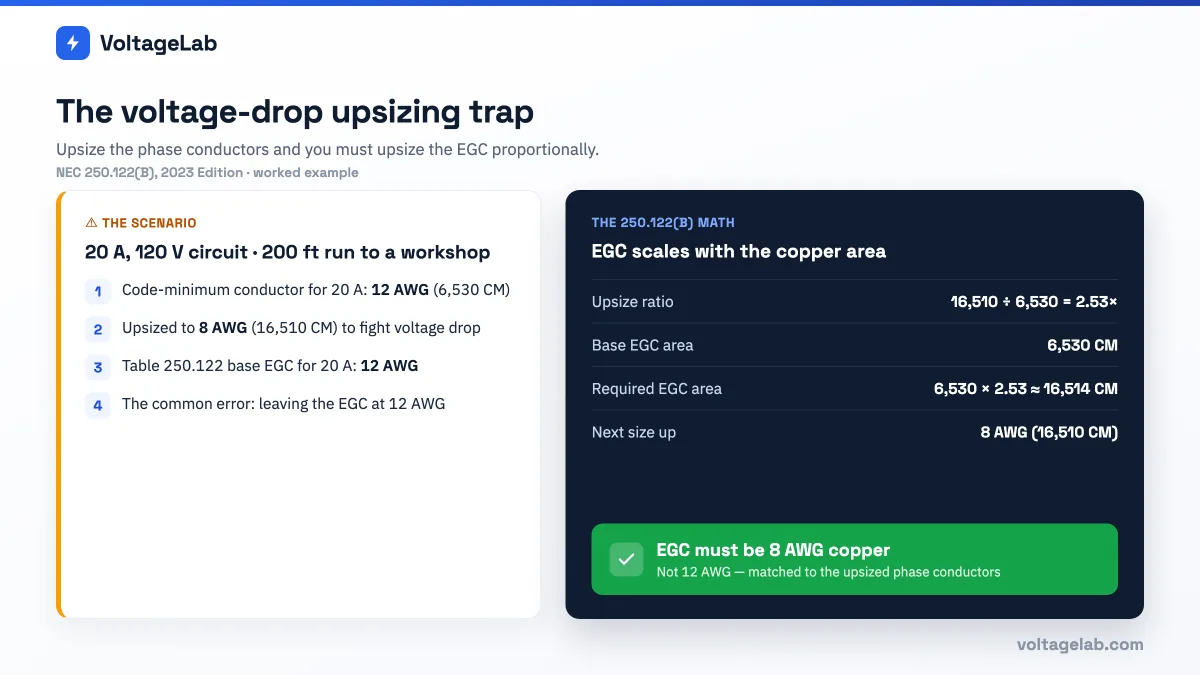
Worked example
Scenario: a 20 A, 120 V circuit runs 200 ft to a workshop. To hold voltage drop in check, the run uses 8 AWG copper instead of the code-minimum 12 AWG. What’s the minimum EGC?
- Table 250.122 base for a 20 A OCPD: 12 AWG (6,530 CM)
- Code-minimum conductor for 20 A: 12 AWG (6,530 CM)
- Upsized conductor actually installed: 8 AWG (16,510 CM)
- Upsize ratio = 16,510 ÷ 6,530 = 2.53
- Required EGC = 6,530 × 2.53 ≈ 16,514 CM → next standard size is 8 AWG (16,510 CM)
Result: when 8 AWG phase conductors go in on that 20 A circuit, the EGC must be upsized to 8 AWG copper — not left at 12 AWG. The logic is simple: bigger phase conductors mean lower circuit impedance and higher fault current, so the EGC has to grow to carry that fault current safely until the OCPD trips.
Common mistake: upsizing the phase conductors for voltage drop but leaving the EGC at the Table 250.122 minimum. This is one of the most consistently missed rules on long branch-circuit and feeder runs — and inspectors know exactly where to look for it.
Bare Copper as a GEC — NEC 250.64
The grounding electrode conductor — the wire from the service to the electrode system (ground rods, water pipe, building steel, Ufer) — is very commonly bare copper. NEC 250.64 sets the install rules.
Material options (NEC 250.62)
The GEC must be copper, aluminum, or copper-clad aluminum. Bare copper is explicitly permitted — there’s no requirement for the GEC to be insulated, though insulated copper is also fine.
Physical protection (NEC 250.64(B))
Where a GEC of 6 AWG copper or larger is not exposed to physical damage, it can run exposed without a raceway. A bare 6 AWG copper GEC stapled down an exterior wall to the ground rods is code-compliant. Where the GEC is smaller than 6 AWG, or is subject to physical damage, it must be protected in conduit or cable armor (metallic or nonmetallic).
Aluminum restrictions that don’t apply to bare copper (NEC 250.64(A))
Aluminum and copper-clad aluminum GECs — but not bare copper — carry extra restrictions: they can’t terminate within 18 in. (450 mm) of the earth, can’t contact concrete unless listed for it, and can’t be used in corrosive conditions unless listed for the environment. Bare copper has none of these limits — it can be buried in earth and encased in concrete.
Concrete-encased “Ufer” electrode — must be bare copper
NEC 250.52(A)(3) requires the concrete-encased electrode to be at least 20 ft (6 m) of bare copper no smaller than 4 AWG, encased in at least 2 in. (50 mm) of concrete. This is the one application where bare copper isn’t just permitted — it’s effectively required, because the conductor must be bare to make electrical contact with the concrete and rebar.
The GEC is sized from NEC Table 250.66 by the largest ungrounded service or feeder conductor — not from Table 250.122. See our full breakdown of grounding electrode conductor sizing for the electrode-specific exceptions.
Where Bare Copper Ground Wire Is NOT Permitted
Bare copper is broadly usable, but a few situations call for something else:
- Severely corrosive environments (NEC 250.120(C)). Where the EGC is exposed to physical or chemical deterioration, it must be suitable for that environment. In chemical plants, salt air, sewage treatment, or high-corrosive-gas areas, bare copper can corrode until it loses continuity — use insulated copper, a listed aluminum, or a corrosion-resistant raceway EGC instead.
- Where clear visual identification matters. Bare satisfies 250.119, but in open wiring or accessible spaces where accidental contact is possible, insulated green EGCs are often preferred to prevent unintended contact.
- Where a small GEC needs protection. A bare copper GEC smaller than 6 AWG, or any GEC subject to damage, must be enclosed per 250.64(B). “Bare” here means no insulation — it still runs inside conduit.
- As a phase or neutral conductor. Never. Ungrounded and grounded conductors require insulation rated for the voltage and environment. Bare wire is grounding/bonding only.
Solid vs Stranded Bare Copper Ground Wire
| Type | Common sizes | Best for |
|---|---|---|
| Solid bare copper | 14 AWG – 8 AWG | Residential NM-cable EGCs, short GEC runs, direct-burial where flexibility isn’t needed. Less flexible, but easy to form and staple. |
| Stranded bare copper | 8 AWG and larger | Long conduit runs, service GECs, runs with multiple bends, larger commercial/industrial EGCs. More flexible and far easier to route. |
5 Bare Copper Ground Wire Mistakes That Fail Inspections
- Sizing the EGC from the load, not the OCPD. A 20 A circuit pulling 18 A still has a 20 A OCPD — the EGC is the 20 A row (12 AWG copper). Use Table 250.122 with the breaker rating, every time.
- Forgetting 250.122(B) when phase conductors are upsized. Upsize for voltage drop and the EGC must scale proportionally. The most-missed rule on long runs.
- Confusing the GEC and EGC tables. GEC → Table 250.66 by service conductor. EGC → Table 250.122 by OCPD. Different inputs, different results.
- Leaving a small GEC unprotected. A bare GEC smaller than 6 AWG, or one exposed to damage, must be in conduit or armor per 250.64(B).
- Using bare aluminum where bare copper is required. The Ufer electrode demands bare copper (250.52(A)(3)); aluminum can’t survive the alkaline concrete.
- EGC → Table 250.122 → sized by the OCPD rating. Not the load, not the conductor ampacity. Bare copper of any size is a compliant EGC under NEC 250.119.
- Upsize the EGC when phase conductors grow. NEC 250.122(B) requires proportional upsizing — the 20 A / 8 AWG example lands on an 8 AWG EGC, not 12 AWG.
- GEC → Table 250.66 → sized by service/feeder conductor. Bare copper is permitted and often preferred; the Ufer electrode requires it.
- Watch the environment. Protect small GECs from damage, and skip bare copper in severely corrosive locations (NEC 250.120(C)).
Conclusion
Bare copper ground wire lives in two separate NEC worlds — the wire-type EGC and the GEC — and the rules never cross. Size the EGC from Table 250.122 by the OCPD, upsize it with the phase conductors under 250.122(B), and size the GEC from Table 250.66 by the service conductor. Reach for bare copper freely, remember it’s mandatory for the Ufer electrode, and protect or swap it only where damage or corrosion demands.
Next, tighten up the service side: read our guide to bonding jumpers — types, sizing & NEC code rules, and size any EGC in seconds with the EGC size calculator.
📱 The electrical reference and study app built for working electricians.
VoltageLab puts wiring guides, an interactive circuit simulator, unlimited AI practice questions, and flashcards in your pocket — so grounding rules like these stick before the inspector shows up. Built for electricians and apprentices. Free on iOS and Android.
Frequently Asked Questions
Is bare copper ground wire required, or is insulated green wire acceptable?
Both are acceptable under NEC 250.119. The code permits an EGC to be bare, insulated green, or green with yellow stripes. Bare copper is traditional in NM cable (Romex); insulated green is common in conduit. The choice is usually driven by the cable or raceway type, not a code requirement — both give equivalent grounding performance.
How is bare copper ground wire sized under the NEC?
A wire-type EGC is sized from NEC Table 250.122 by the ampere rating of the OCPD protecting the circuit — for example, 12 AWG copper for a 20 A circuit. If the phase conductors are upsized for voltage drop, NEC 250.122(B) requires the EGC to be upsized proportionally. A GEC is a different conductor, sized from NEC Table 250.66 by the service or feeder conductor.
Can bare copper be buried in concrete?
Yes. Bare copper is permitted in direct contact with concrete, and the concrete-encased “Ufer” electrode in NEC 250.52(A)(3) specifically requires bare copper no smaller than 4 AWG. Bare aluminum is not permitted in concrete (NEC 250.64(A)) because the alkaline environment attacks the protective oxide layer aluminum relies on.
What is the difference between a GEC and an EGC?
The GEC ties the system neutral to earth through the electrode system (ground rods, water pipe, Ufer) and is sized from Table 250.66 by the service conductor. The EGC provides a fault-current return path from equipment back to the source OCPD, runs with branch-circuit and feeder conductors, and is sized from Table 250.122 by the OCPD rating. Both may be bare copper, but they do different jobs and follow different tables.
Does every circuit need a separate bare copper EGC in conduit?
Not necessarily. NEC 250.118 lets properly installed metal raceways (RMC, IMC, EMT) serve as the EGC. When metal conduit is made up with listed, wrench-tight fittings, the conduit is the EGC and no separate bare copper wire is required inside it. You need a wire-type EGC inside the raceway when the conduit doesn’t qualify (such as PVC) or when a supplemental EGC is wanted for circuits like VFD-driven motors.
FREE PRACTICE TOOL
Think you'd pass this on a real exam?
Test what you just read with instant-feedback quizzes built around real code questions — not generic trivia.
5
Code standards
10,000+
Active learners
100%
Free to start
Instant explanations on every answer, right or wrong
NEC, BS7671, AS/NZS, CEC, and DIN VDE covered
Bite-sized quizzes you can finish in 5 minutes
No signup required to try your first quiz
No account needed · Takes less than 2 minutes