


Two electricians pull 8 AWG on the same day. One lands 8 AWG THHN in a panel and puts it on a 50-amp breaker. The other runs 8/3 NM-B to a range and gets red-tagged for the same breaker. Neither of them read the table wrong — they read different rules, and only one of those rules was the ampacity table.
That is why 8 AWG ampacity is the size electricians argue about more than any other. It sits right above the small-conductor rule that caps 14, 12 and 10 AWG, so nothing protects you from your own arithmetic, and it happens to straddle two of the most common breaker sizes in residential work — 40 and 50 amps.
Study smarter with VoltageLab
Built for electricians, apprentices, and electrical engineers who want faster practice and better exam prep.
⭐️ Join thousands of electricians upgrading their skills
This guide gives you the three 8 AWG numbers from NEC Table 310.16, shows which one your specific installation is allowed to use, walks the derating math in order, and covers the three situations where 8 AWG copper is legally 40 amps even though the table says 50.
Quick Answer
8 AWG ampacity for copper in NEC Table 310.16 is 40 A at 60 °C, 50 A at 75 °C and 55 A at 90 °C. For 8 AWG aluminium it is 35 A, 40 A and 45 A. In practice, 8 AWG copper THHN landed on 75 °C-rated terminals is a 50-amp conductor, because NEC 110.14(C) holds you to the termination rating and almost all modern breakers and equipment are listed 75 °C.
It drops to 40 amps in three cases: the conductor is inside NM-B cable (Romex), where NEC 334.80 forces the 60 °C column; the equipment terminals are only rated 60 °C; or ambient and conduit-fill corrections under 310.15 pull the 55 A starting figure below 50. The 90 °C column is a derating starting point — you may never terminate on it.
Key Takeaways
- 8 AWG copper is 40 A / 50 A / 55 A in the 60 °C, 75 °C and 90 °C columns of NEC Table 310.16; 8 AWG aluminium is 35 A / 40 A / 45 A
- 8 THHN ampacity is 55 A on paper, but 110.14(C) limits you to the 50 A figure on 75 °C terminals — the 90 °C column exists for derating only
- 8/3 NM-B cable is a 40-amp conductor, not 50, because NEC 334.80 requires the 60 °C column for all NM cable
- The small-conductor rule in NEC 240.4(D) stops at 10 AWG, so nothing caps 8 AWG the way 12 AWG is capped at 20 amps
- Ambient temperature above 30 °C and more than three current-carrying conductors both derate from the 90 °C value of 55 A, then the result is compared to the termination limit
- A 50-amp circuit on 8 AWG copper carries a maximum continuous load of 40 amps under the 125 percent rule in NEC 210.19(A)(1)
- A 50-amp circuit needs a 10 AWG copper equipment grounding conductor per NEC Table 250.122, not another 8 AWG
What 8 AWG actually is
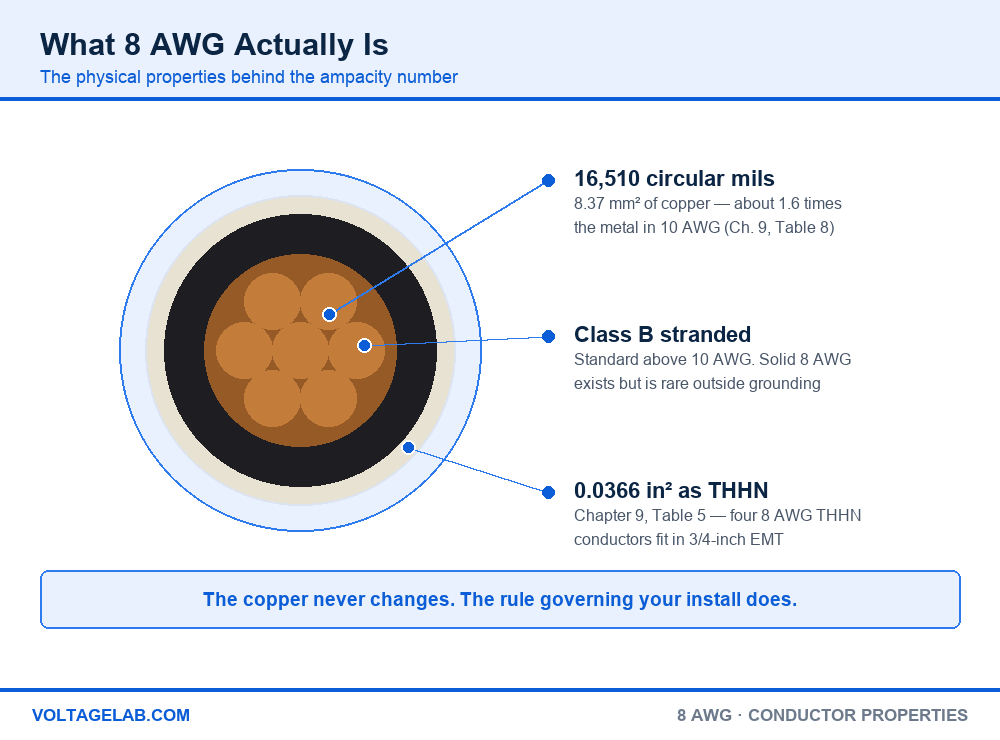
Before the ampacity argument makes sense, it helps to know what you are holding. 8 AWG is the first size in the American Wire Gauge series that most electricians stop calling “wire” and start calling “conductor” — it is the point where solid stops being practical and stranding becomes the norm.
Pass your electrical exam the first time
Practice real NEC exam questions with full code-referenced explanations and progress tracking — built for journeyman, master and apprentice exam prep.
Thousands of NEC practice questions with code-referenced answers
- Cross-sectional area. 16,510 circular mils, or 8.37 mm², from NEC Chapter 9, Table 8. That is roughly 1.6 times the copper in 10 AWG.
- Stranding. Class B stranded in nearly every raceway application. Solid 8 AWG exists but fights you in a panel and is rarely stocked outside of grounding work.
- Resistance. About 0.78 ohms per 1,000 feet solid and 0.81 ohms per 1,000 feet stranded, uncoated copper, per Chapter 9 Table 8. This is the number that drives voltage drop, not ampacity.
- Conduit footprint. 8 AWG THHN occupies roughly 0.0366 in² in Chapter 9 Table 5, so four of them fit comfortably in 3/4-inch EMT.
Why ampacity is a property of the install, not the wire
The NEC defines ampacity as the current a conductor can carry continuously under the conditions of use without exceeding its temperature rating. Those last five words are the whole argument. The copper does not change between the range circuit and the conduit run — the insulation rating, the terminal rating, the ambient air and the number of neighbours in the pipe all do, and each one can move the answer.
So “what is the ampacity of 8 AWG” is not a question with one answer. It is a question with a starting value from the table and three filters applied afterwards. Get the order of those filters right and the 40-versus-50 confusion disappears.
8 AWG at 40 A or 50 A — which one is yours
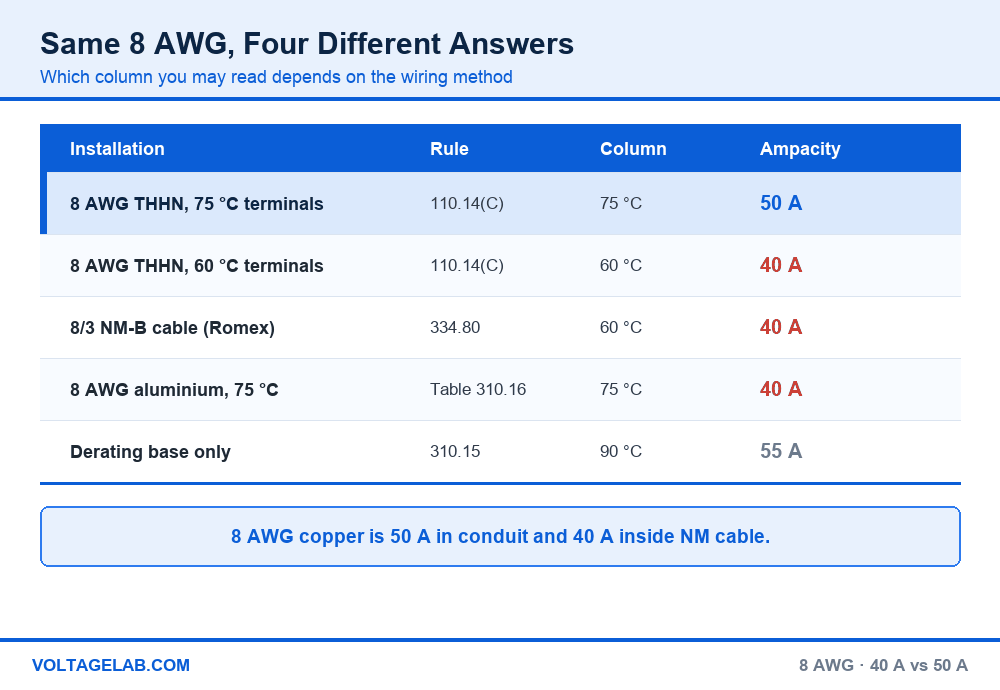
Here is the same 8 AWG copper conductor in five common installations. Nothing about the metal changes across these rows — only the rule that governs which column you are permitted to read.
| Installation | Governing rule | Column | Ampacity |
|---|---|---|---|
| 8 AWG THHN in conduit, 75 °C terminals | 110.14(C)(1)(a) | 75 °C | 50 A |
| 8 AWG THHN, terminals rated 60 °C only | 110.14(C)(1)(a) | 60 °C | 40 A |
| 8/3 NM-B cable (Romex) | 334.80 | 60 °C | 40 A |
| 8 AWG aluminium XHHW-2, 75 °C terminals | Table 310.16 | 75 °C | 40 A |
| 8 AWG THHN — derating starting point | 310.15(B), 310.15(C) | 90 °C | 55 A (never terminated) |
Four of those five rows are the same wire. The one that catches people is row three, and it catches them because the conductor inside 8/3 NM-B is itself a 90 °C conductor — you can read “90 °C” printed on it while the cable is legally a 60 °C assembly.
The violation inspectors actually write: 8/3 NM-B on a 50-amp breaker. NEC 334.80 requires the ampacity of NM, NMC and NMS cable to be taken from the 60 °C column, which makes 8 AWG NM-B a 40-amp conductor no matter what is stamped on the individual conductors. If the load needs 50 amps and you are running cable, you go to 6/3 NM-B — or you run 8 AWG THHN in conduit instead.
8 AWG ampacity — how to read NEC Table 310.16
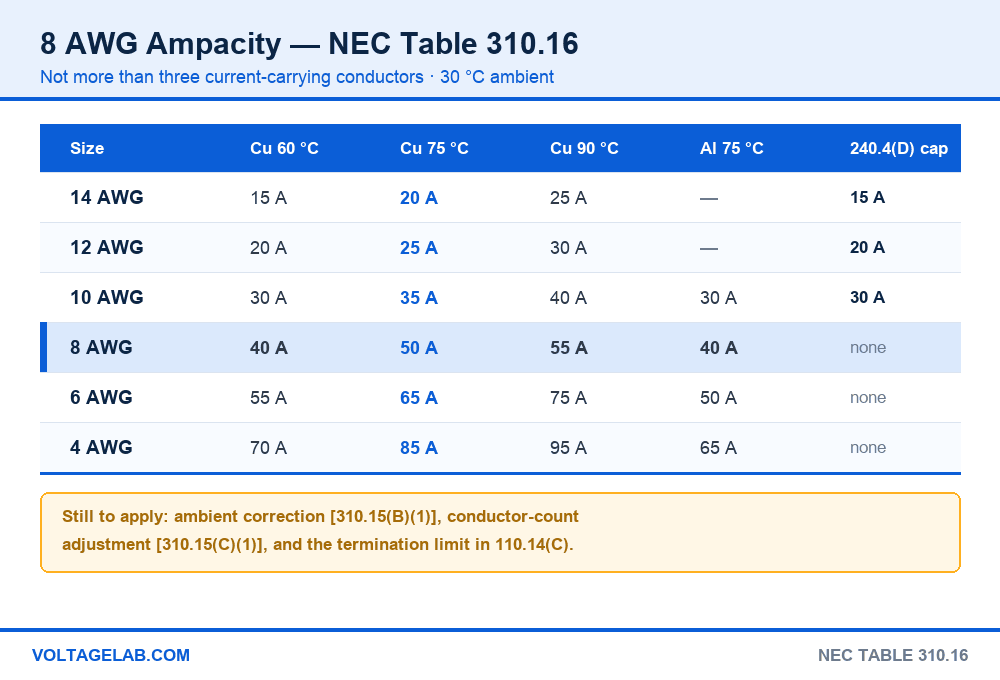
Table 310.16 gives the allowable ampacities of insulated conductors rated up to 2,000 volts, for not more than three current-carrying conductors in a raceway, cable or earth, at an ambient of 30 °C. Every number in it assumes those conditions. Change a condition and you owe the table a correction.
| Size | Copper 60 °C | Copper 75 °C | Copper 90 °C | Alum. 60 °C | Alum. 75 °C | Alum. 90 °C |
|---|---|---|---|---|---|---|
| 10 AWG | 30 A | 35 A | 40 A | 25 A | 30 A | 35 A |
| 8 AWG | 40 A | 50 A | 55 A | 35 A | 40 A | 45 A |
| 6 AWG | 55 A | 65 A | 75 A | 40 A | 50 A | 55 A |
| 4 AWG | 70 A | 85 A | 95 A | 55 A | 65 A | 75 A |
Note what the 10 AWG row does: 40 amps in the 90 °C column, the same headline number as 8 AWG at 60 °C. That coincidence is behind a lot of bad 40-amp circuits, because 10 AWG is capped at 30 amps by the small-conductor rule regardless. For the full walkthrough of the table’s structure, see our guide to reading NEC Table 310.16.
The five-step method for sizing 8 AWG
- Start in the column matching the conductor insulation. For 8 AWG THHN/THWN-2 copper that is 90 °C — 55 amps. This is your derating base and nothing else.
- Apply the ambient correction. Table 310.15(B)(1) gives the factor. At 40 °C in an attic run, the 90 °C factor is 0.91, so 55 × 0.91 = 50.05 amps.
- Apply the conductor-count adjustment. More than three current-carrying conductors in the raceway triggers Table 310.15(C)(1) — 80 percent for four to six, 70 percent for seven to nine.
- Compare the result to the termination limit. Look up the same size in the column matching the lowest-rated terminal in the circuit — 50 amps at 75 °C. Your final ampacity is the lower of the derated value and the termination value.
- Pick the overcurrent device. Round down to a standard size from 240.6(A), or use 240.4(B) to round up to the next standard size when the ampacity lands between two and the circuit does not feed multiple receptacles.
Worked through: 8 AWG THHN, four current-carrying conductors, 40 °C attic. Start at 55. Ambient 0.91 gives 50.05. Four conductors at 80 percent gives 40.04 amps. Compare to the 50-amp termination limit — the derated figure is lower, so the conductor is good for 40 amps and takes a 40-amp breaker. Same wire, same panel, half a day’s difference in routing.
The one that catches everyone: NEC 240.4(D), the small-conductor rule, stops at 10 AWG. There is no 240.4(D) entry for 8 AWG, so nothing in the Code quietly rescues a bad calculation the way it caps 12 AWG at 20 amps. With 8 AWG, the number you calculate is the number you are protected at — which means the derating math is the only thing standing between the conductor and a breaker that is too big for it.
Where 8 AWG at 50 amps is legitimate — and where it is not
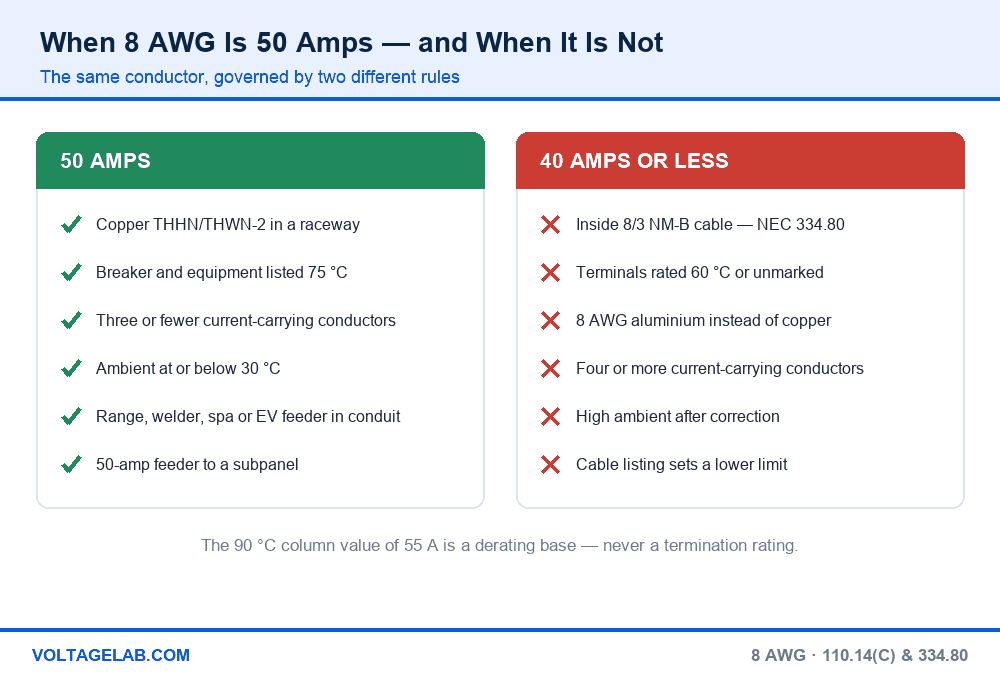
8 AWG copper is a 50-amp conductor when
- It is THHN/THWN-2, XHHW-2 or another 75 °C-or-better conductor in a raceway
- Both the breaker and the equipment terminals are listed and marked for 75 °C conductors, which covers most modern gear
- There are no more than three current-carrying conductors in the raceway
- The ambient stays at or below 30 °C, or the correction still lands the result at 50 amps or above
- It is the ungrounded conductor of a 50-amp range, welder, EV charger or spa feeder run in conduit
- It is a 50-amp feeder to a subpanel, sized under Article 215 and 210 rules
8 AWG is capped at 40 amps or less when
- It is inside NM-B, NMC or NMS cable — 334.80 sends you to the 60 °C column
- The equipment terminals are rated 60 °C only, or carry no temperature marking at all
- It is aluminium, where the 75 °C value is 40 amps to begin with
- Four or more current-carrying conductors share the raceway
- Ambient correction plus conductor-count adjustment drops the derated value below 50
- It is inside a cable assembly whose listing carries its own lower ampacity limit
The continuous-load calculation on a 50-amp circuit
A load that runs three hours or more is continuous, and NEC 210.19(A)(1) requires the branch-circuit conductor to be sized at 125 percent of it. Run that backwards on a 50-amp circuit and the maximum continuous load is 40 amps — which is exactly why a 40-amp EV charger is the largest unit you put on 8 AWG copper and a 50-amp breaker. Wire a 48-amp charger to the same circuit and you are 20 percent over, even though the nameplate is under 50. The same arithmetic governs NEMA 14-50 receptacle circuits, and it is the same logic behind minimum circuit ampacity on HVAC nameplates.
8 AWG vs 10 AWG vs 6 AWG
Most 8 AWG decisions are really a choice between three adjacent sizes. This is how they compare on the things that decide the job.
| Factor | 10 AWG Cu | 8 AWG Cu | 6 AWG Cu |
|---|---|---|---|
| Ampacity at 75 °C | 35 A | 50 A | 65 A |
| Usable breaker size | 30 A max | 40 or 50 A | 60 or 65 A |
| Capped by 240.4(D)? | Yes — 30 A | No | No |
| Ampacity in NM cable | 30 A | 40 A | 55 A |
| Typical job | Dryer, water heater | Range, EV, spa | Subpanel feeder |
| Copper EGC required | 10 AWG | 10 AWG | 10 AWG |
| Terminates by hand? | Easily | Yes, with effort | Awkward |
If you work with these sizes regularly, three related guides on this site fill in the surrounding rules: the full NEC 310.16 ampacity chart for every size above and below 8 AWG, Chapter 9 Table 8 for the conductor properties that drive voltage-drop math, and grounding conductor sizing for the 250.122 side of the same circuit.
Study smarter with VoltageLab
Built for electricians, apprentices, and electrical engineers who want faster practice and better exam prep.
⭐️ Join thousands of electricians upgrading their skills
Is 8 AWG the right size for your circuit?
Pros
- Covers both 40 and 50-amp circuits, the two most common large residential loads
- Not restricted by the small-conductor rule, so the full table value is available
- Still bends and terminates by hand without a bender or hydraulic lug tool
- Fits four conductors in 3/4-inch EMT, keeping raceway costs down
- Low enough resistance that voltage drop is a non-issue on typical branch-circuit lengths
Cons
- Loses 10 amps the moment it goes into NM cable, which surprises people every time
- Sits close enough to the 50-amp line that mild derating pushes it under
- Aluminium 8 AWG buys you nothing over copper 10 AWG in most terminations
Working with 8 AWG in the field
Do
- Read the temperature marking on the breaker and the equipment before choosing a column
- Write the derating math on the permit drawing so the inspector can follow it
- Torque every 8 AWG lug to the listed value with a calibrated tool
- Count only current-carrying conductors when applying the adjustment factor — the EGC does not count
- Go to 6 AWG when the load is 50 amps and cable is the only practical wiring method
Avoid
- Putting 8/3 NM-B on a 50-amp breaker because the conductors read 90 °C
- Terminating on the 90 °C column value of 55 amps under any circumstances
- Assuming a breaker is 75 °C rated without checking the label
- Loading a 50-amp circuit to more than 40 amps continuously
- Substituting 8 AWG aluminium for 8 AWG copper on a 50-amp load
That fourth “Do” is the one worth building a habit around. NEC 110.14(D) now requires a calibrated torque tool wherever a tightening torque is provided, and 8 AWG lands in the size range where a loose lug heats fastest — see our guide to torque screwdrivers and 110.14(D).
Frequently asked questions
Is 8 AWG good for 50 amps?
Yes, if it is copper, rated 75 °C or better, run in a raceway, and landed on terminals listed for 75 °C. That combination gives you the 50-amp value from NEC Table 310.16. It is not good for 50 amps as 8/3 NM-B cable, as aluminium, or with more than three current-carrying conductors in the pipe.
What is 8 THHN ampacity?
8 AWG THHN copper is listed at 55 amps in the 90 °C column of Table 310.16, but you may not terminate on that figure. Because THHN is nearly always landed on 75 °C terminals, its usable ampacity is 50 amps. The 55-amp value is only a starting point for ambient and conductor-count derating.
Why is 8/3 Romex only 40 amps?
NEC 334.80 requires the ampacity of NM cable to be determined from the 60 °C column, and 8 AWG copper at 60 °C is 40 amps. The conductors inside are 90 °C rated and that rating may be used for derating calculations, but the final result can never exceed the 60 °C value.
Can 8 AWG be used on a 60-amp breaker?
No. The highest ampacity 8 AWG copper reaches in Table 310.16 is 55 amps at 90 °C, and that column cannot be terminated on. Even the 240.4(B) round-up rule does not help, because it only applies where the conductor ampacity does not correspond to a standard device size — 50 amps is a standard size, so you take 50. A 60-amp circuit needs 6 AWG copper.
What size ground wire goes with 8 AWG?
For a 50-amp or 40-amp circuit, Table 250.122 calls for a 10 AWG copper equipment grounding conductor. The EGC is sized from the overcurrent device rating, not from the ungrounded conductor, so it does not have to match the 8 AWG circuit conductors.
Does 8 AWG aluminium work for a 50-amp circuit?
No. 8 AWG aluminium is 40 amps at 75 °C and 35 amps at 60 °C. For a 50-amp circuit in aluminium you need 6 AWG, which is rated 50 amps at 75 °C. Aluminium always runs roughly two sizes behind copper for the same ampacity.
How far can you run 8 AWG before voltage drop matters?
Stranded 8 AWG copper runs about 0.81 ohms per 1,000 feet. On a 240-volt circuit carrying 40 amps, a 100-foot one-way run drops roughly 6.5 volts, or about 2.7 percent — just inside the 3 percent branch-circuit figure the NEC recommends in an informational note. Past about 110 feet at that load you should be looking at 6 AWG.
Does the small-conductor rule apply to 8 AWG?
No. NEC 240.4(D) covers 18 through 10 AWG only. 8 AWG is protected at its calculated ampacity under the general rule in 240.4, which is exactly why the derating arithmetic matters more at this size than it does at 12 or 10 AWG.
The bottom line
8 AWG copper is a 50-amp conductor in conduit and a 40-amp conductor in cable, and both statements come out of the same row of NEC Table 310.16. The difference is never the copper — it is whether 110.14(C) or 334.80 is the rule governing your install. Ask which one applies before you look at the table and the confusion never starts.
Two restraints are worth carrying to every 8 AWG job. The 90 °C column is a derating base, not a rating you terminate on. And because 240.4(D) does not reach this size, your calculated ampacity is the only thing sizing the breaker — there is no backstop. Get comfortable with the five-step method above, and if you want the same logic applied across every conductor size, work through our full guide to NEC Table 310.16.
FREE PRACTICE TOOL
Think you'd pass this on a real exam?
Test what you just read with instant-feedback quizzes built around real code questions — not generic trivia.
5
Code standards
10,000+
Active learners
100%
Free to start
Instant explanations on every answer, right or wrong
NEC, BS7671, AS/NZS, CEC, and DIN VDE covered
Bite-sized quizzes you can finish in 5 minutes
No signup required to try your first quiz
No account needed · Takes less than 2 minutes