


On a January morning in Minnesota, a string of residential solar modules can put out noticeably more voltage than its nameplate says. Cold silicon pushes open-circuit voltage up, and a string that looked fine at 540 volts on the design sheet can climb past the inverter’s limit before the sun is fully up.
That is the kind of thing NEC Article 690 exists to catch, and it is why PV questions keep showing up on journeyman and master exams. The rules are not hard, but they use multipliers that compound — a temperature factor on voltage, two 125% factors on current, and a 120% allowance on the panel busbar — and mixing them up is how candidates lose points and installers fail inspections.
Study smarter with VoltageLab
Built for electricians, apprentices, and electrical engineers who want faster practice and better exam prep.
⭐️ Join thousands of electricians upgrading their skills
This guide covers what Article 690 governs, the key sections side by side, how to size PV voltage and current with Table 690.7(A) and 690.8, rapid shutdown under 690.12, how 690 fits with Articles 705, 706 and 691, and a set of worked practice questions.
Quick Answer
NEC Article 690 covers solar photovoltaic (PV) systems — the modules, the DC circuits, inverters, disconnects, rapid shutdown, grounding and labelling. Its core numbers: PV DC circuits on one- and two-family dwellings are limited to 600 volts (690.7), maximum string voltage is the sum of module Voc multiplied by the cold-temperature factor from Table 690.7(A), and maximum circuit current is 125% of Isc (690.8(A)(1)).
Conductors and overcurrent devices then get a second 125% for continuous duty under 690.8(B) — 156% of Isc in total. Rapid shutdown under 690.12 must bring conductors outside the array boundary to 30 V within 30 seconds, and conductors inside it to 80 V or use a listed system. Connection to the building’s wiring is covered separately in Article 705.
Key Takeaways
- PV DC circuits on or in one- and two-family dwellings are limited to 600 volts under 690.7
- Module open-circuit voltage rises in cold weather, so string voltage is corrected with Table 690.7(A) or the module’s temperature coefficient
- Maximum PV circuit current is 125% of the summed short-circuit current, and conductors get another 125% — 156% in total
- Rapid shutdown limits conductors outside the array boundary to 30 V within 30 seconds
- The array boundary is 1 ft from the array in all directions
- The 120% busbar rule for back-fed breakers lives in Article 705, not 690
- Article 690 calculations are a favourite on journeyman and master exams because the multipliers compound
What NEC Article 690 covers
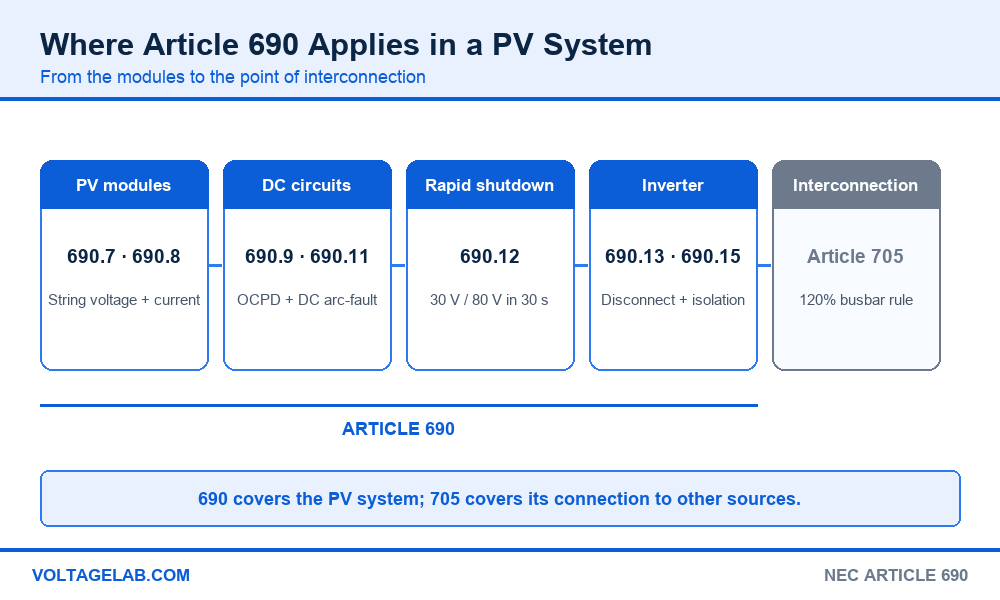
Article 690 applies to solar PV systems, including the array circuits, inverters and controllers. Follow the energy from the roof to the panel and you pass through every part of it:
Study smarter with VoltageLab
Built for electricians, apprentices, and electrical engineers who want faster practice and better exam prep.
Join thousands of electricians upgrading their skills
- Modules and PV string circuits. Modules wired in series form a string. Voltage limits in 690.7 and current calculations in 690.8 start here.
- DC circuit protection. Overcurrent protection in 690.9, and DC arc-fault protection in 690.11 for PV systems operating at 80 volts DC or more.
- Rapid shutdown. 690.12 requires PV circuits on or in buildings to drop to safe voltages for firefighters.
- Disconnecting means. 690.13 covers the PV system disconnect; 690.15 covers isolating equipment such as inverters.
- Wiring methods. 690.31 covers the conductors and raceways used for PV circuits.
- Grounding and bonding. 690.41 through 690.47, which work alongside Article 250.
- Labels. 690.56 requires signs, including the rapid shutdown label.
Once the power leaves the inverter as AC and connects to the building or utility, Article 705 takes over. If you need a refresher on how cells and modules produce power in the first place, see our overview of solar cells and power systems.
The terms you need
- Voc — module open-circuit voltage at standard test conditions, printed on the nameplate.
- Isc — module short-circuit current at standard test conditions.
- PV string circuit — the 2023 NEC term for modules connected in series; older editions called it the PV source circuit.
- Array boundary — the area 1 ft from the PV array in all directions, used to apply rapid shutdown limits.
- PVHCS — a listed PV hazard control system, one of the ways to comply with rapid shutdown inside the array boundary.
The key Article 690 sections compared
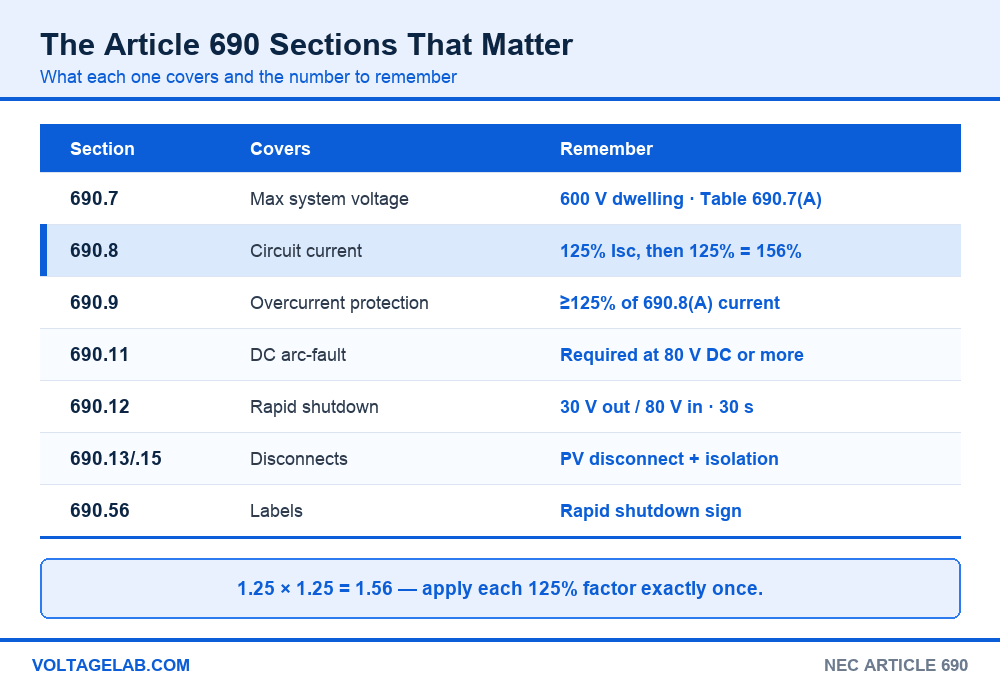
These are the sections that come up on the job and on the exam most often:
| Section | Covers | The number to remember |
|---|---|---|
| 690.7 | Maximum PV system voltage | 600 V on 1- and 2-family dwellings; Table 690.7(A) cold correction |
| 690.8 | Circuit current and conductor sizing | 125% of Isc, then 125% again — 156% |
| 690.9 | Overcurrent protection | OCPD at least 125% of the 690.8(A) current |
| 690.11 | DC arc-fault protection | Required at 80 V DC or more |
| 690.12 | Rapid shutdown on buildings | 30 V in 30 s outside the boundary; 80 V inside |
| 690.13 / 690.15 | Disconnects and equipment isolation | A PV system disconnect plus isolating means for equipment |
| 690.56 | Identification of power sources | Rapid shutdown label at the service |
The cold-weather voltage trap: a module’s Voc is rated at 25 °C. In cold weather it rises — at −8 °C, Table 690.7(A) multiplies it by 1.14. A string designed to the nameplate number can exceed the 600 V dwelling limit in 690.7, or the inverter’s maximum input voltage, on the coldest morning of the year. Always size strings on the corrected voltage for the lowest expected ambient temperature at the site, never on the nameplate alone.
Sizing PV circuits — NEC 690.7 voltage and 690.8 current
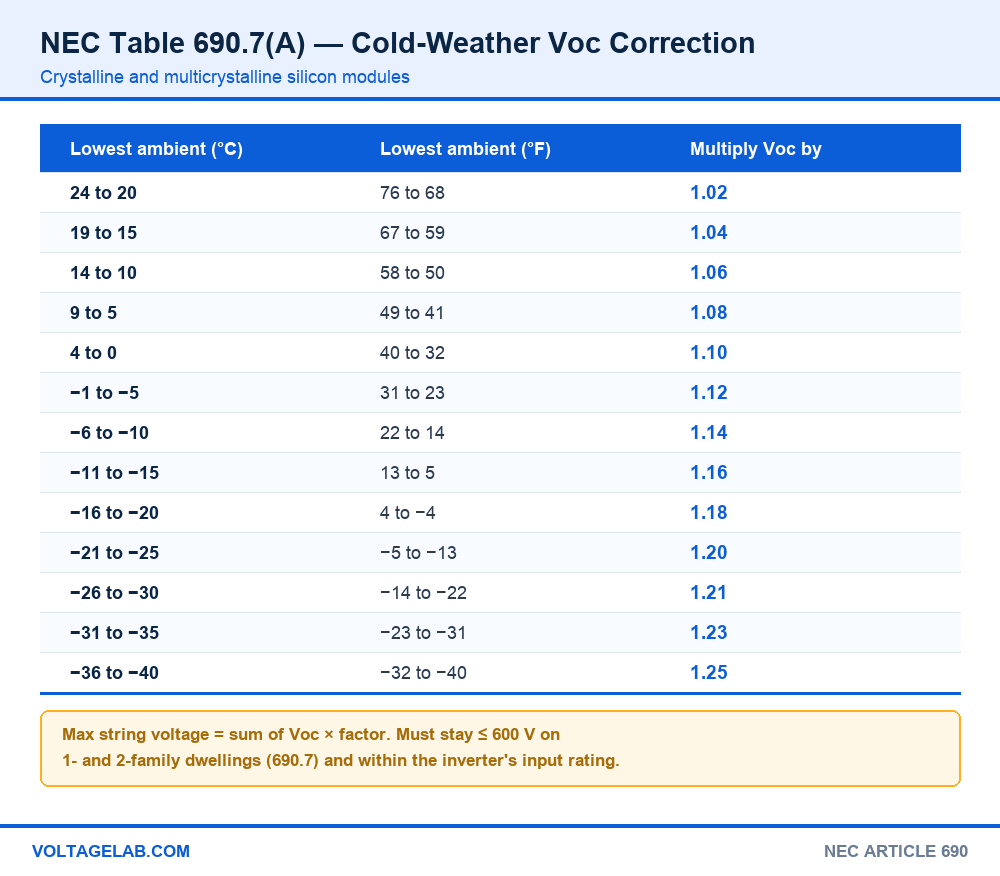
For crystalline and multicrystalline silicon modules, 690.7(A) lets you correct voltage with the module’s own temperature coefficient or with Table 690.7(A). Below −40 °C, or for other module types, use the manufacturer’s instructions.
| Lowest expected ambient (°C) | Lowest expected ambient (°F) | Multiply rated Voc by |
|---|---|---|
| 24 to 20 | 76 to 68 | 1.02 |
| 19 to 15 | 67 to 59 | 1.04 |
| 14 to 10 | 58 to 50 | 1.06 |
| 9 to 5 | 49 to 41 | 1.08 |
| 4 to 0 | 40 to 32 | 1.10 |
| −1 to −5 | 31 to 23 | 1.12 |
| −6 to −10 | 22 to 14 | 1.14 |
| −11 to −15 | 13 to 5 | 1.16 |
| −16 to −20 | 4 to −4 | 1.18 |
| −21 to −25 | −5 to −13 | 1.20 |
| −26 to −30 | −14 to −22 | 1.21 |
| −31 to −35 | −23 to −31 | 1.23 |
| −36 to −40 | −32 to −40 | 1.25 |
The four-step PV circuit method
Step 1 — find the lowest expected ambient temperature. Use the site’s design low temperature, then pick the matching factor from Table 690.7(A). If you do not know it, 1.25 is the worst case in the table.
Step 2 — calculate maximum string voltage. Add the Voc of every module in series and multiply by the factor. Twelve 40.0 V modules at −12 °C: 12 × 40.0 × 1.16 = 556.8 V — under the 600 V dwelling limit.
Step 3 — calculate maximum circuit current. Under 690.8(A)(1), multiply the module Isc (summed for parallel strings) by 1.25. An 11.0 A string becomes 13.75 A.
Step 4 — size the conductor and OCPD. Under 690.8(B), the conductor must carry 125% of that current before any adjustment — 13.75 × 1.25 = 17.19 A, which is 156% of Isc — and must also carry the 690.8(A) current after temperature correction and conduit fill adjustment, whichever is larger. Overcurrent devices under 690.9 are sized the same way. Use ampacity tables for the conductor and check voltage drop on long DC runs.
The one that catches everyone: the 156% factor is 1.25 × 1.25 — not 1.25 + 1.25, and not three 125% factors stacked. The first 125% (690.8(A)) accounts for sunlight brighter than test conditions; the second (690.8(B)) is the continuous-duty factor. Apply each once. On exams, the wrong answers are almost always 125% of Isc used as the conductor size, or 156% applied a second time.
Drill the PV calculations
NEC Exam Prep includes timed questions on special equipment and calculations like these, so you can practise the 690.7 and 690.8 maths until it is automatic (iPhone · Android).
Rapid shutdown under NEC 690.12 — what passes and what fails
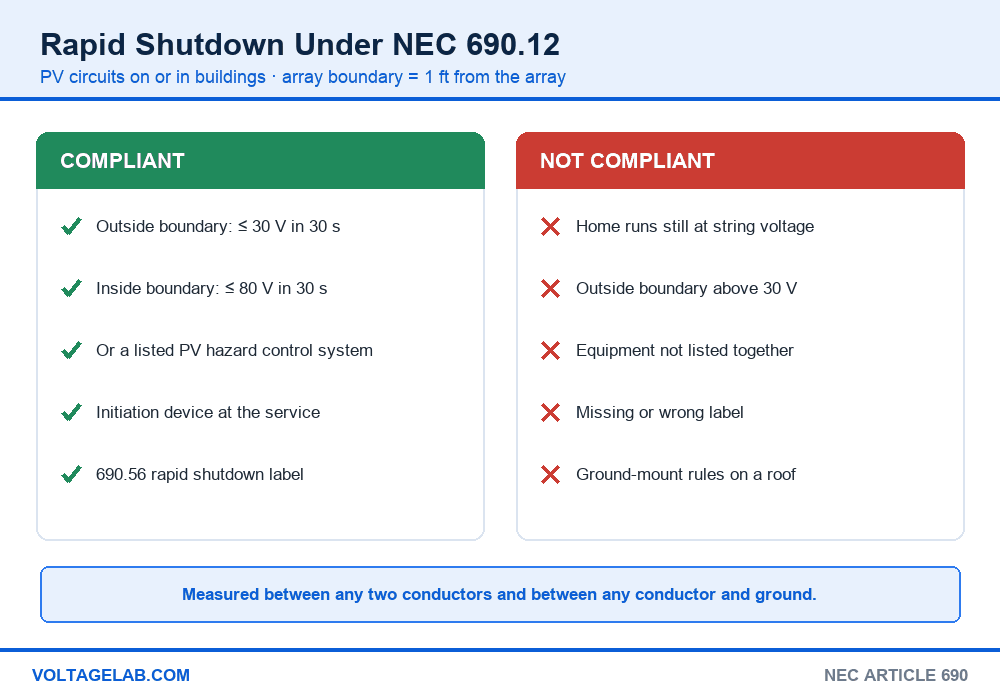
Rapid shutdown applies to PV system circuits installed on or in buildings. Its job is to let firefighters de-energise conductors on a roof without waiting for dark. The limits depend on where the conductor sits relative to the array boundary.
Study smarter with VoltageLab
Built for electricians, apprentices, and electrical engineers who want faster practice and better exam prep.
⭐️ Join thousands of electricians upgrading their skills
Compliant
- Conductors outside the array boundary, or more than 3 ft inside the building from the point of entry, reduced to 30 V or less within 30 seconds
- Conductors inside the array boundary reduced to 80 V or less within 30 seconds
- Inside the boundary, a listed PV hazard control system or a listed rapid shutdown PV array instead of the 80 V method
- Voltage measured between any two conductors and between any conductor and ground
- A rapid shutdown initiation device and the required 690.56 label at the service
Not compliant
- A string inverter with home runs that stay at full string voltage after shutdown
- Conductors outside the boundary still above 30 V after 30 seconds
- Mixing equipment that is not listed to work together as a rapid shutdown system
- No label, or a label that does not match the system installed
- Assuming ground-mounted rules apply to an array on a building
Related calculation — the 120% busbar rule
When the inverter back-feeds a breaker in the main panel, Article 705.12 limits how much it can add. Where the PV breaker is at the opposite end of the busbar from the main, 125% of the inverter’s output current plus the main breaker rating may not exceed 120% of the busbar rating. On a 200 A busbar with a 200 A main: 200 × 1.20 = 240 A, leaving 40 A for the PV breaker — enough for an inverter with up to 32 A of continuous output (40 ÷ 1.25). If the breaker cannot go at the opposite end, the allowance drops to 100% of the busbar.
Article 690 vs 705 vs 706 vs 691
| Article | Covers | Typical exam topic |
|---|---|---|
| 690 | Solar PV systems — array, DC circuits, inverters, rapid shutdown | String voltage, 156% current, rapid shutdown limits |
| 705 | Interconnected power production sources | 120% busbar rule, supply-side vs load-side connections |
| 706 | Energy storage systems (batteries) | ESS disconnects, labelling and location |
| 691 | Large-scale PV electric supply stations | Rarely tested at journeyman level |
Off-grid and battery-based systems pull in charge controllers too — our solar charge controller wiring guide covers the hardware side. For what changed in the latest code cycle, see the top NEC 2026 changes, and check our guide to NEC editions for which one your jurisdiction enforces — PV rules have changed in almost every cycle.
Module-level electronics — the right choice for rapid shutdown?
Pros
- Brings each module to a low voltage, which meets the inside-boundary requirement
- Shading on one module does not drag down the whole string
- Microinverters remove high-voltage DC from the roof entirely
Cons
- More electronics on the roof to fail and replace
- Components must be listed to work together as a system
Working with PV systems in the field
Do
- Correct string voltage for the site’s coldest expected temperature
- Treat every PV conductor as live in daylight
- Verify rapid shutdown voltages after commissioning
- Place the back-fed PV breaker at the opposite end of the busbar
- Install every 690.56 label before inspection
Avoid
- Sizing strings on nameplate Voc alone
- Using 125% of Isc as the conductor size
- Opening DC connectors under load
- Mixing rapid shutdown equipment not listed together
- Exceeding the 120% busbar allowance
NEC 690 practice questions
Work each one before reading the answer. These mirror the style of PV questions on journeyman and master exams.
1. What is the maximum PV system DC voltage permitted on a one-family dwelling?
Answer: 600 volts, under 690.7.
2. A string has 14 crystalline modules rated 38.5 V Voc. The lowest expected ambient is −18 °C. What is the maximum string voltage using Table 690.7(A)?
Answer: 14 × 38.5 = 539 V; factor at −18 °C is 1.18; 539 × 1.18 = 636 V. That exceeds 600 V, so the string is too long for a dwelling.
3. A module has an Isc of 10.2 A. What is the maximum circuit current under 690.8(A)(1)?
Answer: 10.2 × 1.25 = 12.75 A.
4. For the same string, what is the minimum conductor ampacity before adjustment under 690.8(B)?
Answer: 12.75 × 1.25 = 15.94 A — 156% of Isc.
5. Outside the array boundary, rapid shutdown must reduce conductors to what voltage, within what time?
Answer: 30 V within 30 seconds, under 690.12.
6. How far from the array does the array boundary extend?
Answer: 1 ft in all directions.
7. A panel has a 200 A busbar and a 200 A main breaker. With the PV breaker at the opposite end, what is the largest PV breaker allowed under the 120% rule?
Answer: (200 × 1.20) − 200 = 40 A.
For more mixed practice across the whole code, try our free NEC practice test.
Frequently asked questions
What does NEC Article 690 cover?
Solar photovoltaic systems: modules and arrays, PV DC circuits, inverters, overcurrent protection, arc-fault protection, rapid shutdown, disconnects, wiring methods, grounding and labelling. Interconnection to other sources is covered in Article 705.
What is the maximum PV voltage for a house?
600 volts DC for PV system circuits on or in one- and two-family dwellings under 690.7. Other buildings can generally go up to 1,000 volts.
What is the 156% rule in solar?
It is the two 125% factors in 690.8 multiplied together: 125% of Isc for maximum current, then 125% for continuous duty when sizing conductors and overcurrent devices. 1.25 × 1.25 = 1.56.
What are the NEC rapid shutdown requirements?
Under 690.12, conductors outside the array boundary must drop to 30 V within 30 seconds of initiation. Inside the boundary, they must drop to 80 V within 30 seconds, or the system must use a listed PV hazard control system or listed rapid shutdown array.
Why does PV voltage go up in cold weather?
Silicon cell voltage rises as temperature falls. Module Voc is rated at 25 °C, so Table 690.7(A) increases it by up to 25% for sites as cold as −40 °C.
Is the 120% rule in Article 690?
No. It is in Article 705.12, which covers load-side connections of power production sources. Article 690 covers the PV system up to that connection.
Does Article 690 require arc-fault protection?
Yes. 690.11 requires DC arc-fault circuit protection for PV systems operating at 80 volts DC or greater between any two conductors.
The bottom line
NEC Article 690 earns its place on the exam because it rewards understanding over lookup: cold makes voltage go up, sunlight above test conditions makes current go up, and continuous duty adds one more margin. The two restraints that matter are sizing strings on the corrected cold-weather voltage, and applying each 125% factor exactly once to reach 156%.
Learn Table 690.7(A), the 690.8 sequence, the 690.12 limits and the 705 busbar rule, and most PV questions become arithmetic. For a full study plan across the rest of the code, see our NEC exam prep guide.
FREE PRACTICE TOOL
Think you'd pass this on a real exam?
Test what you just read with instant-feedback quizzes built around real code questions — not generic trivia.
5
Code standards
10,000+
Active learners
100%
Free to start
Instant explanations on every answer, right or wrong
NEC, BS7671, AS/NZS, CEC, and DIN VDE covered
Bite-sized quizzes you can finish in 5 minutes
No signup required to try your first quiz
No account needed · Takes less than 2 minutes