

The NEC 2026 code book — the 2026 edition of the National Electrical Code (NFPA 70) — was published in 2025 and generated more than 3,900 public inputs, one of the largest code development cycles in recent history. The changes touch everything from arc flash labeling on commercial panels to EV charging receptacle rules to the foundational structure of the code itself. Most states will not adopt the NEC 2026 for inspections or licensing exams until 2027 or later, but contractors, apprentices, and journeymen preparing for the long haul need to know what is coming.
This guide covers the NEC 2026 changes that matter most to field electricians: the arc flash labeling mandate that now hits all commercial equipment, the AFCI expansion into bathrooms and garages, the new EV charging rules, the general lighting load calculation drop from 3 VA to 2 VA per square foot, the IBT location flexibility, and the start of the largest structural reorganization of the NEC in decades.
Study smarter with VoltageLab
Built for electricians, apprentices, and electrical engineers who want faster practice and better exam prep.
⭐️ Join thousands of electricians upgrading their skills
The NEC 2026 (NFPA 70, published in 2025) brings the biggest set of changes field electricians have seen in years: arc flash labels are now required on all non-dwelling service and feeder equipment because the 1,000 A threshold in NEC 110.16 is gone; AFCI protection expands into bathrooms and garages under NEC 210.12; EV charging tightens under Article 625 with EV-listed receptacles and new SPGFCI protection; the general lighting load drops from 3 to 2 VA/ft² (now in Article 120); and the code begins its largest structural reorganization in decades.
Most states will not adopt the NEC 2026 for inspections or licensing exams until 2027 or later — so keep working and testing to your state’s current edition (the 2023 NEC for most), but start learning these changes now.
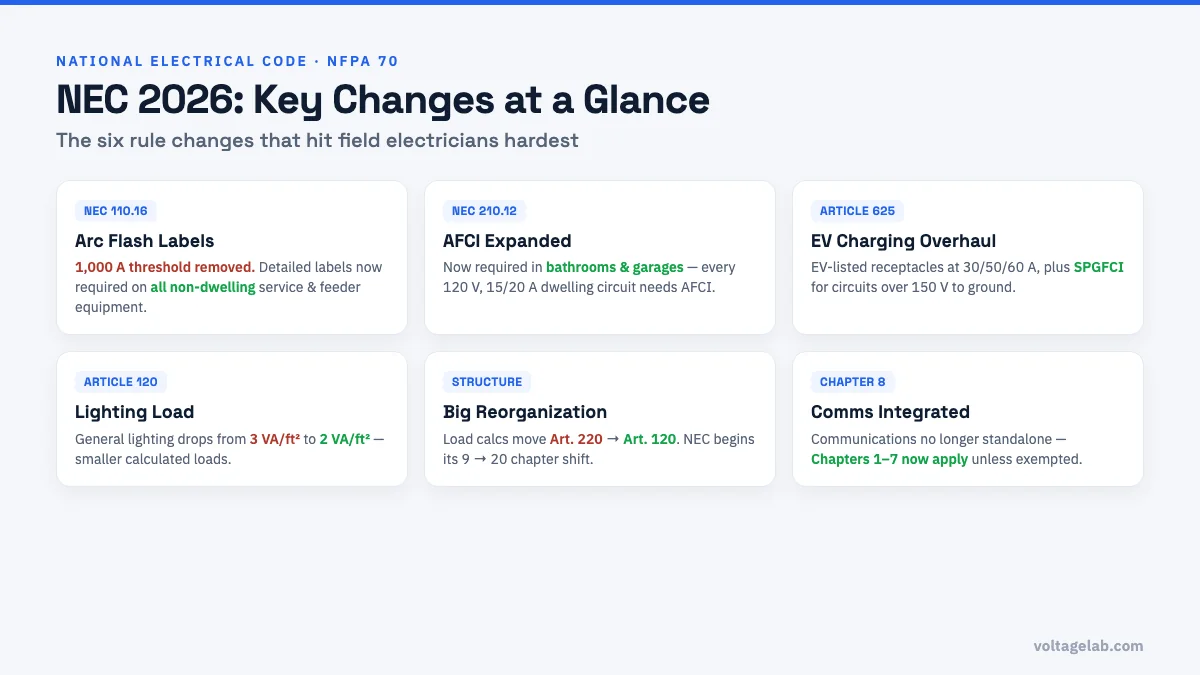
- Arc flash labels expand (NEC 110.16). The 1,000 A threshold is deleted — detailed labels are now required on all non-dwelling service and feeder equipment, effectively mandating arc flash studies for commercial facilities.
- AFCI covers the whole dwelling (NEC 210.12). Bathrooms and garages are added, so every 120 V, 15 A and 20 A branch circuit in a new home needs AFCI protection.
- EV charging overhaul (Article 625). Receptacles must be EV-listed at 30/50/60 A, and SPGFCI is required for circuits over 150 V to ground.
- Lighting load drops to 2 VA/ft². Down from 3 VA/ft² to reflect LED efficiency — and it now lives in Article 120, not Article 220.
- Biggest reorganization in decades. Load calcs move from Article 220 to Article 120 as the NEC begins its shift from a 9-chapter to a 20-chapter structure.
- Adoption is years out. Most states stay on the 2023 (or 2020) NEC until 2027 or later — study your state’s adopted edition, but learn these changes for what is coming.
When Does the NEC 2026 Take Effect?
Publication and enforcement are two separate things. The NFPA published the NEC 2026 in 2025. Each state adopts it independently through a regulatory or legislative process — and that process typically takes 1–3 years after publication. Here is what that means for the field:
| Category | Status as of 2026 | What to Do |
|---|---|---|
| 2023 NEC states (majority) | 2023 NEC governs current inspections and most licensing exams | Study and work to the 2023 NEC until your state formally adopts the NEC 2026 |
| 2020 NEC states (FL, AL, and others) | 2020 NEC governs current inspections and exams | Verify with your state licensing board before studying for 2026 changes |
| NEC 2026 licensing exams | Most states will not transition exams to the NEC 2026 until 2027 at the earliest | Confirm your state’s exam edition with PSI or Pearson VUE before buying study materials |
| Early adopters | A small number of jurisdictions may adopt the NEC 2026 for new construction in late 2026 | Check with your local AHJ for jurisdiction-specific adoption announcements |
Bottom line: As of mid-2026, work to your state’s adopted edition — not the most recently published one. For most US electricians that is the 2023 NEC. Know the NEC 2026 changes for career development, but do not apply 2026 rules on jobs governed by the 2023 or 2020 NEC unless your AHJ specifically requires it. For a full edition-by-edition breakdown, see our guide to NEC code book editions: 2017 vs 2020 vs 2023 vs 2026 differences.
The Structural Reorganization — The Biggest NEC Change in Decades
The most sweeping change in the NEC 2026 is not a single code rule — it is the beginning of a structural overhaul that will transform the NEC from its familiar 9-chapter format into a 20-chapter structure. The 2026 edition initiates this transition; the 2029 NEC will complete the reorganization.
Why the NEC Is Being Reorganized
The 9-chapter structure has been the NEC’s framework since the early 20th century. As the code grew to address new technologies — solar, EV charging, energy storage, microgrids — articles were added within the existing framework in ways that created inconsistent numbering, redundancies across chapters, and navigation headaches. The reorganization aims for a cleaner, more logical structure that separates general requirements, system-level requirements, and special applications more intuitively.
FREE PRACTICE TOOL
Think you'd pass this on a real exam?
Test what you just read with instant-feedback quizzes built around real code questions — not generic trivia.
5
Code standards
10,000+
Active learners
100%
Free to start
Instant explanations on every answer, right or wrong
NEC, BS7671, AS/NZS, CEC, and DIN VDE covered
Bite-sized quizzes you can finish in 5 minutes
No signup required to try your first quiz
No account needed · Takes less than 2 minutes
Key Articles That Have Moved in the NEC 2026
| Topic | 2023 NEC Location | NEC 2026 Location | Notes |
|---|---|---|---|
| Load calculations (branch circuits, feeders, services) | Article 220 | Article 120 | Moved to Chapter 1 — reflects its foundational role in all electrical design |
| Energy management systems (EMS) | Article 220 (partial) | Article 130 | Given its own dedicated article recognizing EMS as a primary design tool |
| Snap switches (dimmers, wall switches) | Article 404 | Article 406 | Consolidated into wiring devices; Article 404 now dedicated to heavy-duty switchgear and disconnects |
| Chapter 8 (Communications) | Standalone — operated independently of Chapters 1–7 | Integrated with Chapters 1–7 | Communications now subject to general NEC requirements; major impact on structured cabling |
What this means for electricians in NEC 2026 jurisdictions: If you learned the NEC in the 2023 edition and your state adopts the NEC 2026, load calculation questions on exams will point to Article 120, not Article 220. Motor calculation questions may reference new article numbers. This is why exam prep for the NEC 2026 needs more orientation time than transitioning between earlier editions. Annex L in the NEC 2026 provides a mapping of old article numbers to new locations — use it during the transition.
What this does NOT mean: The rules themselves have not fundamentally changed simply because of renumbering. The load calculation methodology under Article 120 is the same process formerly in Article 220. The reorganization changes where you look, not necessarily what the rule says — with some exceptions covered below.
NEC 110.16 — Arc Flash Labeling: No More 1,000A Threshold
One of the most immediately impactful NEC 2026 changes for commercial electricians is the expansion of the arc flash label requirement in NEC 110.16.
2023 NEC: Detailed arc flash labels (with voltage, available fault current, clearing time, and calculation date) were required only on service and feeder equipment rated 1,000 amperes or more.
NEC 2026: The 1,000-ampere threshold is deleted. Detailed arc flash labels are now required on virtually all non-dwelling service and feeder equipment — including smaller panelboards, switchboards, MCCs, and industrial control panels that previously only needed a generic “arc flash hazard” warning.
What the label must now contain (NEC 2026, 110.16):
- Nominal system voltage
- Available fault current at the equipment
- Clearing time of the upstream OCPD
- Date of the arc flash risk assessment
Common mistake: Generic “Warning — Arc Flash Hazard” stickers do not meet the NEC 2026 requirement. The label must carry the calculated data (voltage, available fault current, clearing time, and assessment date). This change effectively mandates arc flash studies for all non-residential commercial and industrial facilities — aligning NEC enforcement with what NFPA 70E has long required as best practice.
Residential exemption: Dwelling units remain exempt from the detailed arc flash label requirement. The NEC 2026 arc flash labeling expansion applies only to non-dwelling occupancies.
QR code provision (NEC 110.3(B) update): The NEC 2026 explicitly recognizes that manufacturer installation instructions can be provided via QR code or web address — not just printed material. The practical implication: the “I threw away the instructions” defense no longer holds, because the instructions are always accessible via the QR code on the equipment.
💡 Turn these NEC 2026 changes into practice questions.
VoltageLab’s AI Quiz Generator creates unlimited exam-style questions on any NEC article — so you can drill arc flash labeling, AFCI, and the new Article 120 load calcs until they stick. Fresh questions with explanations, every time.
Study smarter with VoltageLab
Built for electricians, apprentices, and electrical engineers who want faster practice and better exam prep.
⭐️ Join thousands of electricians upgrading their skills
NEC 210.12 — AFCI Expanded to Bathrooms and Garages
The NEC 2026 expanded AFCI requirements to include two locations that were previously exempt in the 2023 NEC: bathrooms and garages in dwelling units.
2023 NEC 210.12(A): AFCI required in kitchens, bedrooms, living rooms, family rooms, dining rooms, hallways, laundry areas, and virtually all other rooms — but bathrooms and garages were not explicitly listed.
NEC 2026, 210.12(A): Bathrooms and garages are now explicitly included. In jurisdictions adopting the NEC 2026, every 120V, 15A and 20A branch circuit in a new dwelling unit requires AFCI protection — no exceptions for any room.
Practical impact: In NEC 2026 jurisdictions, the question of which circuits in a new home need AFCI protection has a simple answer: all of them. The complexity of tracking which rooms are and are not covered disappears.
Dual-function devices remain the solution for wet/AFCI overlap: Bathrooms still require GFCI (NEC 210.8). With the NEC 2026’s addition of AFCI to bathrooms, bathroom circuits now require both — use a dual-function AFCI/GFCI breaker or an AFCI breaker with GFCI receptacles to satisfy both requirements at once. For the full breakdown of where each device is required, see our guide to GFCI vs arc fault (AFCI): differences, requirements & where each is required.
| Location | AFCI Required — 2023 NEC? | AFCI Required — NEC 2026? |
|---|---|---|
| Bedrooms, living rooms, family rooms | ✅ Yes | ✅ Yes |
| Kitchens, kitchenettes | ✅ Yes | ✅ Yes |
| Hallways, closets, laundry areas | ✅ Yes | ✅ Yes |
| Dining rooms, sunrooms, recreation rooms | ✅ Yes | ✅ Yes |
| Bathrooms | ⚠️ Not explicitly listed (AHJ-dependent) | ✅ Yes — added in NEC 2026 |
| Garages | ⚠️ Not explicitly listed (AHJ-dependent) | ✅ Yes — added in NEC 2026 |
Article 625 — EV Charging: A Major Overhaul
Electric vehicle charging is one of the fastest-growing areas in residential and commercial electrical work, and the NEC 2026 reflects that growth with significant changes to Article 625.
New EVSE Receptacle Requirements
The NEC 2026 requires that receptacles used for EV charging at 30A, 50A, and 60A be specifically listed for EV service — generic receptacles of these ratings are no longer permitted for dedicated EV charging outlets. This ends the common field practice of installing a standard NEMA 14-50 or 6-50 receptacle labeled as an “EV outlet” without the receptacle being specifically rated and listed for continuous EV charging duty.
SPGFCI for Higher-Voltage EV Equipment
The NEC 2026 introduces a new protection device requirement: SPGFCI (Special Purpose Ground Fault Circuit Interrupter) — also called shock protection GFCI — for certain EV charging applications where the voltage to ground exceeds 150 volts. This is a more sensitive device designed for circuits that operate at 240V, where a standard GFCI would not otherwise be required.
Key provision (NEC 625.54, with phased effective dates): For EV receptacles or outlets rated at 150V or less to ground, standard Class A GFCI protection applies. For those rated more than 150V to ground (typical 240V EV circuits), SPGFCI protection is required. Some provisions have effective dates extending to January 1, 2029, giving the industry time to develop compliant devices.
Qualified Person Requirement for Permanent EVSE
The NEC 2026 added “qualified person” language for the installation of permanently installed EV power transfer equipment. In many jurisdictions, this is expected to be interpreted as requiring a licensed electrician for permanent EVSE installations — not just any contractor or the homeowner. This aligns EV charger installation with other electrical work that requires a license.
Emergency Shutoffs for Commercial EV Installations
Commercial and public EV charging installations now require emergency shutoff capability — a means to quickly disconnect power to EV charging stations in an emergency. This is driven by first-responder safety concerns in the event of a vehicle fire at a charging station.
New Electric Self-Propelled Vehicle (ESVSE) Article
The NEC 2026 adds new provisions for Electric Self-Propelled Vehicle Power Transfer Systems — addressing the growing category of robots, autonomous vehicles, AGVs (automated guided vehicles), and similar equipment in industrial facilities that use embedded charging systems different from standard EV chargers.
Load Calculation Change: 2 VA/ft² Replaces 3 VA/ft²
One of the most practically significant NEC 2026 changes for residential and commercial electricians is the reduction of the general lighting load factor in the load calculation methodology.
2023 NEC (Article 220): General lighting and receptacle load = 3 VA per square foot
NEC 2026 (Article 120): General lighting and receptacle load = 2 VA per square foot
This reduction reflects two realities of modern buildings: LED lighting consumes dramatically less power per square foot than the incandescent lighting that drove the 3 VA/ft² figure, and homes and offices have become more energy-efficient overall. The 3 VA/ft² figure had been in the NEC for decades and was considered conservative even for its time.
Impact on Service Sizing
| Dwelling Size | Lighting Load at 3 VA/ft² (2023 NEC) | Lighting Load at 2 VA/ft² (NEC 2026) | Reduction |
|---|---|---|---|
| 1,500 sq ft | 4,500 VA | 3,000 VA | 1,500 VA |
| 2,000 sq ft | 6,000 VA | 4,000 VA | 2,000 VA |
| 2,500 sq ft | 7,500 VA | 5,000 VA | 2,500 VA |
| 3,000 sq ft | 9,000 VA | 6,000 VA | 3,000 VA |
After demand factors, the lighting load reduction translates to a smaller calculated demand — which may let some homes that previously calculated to 200A fall within 150A under the NEC 2026 methodology. However, the growing addition of EV charger loads as continuous loads often offsets or exceeds this reduction in practice. The net effect on actual service sizes in new construction depends on the specific load mix — particularly whether EV charging and electric heating/cooking are included.
Important note for exam candidates: The 2 VA/ft² rule applies only in jurisdictions that have adopted the NEC 2026. For exams based on the 2023 NEC, continue using 3 VA/ft². You can pressure-test your load-calc skills with our free NEC practice test.
NEC 250.94 — IBT Location: Mounting to the Building Permitted
The NEC 2026 added another permitted location for the intersystem bonding termination (IBT) under NEC 250.94. In addition to the locations permitted by the 2023 NEC (service equipment enclosure, meter enclosure, disconnect enclosure, and “at the service equipment”), the NEC 2026 now permits the IBT to be mounted directly to the building or structure — provided the connection to the grounding electrode system is made with a minimum 6 AWG copper grounding electrode conductor.
This expansion addresses practical field situations where the service equipment is on a utility pedestal or in a location where mounting an IBT device to a metal enclosure is impractical. The direct-to-building mounting option with a dedicated GEC provides the connection to the grounding system without requiring attachment to the service enclosure itself.
New Article 270 — Medium Voltage Grounding and Bonding
The NEC 2026 adds Article 270, dedicated to grounding and bonding requirements for medium voltage systems. Previously, medium voltage grounding requirements were scattered across Article 250 (general grounding) and the medium voltage wiring method articles (formerly Articles 311/315). The new standalone Article 270 consolidates medium voltage grounding and bonding rules in one place, parallel to Article 250 for low-voltage systems.
Article 270 is relevant for industrial electricians, utility contractors, and those working with 4 kV–35 kV distribution systems. For the majority of residential and commercial electricians working below 1,000V, Article 270 does not affect daily work.
Chapter 8 Integration — Communications No Longer Standalone
In every edition through the 2023 NEC, Chapter 8 (Communications Systems — Articles 800 through 840) operated under a unique provision: its requirements stood alone and were independent of Chapters 1 through 7 unless Chapter 8 specifically referenced them. This meant that general NEC requirements (like grounding, conduit fill, and conductor protection) did not automatically apply to communications wiring.
The NEC 2026 removes this independence. Chapter 8 communications articles are now fully integrated with Chapters 1 through 7 — the general requirements of those chapters apply to communications systems unless Articles 800–840 provide a specific exemption. This has significant practical implications:
- Communications cable installations must now comply with the general wiring method requirements of Chapter 3 unless specifically exempted
- Grounding and bonding requirements of Article 250 apply to communications systems directly
- General equipment installation requirements (Article 110) apply to communications equipment
- Low-voltage structured cabling installers who relied on Chapter 8’s independence must now comply with the broader NEC framework
Summary — NEC 2026 Key Changes Quick Reference
| Change | 2023 NEC Rule | NEC 2026 Rule | Impact |
|---|---|---|---|
| Arc flash labeling | Detailed labels required at ≥1,000A service/feeder equipment | Detailed labels required at all non-dwelling service/feeder equipment (no amperage threshold) | High — arc flash studies now effectively mandatory for all commercial facilities |
| AFCI locations | Required in virtually all dwelling rooms; bathrooms and garages AHJ-dependent | Required in all dwelling unit locations including bathrooms and garages | High — every circuit in a new dwelling unit needs AFCI |
| General lighting load | 3 VA/ft² (Article 220) | 2 VA/ft² (Article 120) | Medium — may reduce calculated service size, offset by EV loads |
| EV charging receptacles | Standard listed receptacles permitted | Must be specifically listed for EV service at 30/50/60A | Medium — new listing requirements for EV receptacles |
| EV GFCI (SPGFCI) | Standard Class A GFCI or no GFCI depending on configuration | SPGFCI required for EV circuits >150V to ground (phased to Jan 1, 2029) | Medium — new device type needed for 240V EV circuits |
| Load calculation location | Article 220 | Article 120 | Low (same math, different article number) |
| IBT location | At service equipment, meter, or disconnect enclosure | Also permitted mounted to building/structure with 6 AWG Cu GEC | Low — adds flexibility |
| Chapter 8 independence | Communications articles stood alone; Chapters 1–7 did not apply unless referenced | Chapter 8 integrated — Chapters 1–7 apply unless specifically exempted | High for communications/low-voltage contractors |
| Article 270 | MV grounding scattered across Articles 250 and 315 | New Article 270 dedicated to medium voltage grounding and bonding | Medium — consolidation for MV workers |
Should You Buy the NEC 2026 Now?
Whether to invest in the NEC 2026 code book depends on your situation:
- If your state is on the 2023 NEC and you are studying for a licensing exam: Buy the 2023 NEC and study that edition. Confirm your exam edition with your testing vendor before any purchase.
- If your state is on the 2020 NEC: Buy the 2020 NEC for exam prep. Know the 2023 changes, but do not study the NEC 2026 for your exam.
- If you are a working electrician and your jurisdiction is adopting the NEC 2026: Buy the NEC 2026 when your state formally adopts it. Using the wrong edition on a job can lead to inspection failures.
- If you are a contractor or project manager planning 2027–2028 projects: Familiarize yourself with the NEC 2026 now — particularly the arc flash labeling, AFCI expansion, and EV charging changes — so you can price and plan accordingly.
Conclusion
The NEC 2026 makes significant changes in three areas that will affect most commercial and residential electricians: arc flash labeling is now mandatory on all non-dwelling commercial equipment (not just large services), AFCI protection now covers bathrooms and garages to complete the whole-dwelling requirement, and EV charging rules have tightened with new listed receptacle requirements and SPGFCI provisions. The structural reorganization — particularly the move of load calculations from Article 220 to Article 120 — is the start of a decade-long restructuring that will culminate in the 2029 NEC.
The smartest move right now is to learn the NEC 2026 changes for career development while still working and testing to your state’s currently adopted edition. Drill the new rules until they are second nature with the VoltageLab electrician app, and you will be ready the day your jurisdiction flips the switch.
📱 Get NEC-ready before your state adopts the 2026 code.
VoltageLab gives you AI-generated practice questions, timed mock exams, flashcards, and a personalized study plan — all with NEC citations. Learn the NEC 2026 changes and stay sharp on your current edition, all in one app. Free on iOS and Android.
Frequently Asked Questions
When will most states adopt the NEC 2026 for inspections and licensing exams?
The NEC 2026 was published in 2025. State adoption typically takes 1–3 years after publication. Most states will not enforce the NEC 2026 for building inspections or licensing exams until 2027 at the earliest, with many not completing adoption until 2028 or later. As of mid-2026, the 2023 NEC governs most US states’ inspections and exams. Always verify with your state licensing board or testing vendor before studying or buying materials for the NEC 2026.
What is the biggest NEC 2026 change for residential electricians?
The AFCI expansion to bathrooms and garages is the most impactful change for residential work. Under the NEC 2026, every 120V, 15A and 20A branch circuit in a new dwelling unit requires AFCI protection — no rooms are exempt. Additionally, the general lighting load calculation drops from 3 VA per square foot to 2 VA per square foot, which may reduce the minimum calculated service size for some homes. For dwellings with EV chargers and electric cooking, those loads may offset the lighting reduction.
What does the NEC 2026 require for arc flash labels on commercial equipment?
The NEC 2026 removed the previous 1,000-ampere threshold for detailed arc flash labeling. All non-dwelling service and feeder equipment — regardless of ampacity — must now be field-marked with a detailed label that includes nominal system voltage, available fault current at the equipment, clearing time of the upstream OCPD, and the date of the arc flash risk assessment. Generic “Warning — Arc Flash Hazard” labels are no longer sufficient. Residential equipment remains exempt.
What is SPGFCI and why does the NEC 2026 require it for some EV circuits?
SPGFCI (Special Purpose Ground Fault Circuit Interrupter) is a GFCI device designed for circuits where voltage to ground exceeds 150 volts — typically 240V circuits. Standard Class A GFCI protects 120V circuits (≤150V to ground) but is not designed for 240V applications. The NEC 2026 (NEC 625.54) requires SPGFCI protection for EV charging receptacles or outlets where voltage to ground is greater than 150V. Some provisions are phased with effective dates through January 1, 2029, giving the device market time to develop compliant products.
What does it mean that the NEC 2026 moved load calculations from Article 220 to Article 120?
The load calculation methodology — the formulas and demand factors for sizing services, feeders, and branch circuits — has been relocated from Article 220 to Article 120 as part of the NEC 2026 structural reorganization. The rules themselves are largely the same (with the 2 VA/ft² change noted above), but they now live under Article 120 in Chapter 1. For electricians transitioning from the 2023 NEC, the main practical impact is relearning where to look — Annex L in the NEC 2026 maps old article numbers to their new locations.
FREE PRACTICE TOOL
Think you'd pass this on a real exam?
Test what you just read with instant-feedback quizzes built around real code questions — not generic trivia.
5
Code standards
10,000+
Active learners
100%
Free to start
Instant explanations on every answer, right or wrong
NEC, BS7671, AS/NZS, CEC, and DIN VDE covered
Bite-sized quizzes you can finish in 5 minutes
No signup required to try your first quiz
No account needed · Takes less than 2 minutes