

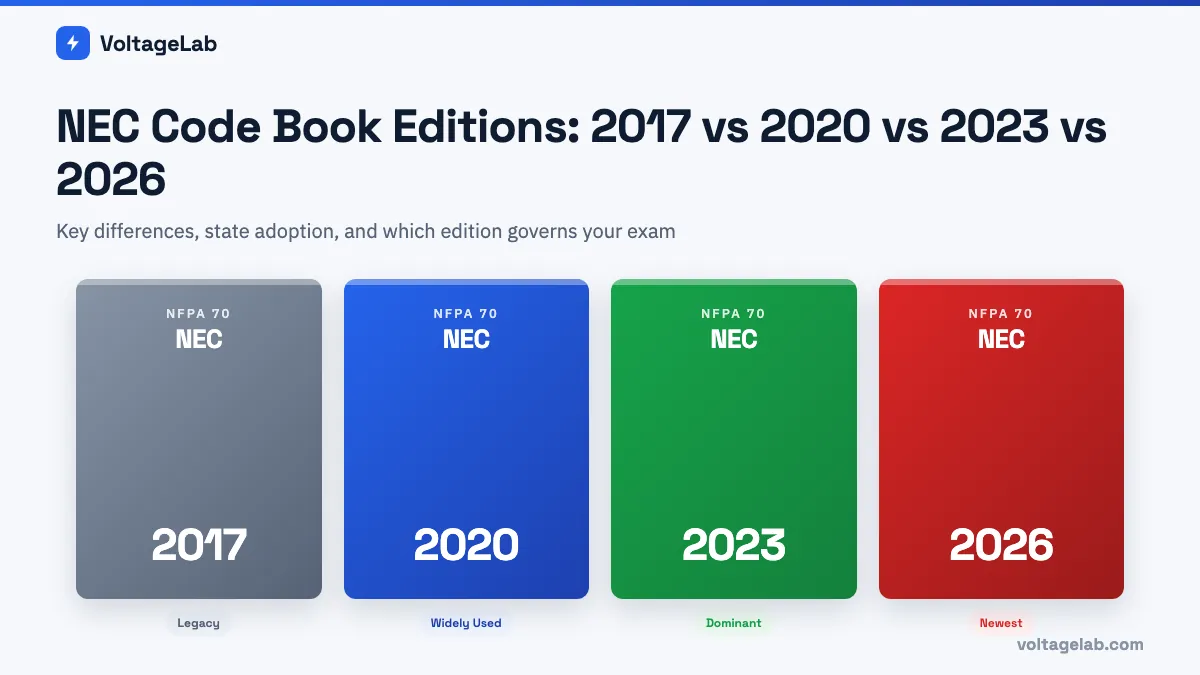
The National Electrical Code is published every three years. Each new edition brings rule changes, expanded requirements, reorganized articles, and new provisions for emerging technologies. For electricians, the edition question matters for two specific reasons: which edition governs your current job, and which edition is used on your state’s licensing exam. Getting either one wrong can mean a failed inspection or a failed test.
This guide covers the key differences between the 2017, 2020, 2023, and 2026 NEC editions, which states are on which edition as of 2026, how to find which edition governs your jurisdiction, and what changed in each cycle that is most likely to appear on a licensing exam.
Study smarter with VoltageLab
Built for electricians, apprentices, and electrical engineers who want faster practice and better exam prep.
⭐️ Join thousands of electricians upgrading their skills
- How NEC editions work — publication vs. state adoption
- Which states use which NEC edition as of 2026
- Key changes in the 2020 NEC
- Key changes in the 2023 NEC
- Key changes in the 2026 NEC
- How to find which edition your state uses for the licensing exam
- Edition-specific exam strategy
Quick Answer
The NEC (NFPA 70) is published every three years: 2017, 2020, 2023 and 2026, with the 2029 edition next. As of 2026, the 2023 NEC is the edition most states enforce and test on. The 2026 NEC was published in 2025, and most states will not adopt it until 2027 or later.
Always check your state’s adopted edition, not the newest one, before you buy a code book or schedule a licensing exam.
How NEC Editions Work — Publication vs. State Adoption
The NEC is published by the NFPA (National Fire Protection Association) every three years. Publication and state adoption are completely separate processes. When the NFPA publishes a new edition, individual states, counties, and municipalities decide independently when — and whether — to adopt it. The adoption process includes legislative or regulatory action in each jurisdiction, and some states take years after publication to formally adopt a new edition.
What this means in practice:
- The “current” NEC edition is the most recently published one (2026 as of 2026)
- Your state’s “adopted” edition is the one that legally governs electrical installations in your jurisdiction — it may be 1–2 cycles behind the published edition
- Your state’s “exam edition” is the one used for the licensing test — may differ from the adopted edition depending on when the state updated its testing specifications
- Local jurisdictions may have amendments — modifications to the adopted NEC that add, remove, or change specific requirements
The only way to know your edition with certainty: Check your state’s electrical licensing board website or contact the testing vendor (PSI Exams, Pearson VUE) directly. Do not rely on secondhand information — adoption timelines shift regularly and state-specific amendments can affect specific answers on exams.
Pass your electrical exam the first time
Practice real NEC exam questions with full code-referenced explanations and progress tracking — built for journeyman, master and apprentice exam prep.
Thousands of NEC practice questions with code-referenced answers
State NEC Adoption — Where States Stand as of 2026
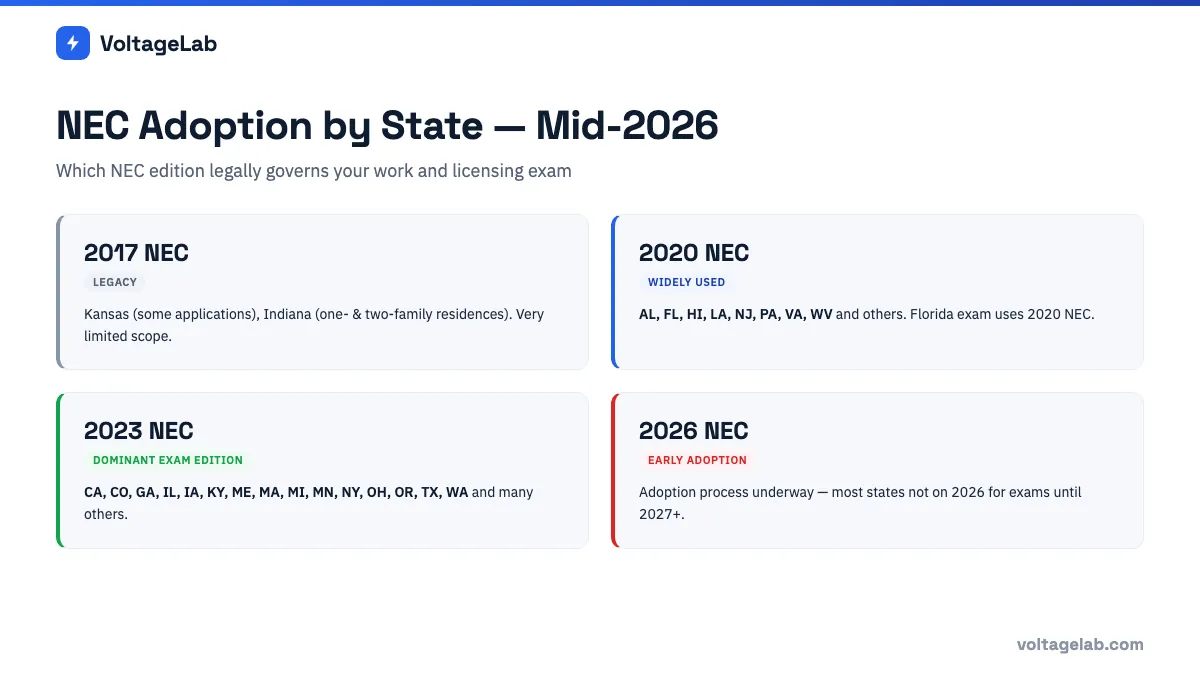
NEC adoption is a moving target. The information below reflects the state of adoption as of mid-2026 and is subject to change. Always verify with your state licensing board before purchasing study materials or sitting for an exam.
| NEC Edition | Notable States Using This Edition (Approximate) | Notes |
|---|---|---|
| 2017 NEC | Kansas (some applications), Indiana (one- and two-family residences) | Very limited — most states have moved beyond 2017. Some jurisdictions in larger states may still use 2017 for specific occupancy types. |
| 2020 NEC | Alabama, Florida, Hawaii, Louisiana, New Jersey, Pennsylvania, Virginia, West Virginia, and others | Still widely used as of 2026; states on this edition use 2020 for exams. Florida exam uses 2020 NEC as of 2026. |
| 2023 NEC | California, Colorado, Georgia, Illinois, Iowa, Kentucky, Maine, Massachusetts, Michigan, Minnesota, New York, Ohio, Oregon, Texas, Washington, and many others | Majority of states as of 2026; this is the dominant exam edition for most PSI/Pearson VUE state exams in 2025–2026 |
| 2026 NEC | Early adoption — limited states; adoption process underway | The 2026 NEC was published in 2025; formal state adoption beginning in 2026–2027 for most jurisdictions |
Important note: The table above represents approximate groupings based on available adoption information through mid-2026. State adoption changes throughout the year. The source for the most accurate, current information is your state’s electrical licensing board or the NFPA’s state adoption page at nfpa.org.
💡 Turn any NEC edition into practice questions
VoltageLab’s AI Quiz Generator creates unlimited exam-style questions from any NEC article — 2020, 2023, or 2026 edition. Match your study to the exact edition your state tests on.
Key Changes in the 2020 NEC
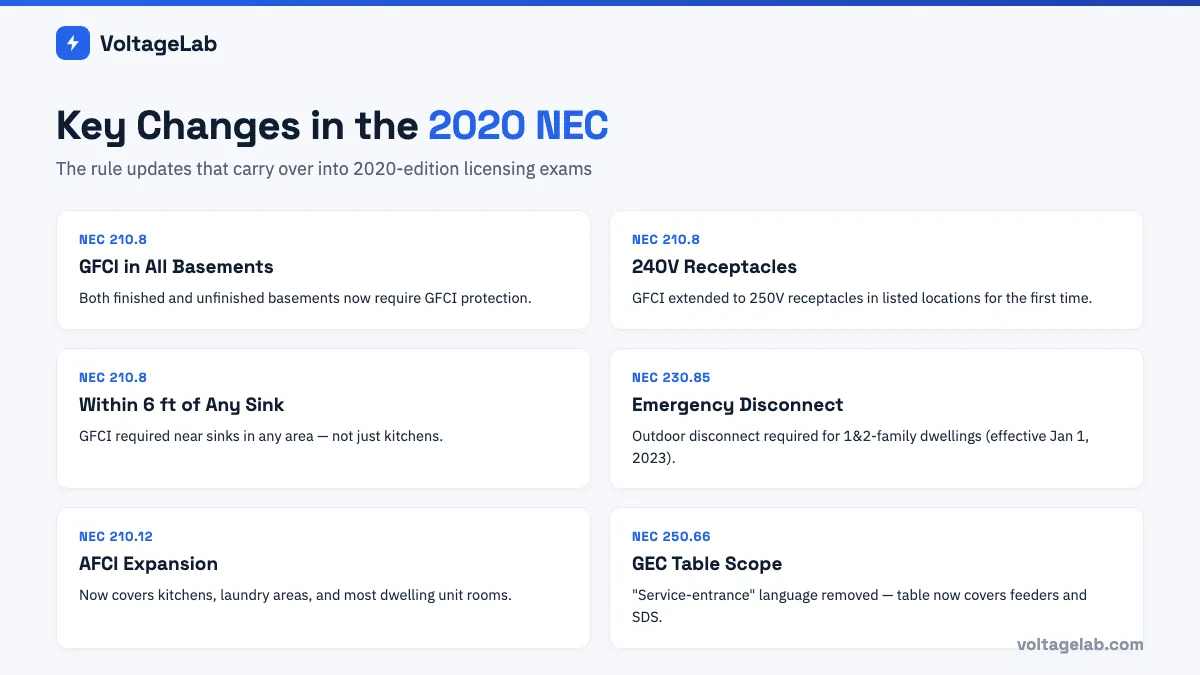
The 2020 NEC made several significant changes from the 2017 edition. These are the changes that appear on exams in states using the 2020 edition.
GFCI Expansions (NEC 210.8)
- All basements: The 2020 NEC required GFCI for all receptacles in finished and unfinished basements — the 2017 edition required it only in unfinished basements or basements without permanent stairs
- Outdoor HVAC equipment: GFCI required for receptacles serving outdoor HVAC equipment (later removed in the 2023 edition)
- Boat hoists: GFCI required for boat hoists in garages and boathouses
- Sinks (all areas): GFCI required for receptacles within 6 feet of sinks in any location — not just kitchens
Service Disconnects (NEC 230.85)
The 2020 NEC added NEC 230.85, requiring an emergency disconnection means for one- and two-family dwelling units located outdoors and within 10 feet of the building. Effective January 1, 2023. This requirement was driven by first responder safety — allowing fire fighters to quickly disconnect power to a burning structure from outside. It specifically requires a labeled means of disconnection that is accessible from outdoors at grade level.
GEC Table Scope Change (NEC 250.66)
The 2020 NEC removed the word “service-entrance” from NEC Table 250.66’s heading, clarifying that the table applies not only to utility services but also to feeder-supplied buildings and separately derived systems.
AFCI Requirements Expanded
Kitchens and laundry areas were added to the dwelling-unit AFCI list in the 2014 NEC, so by the 2020 edition AFCI protection already covered nearly every habitable room in a dwelling unit. Check the 2020 text adopted in your area for any local amendments.
240V GFCI (NEC 210.8)
The 2020 NEC extended GFCI requirements to include 250-volt receptacles in the required locations — the 2017 edition covered only 125-volt receptacles in most locations.
Key Changes in the 2023 NEC
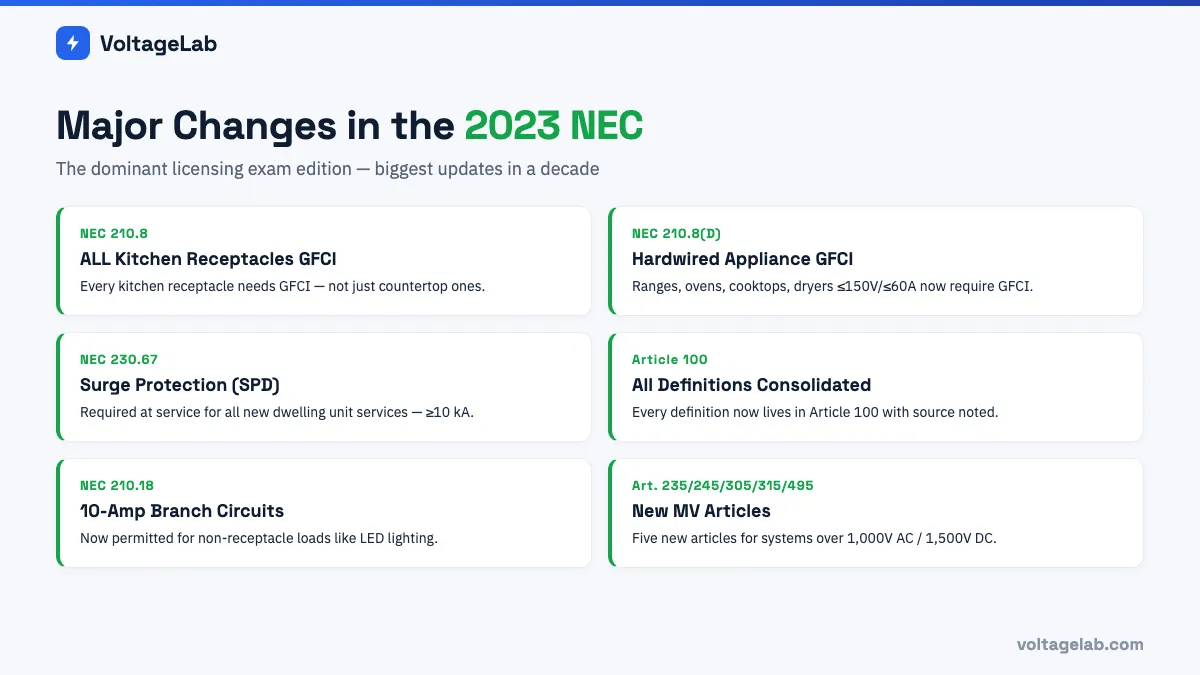
The 2023 NEC made some of the most sweeping changes in recent cycles. Candidates on 2023 NEC exams must know these differences from the 2020 edition.
GFCI Major Expansions (NEC 210.8)
- All kitchen receptacles: The 2023 NEC requires GFCI for all kitchen receptacles — not just countertop receptacles. Any receptacle in the kitchen space needs GFCI regardless of distance from a sink.
- Hardwired appliances: GFCI is now required for hardwired electric ranges, wall ovens, cooktops, microwaves, and clothes dryers rated 150V or less to ground and ≤60A. This extends GFCI beyond receptacle outlets for the first time.
- Laundry areas added to dwelling unit list
- HVAC outdoor equipment removed: The outdoor HVAC receptacle GFCI requirement added in 2020 was removed in 2023
Article 100 Reorganization
The 2023 NEC significantly reorganized Article 100 (Definitions) by consolidating all definitions into a single article. Previous editions scattered article-specific definitions throughout each article. In the 2023 edition, all definitions appear in Article 100, with the originating article noted in parentheses.
Study smarter with VoltageLab
Built for electricians, apprentices, and electrical engineers who want faster practice and better exam prep.
⭐️ Join thousands of electricians upgrading their skills
New Medium Voltage Articles
The 2023 NEC created five new articles for systems over 1,000 volts:
- Article 235 — Branch circuits, feeders, services over 1,000V AC / 1,500V DC
- Article 245 — Overcurrent protection over 1,000V AC / 1,500V DC
- Article 305 — Wiring methods over 1,000V AC / 1,500V DC
- Article 315 — Type MV cable (replaced former Article 311)
- Article 495 — Equipment over 1,000V AC / 1,500V DC
EV Charging — Article 625
Article 625 (Electric Vehicle Power Transfer Systems) was completely reorganized in the 2023 NEC to reflect EV charging infrastructure growth. New NEC 220.57 added EVSE (Electric Vehicle Supply Equipment) load requirements for load calculations.
Surge Protection Devices (NEC 230.67)
Surge protection at the service for dwelling units was first required by the 2020 NEC (new 230.67), and the 2023 NEC carries it forward and extends it to dormitory units, hotel and motel guest rooms, and nursing-home patient sleeping rooms. SPDs must have a nominal discharge current rating of at least 10 kiloamperes.
Emergency Disconnects (NEC 230.85)
The emergency disconnect requirement introduced in the 2020 NEC (effective January 1, 2023) continued in the 2023 code cycle.
10-Ampere Branch Circuits
The 2023 NEC added 10-ampere to the permitted branch circuit ratings in NEC 210.18 for non-receptacle loads such as LED lighting and low-power control circuits.
IBT Location Expansion (NEC 250.94)
The 2023 NEC added “at the service equipment” as an additional permitted location for intersystem bonding termination (IBT) installation.
Key Changes in the 2026 NEC
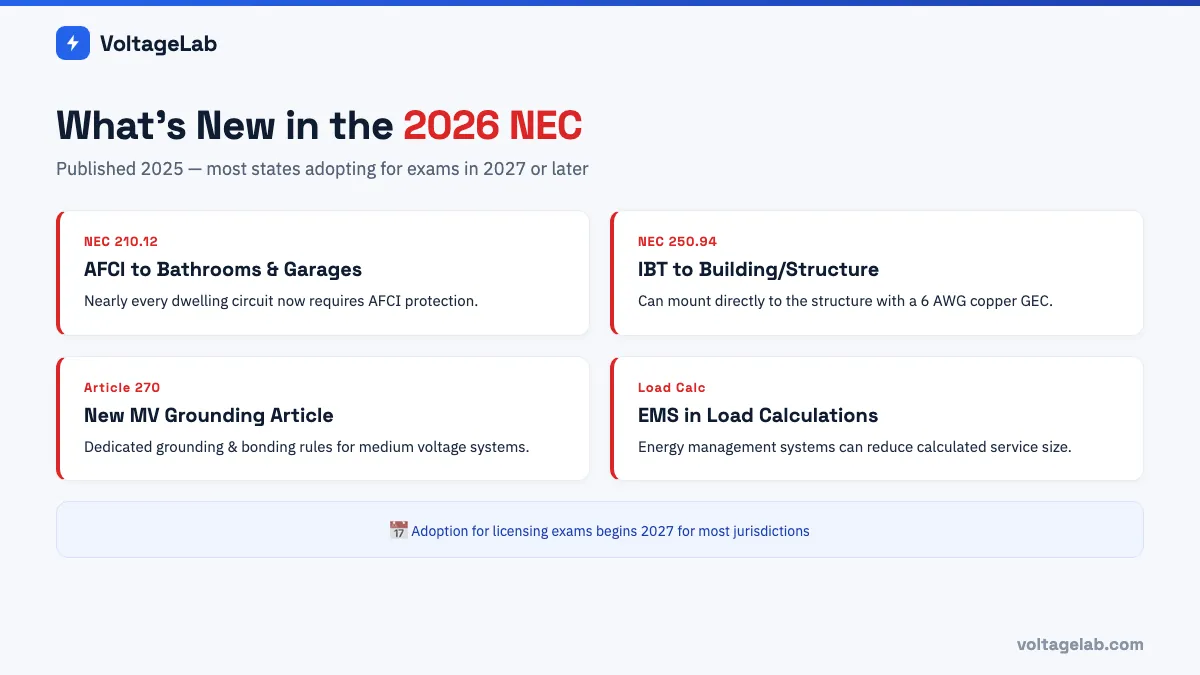
The 2026 NEC was published in 2025 and is in early stages of state adoption as of 2026. Most states will not have adopted the 2026 edition for exam purposes until 2027 or later. The following are the most significant changes for electricians to be aware of as adoption progresses.
AFCI Expansion to Bathrooms and Garages
The 2026 NEC expanded AFCI requirements to include bathrooms and garages in dwelling units — areas that were previously exempt from NEC 210.12 AFCI requirements. This means virtually every circuit in a new dwelling unit requires AFCI protection in jurisdictions adopting the 2026 edition.
IBT Location Further Expanded (NEC 250.94)
The 2026 NEC added the option to mount the intersystem bonding termination (IBT) directly to the building or structure — provided the connection is made with a minimum 6 AWG copper grounding electrode conductor. This addresses practical jobsite conditions where mounting to a metal enclosure is impractical.
Medium Voltage Expansion (Article 315)
Article 315 received expanded construction and insulation specifications in 2026, aligning with UL 1072-2023 and ANSI/ICEA standards. New ampacity adjustments and insulation level guidelines were added.
New Article 270 — MV Grounding and Bonding
The 2026 NEC added Article 270 to address grounding and bonding requirements specifically for medium voltage systems.
Load Calculation Changes for EMS
The 2026 NEC introduced provisions allowing energy management systems (EMS) to be factored into load calculations, potentially allowing smaller service sizes when an EMS is properly designed and documented.
Edition-by-Edition Comparison: High-Impact Items for Exams
| Topic | 2017 NEC | 2020 NEC | 2023 NEC |
|---|---|---|---|
| Kitchen GFCI (210.8) | Countertop only | Countertop + within 6 ft of sink | All kitchen receptacles |
| Basement GFCI (210.8) | Unfinished only | All basements (finished and unfinished) | All basements (same as 2020) |
| Hardwired appliance GFCI | None | None | Required for ranges, ovens, dryers ≤150V/≤60A |
| 240V receptacle GFCI | Not required most locations | Required in listed locations | Same as 2020 |
| AFCI scope | Kitchens, laundry and most habitable rooms (kitchens and laundry added in 2014) | Carried forward | Virtually all rooms in dwelling unit |
| Emergency disconnect (230.85) | Not required | Required for 1&2 family dwellings (effective Jan 1, 2023) | Same as 2020 (effective) |
| Surge protection (230.67) | Not required | Required at service for dwelling units (new 230.67) | Required; extended to dormitories, guest rooms and patient sleeping rooms |
| Medium voltage articles | Article 328 (Type MV cable) | New Article 311 (MV conductors and cable) | New Articles 235, 245, 305, 315, 495 |
| 10A branch circuits | Not permitted (min. 15A) | Not permitted | Permitted for non-receptacle loads (210.18) |
| Article 100 organization | Definitions in each article | Definitions in each article | All definitions consolidated in Article 100 |
How to Find Which NEC Edition Your State Uses for the Licensing Exam
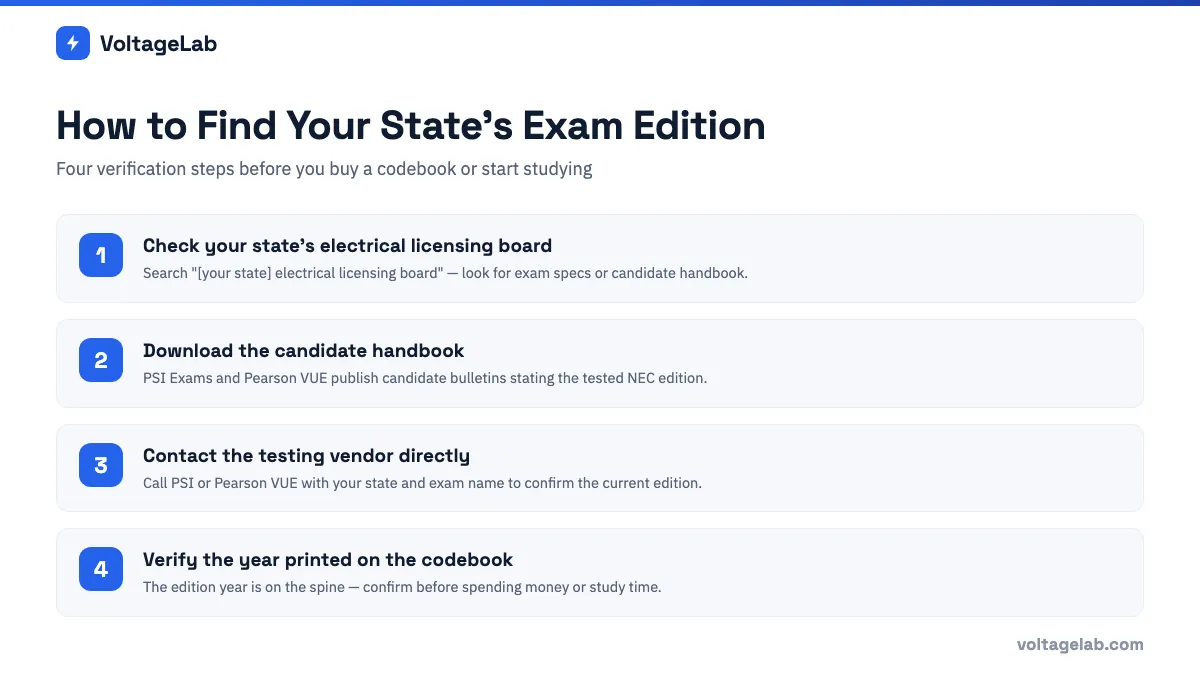
Follow these steps — in order:
- Check your state’s electrical licensing board website. Search “[your state] electrical licensing board” or “[your state] department of labor electrician license.” Look for exam information, candidate handbook, or exam specifications.
- Download the candidate handbook from your testing vendor. PSI Exams and Pearson VUE both publish candidate information bulletins for each state exam. These explicitly state which NEC edition is tested and which reference materials are permitted.
- Contact the testing vendor directly. If you cannot find the edition online, call PSI or Pearson VUE customer service with your state and the specific exam name. They can confirm the current edition.
- Verify the specific NEC edition of the book you purchase. The edition year is printed on the spine and cover of the NEC codebook. Confirm it matches your state’s exam edition before investing study time and money.
Do not: Assume the most recent published edition is the one your state uses. As of 2026, the 2023 NEC is the most common exam edition, but several states still use 2020 for their exams. Studying the wrong edition wastes preparation time and can cause you to answer exam questions incorrectly.
Conclusion
The NEC is a living document that evolves with electrical technology and safety research. The 2020 NEC brought important GFCI expansions and the emergency disconnect requirement. The 2023 NEC made sweeping changes to GFCI coverage (all kitchen receptacles, hardwired appliances), reorganized Article 100, created five new medium voltage articles, and added surge protection requirements for residential services. The 2026 NEC expands AFCI to bathrooms and garages.
For any licensing exam, verifying your state’s adopted exam edition is the single most important first step. Study the right edition, tab it thoroughly, and the content differences between editions become manageable — they are targeted changes to specific articles, not wholesale rewrites.
For the complete guide to preparing for your state’s exam, see Journeyman Electrician Exam 2026: What It Covers & How to Pass.
📱 Ready to pass the journeyman exam?
VoltageLab gives you AI-generated NEC practice questions on the exact edition your state tests on — 2020, 2023, or 2026. Plus timed mock exams, flashcards, custom study plans, and an interactive circuit simulator. Free on iOS and Android.
Frequently Asked Questions
Which NEC edition is most states using for the licensing exam in 2026?
As of 2026, the 2023 NEC is the most widely adopted edition for licensing exams across the United States. However, a significant number of states — including Florida, Alabama, and others — still test on the 2020 NEC. A few jurisdictions use the 2017 NEC for specific occupancy types. Always verify with your state’s licensing board or testing vendor (PSI or Pearson VUE) before studying or purchasing materials.
What are the biggest changes between the 2020 and 2023 NEC?
The most significant exam-relevant changes from 2020 to 2023 include: GFCI protection expanded to all kitchen receptacles (not just countertop); GFCI now required for hardwired appliances including electric ranges, ovens, and dryers rated ≤150V/≤60A; surge protection devices required at services for new dwelling units; five new medium voltage articles (235, 245, 305, 315, 495); Article 100 reorganized to consolidate all definitions; and 10-ampere branch circuits permitted for non-receptacle loads.
Does the 2017 NEC still apply anywhere in the US?
Yes, but in very limited applications. As of 2026, Kansas and Indiana are among the few jurisdictions where the 2017 NEC still governs certain building types. Most states have moved to the 2020 or 2023 NEC. If you are working in or testing for a jurisdiction that still uses the 2017 NEC, confirm with the local AHJ or testing board which edition applies to your specific project or exam type.
What did the 2020 NEC change that most impacts everyday electricians?
For most residential electricians, the most impactful 2020 NEC changes were: GFCI required in all basements (not just unfinished), GFCI extended to 240-volt receptacles in required locations, GFCI within 6 feet of any sink in any area of a dwelling (not just kitchen sinks), AFCI expansion to kitchens and laundry areas, and the emergency disconnect requirement (NEC 230.85) for one- and two-family dwellings.
When will the 2026 NEC be on the licensing exam?
Most states will not adopt the 2026 NEC for licensing exam purposes until 2027 or later. State adoption is a legislative or regulatory process that typically takes 1–3 years after NFPA publication. As of 2026, the exam-relevant edition for most states is the 2023 NEC. Check your state licensing board’s website or the testing vendor (PSI or Pearson VUE) for any updates on when your state plans to transition to the 2026 edition for exam purposes.
More NEC Edition Questions
What is the next edition of the NEC?
The 2029 NEC. NFPA publishes a new edition of NFPA 70 every three years, so the edition after 2026 is 2029.
Is the 2026 NEC code book out?
Yes. NFPA published the 2026 NEC in 2025. Being published does not mean it is enforced: each state adopts it on its own schedule, and most will not inspect or test to it until 2027 or later.
What changed from the 2017 NEC to the 2023 NEC?
The biggest changes across those two cycles: surge protection at dwelling services (230.67) and the outdoor emergency disconnect (230.85) arrived in 2020, GFCI protection expanded in both 2020 and 2023, and the 2023 NEC consolidated all definitions into Article 100, added 10-ampere branch circuits and created new medium-voltage articles.
FREE PRACTICE TOOL
Think you'd pass this on a real exam?
Test what you just read with instant-feedback quizzes built around real code questions — not generic trivia.
5
Code standards
10,000+
Active learners
100%
Free to start
Instant explanations on every answer, right or wrong
NEC, BS7671, AS/NZS, CEC, and DIN VDE covered
Bite-sized quizzes you can finish in 5 minutes
No signup required to try your first quiz
No account needed · Takes less than 2 minutes