


On a Monday morning at the Electrical Training Center on Covern Street, the line starts forming well before 9:00. Some of the people in it will leave with their paperwork accepted. Others drove across Houston to be turned away for a photocopied Social Security card, a personal check, or a transcript that never shows a full credit of algebra.
None of those people failed a test. They failed the paperwork, and at the Houston JATC the paperwork has hard rules. The program gets about ten applicants for every opening, so the committee has no reason to chase a missing document or bend a deadline. An incomplete file is voided, and you start again.
Study smarter with VoltageLab
Built for electricians, apprentices, and electrical engineers who want faster practice and better exam prep.
⭐️ Join thousands of electricians upgrading their skills
This guide covers what the Houston Electrical JATC is, who qualifies, every document you need and how to submit it, the new online application that opens in November 2026, what the aptitude test covers, how the program compares with the other routes into the trade in Houston, and the mistakes that cost applicants a place in line.
Quick Answer
The Houston JATC (Houston Electrical Joint Apprenticeship and Training Committee) is the IBEW Local 716 and NECA apprenticeship for inside electricians in the Houston area. It runs from the Electrical Training Center at 108 Covern St., Houston, TX 77061. To apply you need to be at least 18, have a high school diploma or GED with one full credit of algebra, and hold a Texas TDLR Apprentice Electrician License.
From November 2026, you apply online. You then have 30 calendar days to bring in your documents in person: a $30 money order, your original driver’s license and Social Security card, official transcripts and proof of your TDLR license. If anything is missing at the end of that window, your application is voided.
Key Takeaways
- Houston JATC applications were closed from August 1 to October 31, 2026, and move online starting in November 2026
- The application fee is $30, payable by money order only, with no cash, checks or cards
- Your driver’s license and Social Security card must be the original physical cards, with no copies and no digital versions
- You need a Texas TDLR Apprentice Electrician License ($20) before you apply, not after you are accepted
- Your transcript must show one full credit of algebra, sent sealed from the school or emailed directly by the school
- Documents are only accepted Mondays 9–11 AM and Wednesdays 1–3 PM, and you must be inside and in line before the cut-off
- The program is 8,000 hours of paid on-the-job training plus 180 classroom hours a year for four years
What the Houston JATC actually is
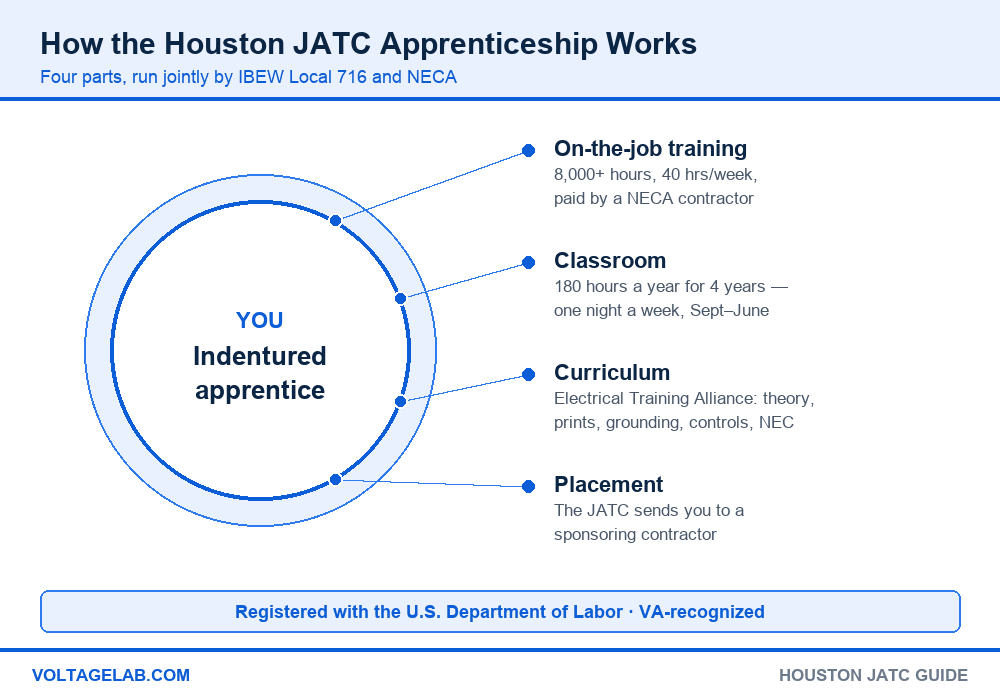
The Houston Electrical JATC is the local training arm of a national partnership between the International Brotherhood of Electrical Workers (IBEW) and the National Electrical Contractors Association (NECA). Labor and management sponsor it jointly, and it is registered as an apprenticeship program with the U.S. Department of Labor. The union side in Houston is IBEW Local 716.
Study smarter with VoltageLab
Built for electricians, apprentices, and electrical engineers who want faster practice and better exam prep.
Join thousands of electricians upgrading their skills
The program has four parts:
- On-the-job training. At least 8,000 hours working full time, 40 hours a week year-round, for a NECA signatory contractor under journeyman electricians.
- Classroom. 180 hours a year for four years. In practice that is one night a week, four hours a night, generally September through June.
- Curriculum. Written and updated by the Electrical Training Alliance. It covers electrical theory, print reading, grounding, controls, communication equipment, test equipment, pipe bending and the National Electrical Code.
- Placement. The JATC places you with a sponsoring contractor when work is available. You do not have to find your own employer first.
That last point is the biggest practical difference from most other routes. In a merit-shop program you usually need to be hired before you can enroll. At the JATC, the committee sends you out to the contractor.
What JATC stands for
- J — Joint: run equally by the union (IBEW) and the contractors (NECA)
- A — Apprenticeship: a registered, indentured training program, not a school you pay to attend
- T — Training
- C — Committee: the labor-management board that interviews, ranks and selects apprentices
You will also see the Houston program called the Electrical Training Center, which is the name on the building. The national body was once called the NJATC and is now the Electrical Training Alliance. The Houston site uses both names.
The aptitude test — what the Electrical Training Alliance exam covers
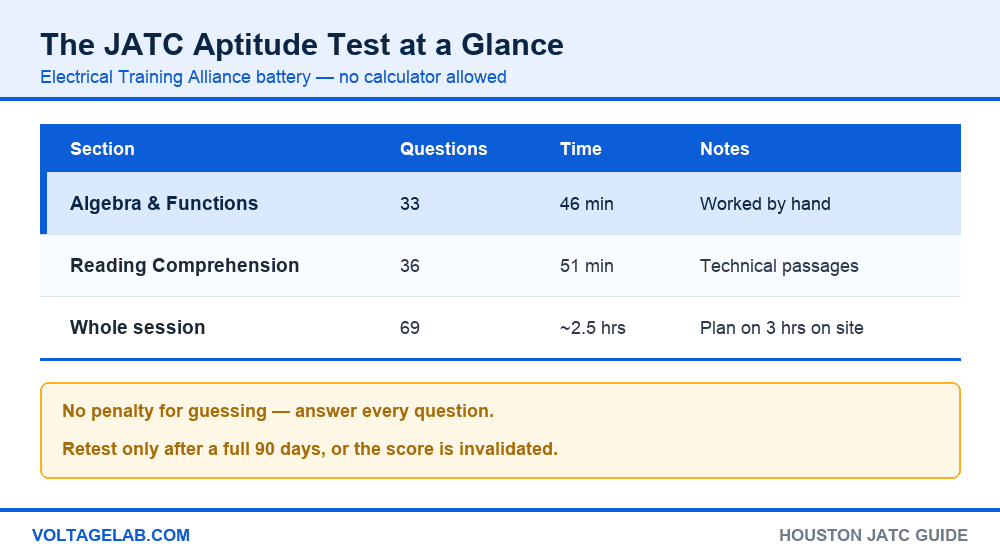
After the JATC confirms you meet the minimum requirements and have turned in every document, you become eligible to sit the Electrical Training Alliance aptitude test. It is the same two-part battery used by IBEW/NECA programs across the country:
| Section | Questions | Time | What it tests |
|---|---|---|---|
| Algebra and Functions | 33 | 46 minutes | Algebra and functions, worked by hand with no calculator — the section most worth practicing |
| Reading Comprehension | 36 | 51 minutes | Technical passages and questions on what they state and imply |
| Whole session | 69 | About 2.5 hours | Includes instructions and a short break, so plan on about 3 hours at the test site |
Calculators are not allowed, and a watch with a calculator has to come off. There is no penalty for guessing, so never leave a question blank. You will not see your score. The Electrical Training Alliance only tells you whether it was a qualifying score, and results reach the JATC about two to four weeks after the test. You do not need any electrical knowledge, and no formulas have to be memorized.
The retest trap: if you do not qualify, you must wait a full 90 days from your last test date before you retest, and the Electrical Training Alliance sets a six-month wait after each later retest. Testing early, even at a different JATC, invalidates the score and adds another 90 days. Willful violations can disqualify you permanently. Write your test date down and count the days before you reapply anywhere.
Bring a photo ID to the test, because the rule is no ID, no test. Arrive at least 15 minutes early and arrange childcare in advance, since children are not allowed in the testing room. If you need a structured way to brush up on algebra and reading, the practice approach we use for the NEC practice test works the same way: timed sets, every miss reviewed, done daily rather than crammed.
How to apply to the Houston JATC — documents, fees and drop-off hours
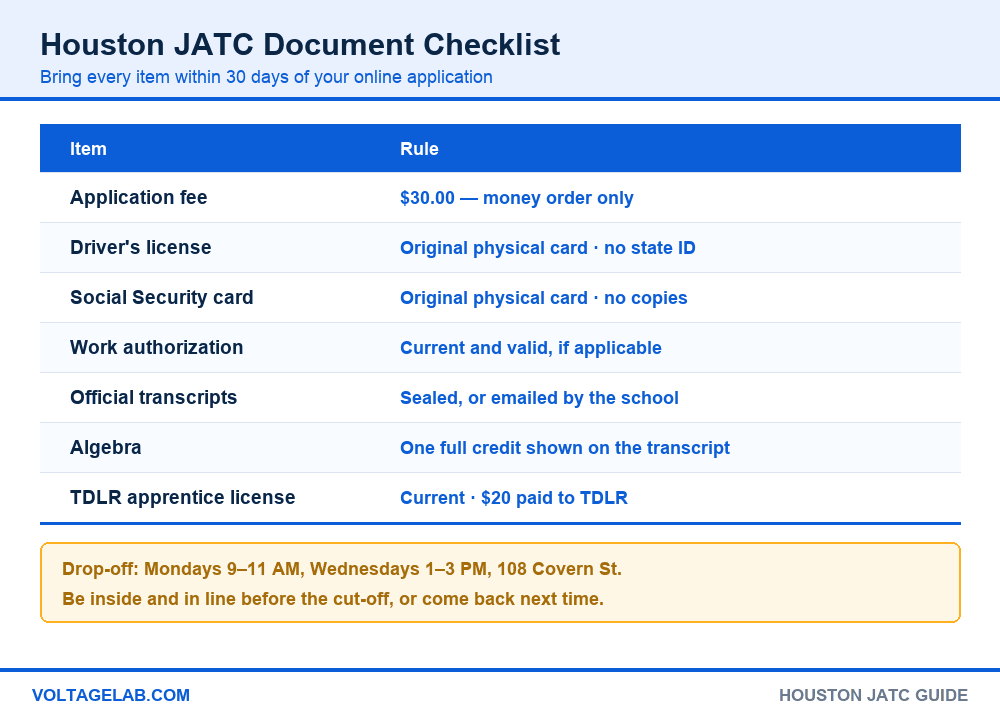
The Houston JATC moved to a two-stage process. You submit the application online, then bring every required document to the training center in person within 30 calendar days. Applications were closed from August 1 to October 31, 2026, and the online application link goes live on houstonjatc.com in November 2026.
| Required item | Exact rule | Most common reason it is refused |
|---|---|---|
| Application fee | $30.00, money order only | Cash, personal check or card offered |
| Driver’s license | Original, valid, physical card | Photocopy, phone photo or expired license |
| Social Security card | Original physical card, plus work authorization if applicable | Photocopy or digital image |
| Official transcripts | Must show one full credit of algebra, graduation date (GED accepted) and any degree | Opened envelope, or a transcript you forwarded yourself |
| TDLR Apprentice Electrician License | Current license, $20 fee paid to TDLR separately | Applying for it after the JATC application |
| Drop-off window | Mondays 9:00–11:00 AM, Wednesdays 1:00–3:00 PM | Arriving in the parking lot after the cut-off |
The application, step by step
Step 1 — get your TDLR Apprentice Electrician License. Apply online through the Texas Department of Licensing and Regulation. The fee is $20, and there is no exam or experience requirement. TDLR runs a criminal history check, and if you have any convictions you send a criminal history questionnaire with the application, which can add one to six weeks. Applicants with no convictions who register online are issued a temporary license automatically. The license is good for one year and renews annually.
Step 2 — order your official transcripts now. Have your high school or college send them either in a sealed envelope or electronically, directly to staff@houstonjatc.com from the school or an authorized transcript service. The JATC keeps accepting transcripts during the closure period, so this is the step to finish first.
Step 3 — buy the money order. Get a $30.00 money order. That is the only form of payment the JATC accepts.
Step 4 — submit the online application. Once the link goes live in November 2026, complete it. Your 30-day clock starts on the date you submit it, so finish steps 1 to 3 before you click submit.
Study smarter with VoltageLab
Built for electricians, apprentices, and electrical engineers who want faster practice and better exam prep.
⭐️ Join thousands of electricians upgrading their skills
Step 5 — drop off your documents in person. Bring everything to 108 Covern St. on a Monday between 9:00 and 11:00 AM or a Wednesday between 1:00 and 3:00 PM. You must be inside the building and in line before the cut-off time.
Step 6 — test, interview, rank. Qualified applicants with complete files sit the aptitude test. Applicants with qualifying scores interview with the JATC committee and receive an interview score, which places them on a ranking list. As contractors ask for apprentices, the committee selects from the top of that list.
The one that catches everyone: the algebra credit has to be on the official transcript. Telling the committee you took algebra does not count, and neither does a diploma on its own. If your transcript shows pre-algebra, a half credit or “math 1”, get a full algebra credit at a community college before you apply. The Houston JATC’s own homepage repeats it: all applicants must provide proof of credit for algebra.
Who qualifies for the Houston JATC — and who does not
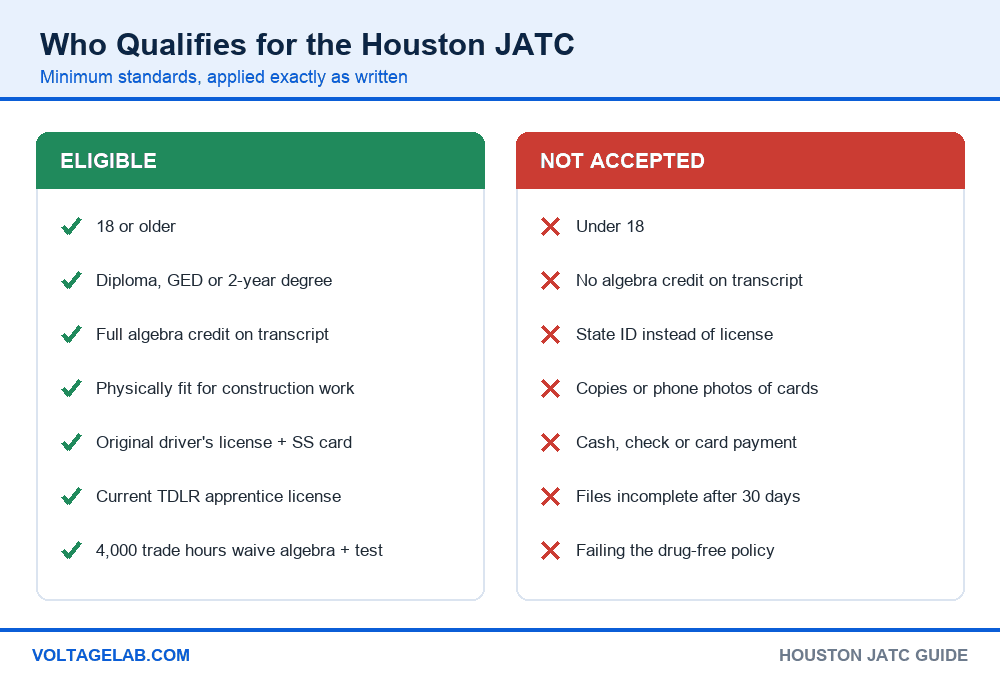
The minimum standards are short, and the committee applies them exactly as written. You do not need any prior electrical experience to apply.
Eligible
- At least 18 years old
- A high school diploma, a GED, or a two-year or higher college degree
- One year of high school or college algebra with a passing grade, shown on an official transcript
- Physically fit and able to do construction work in all weather
- A valid driver’s license and Social Security card, plus work authorization if it applies to you
- A current TDLR Apprentice Electrician License
- Veterans, who can use VA education benefits because the program is VA-recognized
Not accepted
- Applicants under 18, even with a diploma in hand
- A transcript with no full algebra credit
- A state ID offered in place of a driver’s license
- Photocopies or digital versions of your license or Social Security card
- Payment by cash, check, credit or debit card
- Files still incomplete 30 days after the online application
- Anyone unwilling to work under a drug-free policy with scheduled and random testing
The 4,000-hour experience route
If you already work in the trade, the JATC can exempt you from the algebra and aptitude test requirements if you can document 4,000 hours of on-the-job experience in electrical construction. Bring proof such as pay stubs, W-2s or letters from employers. If you have experience but cannot qualify for apprenticeship, the JATC directs you to IBEW Local 716 at 713-869-8900, which places experienced workers at other classifications.
Houston JATC vs other ways into the trade in Houston
All four routes end at the same place: 8,000 hours of supervised on-the-job training, which is what Texas requires before you can sit the TDLR journeyman exam. What differs is cost, who finds you the job, and how competitive it is to get in.
| Factor | Houston JATC (IBEW/NECA) | Merit-shop (IEC / ABC) | Trade school first | Direct hire |
|---|---|---|---|---|
| Need a job before you start | No, JATC places you | Usually yes | No | Yes |
| Paid while training | Yes, from day one | Yes | No, until hired | Yes |
| Your training cost | Mostly covered | Tuition, often employer-shared | Full tuition | None, but no classroom |
| Health and pension | Same plans as journeymen | Depends on employer | Depends on later employer | Depends on employer |
| Entry test | Aptitude test plus interview | Varies | Usually none | Employer interview |
| How hard to get in | About 10 applicants per opening | As hard as getting hired | Open enrollment | As hard as getting hired |
The JATC figures come from the Houston JATC’s own FAQ. It spends about $4,500 a year to train each apprentice, and most accepted apprentices qualify for industry and government scholarships that cover the majority of that cost. Starting pay is listed at $17.33 an hour, with a raise after each completed year. Apprentices are on the same health insurance and pension plans as journeymen, with health coverage starting about five months after full-time work begins.
Whichever route you choose, the journeyman exam at the end is the same. In Texas it is administered by PSI, is open book and needs 70% to pass. Our NEC exam prep guide covers how to study for it, and the NEC edition comparison explains why the code book you train on matters. The math you study for the aptitude test comes back in Ohm’s law problems and voltage drop calculations. For the tools that help on the job, see our roundup of the best electrician apps.
Start learning before day one
Apprentices who already know the vocabulary get more out of the first year in the classroom. The Electrical & Electrician App (also on Android) turns electrical theory, code and calculations into short daily lessons and quizzes you can do on a lunch break.
Is the Houston JATC the right choice for you?
Pros
- Paid full-time work from the start, with a raise after every completed year
- Training costs mostly covered by scholarships rather than student loans
- The JATC places you with a contractor, so you do not job-hunt alone
- Same health insurance and pension plans as journeymen
- A national curriculum covering residential, commercial and industrial work
- VA-recognized, so veterans can draw education benefits
Cons
- About ten applicants per opening, and some apply several times before getting in
- Your start date depends on when contractors call for apprentices
- Strict paperwork rules with no exceptions and a 30-day deadline
- A four-year commitment with night classes on top of a 40-hour week
Getting your Houston JATC application right
Do
- Get the TDLR apprentice license before you submit the online application
- Order transcripts now, as the JATC accepts them during the closure
- Check your transcript for a full algebra credit before anything else
- Arrive at the training center well before the drop-off window opens
- Practice timed algebra without a calculator for several weeks before the test
Avoid
- Submitting online before your documents are ready, which starts the 30-day clock early
- Bringing a state ID, photocopies or phone photos of your cards
- Paying with cash, a check or a card instead of a money order
- Opening the sealed transcript envelope before you hand it in
- Retesting at another JATC inside the 90-day wait
Frequently asked questions
When is the Houston JATC accepting applications?
Applications were closed from August 1 to October 31, 2026. Starting in November 2026, the Houston JATC takes applications online through houstonjatc.com, followed by an in-person document drop-off within 30 days. The committee interviews and accepts apprentices monthly throughout the year, based on industry demand.
How much does it cost to apply to the Houston JATC?
$30 for the JATC application, paid by money order only, plus $20 to TDLR for the Apprentice Electrician License. The two fees are separate, so budget $50 in total.
Where is the Houston JATC located?
The Electrical Training Center, 108 Covern St., Houston, TX 77061. The phone number is (713) 649-2739 and the email is staff@houstonjatc.com. Most classes are held at the same building.
Do I need electrical experience to apply?
No. The program is designed for people with no electrical background. Applicants who can document 4,000 hours of electrical construction experience can be exempted from the algebra and aptitude test requirements.
How much do Houston JATC apprentices make?
The Houston JATC lists a starting wage of $17.33 an hour for electrical apprentices. Pay is a percentage of the journeyman rate and rises after each year you complete. At graduation you move to the full journeyman scale.
How long is the Houston JATC apprenticeship?
Four years: at least 8,000 hours of on-the-job training and 180 classroom hours a year. Class is one night a week, four hours, generally September through June.
Can I use a state ID instead of a driver’s license?
No. The Houston JATC requires an original, valid, physical driver’s license. State IDs, copies and digital versions are not accepted.
What happens if I fail the aptitude test?
You can retest after a full 90 days from your last test date, with a six-month wait after each later retest. Testing early anywhere invalidates the score. Use the wait to practice algebra without a calculator.
The bottom line
The Houston JATC is one of the few ways into the trade where you are paid from the first week, your training is mostly covered, and someone else finds you the job. Getting in comes down to two things: a file that is complete and correct on the first visit, and enough algebra to pass a timed test without a calculator. Get the TDLR license and the transcript sorted before the online application opens in November, and you will be ahead of most of the line.
Four years later you sit the Texas journeyman exam, and every apprentice who passes it has put in the code study along the way. Start early with our free NEC practice test and the 2026 NEC changes.
Your next test
The aptitude test gets you into the program. The journeyman exam at the end is what raises your pay. The NEC Journeyman Exam app (also on Android) gives you 2,700+ NEC practice questions, so you can build a short daily practice habit from your first year.
FREE PRACTICE TOOL
Think you'd pass this on a real exam?
Test what you just read with instant-feedback quizzes built around real code questions — not generic trivia.
5
Code standards
10,000+
Active learners
100%
Free to start
Instant explanations on every answer, right or wrong
NEC, BS7671, AS/NZS, CEC, and DIN VDE covered
Bite-sized quizzes you can finish in 5 minutes
No signup required to try your first quiz
No account needed · Takes less than 2 minutes