


Ask a room of newly licensed journeymen what nearly sank them on the exam and very few say the code. They say the clock. They knew how to size a motor circuit and where GFCI protection goes, but the minutes went into flipping pages for answers they half-remembered, and the last 15 questions got a guess.
That is why the journeyman electrician exam catches good electricians. It is open book, so it feels like a test of what you know. It is really a test of how fast you can find what you know in the National Electrical Code (NFPA 70), under time pressure, with the wording slightly different from how you would say it on the job. Field experience covers maybe half of it. The other half is a skill you have to practise.
Study smarter with VoltageLab
Built for electricians, apprentices, and electrical engineers who want faster practice and better exam prep.
⭐️ Join thousands of electricians upgrading their skills
This guide covers how to pass the journeyman electrician exam: what the test looks like, how it differs from state to state, a 10-week study plan, the NEC articles and calculations that carry the most questions, worked practice questions, and how to run exam day. There is also a short section on what changes when you move up to the master exam.
Quick Answer
To pass the journeyman electrician exam, study the NEC edition your state tests for 8 to 10 weeks. Put the most hours into grounding and bonding, load calculations, conductor ampacity, wiring methods and motors. From the second week, practise finding answers in the code book against a timer. Most state exams have 70 to 100 multiple-choice questions, a time limit of 2½ to 4 hours, and a passing score of 70% or 75%.
The details vary more than most people expect. Each state sets the code edition, the time per question, and whether you may bring your own tabbed code book. Download your state’s candidate bulletin from PSI, Prometric or the licensing board before you buy a book or build a plan.
Key Takeaways
- The journeyman exam is open book. The skill being tested is finding answers in the NEC quickly, not memorising it
- Exam format is set by each state. Maryland allows 3 minutes per question; Michigan allows less than 2
- Code-book rules differ too: some states let you bring your own tabbed book, some allow factory tabs only, and some supply the book
- Grounding and bonding, load calculations, ampacity, wiring methods and motors carry the most questions on most outlines
- An 8–10 week plan of about 8 hours a week, timed from week 2, beats cramming for a month
- Full-length timed practice exams in the last two weeks show you which articles are costing you points
- On exam day, answer lookups and definitions first and leave the long calculations for a second pass
What the journeyman electrician exam actually tests
The journeyman exam is a state licensing test that qualifies you to do electrical work without direct supervision. A testing vendor — usually PSI or Prometric — or the state board itself delivers it as a computer-based, multiple-choice exam. Nearly all of the questions come from the NEC. The rest cover electrical theory and, in many states, the state’s own licensing law and code amendments.
Study smarter with VoltageLab
Built for electricians, apprentices, and electrical engineers who want faster practice and better exam prep.
Join thousands of electricians upgrading their skills
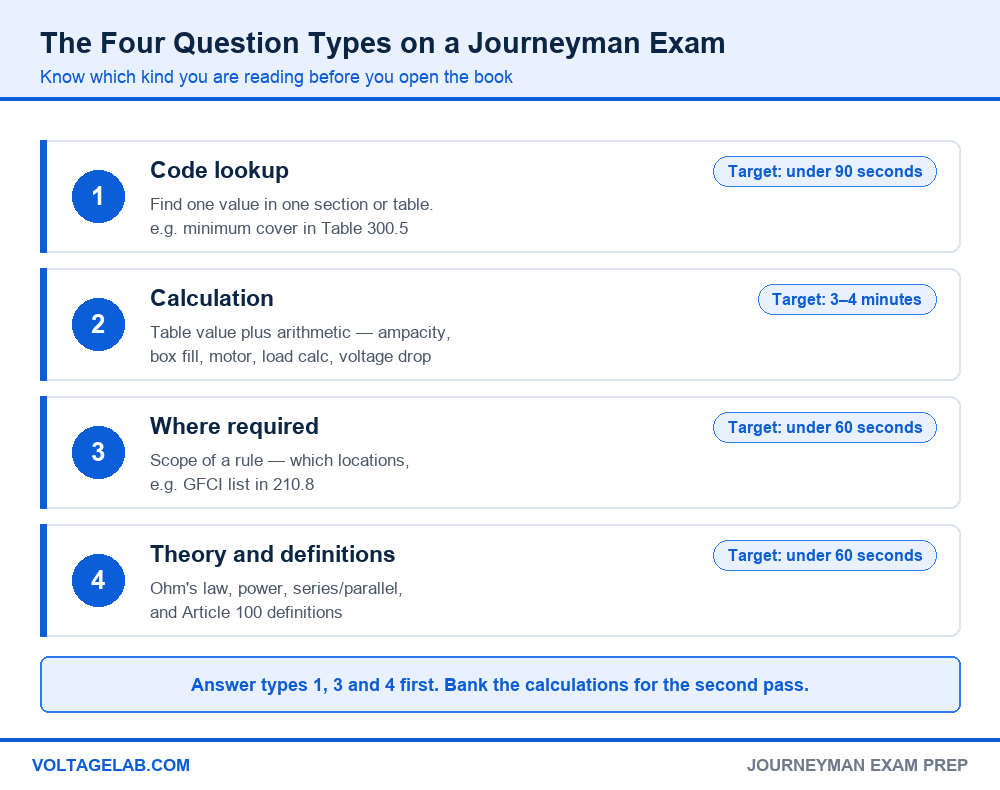
Almost every question is one of four kinds, and knowing which kind you are reading tells you how long it deserves:
- Code lookups. One value from one section or table, such as the minimum cover for a residential branch circuit in Table 300.5. You can answer these quickly if your tabs are good.
- Calculations. A table value plus arithmetic: conductor ampacity after adjustment, box fill, motor circuits, dwelling load calculations, voltage drop. They take the longest and are worth the most practice.
- Where-required questions. The scope of a rule — which locations need GFCI protection under 210.8 or AFCI protection under 210.12. Read every answer option, because the trap is usually one location that sounds right.
- Theory and definitions. Ohm’s law, power, series and parallel circuits, and the exact wording of Article 100 definitions such as branch circuit, feeder and continuous load.
Read your candidate bulletin first
Every state publishes a candidate information bulletin. It gives the content outline (how many questions per topic), the NEC edition, the time limit, the passing score and the reference-book rules. Read it before you spend money on study material. The content outline matters most because it shows where the points are. Colorado’s outline, for example, puts 14 of its 90 scored questions on grounding and bonding. Maryland’s puts 40 of 70 on electrical theory plus wiring and protection.
How journeyman exams differ by state
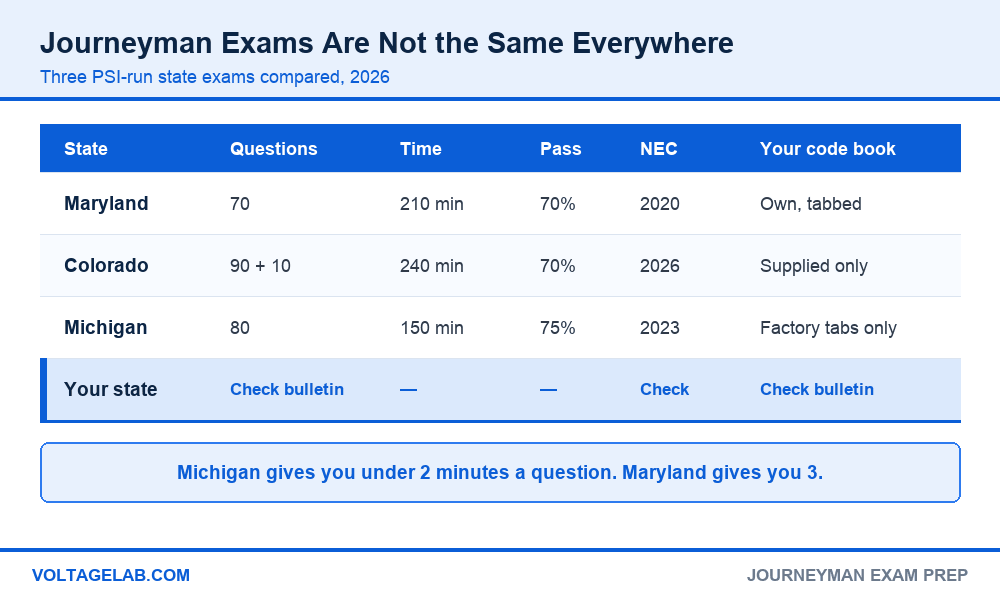
The NEC is national, but the exam is not. These are three PSI-delivered journeyman exams as of 2026, chosen because they differ in almost every way that affects how you study:
| State | Questions / time | Pass mark | NEC edition | Code book rule |
|---|---|---|---|---|
| Maryland | 70 in 210 min (3.0 min each) | 70% (49 correct) | 2020 | Your own book; permanent tabs and highlighting, no notes |
| Colorado | 90 scored + up to 10 unscored in 240 min | 70% (63 correct) | 2026 (from Aug 1, 2026) | PSI supplies the book — you cannot bring or mark one |
| Michigan | 80 in 150 min (1.9 min each) | 75% | 2023 + Michigan Part 8 rules | Soft-bound NEC with factory tabs only |
| Your state | Get all four answers from the current candidate bulletin before you build your plan | |||
The time per question decides how you practise. With 3 minutes a question you can look up nearly everything. With under 2 minutes you have to know the common answers already and use the book only to confirm. The book rule decides whether tabbing is part of your preparation or a waste of an afternoon. If your state supplies the book, practise on an untabbed copy.
The edition trap: the exam follows the NEC edition your state has adopted for the test, which may not be the edition enforced on your jobs — and it is often not the edition most study books on the shelf are written for. Section numbers move between cycles: the conductor adjustment factors, for example, moved from 310.15(B)(3)(a) in 2017 to Table 310.15(C)(1) in 2020. Studying the wrong edition means your tabs and your memory point to the wrong places. Our guide to NEC code book editions covers what moved between cycles.
A 10-week journeyman exam study plan
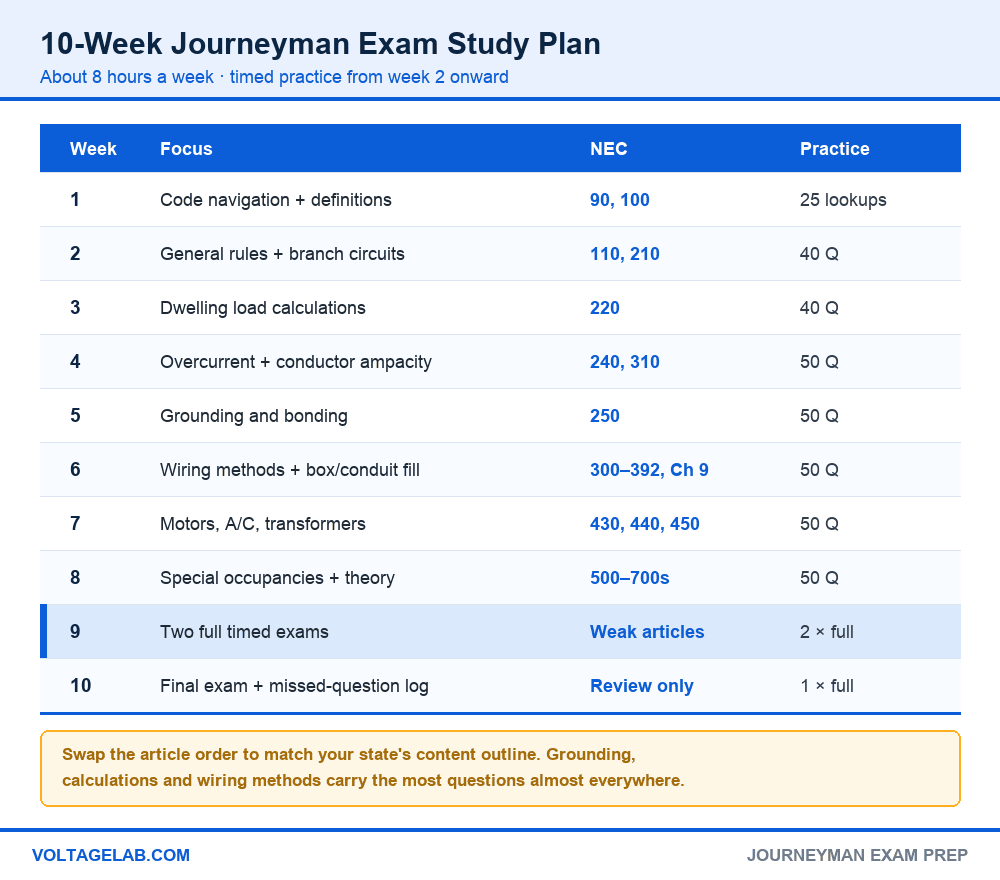
The plan below assumes about 8 hours a week: an hour on weeknights and a longer block at the weekend. It covers the articles in the order most exam outlines weight them. If your state’s outline puts more on a topic, give that week more hours rather than adding a week.
| Week | Focus | NEC articles | Practice target |
|---|---|---|---|
| 1 | Code navigation, tabbing, definitions | 90, 100 | 25 timed lookups |
| 2 | General requirements, branch circuits, GFCI/AFCI | 110, 210 | 40 questions |
| 3 | Dwelling load calculations | 220 | 40 questions |
| 4 | Overcurrent protection, conductor ampacity and adjustment | 240, 310 | 50 questions |
| 5 | Grounding and bonding | 250 | 50 questions |
| 6 | Wiring methods, box fill, conduit fill | 300, 314, 320–392, Chapter 9 | 50 questions |
| 7 | Motors, air conditioning, transformers | 430, 440, 450 | 50 questions |
| 8 | Special occupancies and electrical theory | 500–517, 680, 700–702 | 50 questions |
| 9 | Two full-length timed practice exams | Your weakest articles | 2 full exams |
| 10 | Final timed exam, missed-question log, rest | Review only | 1 full exam |
How to run each study session
Step 1 — read the article with a question in mind. Do not read the NEC like a book. Skim the article’s scope and structure, then read the sections that the practice questions keep returning to.
Step 2 — work 10 to 15 questions on that article against a timer. Give yourself the time per question your state allows. Write the section number next to each answer, even on the ones you knew.
Step 3 — log every miss. Keep one list of every question you got wrong: the section that held the answer and why you missed it (did not know it, could not find it, or misread it). That list becomes your week 9 and 10 study material.
Step 4 — finish with five lookups from earlier weeks. Spaced review is what keeps week 2’s GFCI list from fading by week 8.
The one that catches everyone: practising without a clock. Untimed, most electricians score well — you can find almost anything in the NEC if you have ten minutes. The exam does not give you ten minutes. Divide your state’s time limit by its question count and practise at that pace from week 2. If your untimed and timed scores are more than 10 points apart, your problem is navigation, not knowledge, and more tabbing and lookup drills will fix it faster than more reading.
Practise against the clock
Study smarter with VoltageLab
Built for electricians, apprentices, and electrical engineers who want faster practice and better exam prep.
⭐️ Join thousands of electricians upgrading their skills
NEC Exam Prep by VoltageLab has timed journeyman and master practice questions, both code lookups and calculations, with the NEC section given for every answer, so you can find your weak articles before test day (iPhone · Android).
The NEC articles and calculations worth the most points
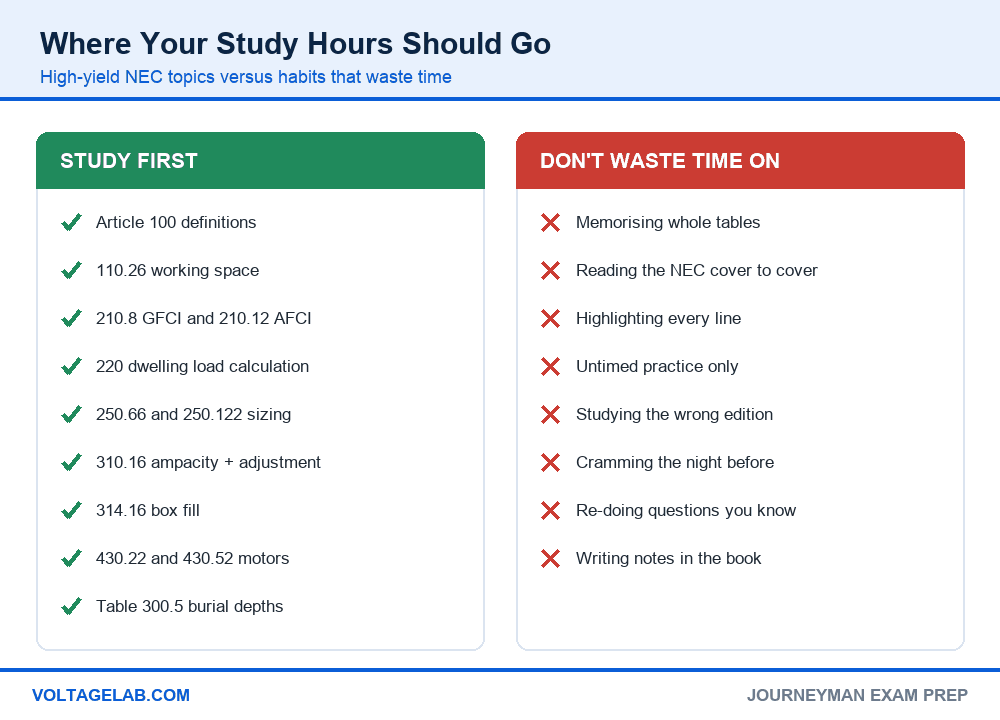
The NEC has well over 900 pages, and exam outlines do not weight them evenly. The articles below show up on almost every journeyman outline. Learn where they are in the book before you learn anything else.
Study these first
- Article 100 — definitions. Many questions turn on whether something is a feeder or a branch circuit, or whether a load is continuous. See our Article 100 definitions guide.
- 110.26 — working space depth, width and headroom. Our breakdown of panel clearance under 110.26 has the three conditions.
- 210.8 and 210.12 — GFCI and AFCI locations, and the branch-circuit ratings in 210.19 to 210.23.
- Article 220 — the standard dwelling load calculation and its demand factors.
- Article 250 — grounding electrode conductor sizing in Table 250.66 and equipment grounding conductor sizing in Table 250.122. See Article 250 explained.
- Table 310.16 — ampacity, plus the temperature correction and conductor-count adjustment in 310.15. Our walkthrough of how to read Table 310.16 covers it.
- 314.16 — box fill, and Chapter 9 conduit fill.
- Article 430 — motor full-load current tables, conductor sizing in 430.22, and short-circuit and ground-fault protection in 430.52.
Habits that waste study time
- Memorising whole tables. Learn where each table is and a few anchor values; look the rest up.
- Reading the NEC front to back. Chapter 8 (communications systems), for example, rarely appears on a journeyman exam.
- Highlighting every line. A page that is all yellow is no faster to scan than one with none.
- Re-working questions you already get right. Your missed-question log is where the points are.
- Writing notes in the book, unless your bulletin says it is allowed. A marked book can be refused at the door.
Five calculations to know by heart
- Continuous loads — the OCPD and conductors must be rated at 125% of the continuous load (210.19(A)(1), 210.20(A)). A continuous load runs 3 hours or more.
- Ampacity with adjustment — start from Table 310.16, multiply by the ambient temperature correction factor and by the Table 310.15(C)(1) factor for more than three current-carrying conductors (80% for 4–6, 70% for 7–9).
- Motor conductors — 125% of the table full-load current, not the nameplate (430.6(A)(1), 430.22).
- Motor branch-circuit protection — table full-load current multiplied by the percentage in 430.52(C)(1), with the next-standard-size allowance in Exception No. 1.
- Voltage drop — VD = 2 × K × I × D ÷ CM for single-phase, with K = 12.9 for copper. The NEC recommends 3% for a branch circuit and 5% total in informational notes; it is not a requirement. Our voltage drop formula guide has more worked examples.
Journeyman practice questions with worked answers
Work each one against a 3-minute timer before reading the answer. Values are from the 2023 NEC; the sections cited have the same numbers in the 2020 edition.
1. A 10 hp, 230 V single-phase motor. What is the minimum ampacity of the branch-circuit conductors?
Table 430.248 gives 50 A full-load current. 430.22 requires 125%: 50 × 1.25 = 62.5 A. Use the table value, not the nameplate — a common distractor is the nameplate current.
2. Same motor, protected by an inverse time breaker. What is the maximum rating?
430.52(C)(1) allows 250% of full-load current: 50 × 2.5 = 125 A, which is a standard size in 240.6(A). If the result were not a standard size, Exception No. 1 would allow the next size up.
3. Six current-carrying 12 AWG THHN copper conductors in one raceway at 30 °C ambient. What is the adjusted ampacity?
Table 310.16 gives 30 A in the 90 °C column. Table 310.15(C)(1) gives 80% for 4–6 conductors: 30 × 0.8 = 24 A. The overcurrent device is still limited to 20 A by 240.4(D).
4. A 4 in. square × 1½ in. deep metal box (21.0 in³) holds one receptacle and three 12-2 NM cables with grounds. Is it legal?
314.16(B): six insulated conductors count 6; all equipment grounding conductors together count 1; the device yoke counts 2. That is 9 volumes × 2.25 in³ = 20.25 in³, which fits in 21.0 in³. Add a cable clamp and it would not.
5. A 2,000 ft² dwelling. What is the general lighting, small-appliance and laundry load after demand factors (standard method)?
Table 220.12: 2,000 × 3 VA = 6,000 VA. Add two small-appliance circuits at 1,500 VA and one laundry circuit at 1,500 VA (220.52): 10,500 VA. Table 220.42: first 3,000 VA at 100%, the remaining 7,500 VA at 35% = 2,625 VA. Total 5,625 VA.
6. A service with 3/0 AWG copper ungrounded conductors. What size copper grounding electrode conductor is required to a concrete-encased electrode?
Table 250.66 gives 4 AWG copper for 2/0 or 3/0, but 250.66(B) says the conductor to a concrete-encased electrode need not be larger than 4 AWG anyway. The answer is 4 AWG copper. Our guide to GEC sizing questions covers the variations.
7. 12 AWG copper, 16 A load, 100 ft one way, 120 V single-phase. What is the voltage drop?
VD = 2 × 12.9 × 16 × 100 ÷ 6,530 cmil (Chapter 9, Table 8) = 6.3 V, or about 5.3%. That exceeds the 3% recommendation. 10 AWG still drops about 4.0 V (3.3%), so the answer to “minimum size to stay within 3%” is 8 AWG, at about 2.5 V.
For 50 more questions with explanations, work through our free NEC practice test.
Self-study vs a prep course vs a practice app
Most electricians pass with some mix of these. What matters is that the mix gives you timed practice on questions written the way the exam writes them.
| Method | Best for | Weak spot | Timed practice? |
|---|---|---|---|
| Code book + exam prep book | Disciplined self-starters on a budget | Easy to drift into reading instead of practising | Only if you time yourself |
| Classroom or online prep course | Calculations, and anyone who needs a schedule | Cost, and a pace set for the class rather than you | Usually, in mock exams |
| Practice question app | Daily repetition in short sessions on the job | Does not teach code-book navigation by itself | Yes |
| Code book + app + timed full exams | Most candidates | Needs the discipline to keep a missed-question log | Yes — the combination that covers both skills |
Whichever method you use, take apart the calculation types the exam repeats. Our exam guides cover voltage drop questions and neutral sizing under 220.61 step by step. If you are deciding between study apps, our comparison of the best electrician apps sets out what each one covers.
Is self-study enough to pass?
Pros
- Costs little more than the code book and a question bank
- You spend your hours on your own weak articles, not the class average
- Fits around overtime and shift work
- Apprenticeship classroom hours have usually covered the theory already
Cons
- No one checks your calculation method until the exam does
- Easy to put off timed practice because untimed scores feel better
- Load calculations are hard to learn from a book alone
If you finished an apprenticeship with classroom hours and are comfortable with Article 220, self-study with a good question bank is usually enough. If load calculations still feel shaky after week 3, a short course aimed at calculations is a better use of money than a full program.
Exam day: what to do and what to avoid
Do
- Write your formulas on the scratch paper before question 1
- Answer lookups and definitions on the first pass; flag long calculations
- Check the clock at every quarter of the question count
- Read the last line of the question first, so you know what you are solving for
- Answer every question — a blank scores the same as a wrong answer
Avoid
- Spending more than double the average time on any one question
- Answering from field habit when the question asks what the NEC says
- Mixing up amps, watts, VA and kVA in calculation answers
- Bringing a book with notes, sticky flags or the wrong edition
- Changing an answer unless you have found the section that proves it wrong
Arrive early with the ID your bulletin requires. Check whether a calculator is provided or you must bring an approved basic model; many states allow only a non-programmable calculator. Most computer-based exams show your pass or fail result before you leave the test centre.
What changes on the master exam
The master exam draws on the same NEC but leans much harder on calculations. Expect more service and feeder sizing, commercial and multifamily load calculations under Article 220, three-phase motor and transformer problems, and, in many states, business and law questions. Most states require several years of journeyman experience before you can sit for it. If your journeyman exam was a few years ago, spend a full week back in Article 220 before you start practice exams.
Frequently asked questions
How many questions are on the journeyman electrician exam?
Most state exams have 70 to 100 multiple-choice questions. Maryland uses 70, Michigan 80, and Colorado 90 scored questions plus up to 10 unscored ones. Check your state’s candidate bulletin for the exact count and time limit.
What score do you need to pass the journeyman exam?
Usually 70% or 75%. Maryland and Colorado require 70%; Michigan requires 75%. A few states report a scaled score instead of a raw percentage, so read how your bulletin defines a pass.
Is the journeyman electrician exam open book?
Almost always, but the book rules differ. Some states let you bring your own NEC with permanent tabs and highlighting. Some allow only factory tabs. Some supply the book at the test centre and do not allow your own. Your bulletin lists exactly what is permitted.
How long should I study for the journeyman exam?
Plan on 8 to 10 weeks at about 8 hours a week if you have recently finished an apprenticeship. Add two to four weeks if load calculations or code navigation are weak, or if it has been several years since your classroom training.
Which NEC edition is on the journeyman exam?
Whichever edition your state has adopted for the test. In 2026 that ranges from the 2020 NEC to the 2026 NEC, depending on the state. Our summary of 2026 NEC changes covers the newest edition.
What is the hardest part of the journeyman exam?
For most candidates it is time, not content. Calculation questions — load calculations, motors and conductor adjustment — take the longest, and running out of time on the last section costs more points than any single topic.
What happens if I fail the journeyman exam?
You can retake it after a waiting period and a new fee. Maryland, for example, allows a retake after 30 days, and Michigan allows two attempts within a year. Use the score report to find the sections where you lost points and rebuild your plan around them.
What is the difference between the journeyman and master exam?
The master exam covers the same NEC with much more weight on service, feeder and commercial load calculations, three-phase and transformer problems, and often business and law. It also usually requires years of experience as a licensed journeyman before you can apply.
The bottom line
Passing the journeyman electrician exam takes two skills: knowing the code, and finding it fast. A field career gives you most of the first. The second only comes from timed practice with the code book open, on questions written the way the exam writes them. Put the most hours into the articles that carry the most points — grounding, load calculations, ampacity, wiring methods and motors — and keep a log of every question you miss.
Get your state’s bulletin first, study the edition it names, and practise at the pace it gives you. When you are ready to test yourself, start with our free 50-question NEC practice test.
FREE PRACTICE TOOL
Think you'd pass this on a real exam?
Test what you just read with instant-feedback quizzes built around real code questions — not generic trivia.
5
Code standards
10,000+
Active learners
100%
Free to start
Instant explanations on every answer, right or wrong
NEC, BS7671, AS/NZS, CEC, and DIN VDE covered
Bite-sized quizzes you can finish in 5 minutes
No signup required to try your first quiz
No account needed · Takes less than 2 minutes