


Turn up to a commercial site in the UK without the right card and you won’t get past the gate. The site manager won’t check whether you can wire a three-phase board. They’ll check your card, and for electricians that card is almost always an ECS card. Hold the wrong one, or one that expired last month, and you’re sitting in the van while the rest of the gang gets inducted.
Getting one is simple once you know the steps, but people trip over the same things. They book the CSCS health and safety test, which ECS doesn’t accept. They pay an agent a booking fee for a test they could book themselves. Or they fail the ECS health and safety assessment by a question or two, because the pass mark is much higher than they expected.
Study smarter with VoltageLab
Built for electricians, apprentices, and electrical engineers who want faster practice and better exam prep.
⭐️ Join thousands of electricians upgrading their skills
This guide explains what the ECS card is, which card you need at each stage of your career, how the ECS Health, Safety and Environmental (HS&E) assessment works and how to pass it, how to apply and renew, and the mistakes that cost people time and money.
Quick Answer
An ECS card is the skills card for the UK electrotechnical industry, run by the JIB under the Electrotechnical Certification Scheme. It shows site managers your occupation and qualifications. Qualified installation electricians hold the ECS Gold Card, which needs a Level 3 NVQ or apprenticeship with the AM2 or AM2S, plus a current 18th Edition qualification. Apprentices, trainees, labourers and experienced workers have their own cards.
Almost every ECS card also needs a pass in the ECS health, safety and environmental assessment: 50 multiple-choice questions in 30 minutes, with 43 correct needed to pass. You can take it online through MyECS with remote invigilation. The CITB test used for CSCS cards isn’t accepted. A pass stays valid for two years for a card application, and most cards last three years.
Key Takeaways
- ECS is the electrotechnical industry’s card scheme, run by the JIB.
- The ECS Gold Card (Installation Electrician) needs a Level 3 NVQ or apprenticeship, the AM2 or AM2S, and the 18th Edition.
- The HS&E assessment is 50 questions in 30 minutes. You need 43 correct, which is 86%.
- Every question comes from the question bank printed in the official ECS revision guide.
- The CITB health and safety test for CSCS cards is not accepted for an ECS card.
- A pass is valid for two years for an application. Most cards last three years.
- You can book and apply yourself through MyECS. You don’t need an agent.
What the ECS card is and why you need one
The Electrotechnical Certification Scheme is the industry’s own card scheme, managed by the Joint Industry Board (JIB). The card carries your photo, your occupation and your qualifications, so a main contractor can check at a glance that you are who you say you are and that you’re trained for the work. On most building sites a recognised skills card is a condition of entry, and for electricians that means ECS.
Study smarter with VoltageLab
Built for electricians, apprentices, and electrical engineers who want faster practice and better exam prep.
Join thousands of electricians upgrading their skills
Decoding the ECS terms: JIB, MyECS, HS&E and Gold Card
- JIB: the Joint Industry Board for the electrical contracting industry, which runs ECS. In Scotland, the SJIB administers the scheme and runs paper-based assessments.
- MyECS: the online account where you book the assessment, upload evidence, apply, pay and renew.
- HS&E assessment: the ECS Health, Safety and Environmental assessment, the test almost every card needs.
- Gold Card: the common name for the ECS Installation Electrician card, the one qualified electricians carry.
- EWA: the Experienced Worker Assessment, for people with years of work but no formal qualification. Its card lasts 18 months and isn’t renewable.
The card on its own doesn’t make anyone safe. What it proves is that you’ve been trained and assessed. On site, the habits that matter are the ones the scheme checks for, starting with the safe isolation procedure and safe handling of live circuits.
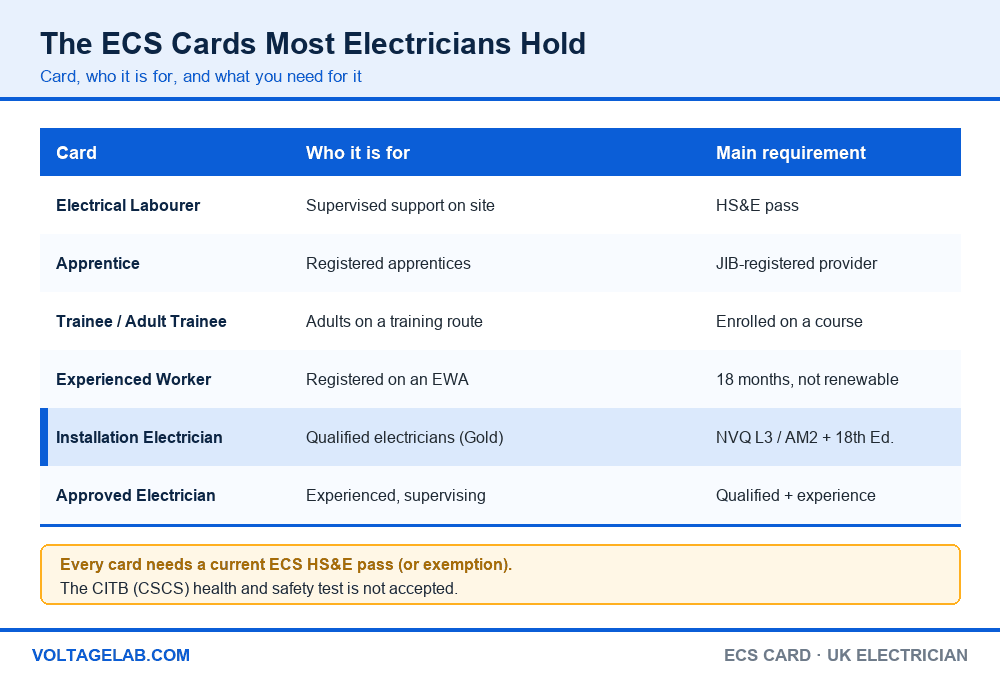
ECS card types compared: which one do you need?
| Card | Who it’s for | What you need |
|---|---|---|
| Electrical Labourer | Labourers and mates working under supervision | ECS HS&E pass |
| Apprentice | Apprentices on the electrotechnical apprenticeship | Registration through a JIB-registered training provider, plus HS&E |
| Trainee / Adult Trainee | Adults working towards a Level 3 qualification | Evidence you’re enrolled on a recognised course, plus HS&E |
| Experienced Worker | Workers registered on an Experienced Worker Assessment | EWA registration. Lasts 18 months, not renewable. |
| Installation Electrician (Gold Card) | Qualified electricians | Level 3 NVQ or apprenticeship, AM2 / AM2S, 18th Edition, HS&E |
| Approved Electrician | Experienced electricians who supervise work | Gold Card qualifications plus further experience and inspection and testing |
| Domestic Installer | Electricians who work in homes only | A recognised domestic qualification, plus HS&E |
ECS also covers specialist trades: fire and security, building management systems, network infrastructure, highways electrical, and manager, supervisor and professional cards. Check the exact requirements for your occupation on the ECS website before you apply, because they change from time to time.
The test that doesn’t count: the CITB health, safety and environment test used for CSCS cards is not accepted for an ECS card. ECS says so plainly on its own assessment page. People book the CITB test because it’s the one everyone on site has heard of, pass it, and then find they have to book and pay for the ECS assessment as well. If you’re an electrician, book the ECS HS&E assessment through MyECS.
The ECS health and safety test: format, topics and pass mark
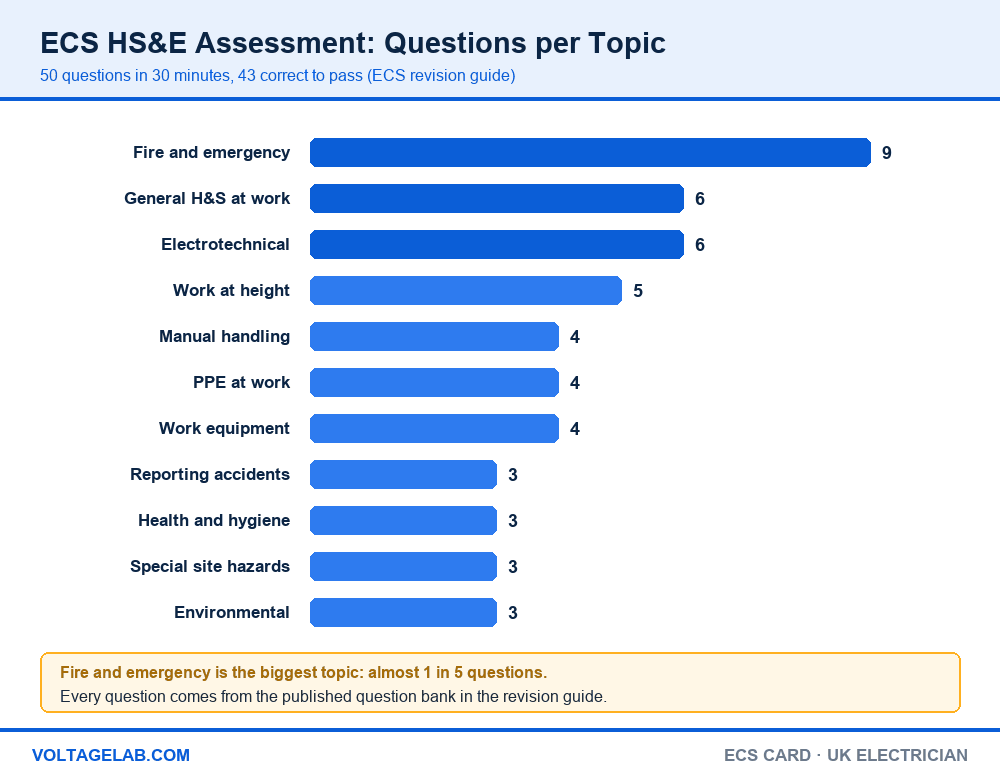
The official ECS revision guide sets out the format. The assessment has 50 multiple-choice questions, drawn at random from the question bank, to be completed in 30 minutes. Each question has one correct answer, and you need 43 correct to pass. The questions are spread across eleven topics.
| Topic | Questions in each assessment |
|---|---|
| Fire and emergency | 9 |
| General health and safety at work | 6 |
| Electrotechnical | 6 |
| Work at height | 5 |
| Manual handling operations | 4 |
| Personal protective equipment at work | 4 |
| Work equipment | 4 |
| Reporting accidents | 3 |
| Health and hygiene | 3 |
| Special site hazards | 3 |
| Environmental | 3 |
How to prepare for the ECS test, step by step
- Get the official revision guide from the ECS website’s preparation and revision section. The guide states that there are no questions in the assessment that aren’t in it.
- Work through it topic by topic, starting with fire and emergency, which carries the most questions.
- Mark the questions you get wrong and go back over them until you get each right twice in a row.
- Do timed runs of 50 questions in 30 minutes. That’s 36 seconds a question, so speed matters as much as knowledge.
- Set up for the remote test: a webcam, a stable connection, a quiet private room and in-date photo ID such as a passport or driving licence.
- Book through MyECS, or through your employer’s portal. Your result appears in MyECS or arrives by email.
The one that catches everyone: the pass mark. 43 out of 50 is 86%, so you can drop only seven questions. People used to a 60 or 70% pass mark go in expecting common sense to carry them, then fail by one or two answers on fire extinguisher types, reporting rules under RIDDOR or work-at-height details. Common sense isn’t enough at 86%. Learn the revision guide.
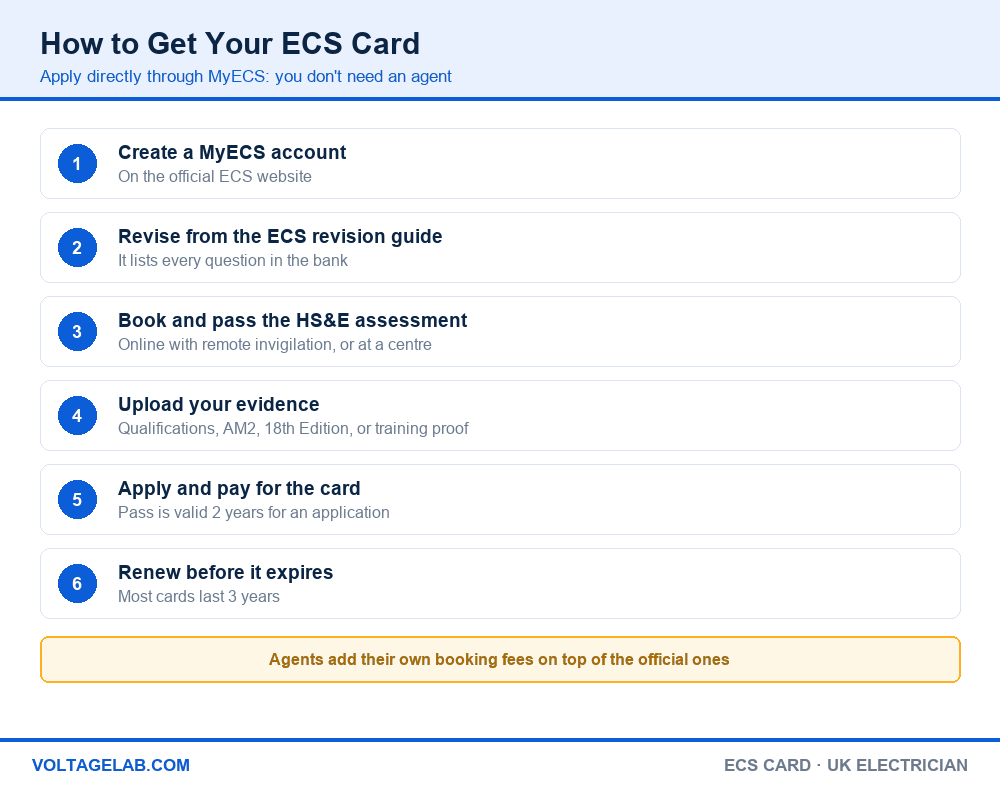
How to apply for an ECS card
What you’ll need to apply
- A MyECS account on the official ECS website
- A current HS&E assessment pass, taken within the last two years, or a valid exemption
- A passport-style photo and photo ID
- Evidence for your card: qualification certificates, an AM2 or AM2S certificate and an 18th Edition certificate for the Gold Card, or proof of registration for an apprentice, trainee or EWA card
- The card fee, paid through MyECS. JIB member firms’ employees can get reduced rates.
What slows an application down
- An HS&E pass more than two years old, so you have to sit it again
- Missing or unclear certificate scans, especially for the AM2 and 18th Edition
- Applying for the wrong card for your qualifications
- Paper applications, which are slower than applying online and can cost extra
- Using a third-party agent, which adds fees and another step
Check the current fees in MyECS or on the ECS fees page before you pay. ECS warns that agents add their own charges on top of the official fees, and that you don’t need one to book the assessment or apply for a card.
ECS vs CSCS and other site cards
| Card | Run by | For | Health and safety test |
|---|---|---|---|
| ECS | JIB (SJIB in Scotland) | Electricians and electrotechnical trades | ECS HS&E assessment |
| CSCS | CSCS | General construction trades and labourers | CITB HS&E test, not accepted for ECS |
| Other partner schemes | Trade bodies, such as those for plumbing and plant | Their own trades | Set by each scheme |
For an electrician, ECS is the card that shows your trade. A CSCS labourer card says nothing about your electrical qualifications. To learn the electrical side behind those qualifications, start with why earthing rules matter, the types of MCB and open, short and closed circuits. If you’re earlier in the journey, how long it takes to become an electrician sets out each stage.
Is the ECS Gold Card worth it?
Pros
- Gets you onto most commercial and industrial sites.
- Proves your qualifications without carrying certificates around.
- Recognised by contractors and agencies across the UK.
- Links to JIB grading and pay at member firms.
Cons
- It has to be renewed, usually every three years, with fees each time.
- Domestic-only electricians may rarely be asked for it.
Passing the ECS test first time
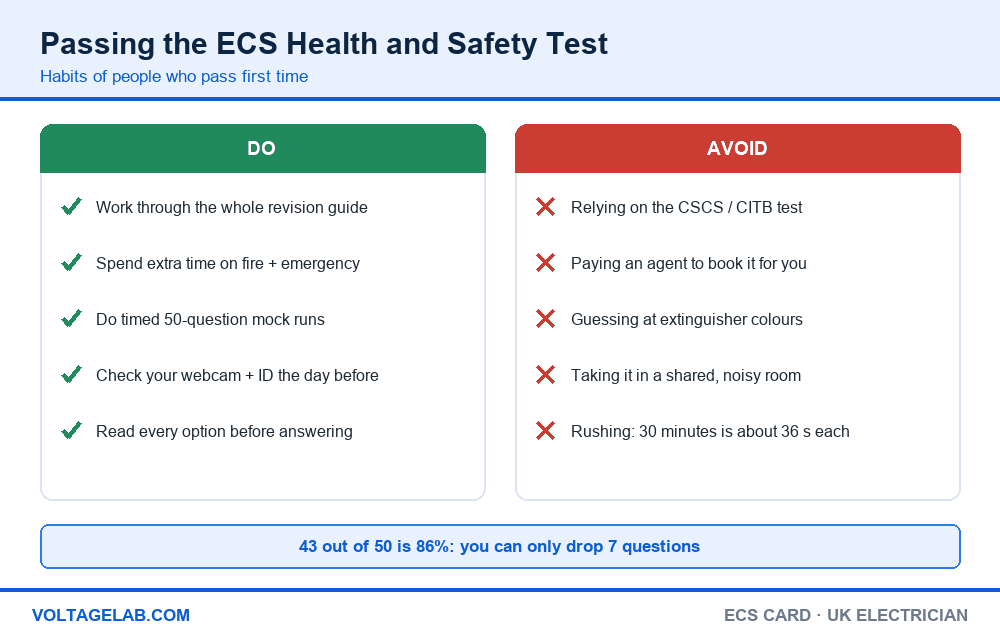
Do
- Work through the whole official revision guide, not a sample.
- Learn the extinguisher types and which fires each one is for.
- Practise 50 questions against a 30-minute timer.
- Test your webcam, connection and ID the day before.
- Apply for your card well within the two years your pass is valid.
Avoid
- Booking the CITB test for an ECS card.
- Paying an agent’s booking fee.
- Relying on site common sense at an 86% pass mark.
- Sitting a remote test in a shared or noisy room.
- Letting your card expire before you renew it.
Learn the safety side of the trade
Study smarter with VoltageLab
Built for electricians, apprentices, and electrical engineers who want faster practice and better exam prep.
⭐️ Join thousands of electricians upgrading their skills
The VoltageLab app is built for electricians and apprentices learning the trade. Make a flashcard deck or a short study plan on any topic you’re revising, such as fire safety or work at height, then test yourself with quizzes that explain why each answer is right. With BS 7671 selected, the same quizzes cover safe isolation, earthing and inspection and testing, with the regulation number for each answer. Use it alongside the official ECS revision guide, not instead of it.
Frequently asked questions
How many questions are in the ECS test?
The ECS Health, Safety and Environmental assessment has 50 multiple-choice questions, drawn at random from the official question bank, to be completed in 30 minutes. You need 43 correct answers to pass.
Can I take the ECS test online?
Yes. You can take it at home or work through MyECS or the Employer Portal with remote invigilation. You’ll need a webcam, a reliable connection, a private space and photo ID. Face-to-face sessions are also run through some employers and training providers, and the SJIB offers paper-based assessments in Scotland.
Is the CSCS test accepted for an ECS card?
No. ECS states that the CITB health and safety test used for CSCS cards is not accepted. You need the ECS HS&E assessment, unless you hold a valid exemption.
How long is an ECS test pass valid?
Two years. Within that time you must apply for your ECS card, or you’ll have to take the assessment again.
What do I need for an ECS Gold Card?
For the Installation Electrician Gold Card you need a recognised Level 3 qualification, either the NVQ (such as 2357) or the electrotechnical apprenticeship, a pass in the AM2 or AM2S, a current 18th Edition (BS 7671) qualification and a current ECS HS&E pass.
How long does an ECS card last?
Most ECS cards are valid for three years and then need renewing through MyECS. Some cards are shorter and can’t be renewed, such as the Experienced Worker card, which lasts 18 months.
How much does an ECS card cost?
There’s a fee for the HS&E assessment and a separate fee for the card, with lower rates for employees of JIB member firms. Fees change, so check the current amounts on the ECS fees page or in MyECS. Book directly to avoid agents’ extra charges.
The bottom line
The ECS card is how the UK electrical industry shows who you are and what you’re qualified to do, and the Gold Card is the one every installation electrician works towards. Whichever card you need, the first step is the same: pass the ECS health, safety and environmental assessment, 50 questions in 30 minutes, 43 to pass.
Two things save the most time. Book the ECS test, not the CITB one, and book it yourself through MyECS. And prepare from the official revision guide, because at 86% common sense isn’t enough. The safety habits behind the test matter on site every day, starting with the safe isolation procedure.
FREE PRACTICE TOOL
Think you'd pass this on a real exam?
Test what you just read with instant-feedback quizzes built around real code questions — not generic trivia.
5
Code standards
10,000+
Active learners
100%
Free to start
Instant explanations on every answer, right or wrong
NEC, BS7671, AS/NZS, CEC, and DIN VDE covered
Bite-sized quizzes you can finish in 5 minutes
No signup required to try your first quiz
No account needed · Takes less than 2 minutes