


It usually comes up at lunch on the tailgate. A first-year apprentice has spent the morning carrying sticks of EMT and digging out boxes. They ask the journeyman how long it took to get a card. The answer is a number of years, followed by the real point: “Depends how many of your hours actually count.”
That is the honest answer to how long does it take to become an electrician. In most of the US, a license is earned in documented hours of supervised work, not in years. A year on paper and a year on the calendar can be very different things. Layoffs, short weeks and unregistered side work quietly push the finish line back, and most people only find out when they apply.
Study smarter with VoltageLab
Built for electricians, apprentices, and electrical engineers who want faster practice and better exam prep.
⭐️ Join thousands of electricians upgrading their skills
This guide walks the timeline stage by stage, from applying to the master license. It compares the routes into the trade, shows the hours four state boards require, and lays out what to learn each year so your time counts for more than hours alone.
Quick Answer
It takes 4 to 5 years to become a licensed journeyman electrician in most of the US. That is the length of a typical registered apprenticeship, built around roughly 8,000 hours of supervised on-the-job training plus classroom instruction. Merit shop programs usually run 4 years. Union inside wireman programs usually run 5.
Add a few months up front to meet entry requirements and get accepted. A master license usually adds at least another 2 years of journeyman experience, so about 6 to 7 years from your first day is typical. Residential-only licenses can take about half as long, and every state sets its own hours.
Your next step
Plan by stage: apprentice to journeyman in the Electrician App. Build a custom learning plan for the year you are in, from conduit and box fill in year one to services and motors later, and keep the NEC tables you use on the job in your pocket. Get it on iPhone or Android.
Pass your electrical exam the first time
Practice real NEC exam questions with full code-referenced explanations and progress tracking — built for journeyman, master and apprentice exam prep.
Thousands of NEC practice questions with code-referenced answers
Key Takeaways
- A journeyman license takes 4 to 5 years in most states, the length of a registered apprenticeship
- About 8,000 hours of supervised work is the common benchmark, and 2,000 hours is roughly one full-time year
- A master license usually needs at least 2 more years as a journeyman, so plan on 6 to 7 years in total
- Residential-only licenses often need about half the hours, such as 4,000 in Texas or 4,800 in California
- Trade school can shorten the path only by the credit your state accepts, which is limited
- Unregistered hours, unsigned forms and work under unlicensed supervisors are the biggest causes of delay
How long does it take to become an electrician? Stage by stage
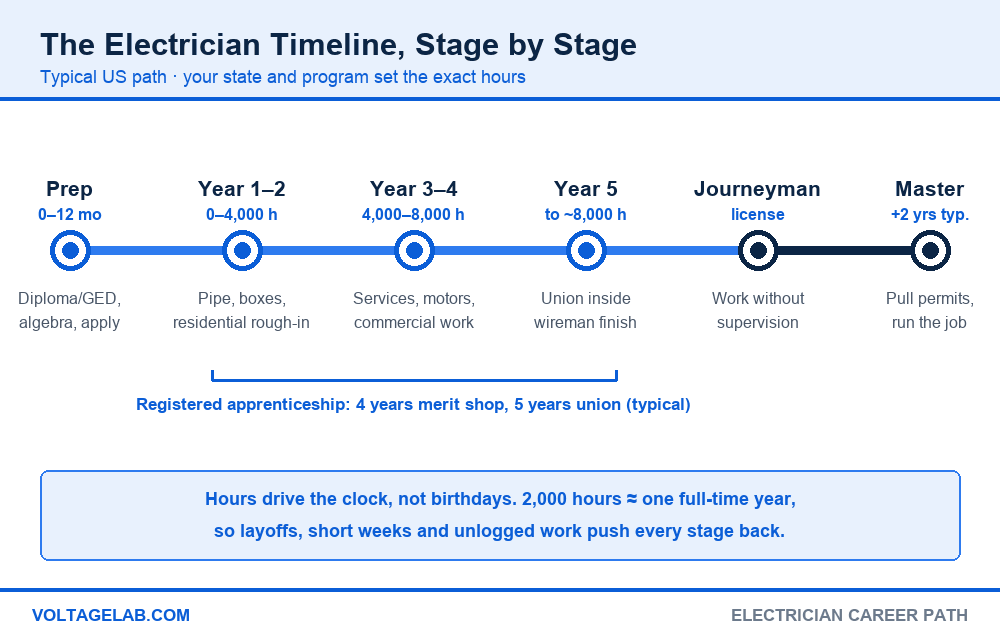
The path has four stages. Your state sets the hours. The rest depends on you, your program and how steady the work is.
Stage 1 — Getting in (0 to 12 months)
Most programs want you to be 18, hold a high school diploma or GED, and have passed a year of algebra. Union programs add an aptitude test and an interview, and many take applications only at set times of year. If you meet the requirements today, getting in can take a few weeks with a merit shop contractor or most of a year with a competitive union local. Use any wait to brush up on algebra and basic theory.
Stage 2 — The apprenticeship (4 to 5 years)
This is the long stretch, and it is paid. Federal rules for registered apprenticeship, in 29 CFR 29.4, only recognize trades that need at least 2,000 hours of on-the-job learning. Electrical programs run well past that. IBEW/NECA inside wireman programs typically require 8,000 hours on the job over 5 years. Classroom time varies by local. IBEW Local 26, for example, lists 900 classroom hours. Merit shop programs through IEC and ABC chapters usually run 4 years. Many states set a minimum of 144 classroom hours per year of apprenticeship, and Minnesota and Nevada write that figure into their rules.
Stage 3 — The journeyman license
Once your hours are verified, you apply to your state board and sit the licensing exam, which is built on the edition of the NEC your state has adopted. Some states let you test a little early. Texas accepts applicants for the journeyman exam at 7,000 hours, though the license itself still needs the full 8,000. As a journeyman you can work without direct supervision and, in most states, supervise apprentices.
Stage 4 — Master electrician (2 or more years later)
A master license lets you pull permits and act as the license holder for a company. Texas is a useful benchmark: it requires 12,000 hours of on-the-job training and at least two years holding a journeyman license. Other states set their own numbers. If you want to run your own shop, the contractor license is a separate step. Our guide to Florida electrical contractor license requirements shows what one state asks for.
Union vs merit shop vs trade school — how long each route takes
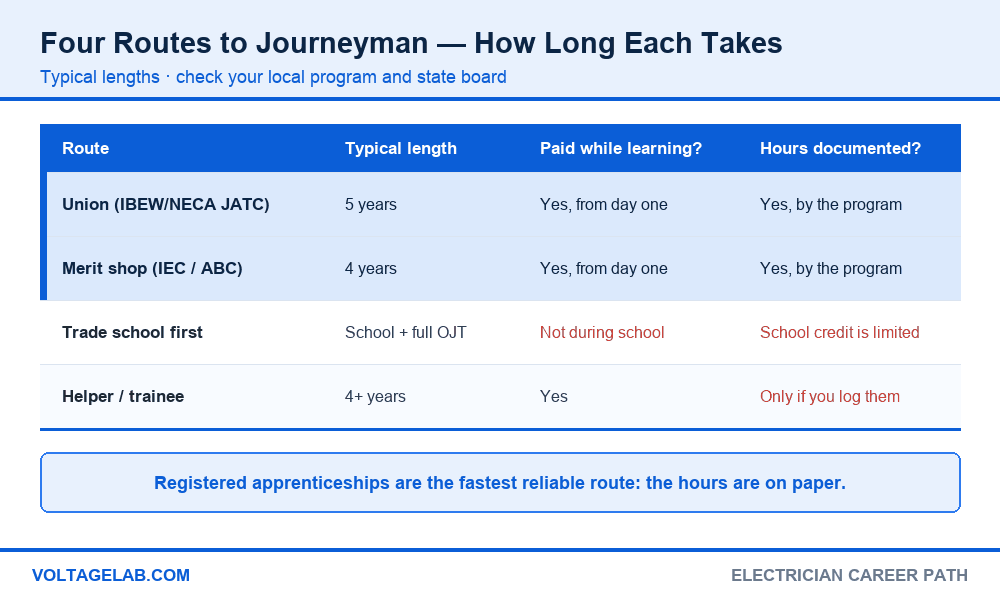
Every route ends at the same journeyman exam. What changes is how quickly you collect hours your state will accept.
| Route | Typical time to journeyman | Paid while learning? | Hours documented for you? |
|---|---|---|---|
| Union apprenticeship (IBEW/NECA JATC) | 5 years | Yes | Yes, by the program |
| Merit shop apprenticeship (IEC / ABC) | 4 years | Yes | Yes, by the program |
| Trade school, then a job | School time plus nearly the full field hours | Not during school | Only limited school credit |
| Helper or registered trainee | 4 years or more | Yes | Only if you log them |
A registered apprenticeship is the most dependable clock. The program tracks your hours in a form the board accepts, and classroom instruction runs alongside the work, so you are not adding school time on top. Merit shop programs are usually a year shorter. Union programs often pay more, which many apprentices see as worth the extra year.
Trade school front-loads theory but rarely shortens the total much. Most states credit only a capped number of school hours toward the experience requirement.
Common inspection mistake: the rough-in red tag that catches first-year apprentices most is an overfilled box. Under NEC 314.16(B), each conductor that originates outside the box counts, every device yoke counts as two, internal cable clamps count as one, and up to four equipment grounding conductors together count as one, with a quarter volume added for each one beyond four. Apprentices who only count the hots and neutrals undersize the box. Learning to count every item on the first job saves you a re-pull later, and it is the kind of skill your years in the trade are meant to teach.
How many hours your state requires before the license
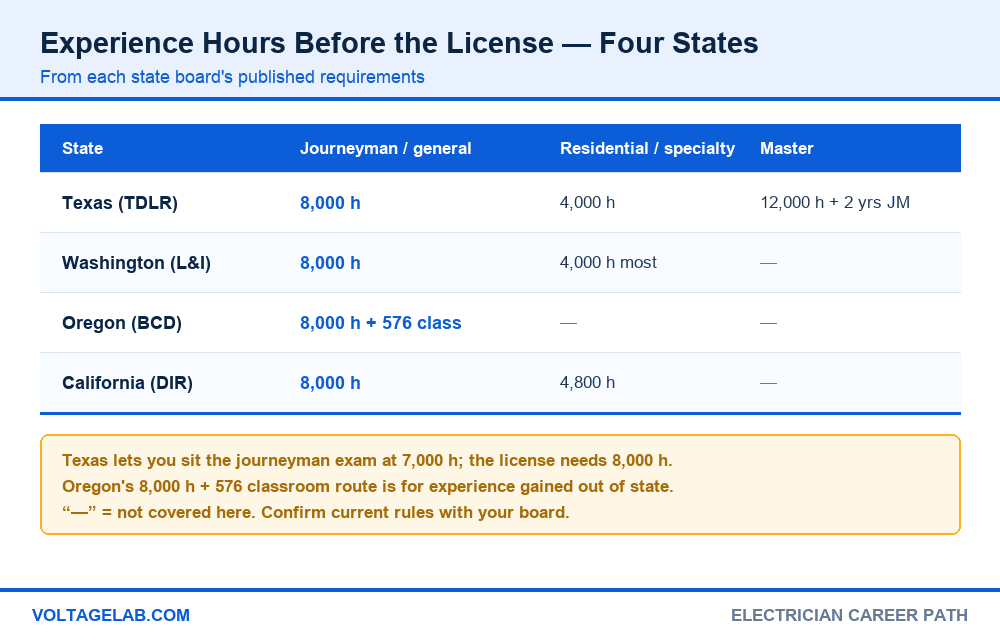
There is no national electrician license. Each state board, and in some states each city, sets the hours. These four show the common pattern: 8,000 hours for a general journeyman and about half that for a residential or specialty license.
| State and board | Journeyman / general | Residential or specialty | Master |
|---|---|---|---|
| Texas (TDLR) | 8,000 hours (exam eligibility at 7,000) | Residential wireman: 4,000 hours | 12,000 hours plus 2 years as a journeyman |
| Washington (L&I) | 01 general journey level: 8,000 hours | Most specialties: 4,000 hours, a few 2,000 | Not covered here |
| Oregon (BCD) | Approved Oregon apprenticeship, or 8,000 hours plus 576 classroom hours earned out of state | Not covered here | Not covered here |
| California (DIR) | General electrician: 8,000 hours | Residential electrician: 4,800 hours | No state master certification |
If you plan to move during your career, check reciprocity before you pick a state to train in. Hours earned in one state do not always transfer cleanly. Our electrician license reciprocity by state guide lists which states accept each other’s licenses.
Study smarter with VoltageLab
Built for electricians, apprentices, and electrical engineers who want faster practice and better exam prep.
⭐️ Join thousands of electricians upgrading their skills
How to work out your own timeline
Step 1 — find the target. Look up the hours your state board requires for the license you want, and whether they must include a minimum in commercial or industrial work.
Step 2 — estimate your real yearly hours. A full-time year is about 2,000 hours. Subtract weeks lost to weather or layoffs, and count overtime only if it is steady.
Step 3 — divide, then add the fixed time. Divide the required hours by your yearly estimate. Then add time to get into a program and time for board approval and exam scheduling. At 1,700 hours a year, 8,000 hours takes about 4 years and 9 months of work.
The one that catches everyone: four years in the trade is not the same as 8,000 hours. A winter layoff, a few short weeks and one job that never signed your experience form can leave you 1,000 hours short in year four. Keep your own log, match it to your employer’s records every month, and get signatures before you leave any job.
What speeds the timeline up, and what slows it down
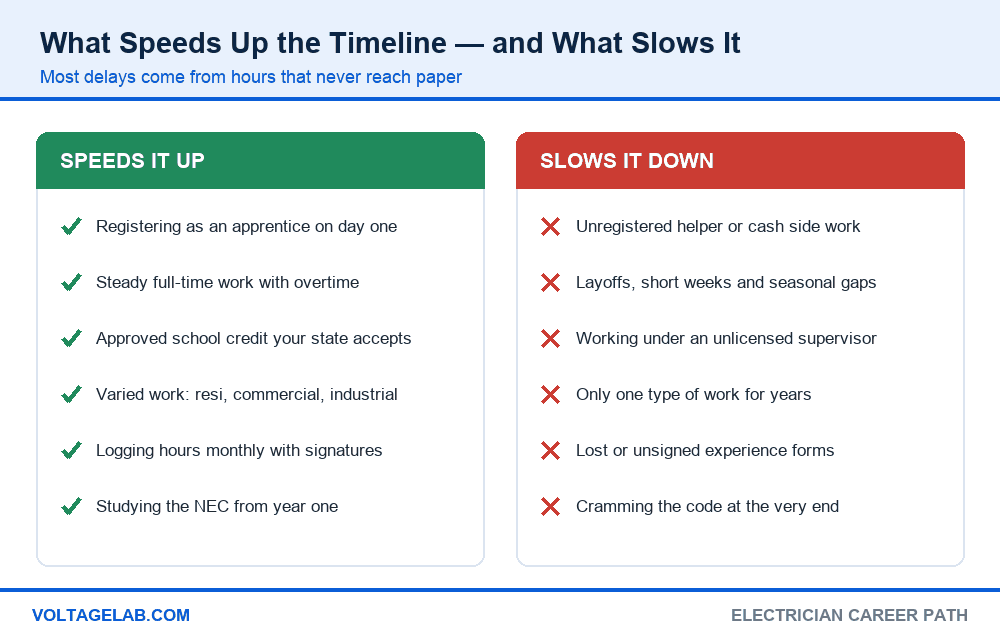
You cannot shrink the hour requirement, but you control most of what decides whether your hours count. The fastest apprentices register before their first paid hour, work steady full-time weeks, and rotate through residential, commercial and industrial work so category minimums never hold them back. The slowest lose time to unregistered side work, seasonal gaps, and employers who were never asked to sign. Work under someone without the license your board requires, and those hours may not count at all.
What to learn at each stage of the apprenticeship
Hours make you eligible. What you learn in them decides whether you are ready to work alone. Most programs build the NEC in roughly this order.
| Stage | Typical field work | NEC to learn |
|---|---|---|
| Year 1 | Material handling, boxes, conduit, residential rough-in | Article 100 definitions, 110 general requirements, 314.16 box fill |
| Year 2 | Branch circuits, devices, bending, wire pulls | Article 210 branch circuits, Table 310.16 ampacity, Chapter 9 conduit fill |
| Year 3 | Services, panels, feeders, commercial work | Article 230 services, Article 250 grounding and bonding, Article 220 load calculations |
| Year 4–5 | Motors, controls, transformers, industrial work | Article 430 motors, Article 450 transformers, special occupancies in Chapter 5 |
Each step builds on the last. Box fill leads into conduit fill. Ampacity from NEC Table 310.16 leads into feeder sizing and voltage drop. Grounding under NEC Article 250 ties all of it together at the service. When the license is in sight, our NEC exam prep guide shows how to turn four years of field knowledge into a study routine. Make sure you study the NEC edition your state has adopted, not just the newest one.
Is the long path worth it?
Pros
- You are paid from the first day of a registered apprenticeship
- Wages usually rise on a set scale as your hours build
- Classroom training is built in, with no college degree required
- A journeyman license is a credential you keep and can build on
- The same hours count toward a master or contractor license later
Cons
- Four to five years is a long time at apprentice wages
- Night or weekend classes on top of full workdays
- Layoffs can stall your hours through no fault of your own
Making your years count on the job
Do
- Register with your state or program before you start work
- Keep your own hour log and match it to pay stubs every month
- Ask to rotate into commercial or industrial work if your state requires it
- Ask your journeyman which NEC section covers the work in front of you
- Get experience forms signed before you leave any employer
Avoid
- Taking cash side work and expecting it to count
- Assuming school hours count before your board confirms it
- Letting your apprentice or trainee registration lapse
- Leaving the code book closed until the last few months
- Guessing at box fill or wire size instead of looking it up
Your next step
Plan by stage: apprentice to journeyman in the Electrician App. Set up a plan for the stage you are in now and work through it alongside the job, so the code you need for each year is learned when you use it, not crammed at the end. Available on iPhone and Android.
Frequently asked questions
How long does it take to become a journeyman electrician?
Usually 4 to 5 years: a registered apprenticeship of about 8,000 supervised hours, then your state’s licensing exam.
Can you become an electrician in 2 years?
Not as a general journeyman in most states, because about 8,000 hours is roughly four full-time years. Some limited and specialty licenses need fewer hours. Washington lists a few specialties at 2,000 hours, which a full-time worker could reach in about a year.
How long does it take to become a master electrician?
Usually at least 2 years after the journeyman license, or about 6 to 7 years in total. Texas, for example, requires 12,000 hours of experience and two years holding a journeyman license.
Does trade school shorten the time to become an electrician?
A little, at best. Most states credit only a limited number of school hours toward the experience requirement, so you still need most of the field hours. Confirm in writing with your board how much credit your program earns before you enroll.
Is a union apprenticeship longer than a non-union one?
Usually, yes, by about a year. IBEW/NECA inside wireman programs typically run 5 years, while IEC and ABC merit shop programs typically run 4. Both lead to the same state license.
How many hours a year does an apprentice electrician work?
About 2,000 hours in a full-time year, which is 40 hours a week for 50 weeks. Layoffs and short weeks often bring the real total lower.
Can I become an electrician at 30 or 40?
Yes. Apprenticeships set a minimum age, usually 18, not a maximum. Starting later does not change the timeline. You still need the same hours, so a 35-year-old who starts today can typically hold a journeyman license around 40.
Do I need to renew my license once I have it?
Yes. Licenses renew on a fixed cycle set by each state, and most cycles require continuing education hours on code changes. Our guide to electrical license renewal and CE hours by state lists the requirements.
The bottom line
Becoming an electrician takes 4 to 5 years to journeyman and about 6 to 7 to master, and almost all of that time is paid work. The hour requirement is fixed by your state. What you control is whether every hour counts and whether you learn the code as you go instead of all at once at the end.
Register before your first day, log your hours every month, and get every employer to sign before you leave. For the code changes your apprenticeship will be working under, see our summary of what changed in the 2026 NEC.
FREE PRACTICE TOOL
Think you'd pass this on a real exam?
Test what you just read with instant-feedback quizzes built around real code questions — not generic trivia.
5
Code standards
10,000+
Active learners
100%
Free to start
Instant explanations on every answer, right or wrong
NEC, BS7671, AS/NZS, CEC, and DIN VDE covered
Bite-sized quizzes you can finish in 5 minutes
No signup required to try your first quiz
No account needed · Takes less than 2 minutes