


A condensing unit sits on the pad with a nameplate reading MCA 21.7, MAX FUSE OR HACR BKR 35. Half the trucks on the job will pull 8 AWG and land it on a 35 A breaker. The other half will pull 10 AWG and land it on a 30. Both installations pass. One of them cost forty dollars more in wire for no reason, and the electrician who pulled it could not tell you why.
Minimum circuit ampacity is the least-understood number on any piece of HVAC equipment, and the confusion is almost never arithmetic. It is a category error: people treat MCA as a breaker size, or as the running current, or as something they still need to multiply by 125%. It is none of those. MCA sizes one thing — the branch-circuit conductors — and the manufacturer has already done the maths for you.
Study smarter with VoltageLab
Built for electricians, apprentices, and electrical engineers who want faster practice and better exam prep.
⭐️ Join thousands of electricians upgrading their skills
This guide covers what MCA actually means, where the 125% comes from in NEC 440.32 and 440.33, how MCA differs from MOCP and why the two round in opposite directions, how to pick a conductor from a nameplate MCA, and the Article 240 exception that lets you legally put a 40 A breaker on 12 AWG wire.
Quick Answer
Minimum circuit ampacity (MCA) is the smallest conductor ampacity that may supply a piece of air-conditioning or refrigeration equipment. For a single motor-compressor it is 125% of the rated-load current [NEC 440.32]. Where other loads share the circuit it is 125% of the largest motor plus 100% of everything else [NEC 440.33]. Manufacturers calculate it and stamp it on the nameplate under NEC 440.4(B).
MCA sizes the wire, not the breaker. It is a minimum — your conductor’s ampacity must equal or exceed it. The separate MOCP figure on the same nameplate is a maximum for the fuse or breaker. Where the nameplate gives an MCA, use it as-is: the 125% is already inside it, and applying it again oversizes the conductor.
Key Takeaways
- MCA is the minimum ampacity of the branch-circuit conductors supplying air-conditioning or refrigeration equipment — it is never a breaker rating.
- For a single motor-compressor, MCA equals 125% of the rated-load current or the branch-circuit selection current, whichever is greater [NEC 440.32].
- Where a compressor shares the circuit with fans or heaters, MCA equals 125% of the largest motor plus 100% of the remaining loads [NEC 440.33].
- MCA is a minimum and MOCP is a maximum, so the conductor rounds up and the overcurrent device rounds down — they move in opposite directions.
- A nameplate MCA already contains the 125% multiplier; multiplying it again is the single most common oversizing error on HVAC circuits.
- The small-conductor rule of NEC 240.4(D) does not apply to A/C branch circuits, because 240.4(G) sends you to Article 440 instead — a 40 A breaker on 12 AWG can be entirely legal.
- Select conductors from the 60 °C column of Table 310.16 unless the terminations at both ends are listed for 75 °C [NEC 110.14(C)].
What is minimum circuit ampacity?
Minimum circuit ampacity is a conductor-sizing instruction from the equipment manufacturer to the electrician. It says: whatever wire you run to this unit, its ampacity must be at least this many amps. Nothing more. It is not a measurement of what the equipment draws, and it does not tell you what to protect the circuit with.
Pass your electrical exam the first time
Practice real NEC exam questions with full code-referenced explanations and progress tracking — built for journeyman, master and apprentice exam prep.
Thousands of NEC practice questions with code-referenced answers
The reason it exists is that motor loads are not resistive loads. A hermetic refrigerant motor-compressor draws locked-rotor current on start, runs continuously once loaded, and heats its conductors the whole time. The NEC handles that by requiring conductors sized above the running current, and Article 440 sets the multiplier at 125%. Because the manufacturer knows the compressor’s rated-load current, the fan motor’s full-load amps and any strip-heat load, it can run that calculation once at the factory and print the answer.
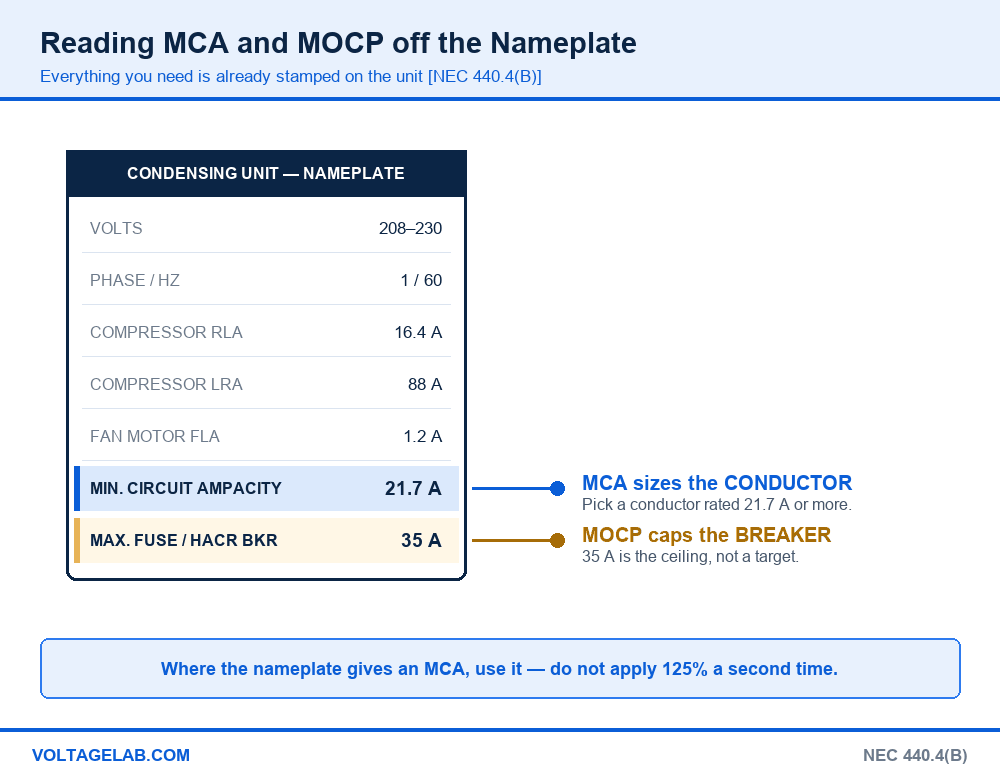
NEC 440.4(B) makes that marking mandatory. Multimotor and combination-load equipment must carry a visible nameplate giving the maker’s name, the voltage, frequency and phase, the minimum supply circuit conductor ampacity, and the maximum rating of the branch-circuit short-circuit and ground-fault protective device. Where that nameplate exists, NEC 440.35 requires the branch-circuit conductors to be not less than the marked minimum circuit ampacity. You are not being asked to check the manufacturer’s work — you are being told to honour it.
RLA, FLA, LRA and BCSC — which current feeds the formula
Four current figures appear on HVAC nameplates and only some of them belong in an MCA calculation.
- RLA (rated-load current) — the compressor’s running current. This is the number Article 440 uses. Under NEC 440.6(A) you take it from the nameplate, not from the motor tables in Article 430.
- FLA (full-load amps) — used for the fan motors and other conventional motors on the unit. These enter the calculation at 100%.
- LRA (locked-rotor amps) — the inrush on start. It matters for disconnect sizing and for whether the breaker will hold, but it plays no part in MCA.
- BCSC (branch-circuit selection current) — a value some manufacturers mark instead, always equal to or greater than RLA. Where it is marked, NEC 440.32 requires you to use it in place of the rated-load current.
If you work regularly with conventional motors as well, our guide to motor nameplate specifications covers how these figures are marked, and NEC Table 430.250 gives the full-load currents Article 430 uses — note that Article 440 deliberately does not send you to those tables for a hermetic compressor.
MCA vs MOCP — the distinction that decides the job
Every nameplate carries both numbers, and they do opposite jobs. Confusing them produces either an undersized conductor or a breaker that cannot legally be installed.
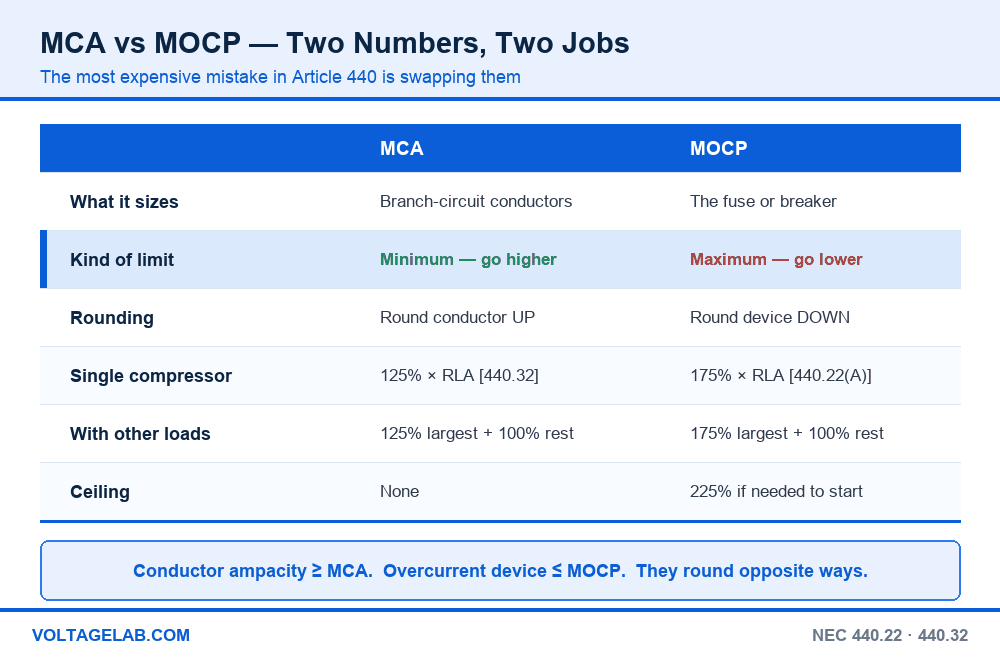
| Question | MCA | MOCP |
|---|---|---|
| What does it size? | The branch-circuit conductors | The fuse or circuit breaker |
| Minimum or maximum? | Minimum — you may go higher | Maximum — you must go lower or equal |
| Which way do you round? | Up, to the next conductor that meets it | Down, to the next standard device at or below it |
| Single motor-compressor | 125% of RLA or BCSC [440.32] | 175% of RLA or BCSC [440.22(A)] |
| With additional loads | 125% largest + 100% of the rest [440.33] | 175% largest + 100% of the rest [440.22(B)] |
| Is there an upper limit? | No — larger conductors are always permitted | 225% where needed to start [440.22(A)] |
| Must the breaker equal it? | Not applicable | No — smaller is fine if it holds on start |
The error that fails inspections: reading MCA as a breaker size. On a nameplate marked MCA 21.7 / MOCP 35, installing a 20 A breaker “because the MCA is 21.7” leaves equipment that nuisance-trips on every start, and installing a 45 A breaker because 8 AWG “can take it” exceeds the marked maximum and is a straight violation of NEC 440.22. The conductor answers to the MCA. The device answers to the MOCP. Neither number answers to the other.
How to calculate minimum circuit ampacity
You rarely need to. Where NEC 440.4(B) requires a nameplate, use the marked value. But you will meet field-assembled equipment, replacement compressors and unmarked older units, and exam questions are written on the formula rather than the nameplate.
Single motor-compressor — NEC 440.32
MCA = 1.25 × RLA
…or the branch-circuit selection current, whichever is greater
A compressor with an RLA of 16.4 A gives 16.4 × 1.25 = 20.5 A. Any conductor whose ampacity is 20.5 A or more will do.
Compressor plus other loads — NEC 440.33
MCA = (1.25 × largest motor) + all other loads
Only the largest motor takes the 125% — everything else counts at 100%
Study smarter with VoltageLab
Built for electricians, apprentices, and electrical engineers who want faster practice and better exam prep.
⭐️ Join thousands of electricians upgrading their skills
Worked example. Take the nameplate above: compressor RLA 16.4 A, condenser fan motor FLA 1.2 A. The compressor is the largest motor, so it takes the multiplier: 16.4 × 1.25 = 20.5 A. The fan enters at 100%: 20.5 + 1.2 = 21.7 A, which is exactly the MCA printed on the plate. Add a 5 kW strip heater at 208 V (24.0 A) to the same circuit and the MCA becomes 20.5 + 1.2 + 24.0 = 45.7 A.
Sizing the conductor, step by step
- Read the MCA from the nameplate. If there is no nameplate MCA, calculate it with 440.32 or 440.33 above.
- Decide which temperature column applies. NEC 110.14(C) limits you to the 60 °C column for equipment rated 100 A or less unless both the equipment and the terminations are listed for 75 °C. Most residential condensing units are 60 °C.
- Apply any ambient temperature correction and conductor bundling adjustment to the conductor’s ampacity before comparing it to the MCA. A rooftop run in 45 °C ambient loses real capacity.
- Pick the smallest conductor whose corrected ampacity equals or exceeds the MCA.
- Select an overcurrent device that does not exceed the MOCP, and that will hold the locked-rotor inrush on start.
- Check the disconnect and any equipment grounding conductor separately — neither is sized from the MCA.
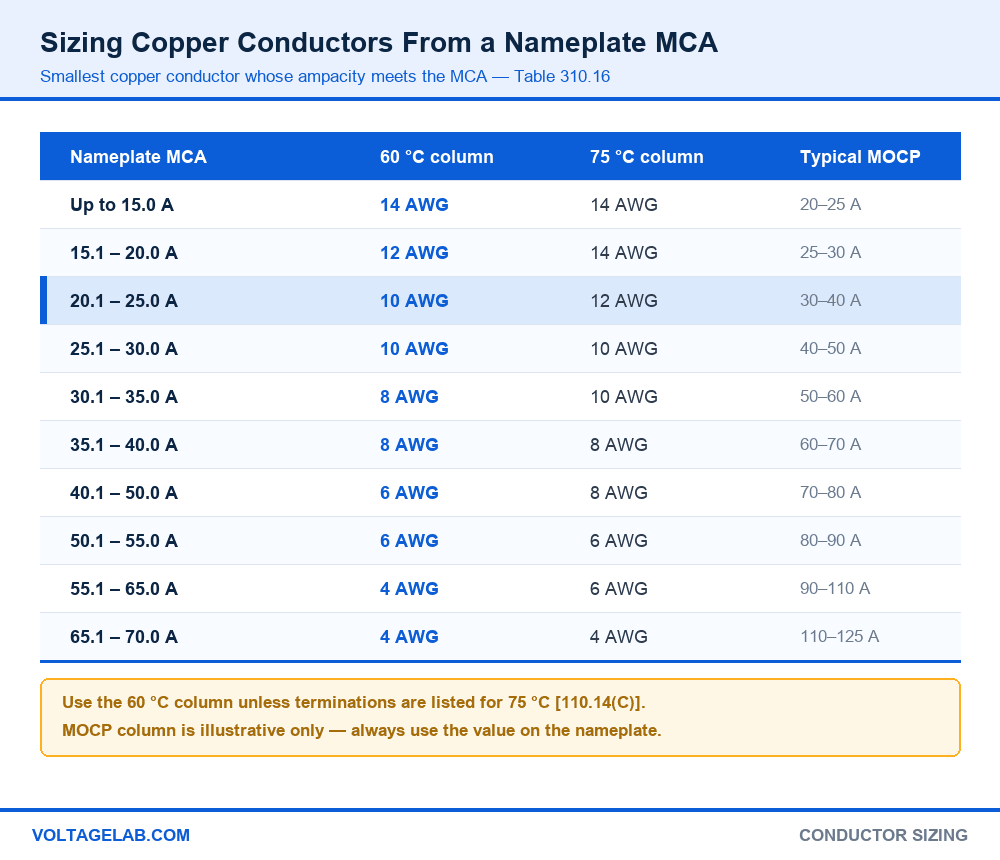
| Nameplate MCA | Copper, 60 °C column | Copper, 75 °C column |
|---|---|---|
| Up to 15.0 A | 14 AWG | 14 AWG |
| 15.1 – 20.0 A | 12 AWG | 14 AWG |
| 20.1 – 25.0 A | 10 AWG | 12 AWG |
| 25.1 – 30.0 A | 10 AWG | 10 AWG |
| 30.1 – 35.0 A | 8 AWG | 10 AWG |
| 35.1 – 40.0 A | 8 AWG | 8 AWG |
| 40.1 – 50.0 A | 6 AWG | 8 AWG |
| 50.1 – 55.0 A | 6 AWG | 6 AWG |
| 55.1 – 65.0 A | 4 AWG | 6 AWG |
| 65.1 – 70.0 A | 4 AWG | 4 AWG |
Our full breakdown of how to read NEC Table 310.16 covers the columns and the correction factors this table depends on, and the 310.16 ampacity chart gives the raw values.
The one that catches everyone: the small-conductor rule in NEC 240.4(D) — 15 A on 14 AWG, 20 A on 12 AWG, 30 A on 10 AWG — does not apply here. That subsection opens with “Unless specifically permitted in 240.4(E) or (G),” and Table 240.4(G) routes air-conditioning and refrigeration circuit conductors to Article 440 instead. So a nameplate reading MCA 18.7 / MOCP 30 is correctly served by 12 AWG on a 30 A breaker, and a 40 A MOCP on 12 AWG can be legal too. It looks wrong on a panel schedule and it is not.
What MCA is not
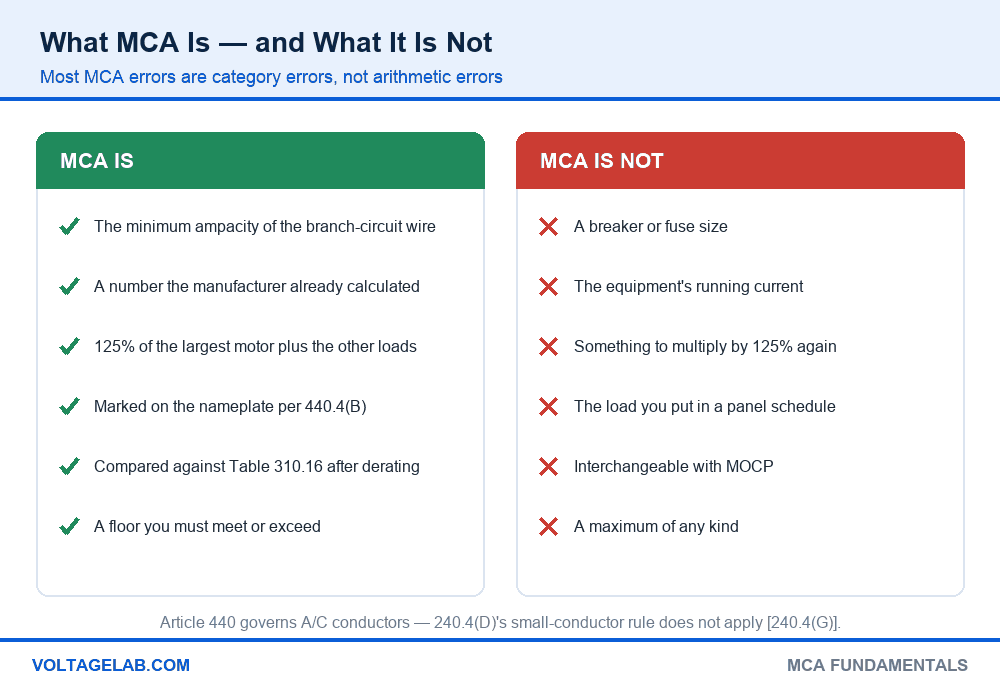
It is not the equipment’s running current
MCA already includes the 125% motor allowance, so it is always larger than what the unit actually draws. The condensing unit above has an MCA of 21.7 A but a real running current nearer 17.6 A. If you are building a service or feeder calculation, use the actual load figures — not the MCA — or you will inflate every HVAC entry on the schedule. Our guide to calculating a home’s electrical load works through where those figures belong.
It is not a number to multiply again
This is the most common oversizing mistake in the trade. Seeing MCA 21.7 and reasoning “motor load, so 125%” gives 27.1 A and pushes you from 10 AWG to 8 AWG for nothing. The 125% is already inside the 21.7. NEC 440.35 asks only that the conductors be not less than the marked value.
It does not size the disconnect or the ground
The disconnecting means for air-conditioning equipment is sized under NEC 440.12, from the rated-load current and locked-rotor current, and must be within sight of the unit under 440.14. The equipment grounding conductor comes from Table 250.122, sized against the overcurrent device — not against the MCA and not against the circuit conductors. Our guide to equipment grounding conductors covers that sizing.
Working with MCA in the field
Do
- Photograph the nameplate before the unit is set and the plate faces the wall.
- Size the conductor to the MCA and the device to the MOCP, separately.
- Apply ambient and bundling corrections before comparing ampacity to the MCA.
- Default to the 60 °C column unless both ends are listed for 75 °C.
- Re-check the nameplate when equipment is swapped — MCA changes with the model.
Avoid
- Applying 125% to a nameplate MCA that already contains it.
- Installing a breaker larger than the marked MOCP, whatever the wire size.
- Sizing the conductor from the breaker instead of from the MCA.
- Using MCA as the connected load in a service calculation.
- Pulling RLA from Article 430 tables — 440.6(A) says use the nameplate.
Frequently asked questions
What is minimum circuit ampacity?
It is the smallest conductor ampacity permitted to supply a piece of air-conditioning or refrigeration equipment. For a single motor-compressor it equals 125% of the rated-load current [NEC 440.32]. Manufacturers calculate it and mark it on the nameplate under NEC 440.4(B), and NEC 440.35 requires your branch-circuit conductors to meet or exceed that marked value.
Is MCA the same as breaker size?
No. MCA sizes the conductors; the breaker is limited by the separate MOCP figure. They are different numbers doing different jobs, and MOCP is usually much larger than MCA because motor circuits need headroom for starting current.
How do you calculate MCA?
Multiply the largest motor’s rated-load current by 1.25 and add 100% of every other load on the circuit [NEC 440.33]. With a single motor-compressor and nothing else, it is simply 125% of the rated-load current or the branch-circuit selection current, whichever is greater [NEC 440.32].
Do I apply 125% to the MCA on the nameplate?
No. The 125% is already built into the marked figure. Applying it a second time oversizes the conductor and often pushes you up a wire size for no benefit. Use the nameplate MCA exactly as printed.
Can the breaker be smaller than the MOCP?
Yes. MOCP is a ceiling, not a target. Any standard device at or below it is acceptable provided it carries the load and holds through the locked-rotor inrush on start. What you may never do is exceed the marked MOCP.
Can I really put a 40 A breaker on 12 AWG for an air conditioner?
Where the nameplate permits it, yes. NEC 240.4(D)’s small-conductor rule begins “Unless specifically permitted in 240.4(E) or (G),” and Table 240.4(G) directs air-conditioning and refrigeration circuit conductors to Article 440. So the conductor is sized to the MCA and the device to the MOCP, and the usual 20 A limit on 12 AWG does not govern.
What is the difference between RLA and FLA?
RLA is the rated-load current of a hermetic refrigerant motor-compressor and is taken from the nameplate under NEC 440.6(A). FLA is the full-load current of a conventional motor such as a condenser fan. In an MCA calculation the largest of them takes the 125% multiplier and the others count at 100%.
Does MCA go into my service or feeder calculation?
No. MCA is a conductor-sizing figure with the 125% motor allowance already applied. Using it as a connected load inflates the calculation. Use the actual nameplate load figures, then apply the demand rules of Article 220 in the normal way.
The bottom line
Minimum circuit ampacity earns its place on the nameplate because it collapses a motor-circuit calculation into a single number you can size wire against. Read it as what it is — a floor for conductor ampacity, with the 125% of NEC 440.32 already inside it — and the rest of Article 440 becomes straightforward.
Two restraints matter more than anything else here. First, keep MCA and MOCP in their own lanes: the conductor must meet or exceed the MCA, the overcurrent device must not exceed the MOCP, and they round in opposite directions. Second, remember that the small-conductor rule you apply on every other circuit is switched off for this one by NEC 240.4(G) — which is why a 12 AWG conductor on a 30 or 40 A breaker is not the mistake it looks like. If you are sizing the rest of the circuit, our guides to reading Table 310.16 and to branch circuit types are the next two pieces.
FREE PRACTICE TOOL
Think you'd pass this on a real exam?
Test what you just read with instant-feedback quizzes built around real code questions — not generic trivia.
5
Code standards
10,000+
Active learners
100%
Free to start
Instant explanations on every answer, right or wrong
NEC, BS7671, AS/NZS, CEC, and DIN VDE covered
Bite-sized quizzes you can finish in 5 minutes
No signup required to try your first quiz
No account needed · Takes less than 2 minutes