


Ask five electricians how many outlets on a 20-amp circuit and you will get five confident answers: ten, twelve, thirteen, eight, and “as many as you want.” Four of those people are quoting something they were told on their first job. One of them has actually opened the Code book to check.
The reason this question never dies is that all of those numbers are real — they just come from different places. Some are calculation results that apply only to commercial work. One is a Canadian rule. One is a rule of thumb about resale and troubleshooting that has nothing to do with the NEC at all. Quote the wrong one to an inspector and you either fail a job you did correctly, or pass one you should have redesigned.
Study smarter with VoltageLab
Built for electricians, apprentices, and electrical engineers who want faster practice and better exam prep.
⭐️ Join thousands of electricians upgrading their skills
This guide covers what the NEC actually says about the number of receptacles on a 20-amp circuit, why dwelling units and everything else follow completely different rules, where the 180 volt-ampere figure comes from and how to use it, the load limits that do bind, and the practical number to design to when the Code leaves it open.
Quick Answer
How many outlets on a 20-amp circuit depends entirely on the occupancy. In a dwelling unit the NEC sets no limit at all — general-use receptacle outlets in a home are covered by the general lighting load calculation, so adding another receptacle adds no calculated load and there is no number to exceed.
In other than dwelling occupancies — offices, retail, schools, industrial — NEC 220.14(I) requires each receptacle outlet to be calculated at not less than 180 volt-amperes per yoke. A 20-amp, 120-volt circuit carries 2,400 VA, so 2,400 ÷ 180 = 13.3, which gives you a hard maximum of 13 receptacle outlets. On a 15-amp circuit the same math gives 10 — and that is where the “ten outlet rule” everyone repeats actually comes from.
Key Takeaways
- The NEC places no limit on the number of general-use receptacles on a dwelling unit branch circuit
- In non-dwelling occupancies, 220.14(I) allows a maximum of 13 receptacle outlets on a 20-amp circuit and 10 on a 15-amp circuit
- 180 volt-amperes is charged per yoke, so a duplex and a single receptacle count exactly the same
- A device with four or more receptacles on one yoke is calculated at 90 volt-amperes per receptacle instead
- The “12 outlets” figure people quote is the Canadian Electrical Code rule, not an NEC requirement
- What genuinely limits a 20-amp circuit is connected load: 16 amperes continuous, and 16 amperes on any one 20-amp receptacle
- Eight to twelve devices per 20-amp residential circuit is a sound design target, but it is judgment, not Code
Outlet, receptacle, yoke — what you are actually counting
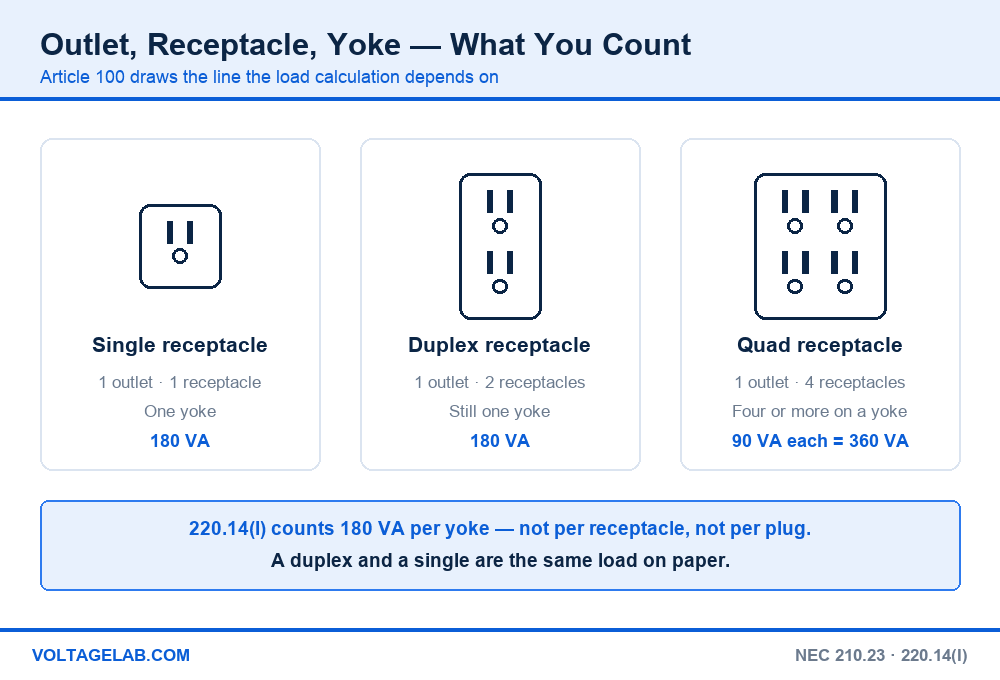
Before any number means anything, the three words have to be separated. Article 100 defines them precisely, and the load calculation depends on which one you are counting:
Pass your electrical exam the first time
Practice real NEC exam questions with full code-referenced explanations and progress tracking — built for journeyman, master and apprentice exam prep.
Thousands of NEC practice questions with code-referenced answers
- Outlet. A point on the wiring system where current is taken to supply utilization equipment. A lighting outlet is an outlet. A hardwired disposal is an outlet. So is a receptacle box.
- Receptacle. The contact device itself — the thing a plug goes into. A standard duplex device contains two receptacles.
- Yoke. The metal strap the receptacle or receptacles are mounted on. A duplex device is two receptacles on one yoke.
This matters because 220.14(I) charges 180 volt-amperes “for each single or for each multiple receptacle on one yoke.” Not per receptacle. Not per plug. Per yoke. Install a single receptacle and you have used 180 VA of your circuit’s calculated capacity. Install a duplex in the same box and you have used exactly the same 180 VA, despite doubling the places somebody can plug something in.
The four-or-more exception
There is one carve-out. Where a single piece of equipment is a multiple receptacle comprising four or more receptacles, 220.14(I) calculates it at not less than 90 volt-amperes per receptacle. A quad device therefore counts as 4 × 90 = 360 VA, not 180. That is worth remembering on commercial fit-outs, where quads are common and quietly consume twice the calculated capacity of a duplex.
If the branch circuit vocabulary underneath this is unfamiliar, our explainer on NEC Article 210 and how branch circuits are rated sets out the definitions the rest of this article leans on.
Dwelling vs non-dwelling — why there are two answers
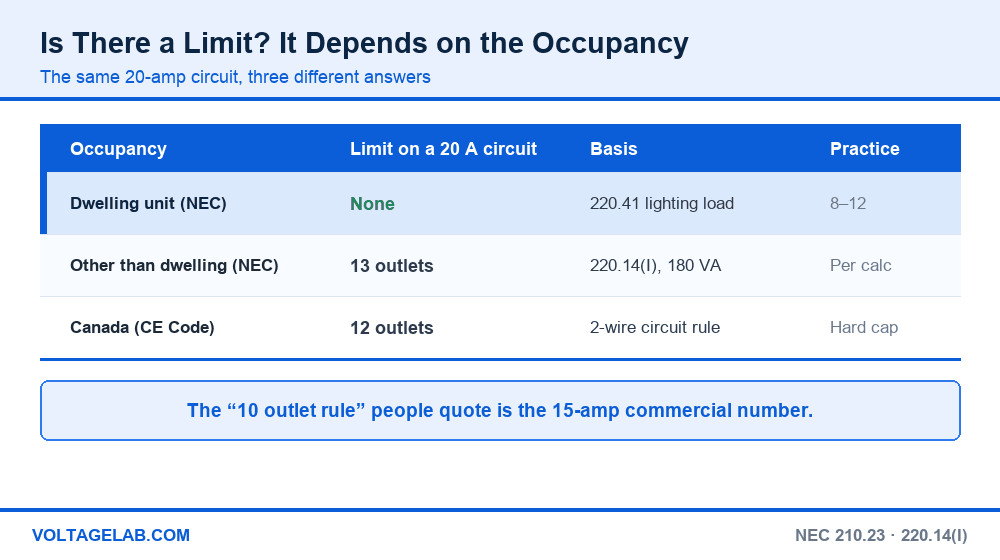
The split is not an oversight. The NEC treats homes and commercial spaces differently on purpose, because the load behaves differently:
| Occupancy | Limit on a 20 A circuit | Where it comes from | Enforceable? |
|---|---|---|---|
| Dwelling unit (NEC) | None | Receptacles are inside the general lighting load | No number to enforce |
| Other than dwelling (NEC) | 13 receptacle outlets | 220.14(I) — 180 VA per yoke | Yes |
| Canada (CE Code) | 12 outlets | Limit on a 2-wire branch circuit | Yes, in Canada |
| Local amendment | Varies | Adopted ordinance, not the base NEC | Yes, where adopted |
In a house, receptacle outlets are not calculated individually at all. They are swept into the general lighting load — 3 volt-amperes per square foot of floor area — on the theory that a bedroom with six receptacles and a bedroom with three draw roughly the same power, because the number of lamps and chargers a family owns does not scale with the number of holes in the wall. That provision sat in 220.14(J) for years and moved to 220.41 in the 2023 NEC reorganisation of Article 220.
In an office, that assumption fails. Every workstation gets a computer, two monitors, a dock and a task light, and those loads do scale with the receptacle count. So the Code charges 180 VA a yoke and lets the arithmetic set the ceiling.
The mistake that fails commercial jobs: applying the residential answer to a non-dwelling occupancy. “There is no limit in the NEC” is true in a house and flatly wrong in an office, a school or a retail space, where the fourteenth receptacle outlet on a 20-amp circuit is a violation of 220.14(I). Multifamily is where this bites hardest — the apartments are dwelling units with no limit, and the corridors, laundry rooms and leasing office in the same building are not.
The 180 VA calculation — NEC 220.14(I)
The commercial number is straightforward arithmetic once you have the two inputs. Circuit capacity in volt-amperes is amperes × volts; the load per device is 180 VA per yoke. Divide, then drop the fraction — you cannot install a third of a receptacle.
| Circuit | Circuit capacity | Device type | VA per device | Maximum devices |
|---|---|---|---|---|
| 15 A, 120 V | 1,800 VA | Single or duplex | 180 VA | 10 |
| 20 A, 120 V | 2,400 VA | Single or duplex | 180 VA | 13 |
| 15 A, 120 V | 1,800 VA | Quad (4 on a yoke) | 360 VA | 5 |
| 20 A, 120 V | 2,400 VA | Quad (4 on a yoke) | 360 VA | 6 |
A four-step method for the commercial count
Step 1 — confirm the occupancy is not a dwelling unit. If it is, stop; there is no count to make. Guest rooms in hotels and motels and dormitory units have their own provisions, so check which category you are in rather than assuming.
Step 2 — take the circuit capacity in VA. 20 A × 120 V = 2,400 VA. Use the actual nominal voltage of the system, not a rounded figure.
Step 3 — subtract anything else on the circuit. The 13-outlet figure assumes the circuit does nothing but feed receptacles. Put lighting or a piece of fixed equipment on it and the capacity available for receptacle outlets shrinks accordingly. Our guide to maximum load capacity rules for circuits covers how to account for mixed loads.
Step 4 — divide by 180 and round down. 2,400 ÷ 180 = 13.33, so 13 receptacle outlets. Never round up to 14 on the grounds that the fraction is large; the section says “not less than” 180 VA, which sets a floor on the load, not a target.
Study smarter with VoltageLab
Built for electricians, apprentices, and electrical engineers who want faster practice and better exam prep.
⭐️ Join thousands of electricians upgrading their skills
The one that catches everyone: 220.14(I) is a load calculation rule, not an installation rule, and it does not apply to the receptacles on the required small-appliance and laundry branch circuits in a dwelling unit — those circuits carry their own fixed 1,500 VA allowance in the service calculation. So the 13-outlet answer never applies to a kitchen counter, even though the kitchen is the room people most often ask about.
What actually limits a 20-amp circuit
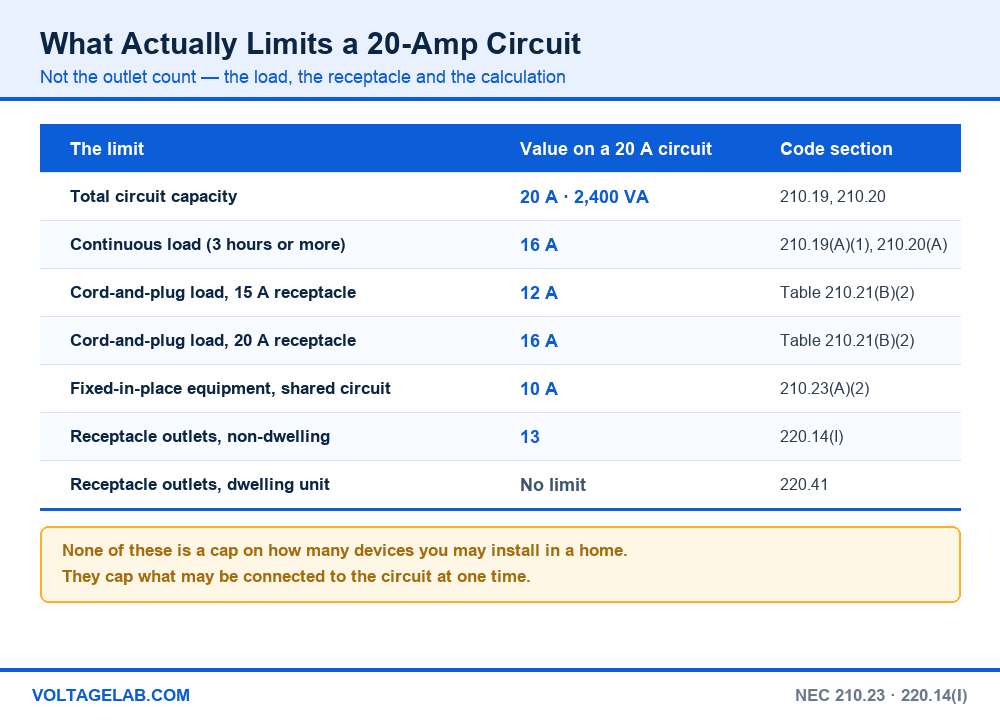
Counting devices is the wrong instinct. The Code controls a 20-amp circuit through the load connected to it and the rating of the devices on it, and those rules bind in a dwelling unit exactly as hard as anywhere else.
Load limits that always apply
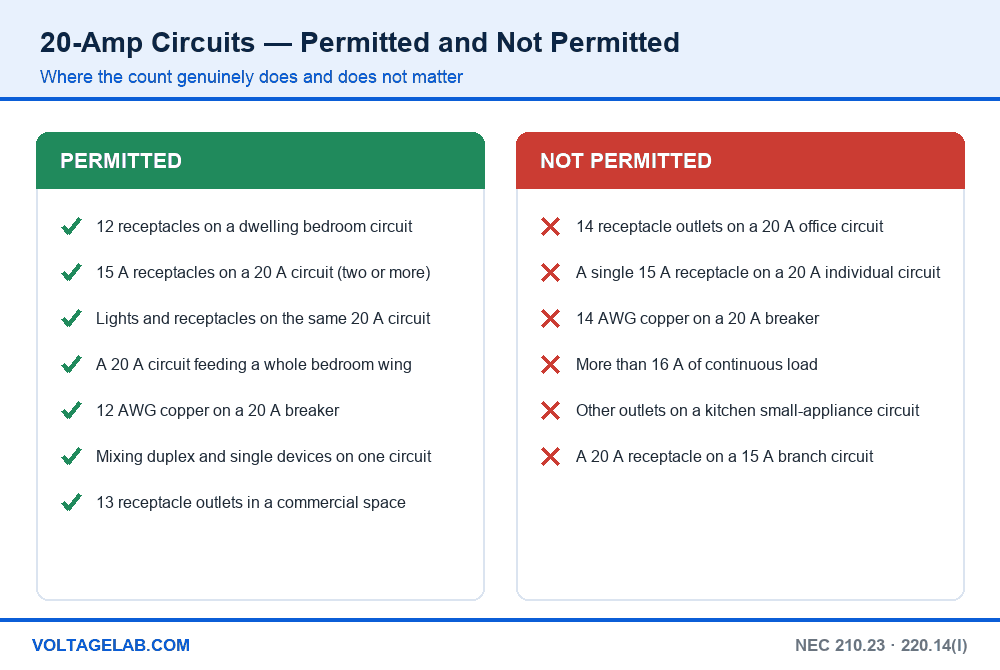
- 16 amperes continuous. Under 210.19(A)(1) and 210.20(A), a circuit supplying a continuous load — three hours or more — must be sized at 125 percent of that load. On a 20-ampere circuit that caps continuous load at 16 amperes.
- 16 amperes on one 20-ampere receptacle. Table 210.21(B)(2) limits the total cord-and-plug-connected load on a single receptacle to 80 percent of its rating where the circuit supplies two or more outlets.
- 12 amperes on a 15-ampere receptacle. Same table. A 15-ampere device on a 20-ampere circuit is still a 15-ampere device.
- 50 percent for fixed-in-place equipment. Under 210.23(A)(2), where a circuit also supplies lighting or receptacle outlets, utilization equipment fastened in place is limited to 50 percent of the circuit rating — 10 amperes on a 20-ampere circuit.
Device and conductor rules
- 12 AWG copper minimum. NEC 240.4(D)(5) caps 12 AWG copper at a 20-ampere overcurrent device, and 14 AWG at 15 amperes. See our guide to THHN and THWN-2 conductor ratings for why the ampacity tables do not override this.
- 15- or 20-ampere receptacles are both fine. Table 210.21(B)(3) permits either on a 20-ampere circuit supplying two or more receptacles. A 15-ampere duplex on a 20-ampere circuit is not a violation and never has been.
- Unless it is an individual branch circuit. Under 210.21(B)(1), a single receptacle on an individual branch circuit must be rated not less than the circuit — so a lone 5-15R on a 20-ampere dedicated circuit is a violation.
Where a 20-amp circuit is shared between two ungrounded conductors of a multiwire arrangement, the neutral and handle-tie rules come into play as well — our breakdown of multiwire branch circuits covers those. And if the reason someone wants fewer outlets is that they intend to hang power strips off them, read our piece on relocatable power taps and where they are permitted first.
So what number should you actually design to?
The Code gives you permission, not a design. In a dwelling, the practical range most electricians settle on is eight to twelve devices per 20-amp circuit, and there are three reasons for it, none of them found in the NEC:
- Troubleshooting. A circuit covering half a house is miserable to fault-find. Keeping a circuit to one or two rooms makes a nuisance trip a five-minute job instead of an afternoon.
- Nuisance tripping. AFCI and GFCI devices trip on the whole circuit. The more that is downstream, the more candidates there are for the fault — and the more of the house goes dark. Our comparison of GFCI vs AFCI protection covers where each is required.
- Future load. Bedrooms acquire space heaters and gaming rigs. Garages acquire compressors. Designing to the theoretical maximum leaves no room for the life the building actually has.
Room type matters more than the count. A living room with a television wall and two lamps is not the same as a home office with three workstations, even if both have eight duplexes. Where the loads are known and heavy, count amperes rather than devices.
Is a fuller circuit the right call?
Pros of loading a circuit up
- Fewer home runs, less wire and less labour
- Fewer breaker spaces consumed in a panel that may be tight
- Fully compliant in a dwelling regardless of the count
- Cheaper on a fixed-price residential bid
Cons
- One trip takes out a large part of the house
- Fault-finding on a long circuit is slow and expensive
- No headroom for loads the owner adds later
- Reads as cheap work to a home inspector, even when compliant
- Illegal the moment the same habit is carried onto commercial work
Laying out circuits in the field
Do
- Establish the occupancy before you quote any outlet number
- Count yokes, not receptacles, when you run the calculation
- Keep circuits inside room boundaries so faults are easy to isolate
- Check for a local amendment before assuming the base NEC applies
- Give known heavy loads their own circuit rather than counting devices
Avoid
- Applying the residential “no limit” answer to commercial work
- Rounding 13.33 up to 14 receptacle outlets
- Counting a duplex as two devices in the 180 VA calculation
- Forgetting that quads are charged at 90 VA per receptacle
- Adding receptacles to a kitchen small-appliance circuit
Frequently asked questions
How many outlets can be on a 20-amp circuit?
In a dwelling unit, as many as you like — the NEC sets no limit on general-use receptacles in a home. In any other occupancy, 13 receptacle outlets, from NEC 220.14(I) at 180 volt-amperes per yoke on a 2,400 VA circuit. Most electricians design residential circuits to eight to twelve devices for practical reasons rather than Code ones.
How many receptacles on a 20-amp circuit in a house?
There is no NEC maximum. Receptacle outlets in a dwelling are included in the general lighting load at 3 volt-amperes per square foot, so installing another duplex adds no calculated load and there is no threshold to cross. The limit that does apply is the connected load, not the device count.
Where does the “10 outlets per circuit” rule come from?
It is the 220.14(I) result for a 15-amp commercial circuit: 1,800 VA ÷ 180 VA = 10. The figure is correct in the occupancy it belongs to and gets repeated everywhere else, which is why it is quoted so confidently about houses, where it does not apply.
Does a duplex receptacle count as one outlet or two?
One outlet, two receptacles, one yoke. For the 220.14(I) calculation it is 180 volt-amperes — identical to a single receptacle. Only when a device carries four or more receptacles on one yoke does the calculation change, to 90 volt-amperes per receptacle.
Can I mix lights and outlets on the same 20-amp circuit?
Yes, on a general-purpose circuit. NEC 210.23 permits a 20-ampere circuit to supply lighting units and utilization equipment together. The exception is the kitchen small-appliance branch circuits required by 210.11(C)(1), which under 210.52(B)(2) may not supply lighting or other outlets — see our guide to kitchen outlet and island placement rules.
Is 12 outlets on a 20-amp circuit too many?
Not in a dwelling — it is compliant and common. Twelve is also the Canadian Electrical Code’s hard limit for a 2-wire branch circuit, which is where a lot of North American electricians picked the number up. In a US commercial space, twelve is legal and thirteen is the ceiling.
Can I put 15-amp receptacles on a 20-amp circuit?
Yes, where the circuit supplies two or more receptacles — Table 210.21(B)(3) permits it explicitly. The one case where you cannot is a single receptacle on an individual branch circuit, which under 210.21(B)(1) must be rated not less than the circuit itself.
How many amps can I actually draw from a 20-amp circuit?
Twenty amperes intermittently, but only 16 amperes for a continuous load of three hours or more, under 210.19(A)(1) and 210.20(A). Any single cord-and-plug load is capped at 16 amperes on a 20-ampere receptacle and 12 amperes on a 15-ampere receptacle by Table 210.21(B)(2).
The bottom line
There is no single answer to how many outlets on a 20-amp circuit, and anyone who gives you one without asking about the occupancy is guessing. In a dwelling the NEC sets no limit, because receptacle count and receptacle load stopped tracking each other a long time ago. In every other occupancy the answer is 13, and it comes from one line of arithmetic in 220.14(I) that has not changed in decades.
The two restraints worth carrying onto the job are these: count yokes rather than receptacles when you calculate, and remember that the Code’s silence in a dwelling is permission, not a design. Eight to twelve devices per circuit, organised by room, will serve the building better than the maximum ever will. For the wider rules on how circuits are rated and loaded, start with the difference between general purpose, appliance and individual branch circuits.
FREE PRACTICE TOOL
Think you'd pass this on a real exam?
Test what you just read with instant-feedback quizzes built around real code questions — not generic trivia.
5
Code standards
10,000+
Active learners
100%
Free to start
Instant explanations on every answer, right or wrong
NEC, BS7671, AS/NZS, CEC, and DIN VDE covered
Bite-sized quizzes you can finish in 5 minutes
No signup required to try your first quiz
No account needed · Takes less than 2 minutes