


Electrical room and panel signage is not optional — it is a code requirement that spans the NEC, NFPA 70E, and OSHA regulations. A contractor who installs a service panel, switchboard, or motor control center and walks away without the required labels and signs is leaving an incomplete, non-compliant installation, regardless of how clean the wiring is.
This guide covers every required marking and sign for electrical rooms, panels, and equipment under the 2023 NEC, NFPA 70E-2024, and OSHA: the equipment marking mandate (NEC 110.21), the arc flash hazard warning (NEC 110.16), available fault current marking (NEC 110.24), the electrical room access restriction (NEC 110.27), circuit directory requirements (NEC 408.4), and service disconnect identification (NEC 230.70).
Study smarter with VoltageLab
Built for electricians, apprentices, and electrical engineers who want faster practice and better exam prep.
⭐️ Join thousands of electricians upgrading their skills
- Switchboards, panelboards, switchgear, and MCCs need a general arc flash warning under NEC 110.16(A) — no exceptions.
- Service/feeder equipment ≥1,000A needs a detailed arc flash label; the 2026 NEC expands this to nearly all non-residential equipment.
- A missing or illegible circuit directory (NEC 408.4) is one of the most commonly failed items on inspection.
NEC 110.21 — Equipment Marking and Field-Applied Hazard Labels
NEC 110.21(A) requires that electrical equipment be marked with the manufacturer’s name, trademark, or other descriptive marking by which the organization can be identified, together with voltage, current, wattage, or other ratings as necessary. This is the baseline equipment identification requirement that applies to all listed electrical equipment.
NEC 110.21(B) governs field-applied hazard markings — labels applied to equipment in the field after installation, such as arc flash labels, voltage warning labels, and identification tags. The requirements:
- Field-applied hazard markings must be durable and suitable for the environment in which the equipment is installed — a paper label in an outdoor weatherproof enclosure is not compliant.
- Markings must be legible under the conditions in which the equipment operates.
- Markings must use signal words consistent with ANSI Z535: DANGER (red) for immediately hazardous conditions, WARNING (orange) for potentially hazardous conditions, and CAUTION (yellow) for minor hazard potential.
- Markings must be visible to the person operating, servicing, or maintaining the equipment — a label on the back of an enclosure that can’t be seen without opening the panel doesn’t satisfy a visible-before-opening requirement.
NEC 110.16 — Arc Flash Hazard Warning Labels
NEC 110.16 requires that electrical equipment likely to require examination, adjustment, servicing, or maintenance while energized be field-marked to warn of potential arc flash hazards. The marking must be visible before a worker opens the enclosure.
NEC 110.16(A) — General Arc Flash Warning (All Required Equipment)
The following equipment types must be marked with an arc flash hazard warning:
- Switchboards
- Switchgear
- Panelboards
- Industrial control panels
- Meter socket enclosures
- Motor control centers
This general arc flash warning label — the minimum required under NEC 110.16(A) — must be visible before the enclosure is opened. It communicates that an arc flash hazard exists and that PPE per NFPA 70E is required before opening. Many manufacturers apply this general warning at the factory on new equipment.
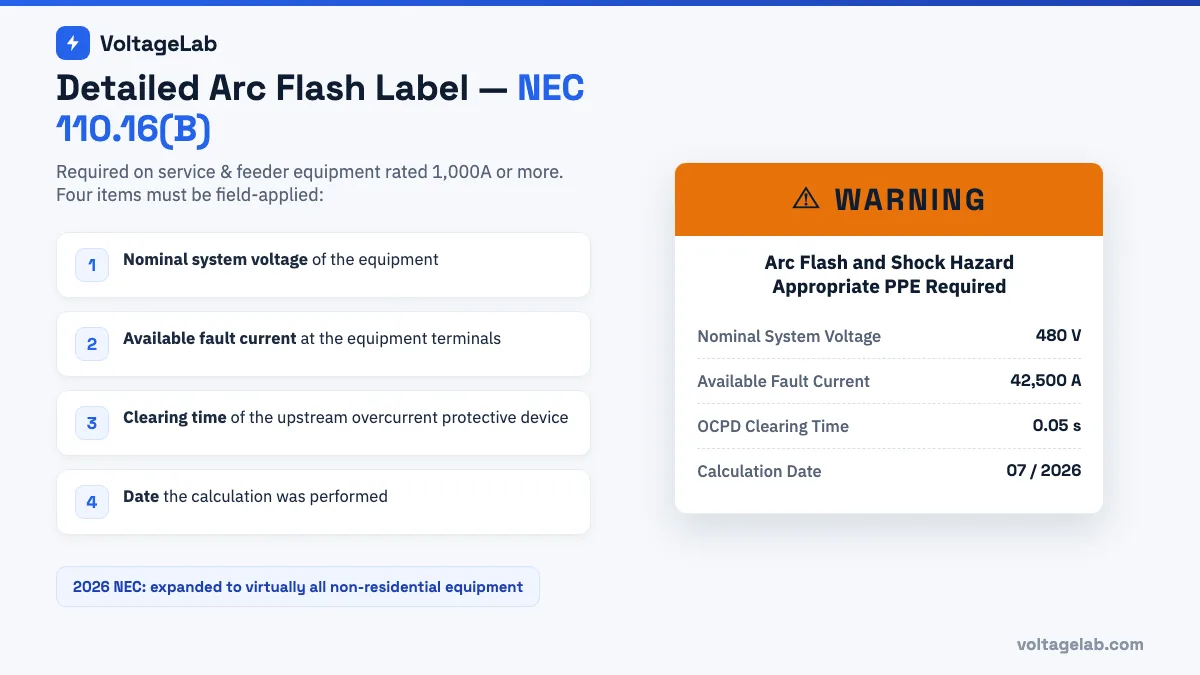
NEC 110.16(B) — Detailed Arc Flash Label (Service and Feeder Equipment ≥1,000A)
For service equipment and feeder equipment rated 1,000 amperes or more, the 2023 NEC requires a more detailed field-applied label that includes:
Pass your electrical exam the first time
Practice real NEC exam questions with full code-referenced explanations and progress tracking — built for journeyman, master and apprentice exam prep.
Thousands of NEC practice questions with code-referenced answers
- Nominal system voltage
- Available fault current at the equipment
- The clearing time of the upstream OCPD
- The date the calculation was performed
This detailed label requirement applies in addition to the general arc flash warning under 110.16(A). It must be field-applied — manufacturer labels don’t satisfy it, because the specific fault current, clearing time, and calculation date are installation-specific and can’t be predetermined.
2026 NEC Expansion — Detailed Labels on All Non-Residential Equipment
As of the 2026 NEC, the detailed arc flash label requirement was significantly expanded. In jurisdictions adopting the 2026 NEC, detailed arc flash labels are required on virtually all commercial and industrial electrical equipment — not just service and feeder equipment rated 1,000A or more. This expansion effectively mandates arc flash studies for non-residential facilities where they were previously optional. Residential equipment remains exempt.
| Requirement | NEC 2023 | NEC 2026 |
|---|---|---|
| General arc flash warning (switchboards, panelboards, MCCs, etc.) | Required — NEC 110.16(A) | Required — same scope |
| Detailed label (voltage, fault current, clearing time, date) | Required for service/feeder equipment ≥1,000A — NEC 110.16(B) | Required for virtually all non-residential equipment |
| Residential equipment | General warning only — no detailed label required | Exempt from detailed label requirement |
| Arc flash study | Best practice for most; mandatory for ≥1,000A service equipment | Effectively mandatory for all non-residential facilities |
NEC 110.24 — Available Fault Current Marking
NEC 110.24 requires that service equipment in commercial, industrial, and other non-dwelling applications be field-marked with the maximum available fault current at the service entrance. The marking must include:
- The maximum available fault current (in amperes)
- The date the calculation was performed
This marking must be updated whenever modifications could change the available fault current — a utility transformer upgrade, service conductor replacement, or added generator. It’s critical for verifying that the equipment’s interrupting rating isn’t exceeded. If the available fault current at a service panel exceeds the interrupting rating of the OCPDs, the breakers or fuses can fail catastrophically under a short circuit. Run the numbers yourself with our Fault Current Calculator before you write the label.
Residential exception: NEC 110.24 applies to other-than-dwelling-unit occupancies. Residential service equipment is not required to carry this marking, though the information is relevant to safe installation at any service.
💡 Drill this rule until it sticks.
VoltageLab’s AI Quiz Generator turns any NEC article — 110.16, 110.21, 110.24, whatever you’re studying — into unlimited exam-style practice questions with explanations, so signage and labeling requirements don’t blur together on inspection day or exam day.
NEC 110.27 — Electrical Room Access Restriction Signage
NEC 110.27(C) requires that entrances to rooms and other guarded locations containing exposed live parts be marked with conspicuous warning signs forbidding unqualified persons from entering. The exact code language: “Entrances to rooms and other guarded locations that contain exposed live parts shall be marked with conspicuous warning signs forbidding unqualified persons to enter.”
What qualifies as a compliant sign:
- Must be conspicuous — large enough and positioned prominently so it can’t be missed at the entrance.
- Must communicate that the room contains exposed live parts.
- Must restrict entry to qualified persons only.
- Standard wording: “DANGER — Electrical Hazard — Authorized Personnel Only,” or equivalent language with the appropriate signal word.
What requires this sign: Any room or guarded location with exposed live parts — electrical rooms with open switchgear, live buswork, or unenclosed service equipment; transformer vaults; generator rooms; and any area where energized conductors are accessible without opening an enclosure. Service panels with all conductors in enclosed equipment don’t technically meet the “exposed live parts” guarding trigger, but good practice calls for restricted-access signage on any dedicated electrical room regardless.
NEC 408.4 — Circuit Directory Labeling for Panelboards
This is one of the most frequently failed NEC requirements on residential and commercial inspections. NEC 408.4(A) requires that every circuit in a panelboard be legibly identified on a circuit directory located inside the panel door or a similar location. The identification must:
Study smarter with VoltageLab
Built for electricians, apprentices, and electrical engineers who want faster practice and better exam prep.
⭐️ Join thousands of electricians upgrading their skills
- Be in legible writing — a directory filled out in pencil, faded ink, or illegible handwriting doesn’t comply.
- Accurately describe the purpose of the circuit and the areas served — “bedroom” isn’t sufficient; the directory must clearly identify which loads each breaker controls.
- Be located on the panel door or in a similarly readily accessible spot inside the enclosure.
NEC 408.4(B) requires that panelboards be identified with a legible label showing supply voltage, current rating, and system voltage. NEC 408.4(C) requires identification of unused spaces — blank covers must be clearly identified or covered with filler plates.
Why accurate circuit directories matter: during an emergency, first responders and occupants rely on circuit directories to de-energize specific circuits quickly. During maintenance, workers use them to verify which breaker controls which equipment before lockout/tagout. Inaccurate directories contribute to energized work incidents.
NEC 230.70 — Service Disconnect Identification
NEC 230.70(B) requires that each service disconnect be legibly marked to indicate its purpose. Where the service disconnecting means is a group of up to six switches or breakers (permitted under NEC 230.71), each disconnect must be clearly labeled with its purpose.
The service disconnect must also be readily accessible, and its location must be known or marked so it can be quickly located in an emergency. NEC 230.85 (added in 2020) requires one- and two-family dwelling units to have an emergency disconnect located outdoors at grade level, labeled as the emergency disconnect for the building — a provision driven by firefighter safety.
NEC 110.26 and Working Clearance Signage
NEC 110.26 doesn’t directly require a sign indicating working clearances, but the requirement creates a practical need for visual markings that communicate the required clear zone to everyone in the building. See our full breakdown of NEC 110.26 working space rules for the complete clearance table and edge cases.
The NEC 110.26(A)(1) working clearance requirements:
| Voltage to Ground | Condition 1 | Condition 2 | Condition 3 |
|---|---|---|---|
| 0–150V | 3 ft (914 mm) | 3 ft (914 mm) | 3 ft (914 mm) |
| 151–600V | 3 ft (914 mm) | 3.5 ft (1.07 m) | 4 ft (1.22 m) |
| 601–2,500V | 3 ft (914 mm) | 4 ft (1.22 m) | 5 ft (1.52 m) |
| 2,501–9,000V | 4 ft (1.22 m) | 5 ft (1.52 m) | 6 ft (1.83 m) |
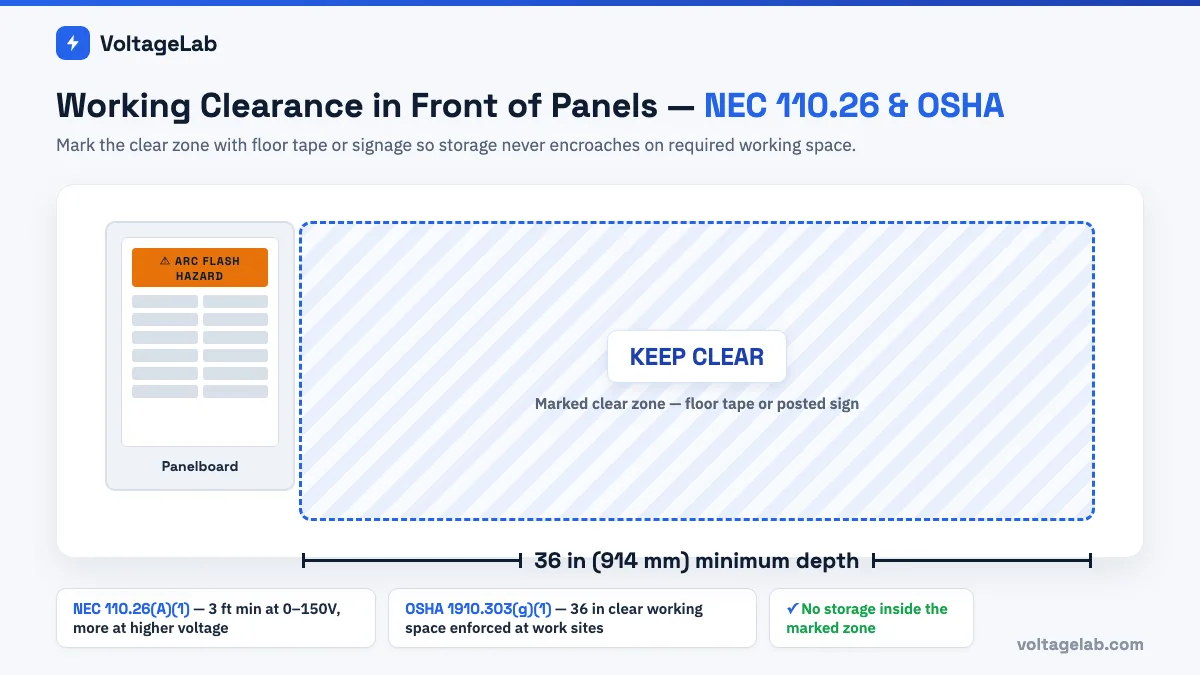
Enforcing the clearance through signage: floor marking tape, painted lines, or posted signs indicating the required clear zone in front of electrical panels are an OSHA-recognized way to communicate working clearances. OSHA 29 CFR 1910.303(g)(1) requires at least 36 inches of clear working space in front of most electrical panels. Floor markings and signage keep storage and equipment from encroaching on that clearance — a persistent problem in buildings where electrical rooms double as storage space.
OSHA Electrical Room Signage Requirements
OSHA requirements for electrical room signage complement the NEC and, in some cases, are more directly enforceable in the workplace:
- OSHA 29 CFR 1910.335(b)(1): requires safety signs, symbols, or accident-prevention tags where necessary to warn employees about electrical hazards that could cause shock, burns, or equipment-failure injury. This broad requirement covers electrical rooms, energized equipment, and hazardous voltage areas.
- OSHA 29 CFR 1910.145: governs the design and use of safety signs and tags — legibility, appropriate signal words (DANGER, WARNING, CAUTION), and maintaining signs in readable condition.
- OSHA 29 CFR 1910.303(g)(1): establishes the 36-inch working clearance requirement in front of electrical equipment that may be examined, adjusted, serviced, or maintained while energized in general industry.
OSHA’s requirements are independently enforceable — an electrical room that fails an OSHA 1910.335(b) inspection can draw citations and fines even if the NEC installation itself is code-compliant. Both sets of requirements apply simultaneously in commercial and industrial facilities.
ANSI Z535 — The Sign Design Standard
The NEC references ANSI Z535 in NEC 110.21(B) for the design of field-applied hazard markings. ANSI Z535 is the series of American National Standards governing safety sign, label, and tag design in the United States. It establishes:
- Signal words: DANGER (red background, white text — imminent hazard, high probability of death or serious injury), WARNING (orange background, black text — potentially hazardous), CAUTION (yellow background, black text — minor injury or property damage potential).
- Format: header panel with signal word, safety symbol panel (optional), and a message panel describing the hazard and consequence.
- Color coding: red = danger, orange = warning, yellow = caution, blue = notice (no injury risk).
- Durability: labels must suit the environment — weatherproof outdoors, heat-resistant in high-temperature locations.
For arc flash labels specifically, the ANSI Z535 signal word depends on incident energy: at or below 40 cal/cm² it’s WARNING or DANGER depending on severity, and above 40 cal/cm² it’s DANGER — meaning the hazard exceeds the protection offered by available PPE categories and work should proceed only with extraordinary precautions or, preferably, after de-energizing.
Summary — Required Electrical Signage by Location
| Location / Equipment | Required Sign / Label | Source |
|---|---|---|
| Electrical room / guarded location entrance | “DANGER — Authorized Personnel Only” (or equivalent) | NEC 110.27(C) |
| Service equipment, switchgear, panelboards, MCCs | General arc flash hazard warning (visible before opening) | NEC 110.16(A) |
| Service/feeder equipment ≥1,000A (or all equipment in 2026 NEC jurisdictions) | Detailed arc flash label: voltage, fault current, clearing time, date | NEC 110.16(B) / 2026 expansion |
| Service equipment (non-dwelling) | Available fault current marking with calculation date | NEC 110.24 |
| Panelboard interior | Circuit directory — legible identification of each circuit | NEC 408.4(A) |
| Service disconnect | Legible identification of purpose | NEC 230.70(B) |
| 1 & 2-family dwelling — outdoor disconnect | Emergency disconnect label | NEC 230.85 |
| Working clearance zone | Floor marking / posted clearance sign | OSHA 29 CFR 1910.303(g)(1) |
| All equipment with electrical hazards | Safety signs to warn of shock, burn, or equipment failure risk | OSHA 29 CFR 1910.335(b)(1) |
Conclusion
Electrical room and panel signage draws from four separate sources — the NEC, NFPA 70E, OSHA, and ANSI Z535 label design standards — and no single document covers all of it. A compliant installation means knowing what each standard requires and where they overlap.
Four labels every commercial electrical installation needs before final inspection:
- Arc flash hazard warning on all switchboards, panelboards, switchgear, MCCs — NEC 110.16(A)
- Available fault current marking on service equipment in non-dwelling applications — NEC 110.24
- Circuit directory on every panelboard — legible, accurate, complete — NEC 408.4(A)
- Electrical room access restriction on every room with exposed live parts — NEC 110.27(C)
If you’re also verifying grounding and bonding sizing during the same panel inspection, see our guide to Bonding Jumpers: Types, Sizing & NEC Code Rules. And if you want to keep every one of these citations straight without flipping through the code book on site, the VoltageLab electrician app puts NEC lookups, quizzes, and study tools in your pocket.
📱 The electrical reference and study app built for working electricians.
VoltageLab puts unlimited AI-generated NEC practice questions, Watch and Quiz lessons, flashcards, and an interactive Apprentice Simulator in your pocket — so code requirements like these stick before the next inspection. Free on iOS and Android.
Frequently Asked Questions
What signs are required on an electrical room door?
Per NEC 110.27(C), any room or guarded location containing exposed live parts must have a conspicuous warning sign at the entrance forbidding unqualified persons from entering. Standard compliant wording is “DANGER — Electrical Hazard — Authorized Personnel Only.” OSHA 29 CFR 1910.335(b)(1) additionally requires signage where necessary to warn employees of electrical hazards that could cause injury. The sign must use ANSI Z535 signal word conventions per NEC 110.21(B).
What is required on an arc flash label per the NEC?
NEC 110.16(A) requires that switchboards, panelboards, switchgear, industrial control panels, and motor control centers be field-marked with a visible arc flash hazard warning before the enclosure is opened — at minimum. For service and feeder equipment rated 1,000A or more (NEC 110.16(B)), the label must also include nominal system voltage, available fault current, clearing time of the upstream OCPD, and the date of the calculation. The 2026 NEC expands the detailed label requirement to virtually all non-residential commercial and industrial equipment.
What does NEC 110.24 require electricians to mark on service equipment?
NEC 110.24 requires that service equipment in other-than-dwelling-unit occupancies be field-marked with the maximum available fault current at the equipment and the date the calculation was performed. The marking must be updated whenever system modifications change the available fault current. This applies to commercial, industrial, and institutional facilities, but not to residential services.
Is a circuit directory required in every electrical panel?
Yes. NEC 408.4(A) requires that every circuit in a panelboard be legibly identified on a circuit directory inside the panel door or a similar location, describing the purpose of each circuit and the areas it serves. Illegible, inaccurate, or missing circuit directories are among the most common electrical code violations found on inspections.
What OSHA regulation covers working clearance in front of electrical panels?
OSHA 29 CFR 1910.303(g)(1) requires a minimum of 36 inches of clear working space in front of electrical equipment that may need to be examined, adjusted, serviced, or maintained while energized in general industry. Floor markings, painted lines, or posted signs indicating the required clear zone are recognized ways to communicate and enforce this clearance, even though OSHA doesn’t mandate a specific sign.
FREE PRACTICE TOOL
Think you'd pass this on a real exam?
Test what you just read with instant-feedback quizzes built around real code questions — not generic trivia.
5
Code standards
10,000+
Active learners
100%
Free to start
Instant explanations on every answer, right or wrong
NEC, BS7671, AS/NZS, CEC, and DIN VDE covered
Bite-sized quizzes you can finish in 5 minutes
No signup required to try your first quiz
No account needed · Takes less than 2 minutes