


An electrical room with 18 kW of transformers and gear in it does not feel warm on the drawing. It feels warm in August, when the mini-split trips on high head pressure and someone props the door open with a fire extinguisher. The mechanical engineer sized that unit off a number an electrician gave them — and if that number was the connected load rather than the heat load, it was wrong before the drawing was stamped.
Converting watts to BTU/hr is the bridge between the electrical side of a job and the mechanical side. The arithmetic is one multiplication and takes three seconds. The part that goes wrong is not the arithmetic — it is deciding which watts to multiply. Feed a transformer’s full kVA into the formula instead of its losses and you will oversize the cooling by a factor of thirty.
Study smarter with VoltageLab
Built for electricians, apprentices, and electrical engineers who want faster practice and better exam prep.
⭐️ Join thousands of electricians upgrading their skills
This guide covers the conversion formula and where its constant comes from, the reverse conversion, tons of refrigeration, a full watts-to-BTU/hr chart for common loads, and — most importantly — how to work out which portion of a piece of equipment’s input power actually shows up as heat in the room.
Quick Answer
To convert watts to BTU/hr, multiply by 3.412142. So BTU/hr = watts × 3.412. A 1,500 W space heater produces 5,118 BTU/hr; 1 kW produces 3,412 BTU/hr. To go the other way, multiply BTU/hr by 0.29307 to get watts.
That conversion assumes all of the input power turns into heat in the space, which is true for resistance heaters, lighting and IT equipment. For transformers, motors, UPS units and drives, only the losses become room heat — convert the loss watts, not the nameplate rating. A 75 kVA transformer at 98% efficiency puts out roughly 1,500 W of heat, or about 5,100 BTU/hr, not 256,000.
Key Takeaways
- BTU/hr = watts × 3.412142; the everyday rounded factor 3.412 is accurate to 0.004%, far tighter than any field measurement.
- The reverse conversion is watts = BTU/hr × 0.29307107, or simply BTU/hr divided by 3.412.
- The constant is a unit definition, not an empirical value: 3,600 joules per watt-hour divided by 1,055.05585262 joules per international-table BTU.
- One ton of refrigeration is 12,000 BTU/hr, which equals 3,516.85 watts — so every 3.5 kW of continuous heat load needs about one ton of cooling.
- Resistance heating, lighting and IT equipment convert essentially 100% of input watts to heat in the space; transformers, motors, UPS units and VFDs convert only their losses.
- BTU is a quantity of energy and BTU/hr is a rate of energy — watts convert to BTU/hr, never to plain BTU, because watts are already a rate.
- NEC 450.9 requires transformer ventilation sized to dispose of the full-load losses without exceeding the transformer’s temperature rating, which is exactly the number this conversion produces.
The watts to BTU/hr conversion formula
The formula is a single multiplication:
Study smarter with VoltageLab
Built for electricians, apprentices, and electrical engineers who want faster practice and better exam prep.
Join thousands of electricians upgrading their skills
BTU/hr = Watts × 3.412142
Watts = BTU/hr × 0.29307107
For kilowatts, multiply by 3,412.14 instead. A 5 kW duct heater is 5 × 3,412.14 = 17,061 BTU/hr. If you prefer to work in your head, remember that 1 kW is almost exactly 3,400 BTU/hr — a 0.36% error, which is nothing next to the safety factor the mechanical engineer is going to add anyway.
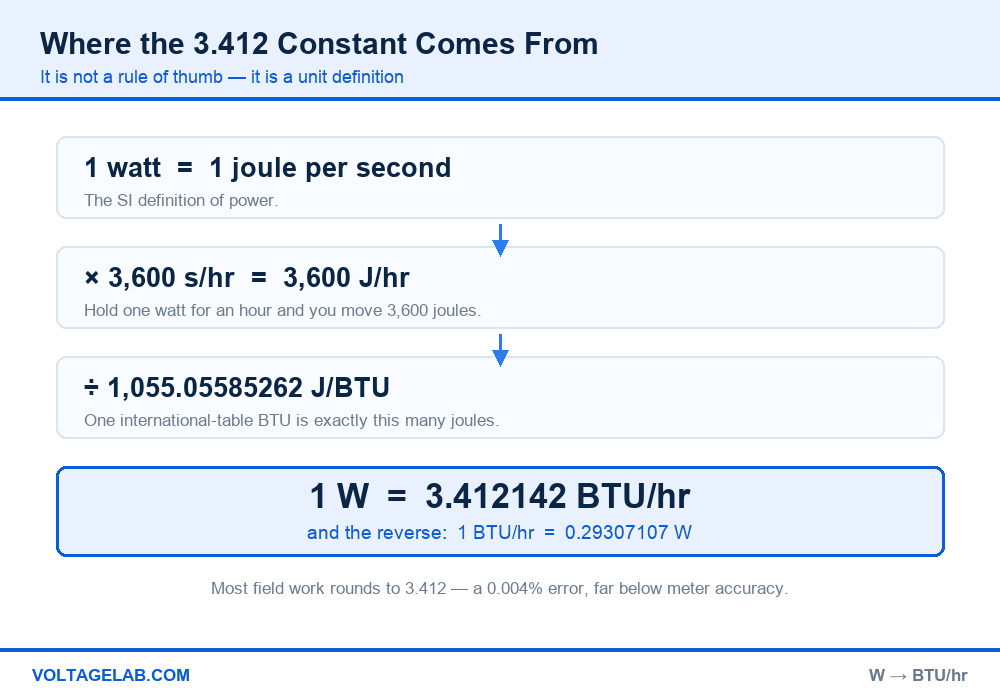
Why the constant is 3.412142 and not something rounder
The number is not measured, and it is not a rule of thumb. It falls straight out of the definitions of the two units. A watt is one joule per second, so a watt sustained for an hour moves 3,600 joules. One British thermal unit — specifically the international-table BTU used in engineering work — is defined as exactly 1,055.05585262 joules. Divide 3,600 by 1,055.05585262 and you get 3.412141633.
You will occasionally see 3.4144 quoted instead. That comes from the thermochemical BTU, which is 1,054.35026444 joules, a slightly different definition used mostly in chemistry. For HVAC and electrical work, use 3.412. The difference is about 0.07% and no equipment schedule in existence is that precise.
BTU and BTU/hr are not the same thing
This trips people up constantly, including equipment manufacturers who should know better. A BTU is a quantity of energy, like a joule or a kilowatt-hour. A BTU/hr is a rate of energy flow, like a watt or a horsepower. Watts convert to BTU/hr because both are rates. Watts do not convert to BTU, any more than miles per hour convert to miles.
When an air conditioner is advertised as “12,000 BTU”, the manufacturer means 12,000 BTU/hr — the /hr is dropped as industry shorthand. If you want actual BTU of energy, you need a time span: watt-hours × 3.412 gives BTU. A 1,500 W heater running for 8 hours consumes 12 kWh, which is 40,946 BTU of energy delivered at a rate of 5,118 BTU/hr.
Watts, kilowatts, BTU/hr, tons and horsepower compared
Electrical work is quoted in watts, mechanical work in BTU/hr, cooling equipment in tons, and motors in horsepower. All four describe the same physical thing — a rate of energy transfer — and any one converts to any other.
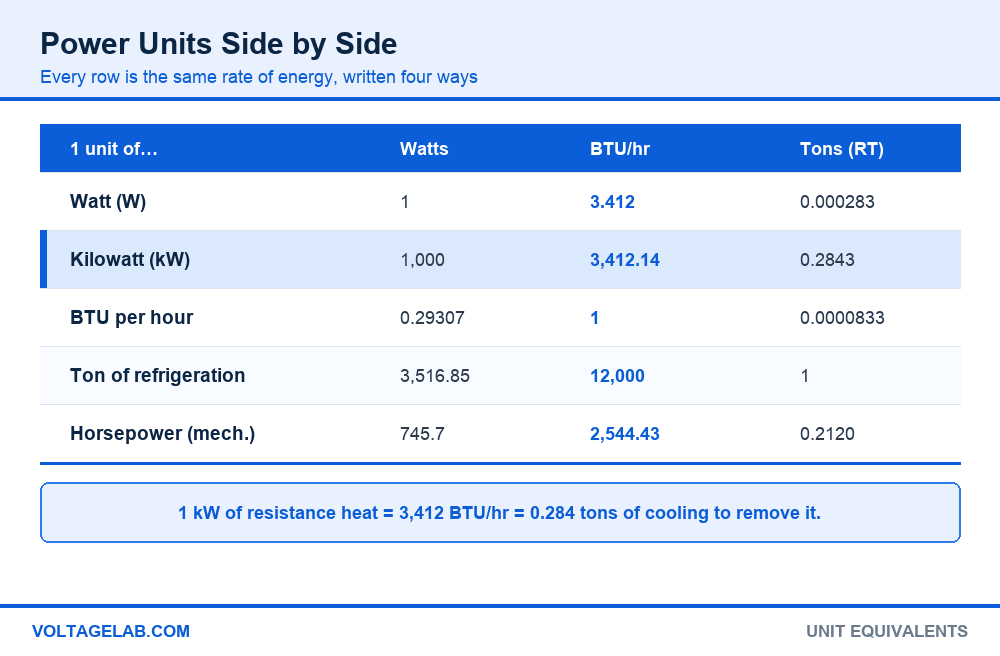
| One unit of… | Watts | BTU/hr | Tons (RT) |
|---|---|---|---|
| Watt (W) | 1 | 3.412142 | 0.000284 |
| Kilowatt (kW) | 1,000 | 3,412.14 | 0.2843 |
| BTU per hour | 0.29307 | 1 | 0.0000833 |
| Ton of refrigeration | 3,516.85 | 12,000 | 1 |
| Horsepower (mechanical) | 745.7 | 2,544.43 | 0.2120 |
Converting heat load to tons of cooling
One ton of refrigeration is defined as 12,000 BTU/hr — historically, the rate that melts one short ton of ice over 24 hours. In electrical terms, one ton equals 3,516.85 watts. That gives you a shortcut worth memorising: every 3.5 kW of continuous heat load needs roughly one ton of cooling.
So an electrical room dissipating 12 kW needs about 3.4 tons before you add any allowance for solar gain through the wall, infiltration, or the lighting you left out of the tally. That is the number the mechanical engineer needs from you, and it is the number that turns a 1.5-ton mini-split into an obviously undersized unit before anyone orders it.
The error that oversizes every electrical room: converting a transformer’s kVA rating instead of its losses. A 75 kVA transformer is not a 75 kW heater. At 98% efficiency it dissipates about 1.5 kW — roughly 5,100 BTU/hr, not 256,000 BTU/hr. NEC 450.9 says the ventilation must dispose of the transformer full-load losses, and the manufacturer publishes those as no-load and load loss figures on the datasheet. Use them.
Watts to BTU/hr conversion chart
Common electrical ratings converted to heat load and cooling tons. Every figure below assumes 100% of input power becomes heat in the space, which holds for the resistive and IT loads listed.
Study smarter with VoltageLab
Built for electricians, apprentices, and electrical engineers who want faster practice and better exam prep.
⭐️ Join thousands of electricians upgrading their skills
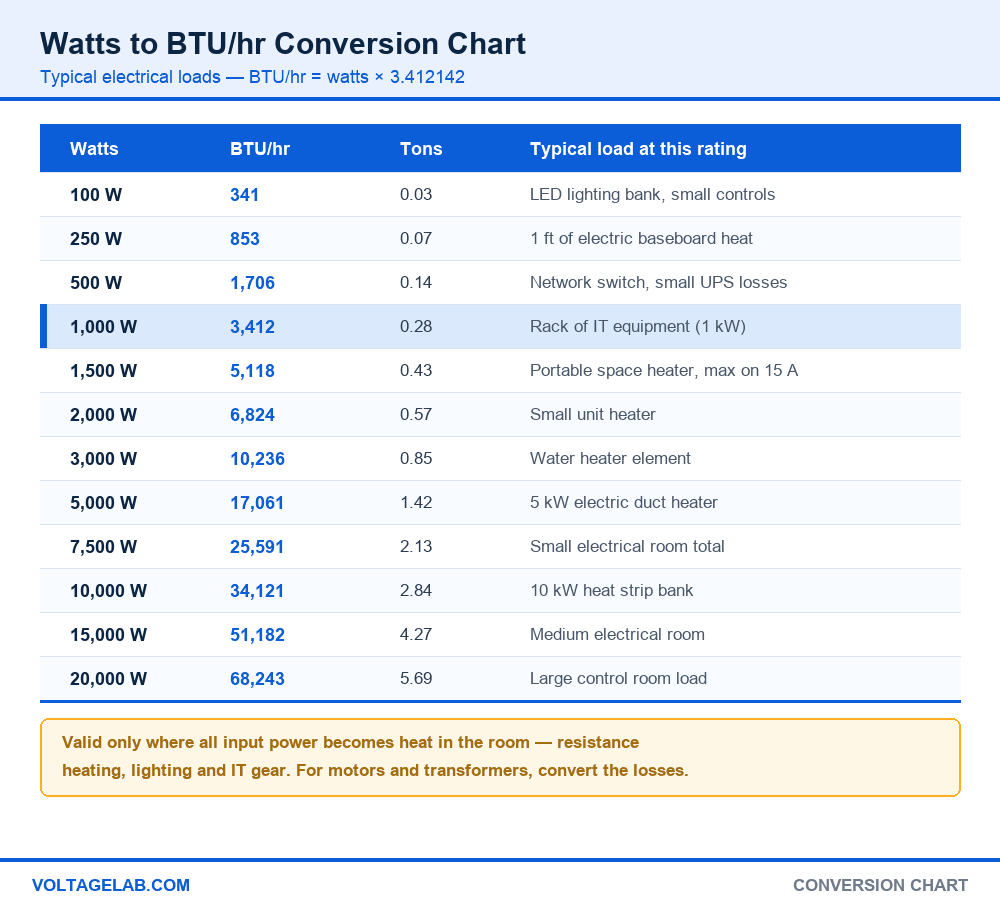
| Watts | Kilowatts | BTU/hr | Tons (RT) |
|---|---|---|---|
| 100 W | 0.1 kW | 341 | 0.03 |
| 250 W | 0.25 kW | 853 | 0.07 |
| 500 W | 0.5 kW | 1,706 | 0.14 |
| 750 W | 0.75 kW | 2,559 | 0.21 |
| 1,000 W | 1 kW | 3,412 | 0.28 |
| 1,500 W | 1.5 kW | 5,118 | 0.43 |
| 2,000 W | 2 kW | 6,824 | 0.57 |
| 3,000 W | 3 kW | 10,236 | 0.85 |
| 5,000 W | 5 kW | 17,061 | 1.42 |
| 7,500 W | 7.5 kW | 25,591 | 2.13 |
| 10,000 W | 10 kW | 34,121 | 2.84 |
| 15,000 W | 15 kW | 51,182 | 4.27 |
| 20,000 W | 20 kW | 68,243 | 5.69 |
| 30,000 W | 30 kW | 102,364 | 8.53 |
How to calculate an electrical room heat load, step by step
- List every piece of equipment in the room and its input power in watts. Use measured or calculated demand load, not connected load, for anything that does not run continuously.
- For each item, decide what fraction of that input becomes heat in the room. Resistive and IT loads: 100%. Transformers: no-load losses plus load losses at the actual loading. Motors: the losses only, if the shaft work leaves the room.
- Add the lighting load in the room. All of it becomes heat, LED included — LEDs are more efficient at making light, not at avoiding heat.
- Sum the heat-producing watts to get total heat load in watts.
- Multiply by 3.412 to get BTU/hr.
- Divide by 12,000 to get tons, if the mechanical engineer wants tons.
- Hand over the envelope loads separately — wall conduction, solar gain and infiltration are the mechanical engineer’s to calculate, not yours.
Worked example. An electrical room contains a 75 kVA transformer loaded to 60% (published losses: 300 W no-load, 1,100 W at full load), a 400 W lighting load, and 900 W of controls and monitoring. Transformer load losses scale with the square of loading, so 1,100 × 0.60² = 396 W, plus 300 W no-load = 696 W. Total heat = 696 + 400 + 900 = 1,996 W. Convert: 1,996 × 3.412 = 6,811 BTU/hr, or 0.57 tons. Converting the transformer’s 75 kVA nameplate instead would have produced 256,000 BTU/hr and a 21-ton answer.
The one that catches everyone: transformer load losses scale with the square of loading, not linearly. A transformer at half load produces one quarter of its full-load copper losses, not half. Miss that and you will overstate heat load on every lightly loaded transformer in the building. No-load core losses, by contrast, are constant whenever the transformer is energised — they do not scale at all.
Which watts actually become heat
The formula never changes. What changes is the number you put into it. The test is simple: does the energy leave the room in any form other than heat? If not, all of it becomes heat.
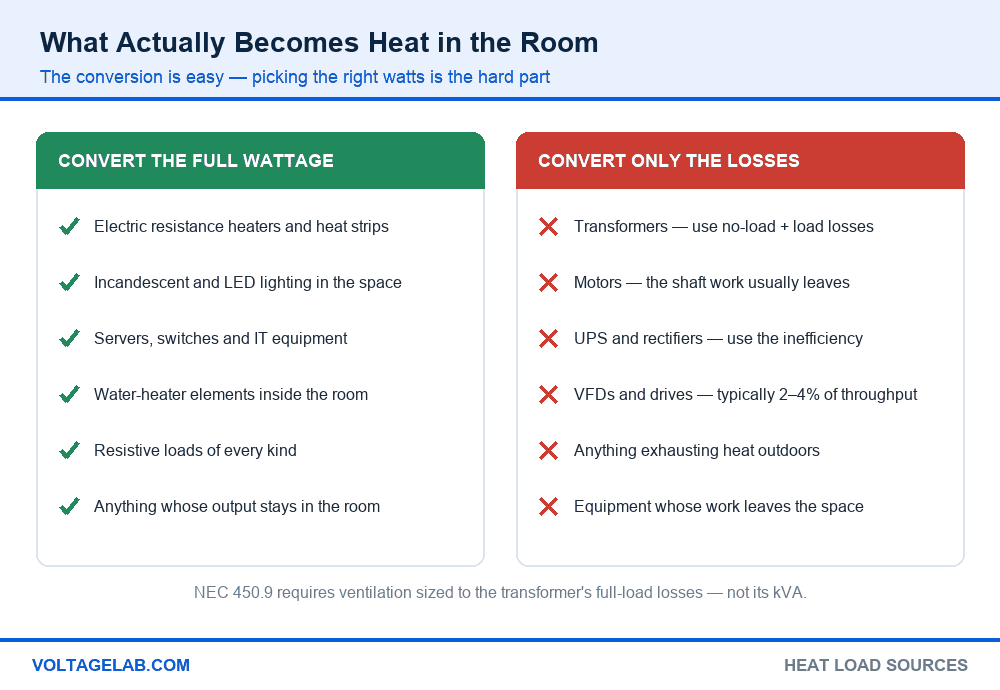
Loads that convert 100% of input watts to heat
- Electric resistance heating — baseboard, unit heaters, duct heaters and heat strips are 100% efficient at making heat by definition. NEC 220.51 requires fixed electric space heating to be calculated at 100% of connected load for feeder and service sizing, and the same figure is your heat load.
- Lighting — every watt ends up as heat in the space, whether it spends time as visible light first or not.
- IT and electronic equipment — servers, switches, PLCs and control gear do no mechanical work, so input power equals heat output. This is why data-centre cooling is sized directly off IT load.
- Water-heater elements, provided the tank and its piping are inside the room and losing heat to it.
Loads where you convert only the losses
- Transformers — use published no-load and load losses. See our transformer sizing chart by kVA for how the ratings relate.
- Motors — if the driven load is outside the room, only the motor’s inefficiency stays behind. A 10 hp motor at 91% efficiency dissipates roughly 738 W, or 2,516 BTU/hr. Our guide to motor nameplate specifications covers where to read efficiency, and NEC Table 430.250 gives the full-load currents.
- UPS systems and rectifiers — convert the inefficiency. A 20 kW UPS at 94% efficiency contributes about 1.28 kW of heat, plus whatever the battery room adds.
- VFDs and drives — typically 2–4% of throughput power, per the manufacturer’s data.
Where power factor fits in — and where it does not
Heat is produced by real power, measured in watts, not by apparent power in volt-amperes. If you only have a kVA figure, you must multiply by power factor before converting: kW = kVA × PF. A 50 kVA load at 0.85 PF is 42.5 kW of real power, and it is the 42.5 kW you convert. Skipping that step overstates heat load by whatever the power factor is short of unity — about 18% in that example. Our guide to electrical power factor covers why the two differ.
Reactive power does not heat the room directly. It does increase current, and that current produces additional I²R losses in conductors and terminations, which do become heat — but that is a second-order effect captured in the equipment loss figures, not something you add separately.
Nameplate watts or measured watts?
Once you know which equipment contributes heat, you still have to pick a wattage for it. Nameplate is easy and defensible; measured demand is accurate. The honest answer is that it depends on what the number is for.
Use nameplate when
- The equipment genuinely runs at or near full load continuously.
- You are sizing for a worst-case condition that must not fail.
- The design is new and there is nothing to measure yet.
- You need a figure you can defend on a stamped drawing.
Where nameplate misleads
- Lightly loaded transformers, because losses scale with the square of loading.
- Intermittent equipment that runs a few minutes an hour.
- Oversized cooling short-cycles, dehumidifies poorly and costs more to run.
For an existing building, log the actual demand over a hot week and use that. For new work, use nameplate with the equipment’s real duty cycle applied — and say on the drawing which you did. The same distinction shows up in residential load calculations and in the maximum load capacity rules for circuits, where connected load and demand load are deliberately different numbers.
Working with the conversion in the field
Do
- Multiply by 3.412 and state the units as BTU/hr, never as BTU.
- Use published transformer loss data, not the kVA rating, for heat load.
- Convert kVA to kW with power factor before applying the formula.
- Include room lighting in the tally — it is 100% heat.
- Write down which assumption you used so the next person can check it.
Avoid
- Converting a transformer or UPS nameplate rating as if it were a heater.
- Scaling transformer load losses linearly with loading.
- Assuming LED lighting adds no heat because it is efficient.
- Counting motor shaft power as room heat when the load is elsewhere.
- Mixing the thermochemical and international-table BTU in one calculation.
Frequently asked questions
How do you convert watts to BTU/hr?
Multiply watts by 3.412142. BTU/hr = watts × 3.412. For kilowatts, multiply by 3,412.14. A 2,000 W load is 2,000 × 3.412 = 6,824 BTU/hr.
How many BTU is 1,000 watts?
1,000 watts is 3,412 BTU/hr. Strictly it is 3,412.14 BTU per hour, not 3,412 BTU — watts are a rate of energy, so they convert to a rate, not to a quantity. To get BTU of energy you need a duration: 1,000 W running for one hour delivers 3,412 BTU.
How do you convert BTU/hr back to watts?
Multiply BTU/hr by 0.29307107, or divide by 3.412142 — they are the same operation. A 12,000 BTU/hr air conditioner removes heat at a rate equivalent to 3,517 watts, which is where the one-ton rating comes from.
How many watts is one ton of cooling?
3,516.85 watts, or 12,000 BTU/hr. As a working rule, every 3.5 kW of continuous heat load in a space requires about one ton of cooling capacity to remove it, before envelope and ventilation loads are added.
Does a 1,500 W space heater really produce 5,118 BTU/hr?
Yes. Electric resistance heating converts essentially 100% of input power to heat, so 1,500 × 3.412 = 5,118 BTU/hr. This is also why every 120 V portable heater on the market is rated 1,500 W — it is the practical maximum on a 15 A branch circuit at 80% continuous loading.
How much heat does a transformer produce?
Only its losses, which are typically 1–3% of throughput for a dry-type unit. Use the manufacturer’s published no-load and load loss figures, remembering that load losses scale with the square of loading. NEC 450.9 requires ventilation sized to dispose of the full-load losses without exceeding the transformer’s temperature rating.
Do I use kVA or kW to calculate heat load?
kW. Heat comes from real power. If you only have kVA, multiply by the power factor first: kW = kVA × PF. Converting kVA directly overstates the heat load by however far the power factor sits below unity.
Is the conversion factor 3.412 or 3.4144?
Use 3.412 for electrical and HVAC work. It is based on the international-table BTU of 1,055.05585262 joules, the standard in engineering. The 3.4144 figure comes from the thermochemical BTU of 1,054.35 joules, used mainly in chemistry. The difference is about 0.07% — immaterial in practice, but do not mix the two in one calculation.
The bottom line
Converting watts to BTU/hr earns its place in your toolkit because it is the one calculation that lets you hand the mechanical side a number they can size equipment from. Multiply by 3.412 and you are done. The constant is a unit definition, not an approximation, and rounding it to three decimals costs you 0.004% — nothing.
Two restraints decide whether the answer is any good. First, convert real power in watts, not apparent power in kVA — apply power factor before the multiplication. Second, and this is the one that wrecks electrical room designs, convert only the watts that actually become heat in the room: full input for resistance heat, lighting and IT gear, but losses alone for transformers, motors, UPS units and drives. Get those two right and the arithmetic takes care of itself. If you are working through the electrical side of a room build, our transformer sizing guide and the NEC 110.26 working space rules are the next two pieces of the same puzzle.
FREE PRACTICE TOOL
Think you'd pass this on a real exam?
Test what you just read with instant-feedback quizzes built around real code questions — not generic trivia.
5
Code standards
10,000+
Active learners
100%
Free to start
Instant explanations on every answer, right or wrong
NEC, BS7671, AS/NZS, CEC, and DIN VDE covered
Bite-sized quizzes you can finish in 5 minutes
No signup required to try your first quiz
No account needed · Takes less than 2 minutes