


You are running two bedroom circuits down the same joist bay. The old answer was a 14/3 and a shared neutral. Then combination AFCI protection became mandatory in bedrooms, and suddenly that multiwire branch circuit needed a two-pole AFCI breaker — a part that costs three times a single-pole, is not stocked at every supply house, and takes two spaces in a panel that did not have them to spare.
14-2-2 cable exists to solve exactly that problem. It is a Type NM-B cable carrying four insulated conductors instead of two or three: two hots, two separate neutrals, and one bare ground. Because neither circuit shares a return path, the two circuits inside it are completely independent — which means two ordinary single-pole AFCI breakers, no handle tie, and none of the MWBC rules in NEC 210.4.
Study smarter with VoltageLab
Built for electricians, apprentices, and electrical engineers who want faster practice and better exam prep.
⭐️ Join thousands of electricians upgrading their skills
This guide covers what is actually inside the cable, how the second neutral is identified and why that matters under NEC 200.4(B), how 14-2-2 compares against a 14/3 multiwire branch circuit and against simply pulling two 14/2 cables, the derating question that catches people when cables get bundled, and the box-fill arithmetic that decides whether it fits the boxes you already bought.
Quick Answer
14-2-2 cable — often called double-neutral or “extra circuit” cable — is a Type NM-B cable containing four 14 AWG insulated conductors plus a bare equipment ground. The conductors are black, white, red, and white with a red stripe. That gives you two entirely separate 15 A circuits in one jacket, each with its own dedicated neutral.
Use it when two circuits follow the same path and you want to keep them independent — typically so each can take a standard single-pole AFCI or GFCI breaker. Because the neutrals are not shared, 14-2-2 is not a multiwire branch circuit, so the handle-tie requirement of NEC 210.4(B) does not apply to it. The trade-off is four current-carrying conductors instead of two, which matters only when three or more cables are bundled together.
Key Takeaways
- 14-2-2 cable holds four insulated 14 AWG conductors plus a bare ground: black and white for one circuit, red and white-with-red-stripe for the other.
- Each circuit has its own neutral, so 14-2-2 is not a multiwire branch circuit and the simultaneous-disconnect rule of NEC 210.4(B) does not apply.
- Two ordinary single-pole AFCI or GFCI breakers will protect the two circuits, avoiding the two-pole AFCI a shared-neutral 14/3 would require.
- All four insulated conductors are current-carrying, but a single 14-2-2 still gives a usable 15 A because NEC 334.80 permits starting the adjustment at the 90 °C column.
- Bundle three or more 14-2-2 cables through a sealed opening or in insulation and the adjusted ampacity drops to 12.5 A, below a 15 A breaker.
- The striped white conductor is there so you can pair each neutral with its own hot, which NEC 200.4(B) requires where multiple circuits’ neutrals share an enclosure.
- Box fill for 14-2-2 is 10.0 in³ per cable in a device box — the same as two 14/2 cables, and a fed-through device box reaches 22.0 in³.
What is 14-2-2 cable?
Read the name as “14 gauge, two conductors, twice over.” Where 14/2 gives you one hot and one neutral and 14/3 gives you two hots sharing a neutral, 14-2-2 gives you two complete two-wire circuits stacked in one jacket. Manufacturers sell it as Romex Brand SIMpull Type NM-B “Extra Circuit” cable; on a plan or a takeoff you will see it written 14-2-2, 14/2/2 or 14-2/2, and all three mean the same product.
Pass your electrical exam the first time
Practice real NEC exam questions with full code-referenced explanations and progress tracking — built for journeyman, master and apprentice exam prep.
Thousands of NEC practice questions with code-referenced answers
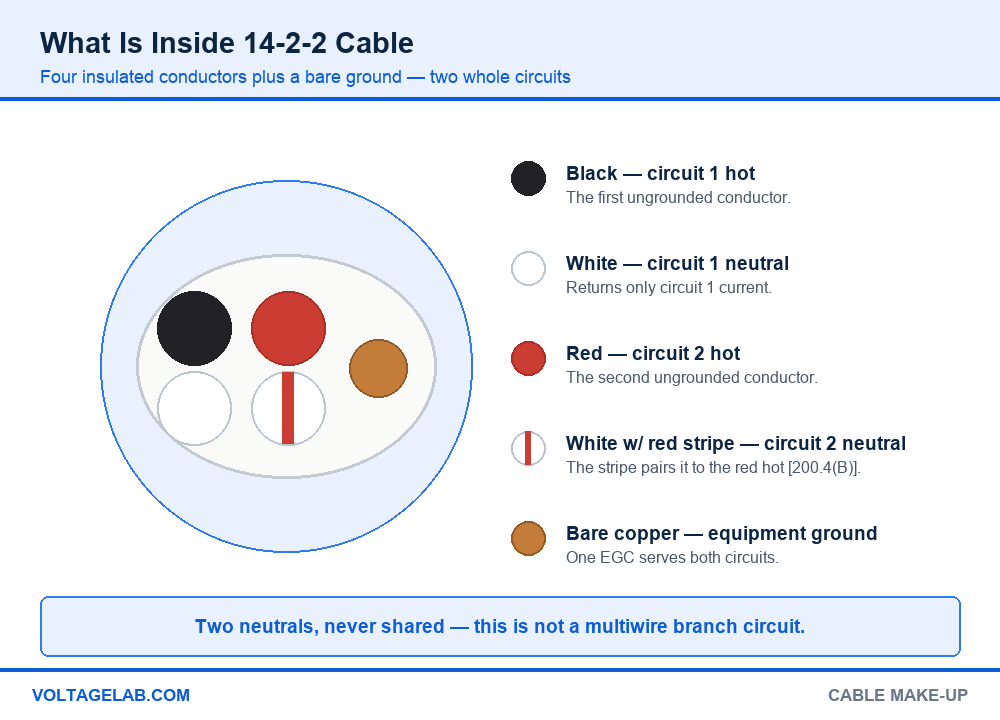
It is an ordinary Type NM-B cable in every other respect: 600 V rated, 90 °C insulation with ampacity limited to the 60 °C column, solid copper conductors, bare copper equipment grounding conductor, and Article 334 governing where you may and may not install it. Nothing about the extra conductor changes the wiring method rules — dry locations, concealed in framing, protected from physical damage, the same as any other Romex.
Why the second neutral has a stripe
Two white conductors in one box is a recipe for someone landing circuit 1’s neutral on circuit 2’s breaker. The stripe prevents that, and it is not decoration — it is how you comply with NEC 200.4(B), which requires that where more than one neutral associated with different circuits is in an enclosure, the grounded conductor of each circuit be identified or grouped to correspond with its ungrounded conductor by wire markers, cable ties or similar means in at least one location in the enclosure.
With 14-2-2 the manufacturer has done that identification for you at the factory: white pairs with black, white-with-red-stripe pairs with red. Keep those pairings consistent at every box and every splice and the 200.4(B) obligation is satisfied by the cable itself. Break the pairing — land the striped neutral with the black hot at one device — and you have created a shared-neutral condition you did not design, with current returning on the wrong conductor. Our guide to electrical wiring colour codes and standards covers the wider identification rules, and Article 200 on grounded conductors covers the neutral rules specifically.
The mistake that turns 14-2-2 into a hazard: tying the two white conductors together at a box “because they are both neutrals.” They are not interchangeable. Bonding them creates a parallel return path, defeats the separation that made single-pole AFCI protection possible, and will trip a GFCI or AFCI breaker immediately — or worse, will not trip and will quietly carry circuit 1’s current back on circuit 2’s neutral. Keep every neutral with its own hot for the whole length of the run.
14-2-2 vs 14/3 multiwire branch circuit vs two 14/2 runs
There are three ways to get two circuits down one path, and the right answer depends on what you are trying to avoid: breaker cost, pulling labour, or derating.
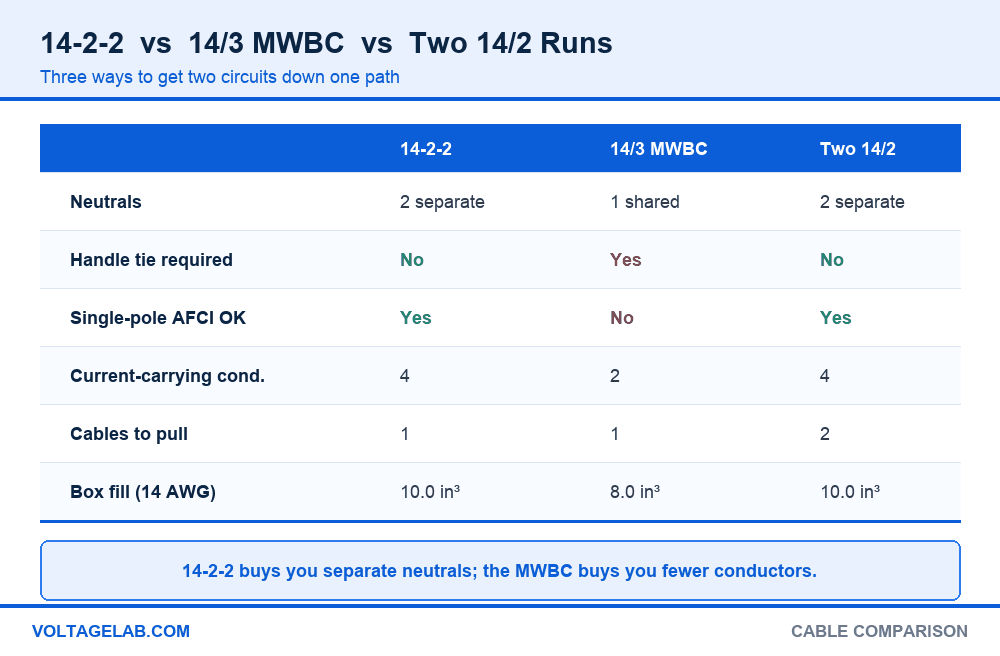
| Consideration | 14-2-2 | 14/3 MWBC | Two 14/2 |
|---|---|---|---|
| Neutral arrangement | Two separate | One shared | Two separate |
| Handle tie required [210.4(B)] | No | Yes | No |
| Single-pole AFCI / GFCI usable | Yes | No — needs two-pole | Yes |
| Current-carrying conductors | 4 | 2 | 4 |
| Cables to pull and staple | 1 | 1 | 2 |
| Box fill per cable, 14 AWG | 10.0 in³ | 8.0 in³ | 10.0 in³ |
| Can serve a 240 V load | No | Yes | No |
The pattern is clear enough. A multiwire branch circuit is the most conductor-efficient option and the only one of the three that can also feed a 240 V load, but it drags in the handle-tie rule, the grouping rule of 210.4(D), and a two-pole AFCI wherever arc-fault protection is required. Two 14/2 cables have none of those problems but double the drilling, stapling and connectors. 14-2-2 sits between them: the independence of two cables with the pulling labour of one.
Why 14-2-2 cannot serve a 240 V load
Physically it has two hots, so the temptation is obvious. Do not. The two circuits in a 14-2-2 are designed and identified as separate 120 V branch circuits, each with its own neutral and its own overcurrent device. Using the black and red as a 240 V pair would leave two neutrals with no defined function, remove the simultaneous disconnect that a 240 V circuit needs, and defeat the identification scheme the cable is built around. If you need 240 V, pull a 14/3 or a 12/3 and treat it as the two-wire or multiwire circuit it is.
14-2-2 ampacity and the four-conductor derating question
This is where people get nervous, and mostly they do not need to. A 14-2-2 with both circuits loaded has four current-carrying conductors, which triggers the adjustment factors of NEC 310.15(C)(1). But NEC 334.80 lets you start that calculation from the 90 °C column of Table 310.16, provided the final answer does not exceed the 60 °C value. Run the numbers and a single 14-2-2 loses nothing.
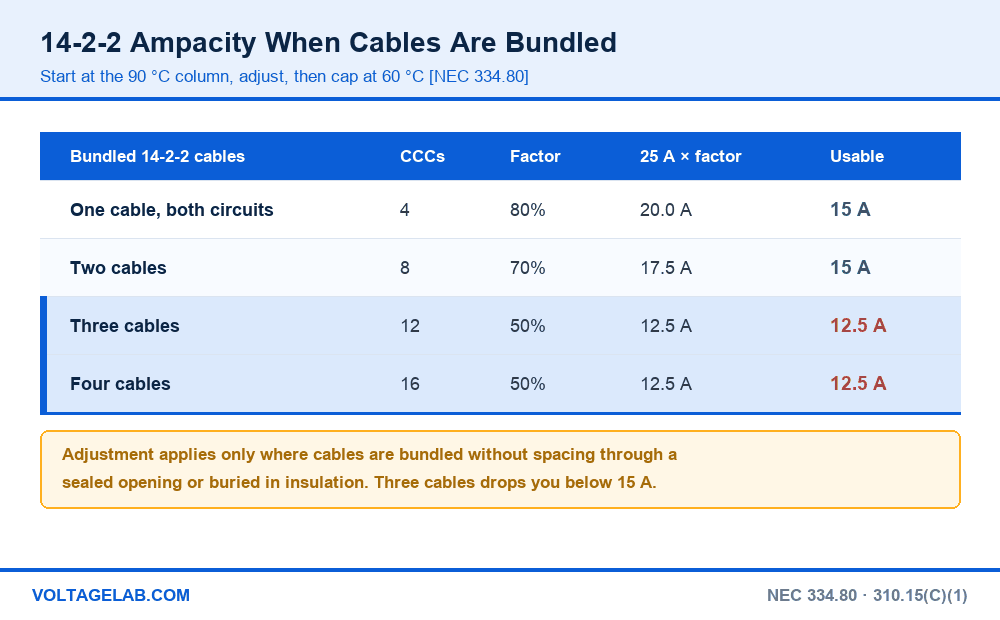
| Condition | Current-carrying conductors | Adjustment factor | 25 A × factor | Usable ampacity |
|---|---|---|---|---|
| One 14-2-2, both circuits loaded | 4 | 80% | 20.0 A | 15 A (capped at 60 °C) |
| Two 14-2-2 bundled | 8 | 70% | 17.5 A | 15 A (capped at 60 °C) |
| Three 14-2-2 bundled | 12 | 50% | 12.5 A | 12.5 A |
| Four 14-2-2 bundled | 16 | 50% | 12.5 A | 12.5 A |
| One 14/3 MWBC (for comparison) | 2 | None | — | 15 A |
So a single 14-2-2, or even two of them bundled, still supports a full 15 A on each circuit. It is the third cable that hurts: twelve current-carrying conductors puts you in the 50% band, 25 × 0.50 = 12.5 A, and that is genuinely below the 15 A breaker you wanted to install. Our breakdown of Table 310.16 ampacities covers the columns this calculation draws on.
The one that catches everyone: at 12.5 A you cannot simply round back up to a 15 A breaker. NEC 240.4(B) permits using the next higher standard overcurrent device only where the circuit does not supply receptacle outlets for cord-and-plug-connected portable loads — which is exactly what a bedroom or living-room circuit is. Space the cables apart through the framing instead, or use fewer cables per opening. Spacing is free; re-pulling is not.
Box fill: the arithmetic that decides your boxes
NEC 314.16(B) allows 2.00 in³ per 14 AWG conductor. Count them the way the Code does — each insulated conductor entering and not leaving counts once, all equipment grounding conductors together count as one, and a device yoke counts as two.
- One 14-2-2 terminating in a device box: 4 insulated × 2.00 = 8.00 in³, plus 2.00 in³ for the grounds, plus 4.00 in³ for the device yoke = 14.00 in³. Comfortable in any standard box.
- One 14-2-2 fed through a device box (in and out): 8 insulated × 2.00 = 16.00 in³, plus 2.00 in³ grounds, plus 4.00 in³ yoke = 22.00 in³. A 22.5 in³ deep single-gang box just takes it; a 20.3 in³ box does not.
- Compare a 14/3 fed through: 6 insulated × 2.00 = 12.00, plus 2.00 grounds, plus 4.00 yoke = 18.00 in³, which fits boxes that 14-2-2 will not.
That is the practical catch nobody mentions on the supply-house shelf: 14-2-2 is a one-cable pull but a two-cable box fill. Order deep boxes with the cable, or plan to terminate rather than feed through. The same counting method is set out in our guide to pull box and junction box sizing.
Study smarter with VoltageLab
Built for electricians, apprentices, and electrical engineers who want faster practice and better exam prep.
⭐️ Join thousands of electricians upgrading their skills
Where 14-2-2 makes sense
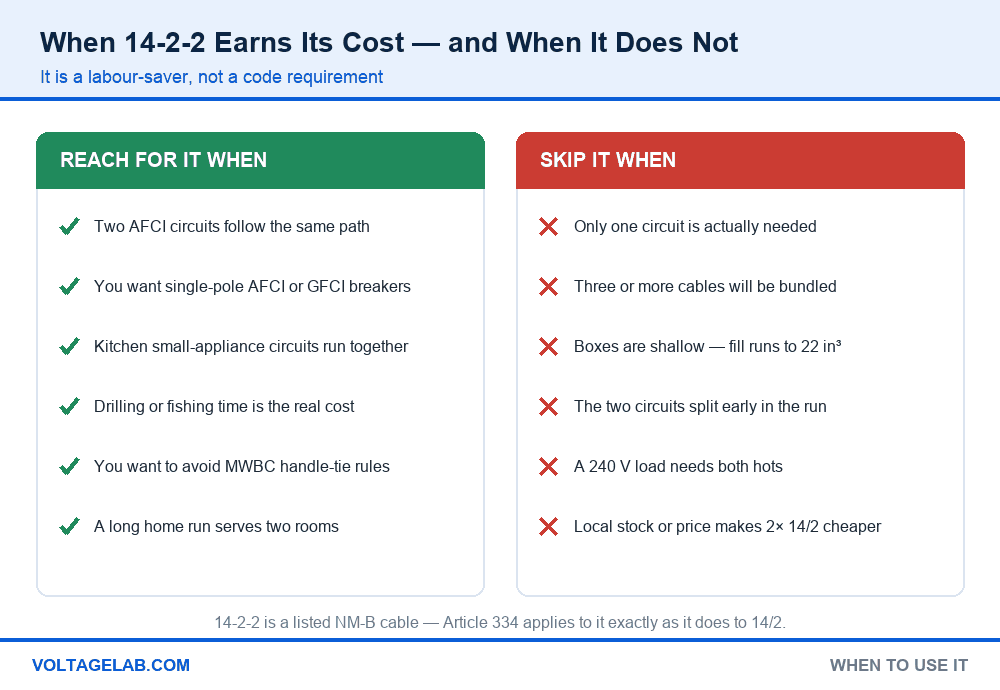
Good applications
- Two AFCI-protected circuits on the same route — bedrooms, living rooms and any of the areas listed in NEC 210.12. Our comparison of GFCI vs AFCI requirements covers where each is mandated.
- Kitchen small-appliance branch circuits — NEC 210.52(B) requires at least two, and they usually run together to the same countertop area.
- A long home run serving two rooms, where one cable through the drilled holes replaces two and the labour saving is real.
- Retrofits and fishing, where getting one cable through a wall cavity is hard and getting two is much harder.
- Panels short on spaces, since two single-pole AFCI breakers occupy the same two slots a two-pole would, but cost far less and are always in stock.
Where it is the wrong choice
- Any run where only one circuit is genuinely needed — you are paying for conductors you will cap off, and unused conductors in a box still count toward fill.
- Bundles of three or more cables through insulated or sealed framing openings, where the 50% adjustment drops you to 12.5 A.
- Shallow boxes, particularly old-work boxes in a remodel, where the 22.00 in³ fed-through figure will not fit.
- Runs where the two circuits diverge early — if they split in the first ten feet, pull two 14/2 and be done.
- Any 240 V load, for the reasons above.
Is 14-2-2 worth using?
For the specific case it was built for — two AFCI circuits on one route — yes, and the saving is in labour and breaker cost rather than in the wire itself. Outside that case the honest answer is that two 14/2 cables do the same job for less money.
Pros
- Two independent circuits with one pull, one set of holes, one staple run.
- Standard single-pole AFCI and GFCI breakers work on both circuits.
- None of the MWBC handle-tie or grouping rules of NEC 210.4 apply.
- Factory-striped neutral satisfies the 200.4(B) pairing requirement.
- Losing one circuit does not de-energise the other, unlike an open shared neutral.
Cons
- Costs more per foot than 14/2 and is not stocked everywhere.
- Four current-carrying conductors derate faster when cables are bundled.
- Box fill matches two cables, so fed-through devices need deep boxes.
- Cannot serve a 240 V load, unlike a 14/3.
Working with 14-2-2 in the field
Do
- Keep white with black and striped white with red at every single box.
- Land each neutral on its own breaker’s neutral bar position or AFCI pigtail.
- Space cables in drilled holes rather than bundling three or more.
- Order deep boxes wherever the cable feeds through a device.
- Cap and identify any conductor you deliberately leave unused.
Avoid
- Splicing the two white conductors together anywhere in the run.
- Using the black and red as a 240 V pair.
- Treating the striped conductor as a spare hot — it is a grounded conductor.
- Bundling three cables through a foamed opening on a 15 A circuit.
- Assuming a standard 18 in³ box will take a fed-through 14-2-2.
Frequently asked questions
What is 14-2-2 wire used for?
Running two independent 15 A circuits along the same path in one cable. It was developed for bedroom and living-area circuits after AFCI protection became mandatory, because two separate neutrals let each circuit use a standard single-pole AFCI breaker instead of the two-pole breaker a shared-neutral 14/3 would need.
What colours are the wires in 14-2-2 cable?
Black, white, red, and white with a red stripe, plus a bare copper equipment grounding conductor. Black pairs with the plain white as circuit 1; red pairs with the striped white as circuit 2.
Is 14-2-2 the same as a multiwire branch circuit?
No, and that is the entire point of it. A multiwire branch circuit has two ungrounded conductors sharing one neutral. 14-2-2 gives each circuit its own neutral, so it is simply two ordinary two-wire branch circuits that happen to share a jacket. The requirements of NEC 210.4, including the simultaneous-disconnect rule in 210.4(B), do not apply.
Do you need a double-pole breaker for 14-2-2?
No. Use two separate single-pole breakers, one per circuit. No handle tie is required because the circuits do not share a neutral. This is the main practical advantage over a 14/3 multiwire branch circuit, which does require a means of simultaneous disconnect.
Does 14-2-2 need to be derated?
A single 14-2-2 has four current-carrying conductors and so takes the 80% adjustment factor, but NEC 334.80 permits starting from the 90 °C ampacity of 25 A. That gives 20 A, which is then capped at the 60 °C value of 15 A — so a full 15 A remains available. Derating only becomes a real limit when three or more cables are bundled through sealed framing openings or buried in insulation.
Can I use both hots in 14-2-2 for a 240 V circuit?
No. The cable is built and identified as two separate 120 V circuits, each with its own neutral and its own overcurrent device. Using the black and red as a 240 V pair leaves the two neutrals without a defined function and removes the simultaneous disconnect a 240 V circuit requires. Pull a 14/3 or 12/3 instead.
Is 12-2-2 available too?
Yes, in the same configuration for 20 A circuits. The derating maths works out the same way: 12 AWG copper is 30 A at 90 °C, so four current-carrying conductors give 30 × 0.80 = 24 A, capped at the 60 °C value of 20 A — no loss. Three bundled 12-2-2 cables drop to 15 A, which is below a 20 A breaker.
What box size do I need for 14-2-2?
A cable terminating at a device needs 14.00 in³, which any standard box handles. A cable fed through a device box needs 22.00 in³ — count 8 insulated conductors at 2.00 in³ each, 2.00 in³ for the grounds and 4.00 in³ for the yoke. That requires a 22.5 in³ deep box; a common 20.3 in³ box is not large enough.
The bottom line
14-2-2 cable earns its place for one specific reason: it delivers two genuinely independent circuits with the pulling labour of a single cable. Every advantage flows from the second neutral — standard single-pole AFCI and GFCI breakers, no handle tie, no 210.4 grouping rules, and no shared return path to open up and put 240 V across someone’s electronics.
Two restraints decide whether it belongs on your job. First, keep the pairings absolute — white with black, striped white with red, never spliced together — because the whole design collapses the moment those neutrals are commoned. Second, respect the four current-carrying conductors: one cable or two costs you nothing, but three bundled through a foamed opening drops you to 12.5 A and you cannot round back up on a receptacle circuit. Space them and the problem disappears. If you are weighing this against a shared-neutral design, read our guide to multiwire branch circuits next — it covers the rules 14-2-2 is built to sidestep.
FREE PRACTICE TOOL
Think you'd pass this on a real exam?
Test what you just read with instant-feedback quizzes built around real code questions — not generic trivia.
5
Code standards
10,000+
Active learners
100%
Free to start
Instant explanations on every answer, right or wrong
NEC, BS7671, AS/NZS, CEC, and DIN VDE covered
Bite-sized quizzes you can finish in 5 minutes
No signup required to try your first quiz
No account needed · Takes less than 2 minutes