

Arc flash safety requirements changed more in 2025 and 2026 than in any period in the last decade — and the NFPA 70E 2026 updates that electricians are searching for are really a bundle of changes from several standards at once. The single most important fact to get straight: there is no 2026 edition of NFPA 70E. The standard runs on its own three-year cycle (2021, 2024, 2027), so the current electrical-safety standard is the 2024 edition. The big 2026 development came from a different direction entirely — the 2026 NEC made detailed arc flash labeling a legally enforceable requirement on virtually all commercial and industrial equipment, not just large services.
This guide lays out the full arc flash picture as of 2026: what is current in NFPA 70E-2024, what the 2026 NEC changed about labeling under NEC 110.16, the November 2024 OSHA guidance that reset enforcement expectations for the first time in 20 years, the NFPA 70B-2023 maintenance requirement, and a practical audit checklist so you can verify your program is actually current. Get these straight and you’ll stop second-guessing which “arc flash 2026” change applies to your facility.
Study smarter with VoltageLab
Built for electricians, apprentices, and electrical engineers who want faster practice and better exam prep.
⭐️ Join thousands of electricians upgrading their skills
There is no NFPA 70E 2026 edition. The current electrical-safety-in-the-workplace standard is NFPA 70E-2024 (next revision: 2027). What genuinely changed for arc flash in 2026 is the NEC: the 2026 NEC removed the old 1,000-ampere threshold in NEC 110.16, so detailed arc flash labels are now required on essentially all non-dwelling switchboards, panelboards, MCCs, switchgear, meter sockets, and control panels serviced while energized.
The detailed label must show four things: nominal system voltage, available fault current, upstream OCPD clearing time, and the arc flash study date. Combined with the November 2024 OSHA guidance and the NFPA 70B-2023 maintenance requirement, this effectively mandates an arc flash study for nearly every commercial and industrial facility in a 2026-NEC jurisdiction.
The Arc Flash Standard Landscape in 2026
Most of the confusion around “arc flash 2026 updates” comes from overlapping documents running on different revision cycles. No single book governs arc flash — installation, worker safety, calculation, and maintenance each live in a separate standard. Here is the complete picture.
| Document | Current Edition | What It Governs | Next Revision |
|---|---|---|---|
| NFPA 70E (Electrical Safety in the Workplace) | 2024 (current) | How workers interact safely with energized equipment — PPE categories, arc flash risk assessment, energized work permits, shock boundaries, training | 2027 — cycle underway |
| NFPA 70 (NEC) | 2026 (adoption varies by state) | How systems are installed — arc flash labeling now required on all commercial/industrial equipment via NEC 110.16 | 2029 |
| IEEE 1584 (Arc Flash Hazard Calculations) | 2018 (current) | The engineering methodology for incident energy analysis — the math behind arc flash studies | Revisions underway |
| NFPA 70B (Electrical Equipment Maintenance) | 2023 (current) | Maintenance, testing, and inspection practices — now includes an arc flash study requirement | 2026 cycle |
| OSHA electrical standards | 29 CFR 1910 Subpart S + Nov 2024 guidance | Legally enforceable worker safety; treats NFPA 70E as the recognized industry standard | Ongoing |
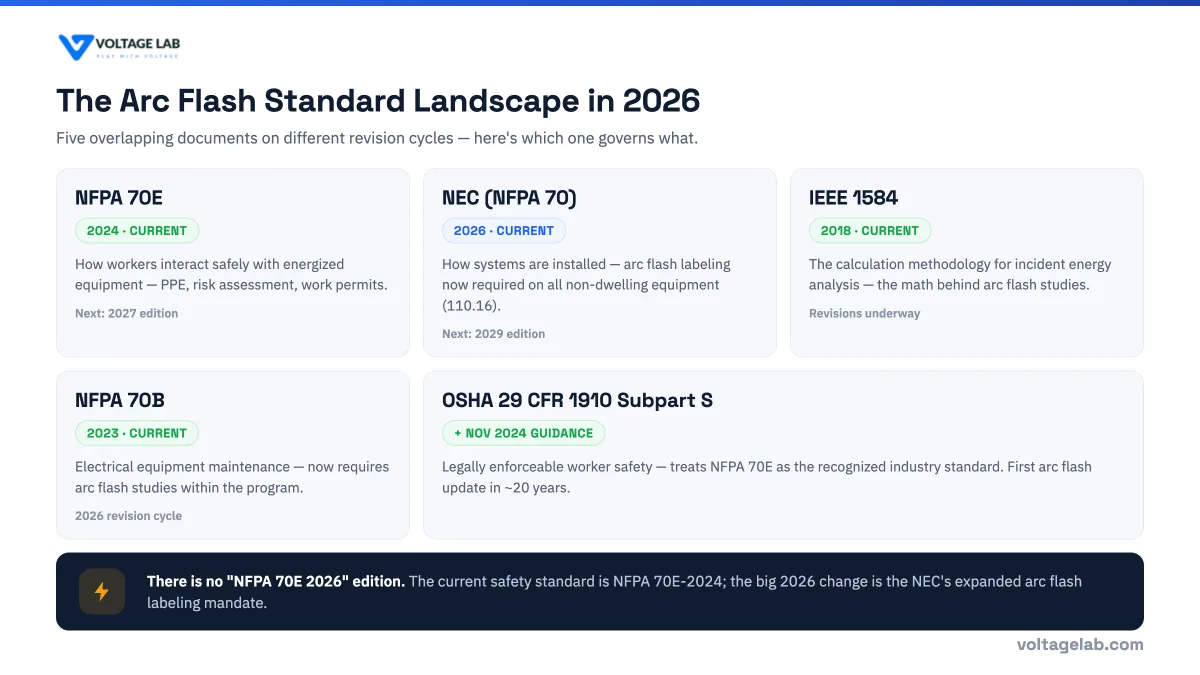
The takeaway: when someone says “the 2026 arc flash changes,” they almost always mean the combination of current NFPA 70E-2024 requirements plus the 2026 NEC labeling expansion. Together with the 2024 OSHA guidance and the 2023 NFPA 70B update, 2025–2026 is the most active stretch for arc flash requirements in a decade. For the wider set of 2026 code changes beyond arc flash, see our breakdown of the NEC 2026 code book: key changes and new rules.
Bottom line: if your safety program or a vendor references an “NFPA 70E 2026” edition, it’s a red flag — that edition does not exist. Verify the program is written to NFPA 70E-2024, and treat the 2026 arc flash news as an NEC labeling change.
NFPA 70E-2024 — What It Requires Today
The 2024 edition took effect on publication and supersedes NFPA 70E-2021. If your electrical safety program still references the 2021 edition or older, it should be updated. These are the provisions that matter most on the job.
Pass your electrical exam the first time
Practice real NEC exam questions with full code-referenced explanations and progress tracking — built for journeyman, master and apprentice exam prep.
Thousands of NEC practice questions with code-referenced answers
Arc Flash Risk Assessment (Section 130.5)
Before any work on or near energized equipment, a qualified person must perform an arc flash risk assessment that identifies the hazards, estimates the likelihood and potential severity of injury, and determines the protective measures — including PPE. The 2024 edition strengthened documentation: the assessment must record who performed it, when, and what methodology was used. Studies must be reviewed at least every five years, or sooner if the electrical system changes.
Two Assessment Approaches
- Incident energy analysis (IEEE 1584-2018): an engineered study that calculates actual incident energy at each work location and defines the arc flash boundary. The most accurate method, and the one required for high-energy systems.
- PPE Category Method (arc flash PPE tables): pre-calculated PPE requirements for specific common tasks at specific voltages. It may only be used when the equipment and task are specifically covered by the tables and the system conditions match the table assumptions.
Hierarchy of Risk Controls
The 2024 edition reinforces that hazard elimination — de-energizing before work — is always preferred. Energized work must be justified by one of these conditions:
- De-energizing introduces additional hazards or increased risk;
- De-energizing is infeasible due to equipment design or operational limitations; and
- A written, documented justification is in place showing the work meets one of these conditions.
PPE Categories
When the category method applies, PPE is selected by category, each with a minimum arc rating in calories per square centimeter (cal/cm²).
| PPE Category | Minimum Arc Rating | Typical Applications (from the PPE tables) |
|---|---|---|
| Category 1 | 4 cal/cm² | Panelboard work ≤240 V, reading panel meters, some low-energy inspections |
| Category 2 | 8 cal/cm² | Panelboard work 240–600 V (certain conditions), MCC work (certain conditions) |
| Category 3 | 25 cal/cm² | Switchgear ≤15 kV (certain conditions), metal-clad switchgear operations |
| Category 4 | 40 cal/cm² | Highest-energy tasks within the category method’s applicability |
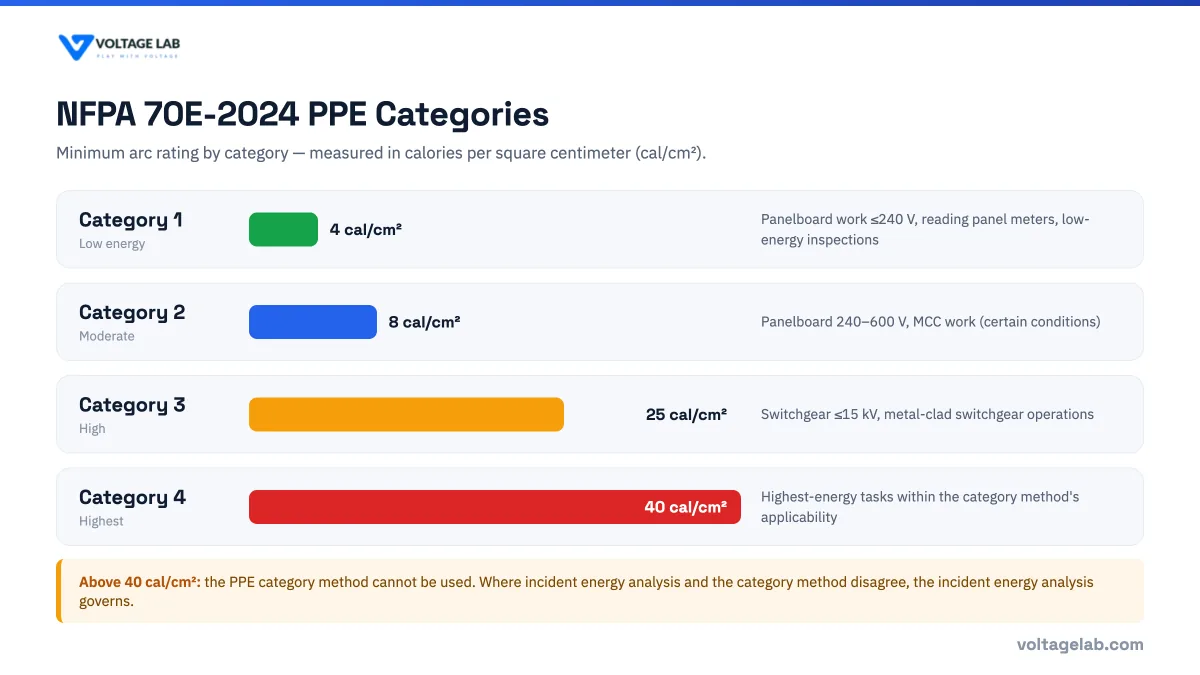
Critical note: when incident energy analysis and the PPE category method disagree, the incident energy analysis governs. Where calculated incident energy exceeds 40 cal/cm², the category method cannot be used and the task should be reconsidered — routine energized work is not appropriate at that energy level.
Training Requirements
Qualified electrical worker training must be documented and repeated at least every three years. It must cover hazard recognition, arc flash risk assessment, PPE selection and use, and the specific tasks the worker performs. Equipment-specific manufacturer training supplements — but does not replace — general NFPA 70E training. For how this fits into a broader written program, see our guide to building an electrical safety program.
💡 Turn these arc flash rules into practice questions.
VoltageLab’s AI Quiz Generator creates unlimited exam-style questions on NFPA 70E, PPE categories, and NEC labeling — so risk-assessment steps and cal/cm² ratings stick before you’re standing in front of a panel. Fresh questions with explanations, every time.
2026 NEC 110.16 — The Arc Flash Labeling Mandate
The most significant arc flash development of 2026 isn’t from NFPA 70E — it’s from the NEC. The 2026 NEC made detailed arc flash labeling a legally enforceable code requirement for virtually all commercial and industrial equipment, closing the gap between NFPA 70E best practice and NEC enforcement.
What Changed
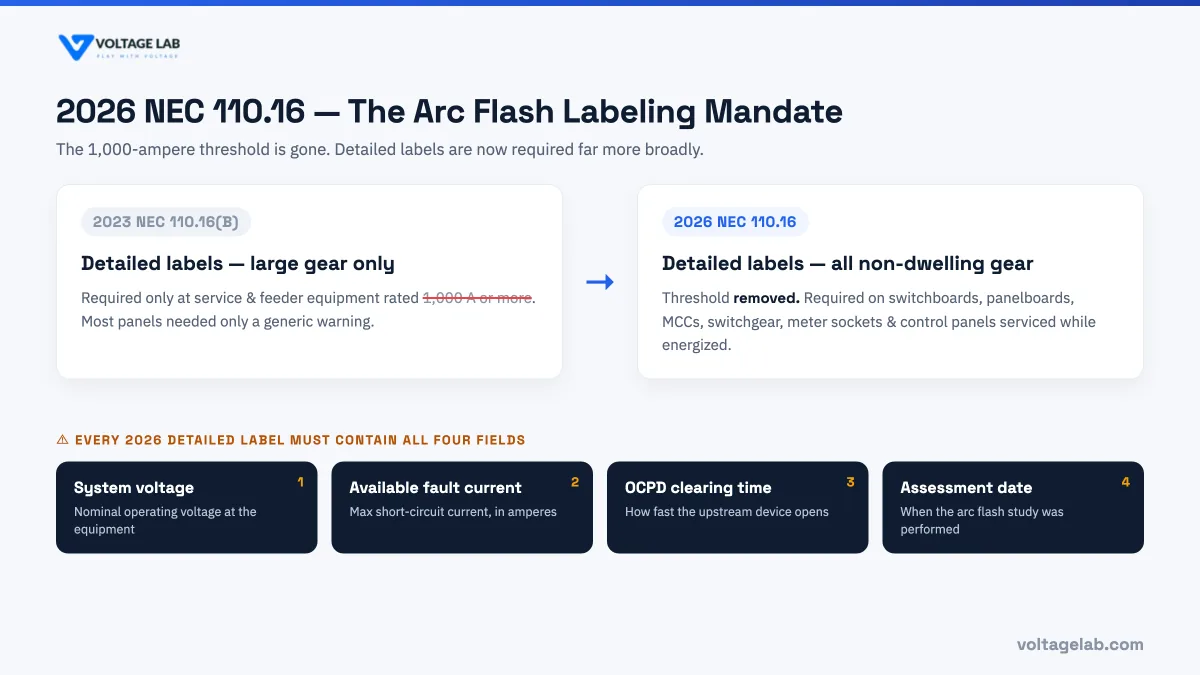
2023 NEC 110.16(B): detailed arc flash labels were required only at service and feeder equipment rated 1,000 amperes or more.
2026 NEC 110.16: the 1,000-ampere threshold is removed. Detailed labels are required at all non-dwelling switchboards, panelboards, industrial control panels, meter socket enclosures, motor control centers, switchgear, and similar equipment that may be examined, adjusted, serviced, or maintained while energized.
What the 2026 NEC Label Must Contain
The field-applied arc flash label on non-dwelling equipment must include all four of the following:
Study smarter with VoltageLab
Built for electricians, apprentices, and electrical engineers who want faster practice and better exam prep.
⭐️ Join thousands of electricians upgrading their skills
| Required Field | What It Means | Why It Matters |
|---|---|---|
| Nominal system voltage | The operating voltage of the system at this equipment | Establishes the shock hazard level and feeds the arc energy calculation |
| Available fault current | Maximum available short-circuit current (amperes) at this equipment | Required input for arc flash calculations; also verifies OCPD interrupting ratings |
| Clearing time of upstream OCPD | How fast the upstream breaker or fuse opens under fault | Directly drives incident energy — faster clearing means lower energy and lower PPE |
| Date of the arc flash risk assessment | When the study was performed | Reinforces the 5-year review cycle and tells workers how current the data is |
Residential exemption: the labeling expansion applies to non-dwelling occupancies. Service panels, subpanels, and equipment in one- and two-family dwellings remain subject only to the general arc flash warning of NEC 110.16(A). For the full family of required panel and room labels, see our guide to electrical room signage: NEC & NFPA requirements.
Common mistake: assuming a generic “Warning — Arc Flash Hazard — Wear Appropriate PPE” sticker still does the job. That satisfies the general warning of 110.16(A) but not the detailed-label requirement in a 2026-NEC jurisdiction. Without an arc flash study, you can’t populate the four required fields — so the label can’t be compliant.
What This Means for Facilities
In jurisdictions adopting the 2026 NEC, the detailed-label requirement effectively mandates an arc flash study for all commercial and industrial facilities — not just those with large high-voltage gear or services above 1,000 A. The study is what produces the fault current, clearing time, and assessment date printed on each label. No study, no compliant labels.
November 2024 OSHA Arc Flash Guidance
In November 2024, OSHA released updated arc flash guidance — its first substantive update on the topic in nearly 20 years. This is enforcement guidance, not a new regulation, but it clarifies OSHA’s expectations and signals a sharper enforcement focus on arc flash compliance.
- NFPA 70E explicitly endorsed: the guidance names NFPA 70E as the recognized industry standard for protecting workers from arc flash. Employers who ignore it face General Duty Clause liability for arc flash incidents.
- Arc-rated clothing underuse is a top concern: inspectors are expected to look for workers doing energized work in appropriate arc-rated PPE — not just hard hats and safety glasses.
- Create an electrically safe work condition first: the primary expectation is de-energizing before work, with lockout/tagout and real-time verification of de-energization.
- Emergency response planning: employers should have response plans that specifically address arc flash incidents, not just generic electrical emergencies.
- Stored energy: capacitors, large UPS banks, and energy storage systems must be assessed as part of routine LOTO.
Scope: the November 2024 guidance applies to commercial and industrial electricians in general industry. It does not cover electric utility transmission and distribution, which falls under OSHA 29 CFR 1910.269. The de-energization and verification expectations line up closely with existing lockout/tagout (LOTO) practice.
NFPA 70B-2023 — The Maintenance Standard Adds Arc Flash Studies
NFPA 70B is the Recommended Practice for Electrical Equipment Maintenance — the standard governing how electrical equipment is maintained, tested, and inspected. The 2023 edition made a significant change with direct arc flash implications: it now includes a requirement for arc flash studies as part of an electrical maintenance program. Previous editions treated the study as best practice; the 2023 edition elevates it to a requirement within the standard’s framework.
This matters most for:
- Facilities that have arc flash labels but haven’t refreshed the underlying study within the five-year cycle;
- Facilities that added equipment, changed protective-device settings, upgraded transformers, or otherwise modified the system since the last study;
- Facilities facing insurance audits or third-party safety assessments — NFPA 70B-2023 compliance increasingly shows up in audit frameworks.
The 2027 NFPA 70E Revision — What’s Being Discussed
The next NFPA 70E edition publishes in 2027, and the revision cycle is already underway. Topics drawing significant committee attention include:
- Alignment with 2026 NEC 110.16: harmonizing NFPA 70E’s labeling guidance with the expanded NEC requirements so the two references stay consistent.
- Energy storage systems: battery energy storage (BESS), large UPS, and EV battery systems present arc flash hazards that differ from traditional AC distribution — new guidance is in development.
- Microgrids and distributed energy resources: multi-source systems where fault current can arrive from several directions need updated assessment methods.
- Continued IEEE 1584 alignment: keeping the calculation guidance in step with IEEE 1584-2018 methodology.
What Facilities Need to Audit and Update
Given NFPA 70E-2024, the 2026 NEC labeling mandate, and the 2024 OSHA guidance, facilities should systematically review their arc flash programs. Use this checklist as a starting point.
| Item | What to Check | Standard Reference |
|---|---|---|
| Arc flash study currency | Study date on labels — if older than 5 years, or the system changed since, a new study is required | NFPA 70E-2024, 130.5(G) |
| Label content completeness | Do non-dwelling labels include voltage, available fault current, clearing time, and assessment date? | NEC 110.16 (2026-adopting jurisdictions) |
| Label durability | Are labels legible, intact, and durable for the environment? | NEC 110.21(B) |
| Worker training | Is qualified-worker training documented and within the last 3 years? | NFPA 70E-2024 |
| PPE availability and condition | Is arc-rated PPE available at each work location and within its inspection/replacement date? | NFPA 70E-2024 |
| Energized work permit | Does a documented energized-work justification exist and get used? | NFPA 70E-2024, Article 130 |
| Emergency response plan | Does the plan specifically address arc flash incidents? | Nov 2024 OSHA guidance |
| LOTO procedures | Do procedures include real-time verification of de-energization and stored-energy assessment? | OSHA 29 CFR 1910.147 + Nov 2024 guidance |
| NFPA 70B compliance | Is there a formal maintenance program incorporating the arc flash study requirement? | NFPA 70B-2023 |
- There is no NFPA 70E 2026 edition — NFPA 70E-2024 is current. The “2026 arc flash change” is really the NEC’s expanded labeling rule.
- 2026 NEC 110.16 drops the 1,000 A threshold. Detailed labels — voltage, fault current, clearing time, study date — are now required on nearly all non-dwelling equipment.
- That effectively mandates an arc flash study for most commercial and industrial facilities in 2026-NEC jurisdictions; generic warning stickers no longer satisfy the detailed-label rule.
- OSHA’s Nov 2024 guidance and NFPA 70B-2023 reinforce it — expect enforcement focus on arc-rated PPE, LOTO verification, and keeping studies current within 5 years.
Conclusion
The arc flash landscape in 2026 is shaped by three concurrent developments: NFPA 70E-2024 as the current safety standard (documented risk assessments, consistent PPE categories, justified energized work, three-year retraining); 2026 NEC 110.16 making detailed labeling enforceable on all non-dwelling equipment and effectively mandating arc flash studies; and the November 2024 OSHA guidance signaling tougher enforcement on arc-rated PPE, LOTO verification, and arc flash emergency planning. Facilities still on an NFPA 70E-2021 program, or whose study is nearing five years, should prioritize an audit using the checklist above.
Keep going: put the labeling side into practice with our guide to electrical room signage and panel labeling, and see how the underlying framework fits together in what an electrical safety program is and why workplaces need one.
📱 The electrical reference and study app built for working electricians.
VoltageLab puts NEC references, an interactive circuit simulator, unlimited AI practice questions, and flashcards in your pocket — so arc flash rules, PPE categories, and labeling requirements are locked in before the inspector shows up. Built for electricians and apprentices. Free on iOS and Android.
Frequently Asked Questions
Is there a 2026 edition of NFPA 70E?
No. NFPA 70E follows a three-year revision cycle — 2021, 2024, and 2027 are the relevant editions around 2026. The current edition is NFPA 70E-2024, and the 2027 cycle is already underway. When people search “NFPA 70E 2026 updates,” they’re usually after a mix of the current 2024 requirements and the 2026 NEC changes to arc flash labeling (NEC 110.16), which together are the major arc flash changes of 2025–2026.
What does the 2026 NEC change about arc flash labeling?
The 2026 NEC removes the previous 1,000-ampere threshold for detailed labels and requires them on virtually all non-dwelling commercial and industrial equipment. Each detailed label must show nominal system voltage, available fault current, upstream OCPD clearing time, and the arc flash study date. Generic “arc flash hazard” warnings no longer suffice. In 2026-NEC jurisdictions, this effectively mandates an arc flash study for all non-residential facilities.
What did the November 2024 OSHA arc flash guidance change?
OSHA released updated arc flash guidance in November 2024 — its first significant update in nearly 20 years. It explicitly references NFPA 70E as the recognized industry standard, flags under-use of arc-rated clothing as a primary enforcement concern, emphasizes real-time verification of de-energization during LOTO, and calls for emergency response plans addressing arc flash. It creates no new regulation but clarifies enforcement under the General Duty Clause and 29 CFR 1910 Subpart S.
How often must arc flash studies be reviewed?
NFPA 70E requires review at least every five years, or sooner if the distribution system is modified. Changes that trigger earlier review include utility service upgrades that alter available fault current, protective-device setting changes, added loads that shift fault current, new transformers or generators, and switchgear or MCC replacements with different device characteristics. The 2026 NEC label puts the study date on every piece of equipment, reinforcing the five-year expectation.
What is NFPA 70B and how does it relate to arc flash?
NFPA 70B is the Recommended Practice for Electrical Equipment Maintenance — how equipment should be maintained, tested, and inspected. The 2023 edition added a requirement for arc flash studies within a formal maintenance program, elevating what was previously a recommendation. It creates a maintenance-side obligation to keep studies current that complements the NFPA 70E safety-program requirement and the NEC labeling mandate.
FREE PRACTICE TOOL
Think you'd pass this on a real exam?
Test what you just read with instant-feedback quizzes built around real code questions — not generic trivia.
5
Code standards
10,000+
Active learners
100%
Free to start
Instant explanations on every answer, right or wrong
NEC, BS7671, AS/NZS, CEC, and DIN VDE covered
Bite-sized quizzes you can finish in 5 minutes
No signup required to try your first quiz
No account needed · Takes less than 2 minutes