

Walk onto any commercial job in Minnesota and the first thing the foreman checks is not your tools. It is your card. Every person touching the wiring is either a licensed electrician or carries a registration number starting with RE, and a state inspector can ask for either at any time.
That is because Minnesota licenses electrical work at the state level, through the Department of Labor and Industry (DLI), and it enforces the rules on the job site. Working unregistered, supervising too many helpers, or showing up for the exam on the wrong code edition are the kinds of mistakes that cost people months.
Study smarter with VoltageLab
Built for electricians, apprentices, and electrical engineers who want faster practice and better exam prep.
⭐️ Join thousands of electricians upgrading their skills
This guide covers every Minnesota electrical license type, the experience each one needs, the journeyworker exam and the 2026 NEC switch, fees and renewal, what each license lets you do, and how reciprocity works if you are licensed in another state.
Quick Answer
A Minnesota electrical license is issued by the Department of Labor and Industry. To become a Class A journeyworker electrician you need 48 months of experience acceptable to DLI — up to one year can come from a two-year post-high-school electrical program — and you must pass an 80-question, open-book state exam with a score of 70% or better.
Before you are licensed, you must register with DLI as a registered unlicensed electrician and work under the direct supervision of a licensed journeyworker or master. A Class A master license needs one year as a licensed journeyworker, five years of qualifying experience, or an electrical engineering degree. Licenses renew every two years with 16 CE hours, at least 12 on the NEC.
Key Takeaways
- Minnesota licenses electricians statewide through DLI, under Minnesota Statutes 326B.33
- Unlicensed workers must hold an RE registration and work under direct supervision at all times
- One licensed electrician may supervise no more than two unlicensed workers on general electrical work
- The Class A journeyworker license needs 48 months of experience and a passing state exam
- Minnesota adopted the 2026 NEC on August 17, 2026, and exams moved to it on September 8, 2026
- Journeyworker and master licenses renew every two years with 16 CE hours, 12 of them on the NEC
- Minnesota grants a journeyworker license without an exam to qualifying electricians from nine reciprocal states
Minnesota electrical license types — the full ladder
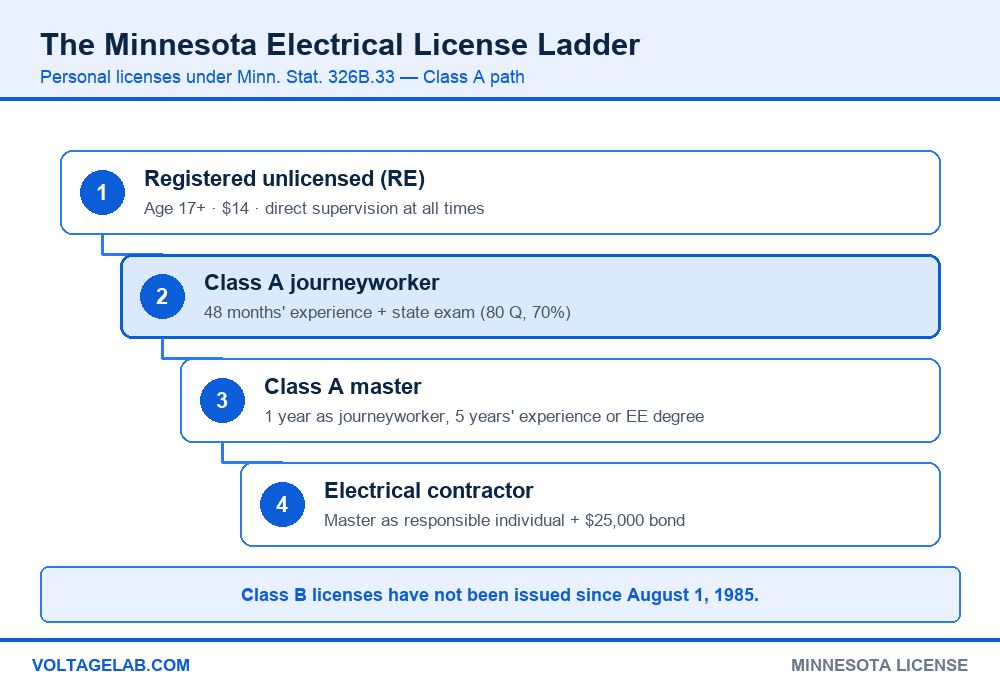
Minnesota Statutes 326B.33 defines the personal licenses. Most electricians only ever deal with the first four rungs:
Study smarter with VoltageLab
Built for electricians, apprentices, and electrical engineers who want faster practice and better exam prep.
Join thousands of electricians upgrading their skills
- Registered unlicensed electrician (RE). Not a license, but a required registration for anyone doing electrical work without one. It is where your experience starts counting.
- Class A journeyworker electrician. The main working license. You can perform and supervise electrical work, but not plan or lay it out.
- Class A master electrician. Adds planning and layout, and is required to act as the responsible licensed individual for an electrical contractor.
- Electrical contractor. A business license, not a personal one. It needs a master on staff, a bond and insurance.
Alongside those sit specialty licenses: maintenance electrician (48 months), power limited technician for technology circuits (36 months), lineman for utility transmission and distribution (48 months), elevator constructor (36 months), master elevator constructor (60 months), and a few narrow installer and satellite licenses.
What Class A and Class B mean
Class A is the unrestricted license — it covers any electrical work within the license’s scope. Class B master and journeyworker licenses were limited to single-phase systems of 200 amps or less on farmsteads and single-family dwellings in towns under 2,500 people. Minnesota has issued no new Class B licenses since August 1, 1985. If you are starting today, Class A is the only path.
Minnesota journeyworker vs master vs power limited — requirements compared
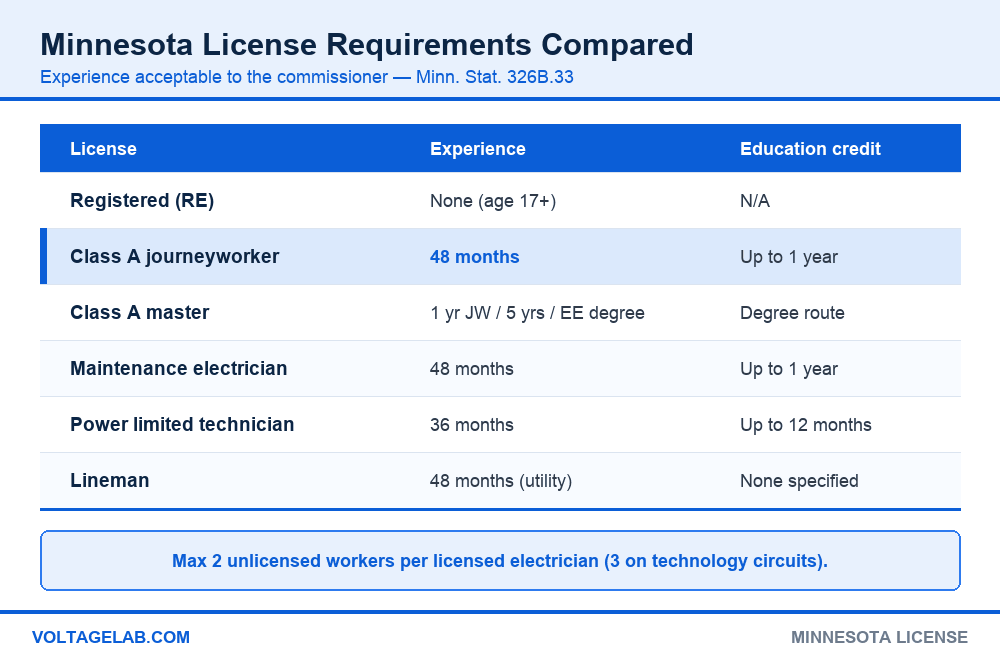
The experience rules come straight from 326B.33. Experience must be acceptable to the commissioner, which in practice means documented on DLI’s verification form while you were registered or employed by a licensed contractor.
| License | Experience required | Education credit | Scope |
|---|---|---|---|
| Registered unlicensed (RE) | None — minimum age 17 | N/A | Work under direct supervision only |
| Class A journeyworker | 48 months | Up to 1 year for a 2-year post-high-school electrical course | Perform and supervise work — the license most people need |
| Class A master | 1 year as licensed journeyworker, or 5 years’ experience, or EE degree | 4-year electrical engineering degree qualifies outright | Adds planning and layout; can qualify a contractor |
| Maintenance electrician | 48 months | Up to 1 year for course work | Maintenance and repair only |
| Power limited technician | 36 months, or EE degree | Up to 12 months (2,000 hours) | Technology circuits and systems |
| Lineman | 48 months of utility work | None specified | Utility transmission and distribution |
Experience credit for the journeyworker exam comes from active RE registration in Minnesota after January 1, 2009, employment with a DLI-licensed contractor or registered employer, or verifiable work for a licensed contractor in another state.
The supervision trap: under 326B.33, a registered unlicensed electrician must be under direct supervision at all times by a licensed journeyworker or master who works for the same company, and one licensed electrician may supervise no more than two unlicensed individuals on general electrical work (three on technology circuits). Hours worked unregistered, or under a supervisor from another company, are both a violation and hours you may not get credited toward the exam.
The Minnesota journeyworker exam — format and 2026 NEC content
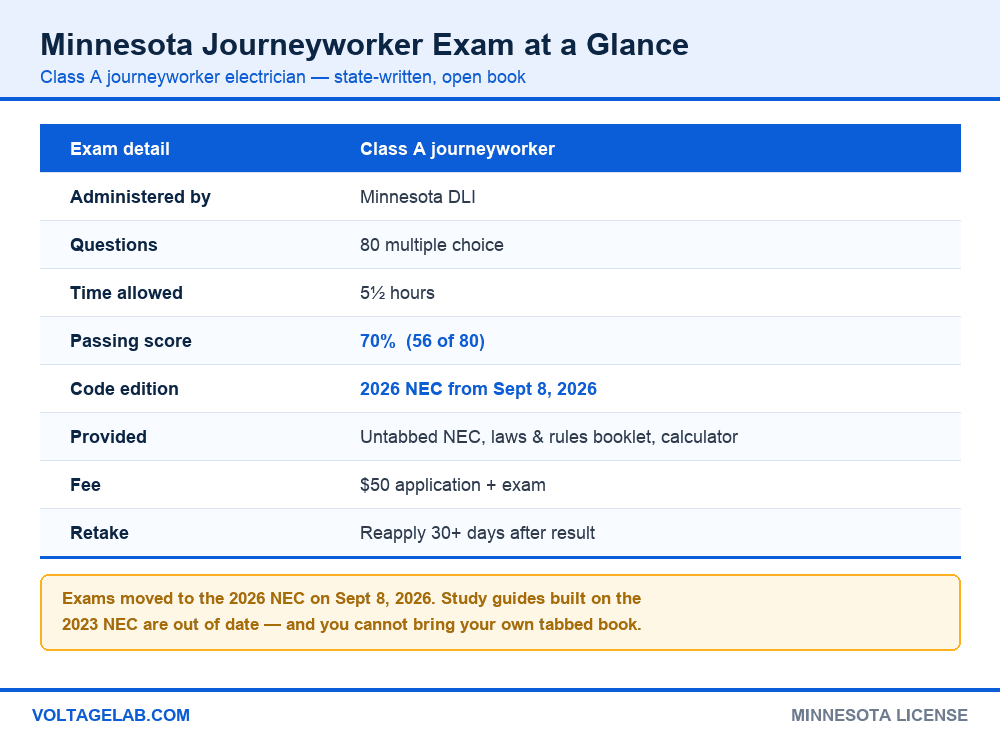
Minnesota writes and grades its own licensing exams rather than buying a national test. The journeyworker exam is open book, but only with the references DLI hands you at the seat — you cannot bring your own tabbed code book.
| Exam detail | Class A journeyworker |
|---|---|
| Administered by | Minnesota DLI |
| Questions | 80 multiple choice |
| Time allowed | 5½ hours |
| Passing score | 70% (56 of 80) |
| Code edition | 2026 NEC from September 8, 2026 |
| References provided | Soft-cover NEC without tabs, Laws and Rules booklet (Minnesota Electrical Act, Rules 3800 and 3801), basic calculator |
| Application and exam fee | $50 |
| Retake | New application and fee, no sooner than 30 days after the result |
Expect most questions to be code lookups and calculations: definitions in NEC Article 100, load calculations such as range demand questions, conductor sizing, and voltage drop, plus a block on Minnesota law and rules.
How to get your Minnesota journeyworker license, step by step
Step 1 — register as an unlicensed electrician. Apply online with DLI for your RE registration ($14) before you start working. It is valid for one year and renews with 2 hours of approved CE and a work-experience verification form.
Step 2 — log 48 months under a licensed electrician. Work for a licensed contractor or registered employer under direct supervision. A two-year post-high-school electrical program can cut up to one year off.
Step 3 — apply for the exam. Submit the application with experience verification and the $50 fee. DLI reviews the experience before it lets you schedule.
Step 4 — study the 2026 NEC with an untabbed book. Practise finding answers fast in a clean code book, because that is what you get on test day. Our NEC exam prep guide lays out a study plan, and the free NEC practice test shows where you stand.
Step 5 — pass and pay the license fee. After a passing score, DLI sends payment instructions for the license itself. Your journeyworker license then expires every two years at the end of the month it was issued.
Study smarter with VoltageLab
Built for electricians, apprentices, and electrical engineers who want faster practice and better exam prep.
⭐️ Join thousands of electricians upgrading their skills
The one that catches everyone: Minnesota adopted the 2026 NEC effective August 17, 2026, and licensing exams switched to it on September 8, 2026. Study guides, practice books and borrowed code books built on the 2023 NEC are now a step behind — article numbers and requirements moved in the 2026 reorganisation. Our summary of the top NEC 2026 changes covers the ones most likely to show up.
Practise for the Minnesota exam
NEC Exam Prep drills timed journeyman and master questions by NEC article, so you get used to finding answers under exam pressure (iPhone · Android).
Once you are licensed, the VoltageLab Electrician App keeps NEC tables and calculators on the job with you (iPhone · Android).
Minnesota license fees, renewal and continuing education
| License | Renewal period | CE required | Renewal fee | Late fee |
|---|---|---|---|---|
| Registered unlicensed (RE) | 1 year | 2 hours | $19 | $5 |
| Class A journeyworker | 2 years, end of month issued | 16 hours, at least 12 NEC | $53 | $20 |
| Class A master | 2 years, last day of February in odd years | 16 hours, at least 12 NEC | $93 | $40 |
| Power limited technician | 2 years | 16 hours, at least 4 code | — | — |
CE must come from DLI-approved courses. A new master needs no CE in the license’s first year, credits can count toward more than one license you hold, and hours above the minimum do not carry into the next term. Renewing without completing CE can bring license suspension and a $1,000 fine.
What each Minnesota license lets you do — and what it does not
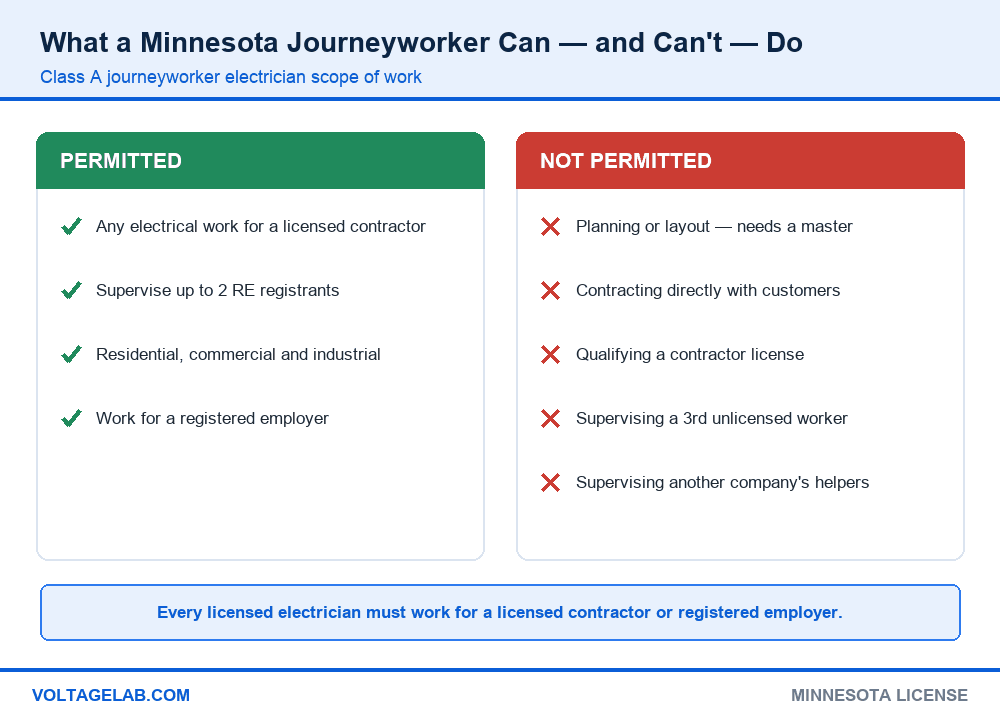
Every licensed electrician in Minnesota must be a W-2 employee of a licensed electrical contractor or registered employer, or the owner of a licensed contractor. A personal license on its own does not let you take work from the public.
Permitted with a Class A journeyworker license
- Performing any electrical work for a licensed contractor or registered employer
- Supervising up to two registered unlicensed electricians from the same company
- Working on residential, commercial and industrial installations
Not permitted with a journeyworker license
- Planning or laying out electrical installations — that needs a master
- Contracting electrical work directly with customers
- Acting as the responsible licensed individual for a contractor
- Supervising more than two unlicensed workers at once
- Supervising unlicensed workers employed by a different company
If you want to contract
An electrical contractor license needs a responsible licensed individual who holds an active master license and is an owner, officer or W-2 employee of the business — and that person can serve only one contractor. The business also needs a $25,000 surety bond, general liability insurance of at least $100,000 per occurrence, $300,000 aggregate and $50,000 property damage, proof of workers’ compensation, and a disclosure of owners and officers.
Minnesota electrical license reciprocity
| Route to a Minnesota license | Exam needed? | Who qualifies |
|---|---|---|
| Standard path | Yes | 48 months of acceptable experience, starting as an RE registrant |
| Reciprocal journeyworker | No | Licensed by state exam in Alaska, Arkansas, Colorado, Iowa, Montana, Nebraska, North Dakota, South Dakota or Wyoming |
| Reciprocal master | No | Master licensed by exam in Iowa, Nebraska, North Dakota or South Dakota |
| Out-of-state experience | Yes | Verifiable work for a licensed contractor in any state counts toward the 48 months |
Reciprocity has conditions: you must have held the other state’s license for at least a year, it must be current and in good standing, it must have been earned by a state-level exam rather than a city license, and you must not have failed the same or a higher Minnesota exam. The application and exam fee is $50. If you are coming from Iowa, Florida or elsewhere, compare requirements with our guide to Florida electrical contractor licensing, and see how the NEC editions differ if your home state is still on an older code.
Is the Minnesota master license worth going for?
Pros
- Only one year as a licensed journeyworker to qualify
- Unlocks planning and layout work
- Required to qualify your own electrical contracting business
- Reciprocal with Iowa, Nebraska, North Dakota and South Dakota
Cons
- A second exam, with business and law content on top of the NEC
- Higher renewal fee ($93 vs $53) for the same 16 CE hours
Getting and keeping your Minnesota license
Do
- Register as an RE before your first day on the tools
- Renew your RE every year so experience keeps counting
- Keep your own log of hours, employers and supervisors
- Study from an untabbed 2026 NEC
- Spread your 16 CE hours across the two-year term
Avoid
- Working on a lapsed RE registration
- Being the third helper under one licensed electrician
- Studying from 2023 NEC material for a 2026 exam
- Taking side jobs without a contractor license
- Letting a license sit expired for two years or more
Frequently asked questions
How do I get an electrical license in Minnesota?
Register with DLI as an unlicensed electrician, work 48 months under a licensed journeyworker or master for a licensed contractor, then apply for and pass the Class A journeyworker exam. A two-year electrical program can count for up to one year of the experience.
How many hours do you need for a journeyworker license in Minnesota?
Minnesota Statutes 326B.33 requires at least four years (48 months) of experience acceptable to the commissioner. Up to one year of credit may be allowed for a two-year post-high-school electrical course.
Is the Minnesota electrical exam open book?
Yes, but only with what DLI provides: a soft-cover NEC with no tabs, a Minnesota laws and rules booklet, and a basic calculator. You cannot bring your own code book.
What NEC edition does Minnesota use?
The 2026 NEC, adopted without amendment and effective August 17, 2026. Permits filed before that date follow the 2023 NEC, and licensing exams moved to the 2026 edition on September 8, 2026.
How much does a Minnesota electrical license cost?
The journeyworker application and exam fee is $50, and RE registration is $14. Renewal is $53 every two years for a journeyworker and $93 for a master. DLI bills the initial license fee after you pass.
Does Minnesota have electrical license reciprocity?
Yes. Journeyworkers licensed by state exam in Alaska, Arkansas, Colorado, Iowa, Montana, Nebraska, North Dakota, South Dakota or Wyoming can get a Minnesota journeyworker license without the exam. Masters from Iowa, Nebraska, North Dakota and South Dakota can get the Minnesota master license.
How many continuing education hours do Minnesota electricians need?
Journeyworkers and masters need 16 hours of DLI-approved CE every two-year term, with at least 12 on the National Electrical Code. Registered unlicensed electricians need 2 hours each year.
Can I do electrical work in Minnesota without a license?
Only as a registered unlicensed electrician, within your employer’s scope of work, and under direct supervision by a licensed electrician from the same company at all times.
The bottom line
Minnesota’s system is strict but predictable: register, log 48 months under supervision, pass one state-written exam, and renew every two years with 16 CE hours. The two things that cost people the most time are both about discipline — keeping the RE registration and supervision ratio clean so every hour counts, and studying the 2026 NEC the exam is now written on rather than whatever code book is lying around.
Start your registration before your first day, keep your own hours log, and give yourself time with an untabbed code book before test day. When you are ready to compare tools for the job, see our roundup of the best electrician apps for US electricians.
FREE PRACTICE TOOL
Think you'd pass this on a real exam?
Test what you just read with instant-feedback quizzes built around real code questions — not generic trivia.
5
Code standards
10,000+
Active learners
100%
Free to start
Instant explanations on every answer, right or wrong
NEC, BS7671, AS/NZS, CEC, and DIN VDE covered
Bite-sized quizzes you can finish in 5 minutes
No signup required to try your first quiz
No account needed · Takes less than 2 minutes