


Ask a foreman how they hired their last apprentice and the answer is rarely “a job board.” It is usually somebody’s nephew, a kid who showed up at the shop at 6:30 with boots on, or a name off the union hall’s ranked list. Apprentice electrician jobs are local, and most of them never get a polished listing.
That is why searching “apprentice electrician jobs near me” and clicking apply fifty times so often goes nowhere. The best openings come through a handful of channels — union training centres, merit-shop training programs, registered apprenticeship sponsors and contractors who hire direct — and each one has its own application window, test and waiting list. Miss the window and you can lose a year.
Study smarter with VoltageLab
Built for electricians, apprentices, and electrical engineers who want faster practice and better exam prep.
⭐️ Join thousands of electricians upgrading their skills
This guide covers where apprentice electrician jobs actually come from, how union, merit-shop and direct-hire routes compare, a step-by-step method for finding openings near you, what apprentices get paid, and what gets an application moved to the top of the pile.
Quick Answer
To find apprentice electrician jobs near you, search the Department of Labor’s apprenticeship finder at apprenticeship.gov by ZIP code, contact the IBEW/NECA training centre (JATC) and your local IBEW hall, and reach out to your area’s IEC and ABC chapters. Then apply directly to licensed electrical contractors — in person if you can.
Apply to more than one route at once. Union programs open applications on fixed dates and can have waiting lists measured in months or years, while merit-shop programs usually need a member contractor to hire you first. Most programs expect you to be 18, hold a high school diploma or GED, and have passed algebra.
Key Takeaways
- Most apprentice electrician openings come from training programs and contractors, not job boards
- Union (IBEW/NECA) apprenticeships hire through a local JATC with an aptitude test and interview
- Merit-shop programs through IEC and ABC usually require a member contractor to employ you
- The apprenticeship.gov finder lists registered apprenticeship jobs and sponsors by location
- Apprentice pay is a percentage of the local journeyman rate and rises as you complete hours and school
- Some states require apprentices to register or hold a license before their hours count
- BLS projects about 81,000 electrician openings a year through 2034
Where apprentice electrician jobs actually come from
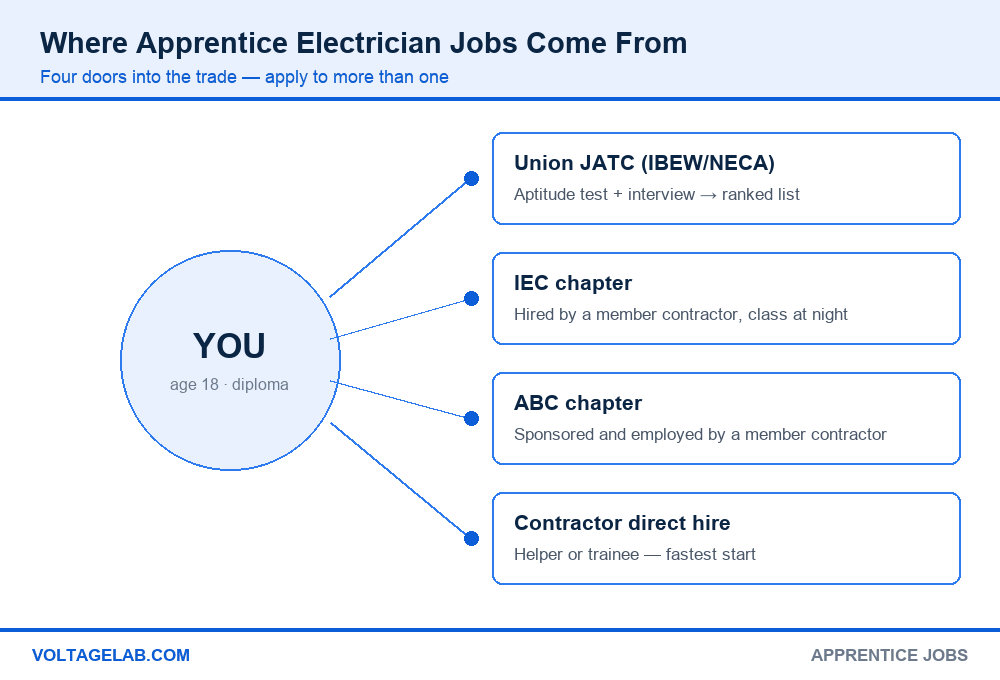
The demand is real. The Bureau of Labor Statistics projects electrician employment to grow about 9% from 2024 to 2034, with roughly 81,000 openings a year, most of them replacing electricians who retire or leave the trade. The median electrician wage was $62,350 in May 2024. The question is not whether jobs exist, but which door to knock on. There are four:
Study smarter with VoltageLab
Built for electricians, apprentices, and electrical engineers who want faster practice and better exam prep.
Join thousands of electricians upgrading their skills
- Union apprenticeships (IBEW/NECA). Run by a Joint Apprenticeship Training Committee (JATC) in your area. You apply to the JATC, not to a contractor; once accepted, you are dispatched to signatory contractors.
- Merit-shop apprenticeships (IEC and ABC). Independent Electrical Contractors runs programs through 53 chapters, and Associated Builders and Contractors through chapters nationwide. You usually work for a member contractor by day and attend class in the evening.
- Registered apprenticeship sponsors. Contractors, utilities and community colleges that register their own program with the Department of Labor or a state apprenticeship agency.
- Direct hire. Contractors who take on helpers or trainees and train them in-house, sometimes enrolling them in a program later.
Apprentice, helper and trainee — what the titles mean
An apprentice is enrolled in a structured, multi-year program that combines paid on-the-job training with classroom instruction and leads toward a journeyman license. A helper assists electricians on the job but is usually not in a formal program. Trainee is a label some states and employers use for either. When you search listings, the job title matters less than one question: will these hours be documented in a way your state accepts for the journeyman exam?
Union vs merit-shop vs direct hire — how the routes compare
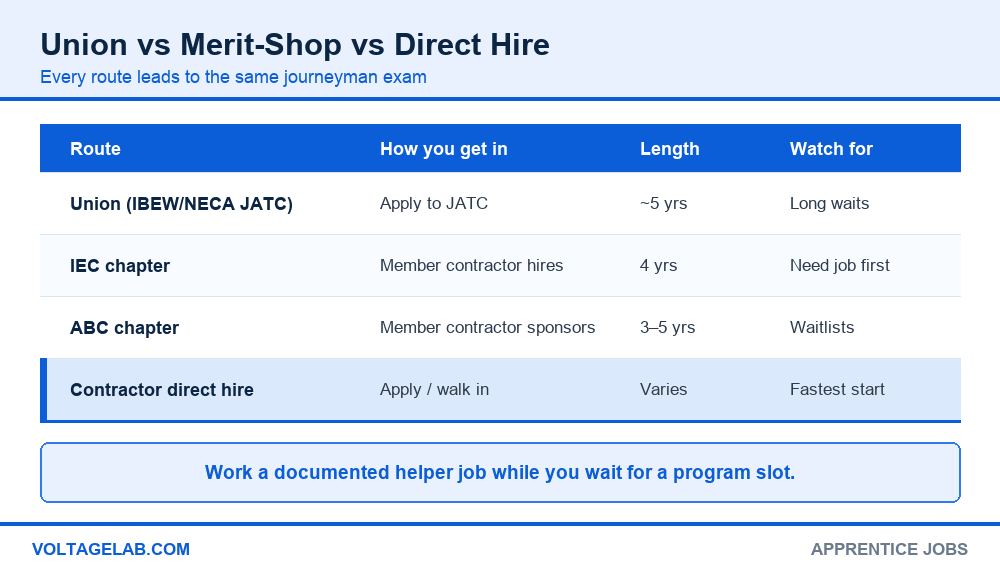
Each route gets you to the same journeyman exam. They differ in how you get in, who pays for school and how long you wait.
| Route | How you get in | Typical length | Watch for |
|---|---|---|---|
| Union (IBEW/NECA JATC) | Apply to the JATC, aptitude test, interview, ranked list | About 5 years | Fixed application dates; waits can run months to years |
| IEC chapter | Get hired by an IEC member contractor, who registers you | 4 years | You need the job first; class is usually evenings |
| ABC chapter | Sponsored and employed by a member contractor | 3–5 years | Some chapters have long electrical waitlists |
| Contractor direct hire | Apply or walk in to a licensed contractor | Until you meet your state’s hours | Fastest start — confirm your hours will be documented |
Many apprentices use the direct-hire route while they wait for a union or merit-shop slot. That works well as long as the job gives you documented experience under a licensed electrician.
The hours that do not count: in several states, experience only counts toward the journeyman exam if you were registered or licensed as an apprentice while you earned it. Texas requires apprentices to hold a TDLR apprentice electrician license, and Minnesota requires unlicensed workers to register with DLI and work under direct supervision. A cash helper job with no registration and no supervising licensed electrician can leave you with two years of work and nothing to show the board. Check your state’s rule before your first day.
How to find apprentice electrician jobs near you
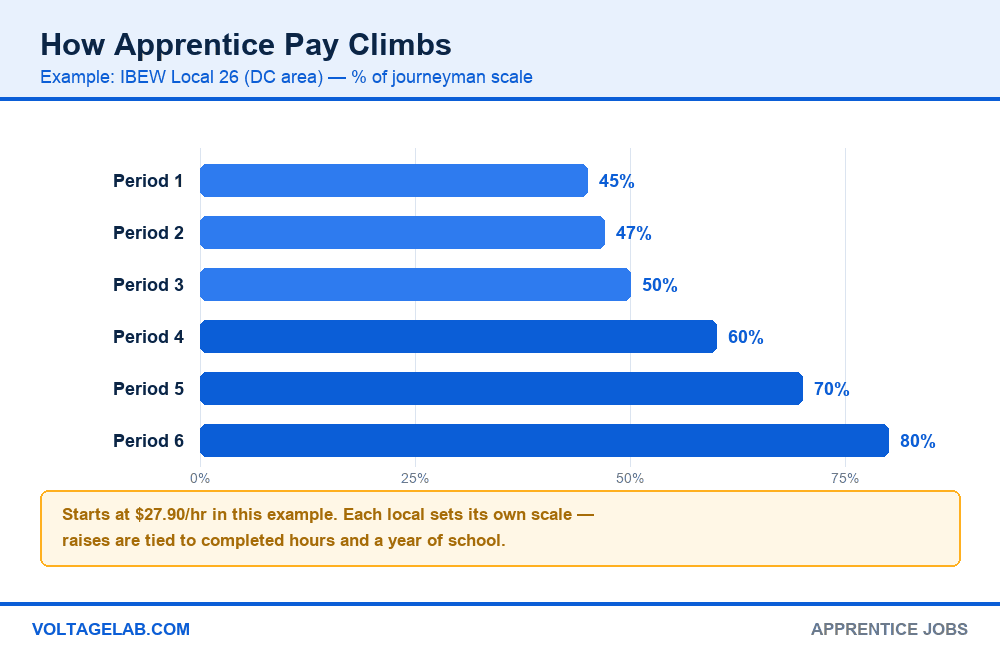
Apprentice pay is set as a percentage of the local journeyman rate, so it varies by area as much as by program. These union scales show how it climbs:
| Program (example) | Starting rate | % of journeyman scale | How pay rises |
|---|---|---|---|
| IBEW Local 26 — Washington, DC area | $27.90/hr | 45% | 47%, 50%, 60%, 70%, 80% by period, tied to hours and school |
| IBEW Local 26 — Roanoke area | $16.22/hr | 47% | Steps by period, tied to hours and school |
| Southern Nevada inside wireman JATC | $20.59/hr | 35% of $58.83 | Steps by period |
| National median, all electricians (BLS, May 2024) | $62,350 per year | ||
The six-step search method
Step 1 — search the apprenticeship.gov finder. Enter “electrician” and your ZIP code. Postings tagged Registered Occupation and Registered Partner are tied to programs recognised by the Office of Apprenticeship. If nothing is open, use the partner search to find sponsors in your area and contact them directly.
Step 2 — find your local JATC. The Electrical Training Alliance site has a training centre locator for IBEW/NECA programs. Write down the application dates — some programs accept applications only one day a month — and what they need: typically age 18, a diploma or GED, one year of algebra, a qualifying aptitude test score and a drug screen.
Step 3 — contact the IEC and ABC chapters. Ask which member contractors are hiring apprentices. Chapters know who is short-handed, and a referral from the chapter carries weight with an owner.
Step 4 — search job boards with the right words. Search “electrical apprentice,” “electrician helper,” “electrical trainee” and “wire puller,” plus your city. Set daily alerts. Commercial and industrial contractors post under helper titles more often than apprentice ones.
Step 5 — walk in. Make a list of licensed electrical contractors within commuting distance, then show up early in the morning with a one-page résumé. Electrical supply houses are a good place to ask who is busy.
Step 6 — follow up weekly. A short call or visit every week or two keeps your name in front of the person who hires. Most shops hire when a job starts, not when you apply.
The one that catches everyone: waiting lists. Sacramento’s JATC warns that testing and interview scheduling can take many months up to several years, and one ABC chapter in Southern California reported an electrical waiting list 600 names long. People apply to one program, wait, and lose a year. Apply to every route at once and take a documented helper job while you wait.
Study smarter with VoltageLab
Built for electricians, apprentices, and electrical engineers who want faster practice and better exam prep.
⭐️ Join thousands of electricians upgrading their skills
Show up knowing the basics
The VoltageLab Electrician App puts wire sizes, NEC tables and calculators on your phone, so you can answer the foreman’s questions on day one (iPhone · Android).
Thinking ahead to the journeyman exam? NEC Exam Prep drills timed code questions by article, a few minutes at a time (iPhone · Android).
What gets you hired — and what gets you passed over
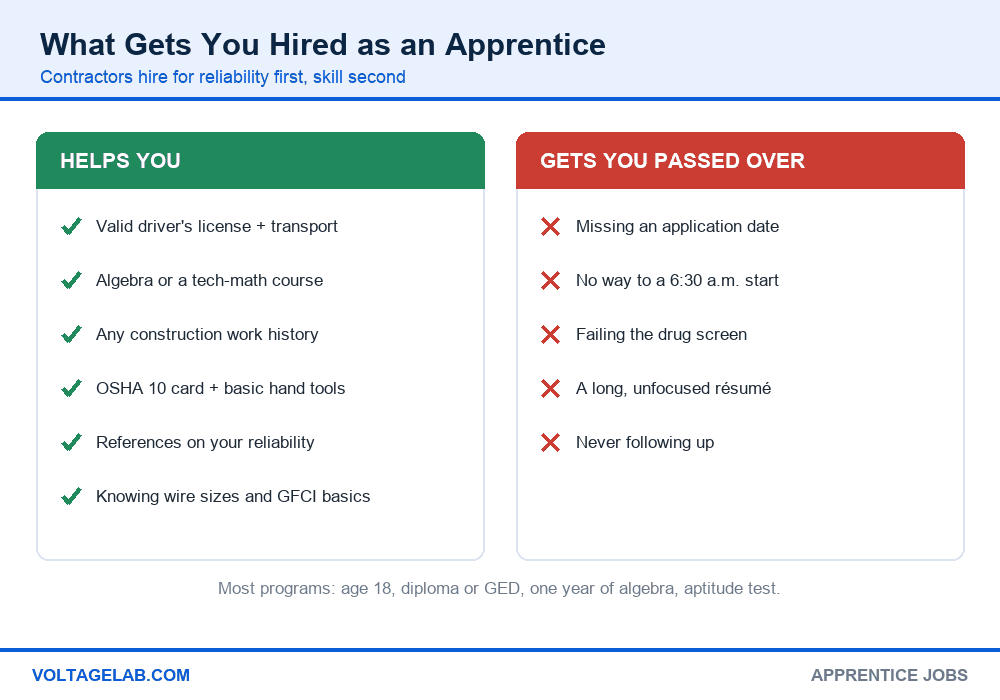
Contractors hiring a first-year apprentice are not looking for skill. They are looking for someone who will show up, listen and stay safe. Everything on your application should point to that.
What helps
- A valid driver’s license and reliable transport to job sites
- Algebra on your transcript, or a completed tech-math course
- Any construction, warehouse or mechanical work history, even short
- An OSHA 10 card and basic hand tools of your own
- References who can speak to your reliability
- Knowing the basics — wire sizes, what a GFCI does, how a circuit works
What gets you passed over
- Missing a program’s application date or required documents
- No way to get to a job site at 6:30 in the morning
- Failing the drug screen
- A long résumé about unrelated goals instead of one page about work ethic
- Never following up after the first application
If you want a head start on the basics, our wire gauge chart, the explainer on GFCI vs AFCI protection and how many outlets go on a 20-amp circuit cover questions you will hear in your first month. Safety comes first on every site — the NFPA 70E 2026 updates explain the arc-flash rules your employer works under.
Job boards vs training programs vs walking in
| Search channel | Best for | Speed | Competition |
|---|---|---|---|
| apprenticeship.gov finder | Registered programs and sponsors | Medium | Medium |
| JATC / union hall | Structured union apprenticeship | Slow | High |
| IEC / ABC chapter | Merit-shop contractor referrals | Medium | Medium |
| Online job boards | Helper and trainee listings | Fast | High |
| Walking in to contractors | Small and mid-size shops that never post | Fast | Low |
The channels with the least competition are the ones that take the most effort, which is exactly why they work. Once you are in, the long game is the journeyman license — our NEC exam prep guide and free NEC practice test show what you will be studying for, and our roundup of the best electrician apps covers tools that help along the way.
Should you take a helper job while you wait?
Pros
- You earn a paycheck instead of waiting on a list
- Documented hours can count toward your license in many states
- Field experience strengthens a union or merit-shop application
- Some contractors later sponsor helpers into a formal program
Cons
- No classroom instruction unless the employer adds it
- Hours may not count if you are not registered or supervised properly
- Easy to get stuck on repetitive work with no path forward
Landing — and keeping — your first apprentice job
Do
- Apply to the JATC, IEC, ABC and direct-hire routes at the same time
- Register with your state as an apprentice if it is required
- Keep your own log of hours, employers and supervisors
- Brush up on algebra before the aptitude test
- Show up early, every day, with your own basic tools
Avoid
- Waiting on a single program’s list without working
- Taking cash work that leaves no record of your hours
- Missing application dates that only open once a month or year
- Working unsupervised before you are licensed to
- Applying once and never following up
Frequently asked questions
How do I find apprentice electrician jobs near me?
Search the apprenticeship.gov finder by ZIP code, contact your local IBEW/NECA JATC and your area’s IEC and ABC chapters, and apply directly to licensed electrical contractors nearby — in person if possible.
Can I get an electrician apprenticeship with no experience?
Yes. Apprenticeships are designed for beginners. Most programs ask for age 18, a high school diploma or GED, a year of algebra and a passing aptitude test score, not prior electrical work.
How much do apprentice electricians make?
Apprentices are paid a percentage of the local journeyman rate, often starting between 35% and 50% and rising as they complete hours and classroom work. Published union scales range from about $16 to $28 an hour to start, depending on the area.
How long is an electrician apprenticeship?
Usually four to five years. IEC programs run four years, ABC programs three to five, and IBEW inside wireman programs about five, typically with at least 8,000 hours on the job plus classroom instruction.
Is it better to join the union or a merit-shop program?
Both lead to the same journeyman license. Union programs offer a fixed wage scale and dispatch but can have long waits; merit-shop programs move faster if a member contractor hires you. Apply to both and take the first good offer.
Do I need to register as an apprentice with my state?
In some states, yes. Texas requires an apprentice electrician license from TDLR, and Minnesota requires registration with DLI. Check your state’s licensing board before you start so your hours count.
What is the difference between an electrician helper and an apprentice?
An apprentice is enrolled in a structured program with classroom training that leads to a journeyman license. A helper assists electricians on the job, usually without formal training, and the hours may or may not count toward licensing.
The bottom line
Apprentice electrician jobs near you are out there, but they are found through training centres, contractor associations and shop doors more than through job boards. The two habits that make the difference are applying to every route at once instead of waiting on one list, and making sure every hour you work is registered and supervised so it counts toward your license.
Search the finder, call the JATC and the IEC and ABC chapters this week, and start walking into shops. While you wait, learn the basics that come up on day one — our wire gauge chart for electricians is a good place to start.
FREE PRACTICE TOOL
Think you'd pass this on a real exam?
Test what you just read with instant-feedback quizzes built around real code questions — not generic trivia.
5
Code standards
10,000+
Active learners
100%
Free to start
Instant explanations on every answer, right or wrong
NEC, BS7671, AS/NZS, CEC, and DIN VDE covered
Bite-sized quizzes you can finish in 5 minutes
No signup required to try your first quiz
No account needed · Takes less than 2 minutes