


It is 9 a.m. in July, and the attic is already over 120 °F. A first-week apprentice is lying across the ceiling joists with a fish tape, sweat in their eyes, trying to find a drilled hole in a top plate they cannot see. Below them, the journeyman is calling out which cable goes where. Before lunch, the same apprentice will be asked how many conductors that box can hold.
That morning answers most of is being an electrician hard. It is hard, but not in one way. The work asks a lot of your body, your math, your memory for the code and your attention to safety, often all at once. People who quit usually underestimated one of those, not all of them.
Study smarter with VoltageLab
Built for electricians, apprentices, and electrical engineers who want faster practice and better exam prep.
⭐️ Join thousands of electricians upgrading their skills
This guide breaks the difficulty into its real parts. It shows how residential, commercial and industrial work differ, walks through one piece of code every new electrician has to learn, and lays out who tends to find the trade easier or harder. It also covers the habits that make the first years go better.
Quick Answer
Being an electrician is hard, mostly in the first two years. The work is physical: ladders, attics, crawl spaces and lifting materials of up to 50 pounds, according to the Bureau of Labor Statistics. It also takes steady math, a working knowledge of the National Electrical Code (NEC), and strict safety habits, because mistakes can cause shocks, burns or falls.
It gets easier as you go. Your body adapts within months. The code and theory take years, but you learn them on the job, paid, through a 4- to 5-year apprenticeship. Most people who struggle are not short on ability. They try to learn everything at once, or leave the studying until the end.
Your next step
Build your first-year learning plan in the Electrician App. Pick the topics you are meeting on the job this month, such as box fill, conduit bending or working clearances, and learn them in order instead of all at once. The NEC tables and calculators you need are in your pocket too. Get it on iPhone or Android.
Study smarter with VoltageLab
Built for electricians, apprentices, and electrical engineers who want faster practice and better exam prep.
Join thousands of electricians upgrading their skills
Key Takeaways
- Electrical work is physically demanding, with long periods of standing and kneeling and lifts of up to 50 pounds
- The math is mostly algebra: Ohm’s law, load calculations, voltage drop and conduit bending
- Learning to find and apply the right NEC section is the skill that takes longest to build
- Safety is the one area with no learning curve allowed: lockout, testing and clearances every time
- Residential work is the hardest on your body; industrial work is the hardest technically
- You are paid while you learn, and the first two years are the hardest for most apprentices
Is being an electrician hard? The five parts that make it hard
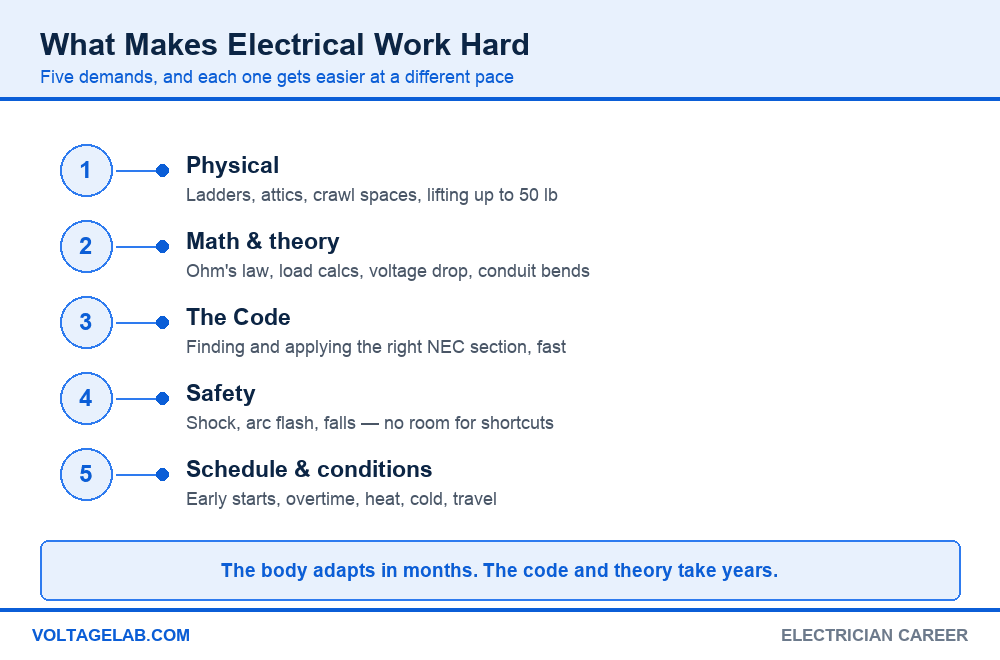
“Hard” means five separate things in this trade. Each one gets easier on its own schedule.
1. The physical work
The BLS describes long periods of standing and kneeling, cramped spaces, and work at heights on construction and renewable energy sites. You carry spools, ladders and boxes of fittings, and you drill, pull and bend all day. The first few months are tiring for almost everyone. After that, most apprentices adapt, and good knee pads, a decent ladder and drinking water before you are thirsty matter more than raw strength.
2. The math and theory
Most apprenticeships ask for a year of algebra, and that is roughly the level you use. Ohm’s law ties voltage, current and resistance together. You use it to understand why a long run needs a bigger conductor, which is the idea behind calculating voltage drop. Conduit bending uses multipliers for offsets and saddles. Load calculations under NEC Article 220 add up the demand on a service. None of it is advanced, but you have to do it right when someone is waiting on you.
3. Learning the code
The NEC is long, and it is written as rules, not as lessons. The skill is not memorizing it. It is knowing where to look. Box fill sits in NEC 314.16, conductor ampacity in Table 310.16, and grounding in Article 250. In year one you look things up slowly. By year four you know which article covers what you are installing before you open the book.
4. Safety
The BLS lists shocks, falls and burns as common injuries for electricians. The habits that prevent them are simple and non-negotiable: de-energize, lock out, and test before touch. Lockout procedures come from OSHA rules, and NFPA 70E covers arc flash and electrical safety in the workplace. Our guide to preventing electrical shocks on the job site covers the daily routine.
5. Schedule and conditions
Almost all electricians work full time, and the BLS notes that evenings, weekends and overtime are common. Construction days start early. You work in summer heat and winter cold, and some jobs mean travel. On the other hand, you are rarely at a desk, and the work changes from week to week.
Residential vs commercial vs industrial — where the hard part sits
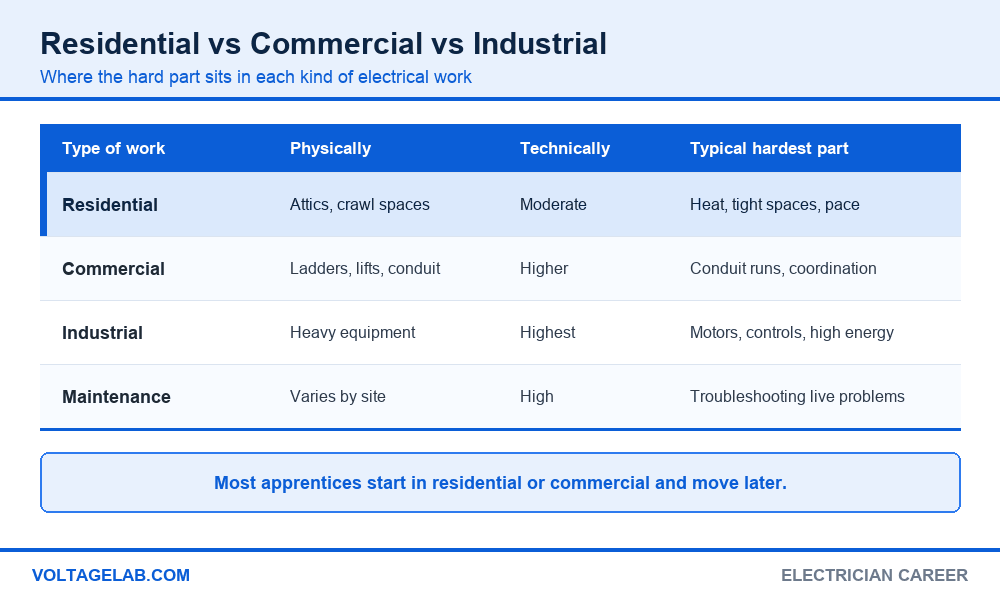
The trade is not one job. What wears you down depends on the kind of work you do.
| Type of work | Physical demand | Technical demand | What makes it hard |
|---|---|---|---|
| Residential | High: attics, crawl spaces | Moderate | Heat, tight spaces and a fast pace on cable-based wiring |
| Commercial | High: ladders, lifts, conduit | Higher | Long conduit runs, three-phase systems, working around other trades |
| Industrial | High: heavy equipment | Highest | Motors, controls and higher-energy systems under NEC Article 430 |
| Maintenance | Varies by site | High | Troubleshooting under time pressure with production waiting |
Residential is where many apprentices start, and it is the hardest on your body. Commercial work adds pipe: you bend and run a lot of EMT, and our conduit bending guide covers the offsets and saddles you will use daily. Industrial and maintenance work is less about speed and more about understanding systems well enough to troubleshoot them.
Common inspection mistake: a panel with shelves, a water heater or stored boxes in front of it. NEC 110.26(B) says the working space in front of electrical equipment cannot be used for storage, and NEC 240.24(D) keeps overcurrent devices away from easily ignitible material such as clothes closets. New electricians often plan the panel location around the cabinets instead of the clearance. Inspectors catch it at rough-in, and moving a panel costs far more than measuring first.
The code you learn first — NEC 110.26 working space
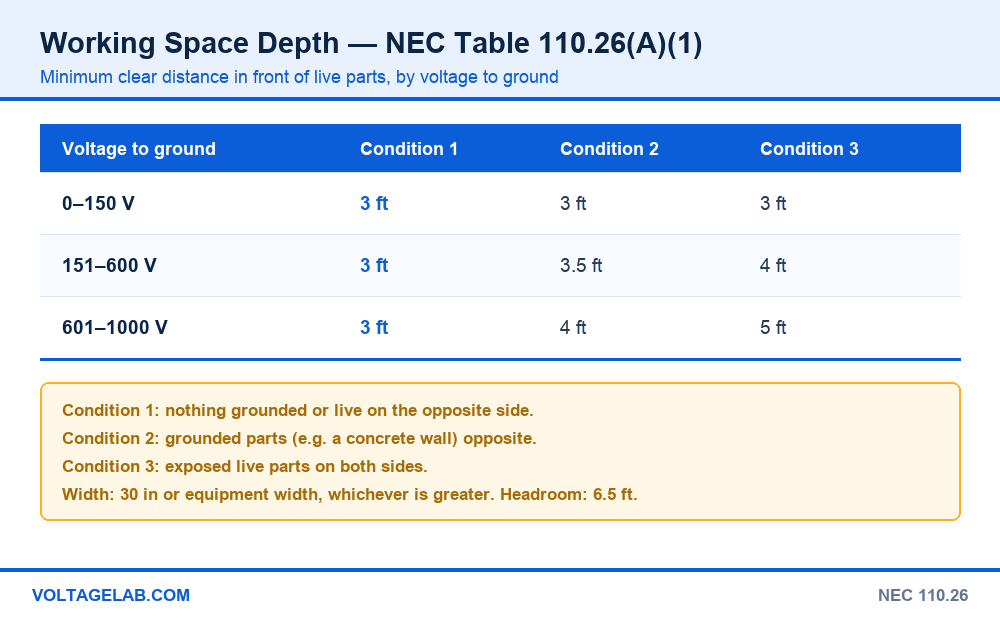
One way to see what “learning the code” means is to take a rule every electrician uses in their first year. NEC 110.26 sets the clear working space in front of panels and other equipment that may be examined, adjusted or serviced while energized. The depth depends on the voltage to ground and on what is on the opposite side of the space.
| Nominal voltage to ground | Condition 1 | Condition 2 | Condition 3 |
|---|---|---|---|
| 0–150 V | 3 ft (900 mm) | 3 ft (900 mm) | 3 ft (900 mm) |
| 151–600 V | 3 ft (900 mm) | 3.5 ft (1.0 m) | 4 ft (1.2 m) |
| 601–1000 V | 3 ft (900 mm) | 4 ft (1.2 m) | 5 ft (1.5 m) |
A 120/240-volt residential panel is 120 volts to ground, so it falls in the first row: 3 feet deep in every condition. A 277/480-volt commercial panel is 277 volts to ground, so the depth depends on what faces it. Our full guide to electrical panel clearance under NEC 110.26 covers the exceptions.
Study smarter with VoltageLab
Built for electricians, apprentices, and electrical engineers who want faster practice and better exam prep.
⭐️ Join thousands of electricians upgrading their skills
How to check working space, step by step
Step 1 — find the voltage to ground. Use the system voltage to ground, not the line-to-line voltage. 120/240 V single-phase is 120 V to ground. 277/480 V wye is 277 V.
Step 2 — decide the condition. Condition 1 has no live or grounded parts opposite. Condition 2 has grounded parts opposite, and concrete, brick and tile walls count as grounded. Condition 3 has exposed live parts on both sides.
Step 3 — measure depth, width and height. Read the depth from the table, then confirm the width (30 in or the equipment width) and the 6.5 ft headroom. Keep the whole space clear of storage.
The one that catches everyone: a concrete or block wall across from a 480-volt panel makes it Condition 2, not Condition 1, because NEC 110.26(A)(1) treats concrete, brick and tile as grounded. The required depth rises from 3 feet to 3.5 feet. In a tight electrical room, that half foot is the difference between passing and moving the gear.
Who finds the trade easier, and who finds it harder
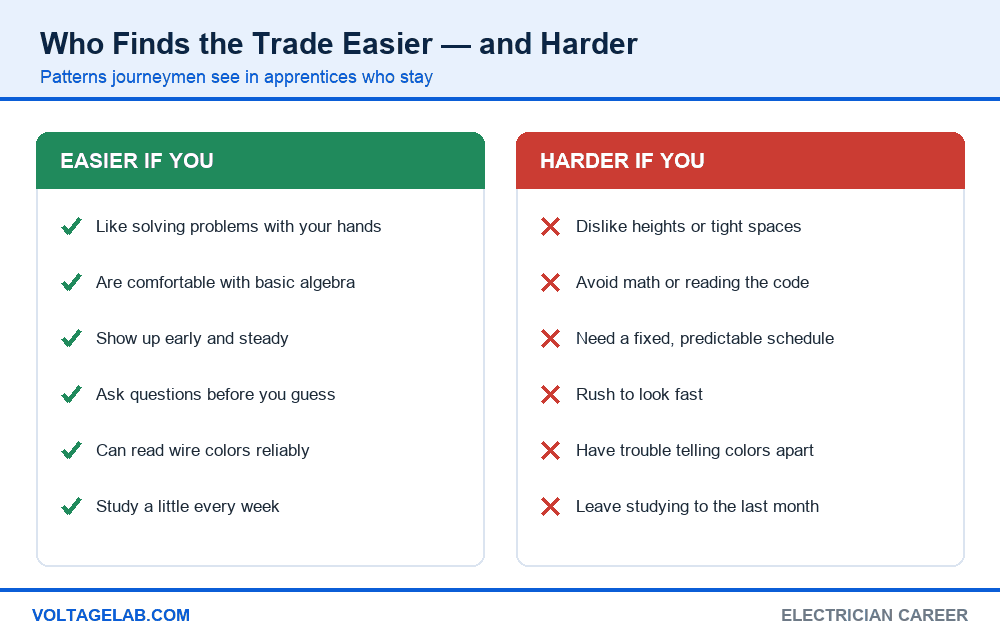
Ability matters less than fit. These are the patterns journeymen tend to see in apprentices who stay in the trade and in those who leave.
Easier for you if
- You like solving problems with your hands and seeing finished work
- You are comfortable with basic algebra, or willing to relearn it
- You show up early and steady, every day
- You ask before you guess
- You can reliably tell wire colors apart, which the BLS lists as a requirement
Harder for you if
- Heights, ladders or tight spaces make you anxious
- You avoid math or reading dense rules
- You need the same hours and the same place every day
- You rush to look fast instead of working carefully
- You plan to cram everything in the last few months of your apprenticeship
Electrician vs other skilled trades
If you are choosing between trades, the difference is less about effort and more about the kind of difficulty.
| Factor | Electrician | Plumber | HVAC technician | Carpenter |
|---|---|---|---|---|
| Main code book | NEC (NFPA 70) | Plumbing code | Mechanical code | Building code |
| Theory load | Heavy | Moderate | Moderate to heavy | Lighter |
| Main hazard | Shock, arc flash, falls | Confined spaces, sewage | Heat, refrigerant, electrical | Power tools, falls |
| Can you see the work? | Rarely: current is invisible | Usually: leaks show | Partly | Yes |
The last row is the real difference. In electrical work you cannot see the thing you are working with, so you rely on theory, meters and the code. That makes the learning curve steeper than in most trades, and it is why the apprenticeship pairs field hours with classroom time. Grounding is a good example: NEC Article 250 makes sense only once you understand fault current paths you will never see. Before any work on equipment, lockout/tagout is the habit that keeps the invisible part from hurting you.
Is the hard work worth it?
Pros
- Paid training from day one, with no college degree needed
- The BLS reports a median wage of $63,190 in May 2025
- Employment projected to grow 9% from 2025 to 2035, per the BLS
- Varied work that changes from job to job
- A license that can lead to master or contractor status
Cons
- Physically tiring, especially in the first months
- Real injury risk from shock, burns and falls
- Early starts, overtime and weather
- Classes on top of full workdays during the apprenticeship
Making the first years easier
Do
- Test before touch, every time, with a meter you have verified
- Learn the code section for each task the week you do it
- Wear knee pads and hydrate before you feel thirsty
- Measure working space before you mount a panel
- Ask your journeyman why, not just how
Avoid
- Working anything live because it is “just 120 volts”
- Skipping lockout because the job is quick
- Guessing at box fill or wire size instead of looking it up
- Leaving the code book closed until the last few months
- Pushing through heat exhaustion to finish a pull
Your next step
Build your first-year learning plan in the Electrician App. Start with the rules you will meet first, such as working space, box fill and conductor ampacity, and add the next topic only when the job brings it up. Learning a little each week is what makes the code feel easier by year three. Available on iPhone and Android.
Frequently asked questions
Is being an electrician physically demanding?
Yes. The BLS describes long periods of standing and kneeling, work in cramped spaces and at heights, and lifting components of up to 50 pounds. Most apprentices adapt within the first few months.
How much math do electricians use?
Mostly algebra. You use Ohm’s law, load calculations, voltage drop and conduit bending multipliers, which is why most apprenticeships ask for a year of algebra before you apply.
What is the hardest part of being an electrician?
For most people it is learning the NEC well enough to apply it quickly on the job. The physical work gets easier within months. Finding and applying the right code section takes years of practice.
Is being an electrician dangerous?
It can be. The BLS lists shocks, falls and burns as common injuries. The risk drops sharply with consistent habits: de-energize, lock out, test before touch, and follow NFPA 70E for any energized work.
Is residential or commercial electrical work harder?
Residential is usually harder on your body, with attics, crawl spaces and a fast pace. Commercial is usually harder technically, with conduit, three-phase systems and larger equipment.
Can you be an electrician if you are color blind?
It depends on the degree. The BLS notes that electricians must identify wires by color, and conductor colors carry meaning under the NEC, such as white or gray for grounded conductors in NEC 200.6 and green for equipment grounding conductors in NEC 250.119. Some programs test color vision, so ask before you apply.
Is being an electrician worth it?
For many people, yes. You are paid while you train, the BLS reports a median wage of $63,190 in May 2025, and employment is projected to grow 9% from 2025 to 2035. The trade-off is physical work and years of study.
The bottom line
Being an electrician is hard in five ways: the body, the math, the code, safety and the schedule. The physical side eases within months. The code and theory take years, but you learn them while you are paid, one job at a time.
Two habits make the biggest difference: never skip test-before-touch, and study the code a little every week instead of all at the end. For the newest rules you will be working under, see our summary of what changed in the 2026 NEC.
FREE PRACTICE TOOL
Think you'd pass this on a real exam?
Test what you just read with instant-feedback quizzes built around real code questions — not generic trivia.
5
Code standards
10,000+
Active learners
100%
Free to start
Instant explanations on every answer, right or wrong
NEC, BS7671, AS/NZS, CEC, and DIN VDE covered
Bite-sized quizzes you can finish in 5 minutes
No signup required to try your first quiz
No account needed · Takes less than 2 minutes