


The inspector walks into a commercial tenant fit-out, looks at the new 208/120-volt panel, and asks one question: “Who pulled the permit?” The journeyman running the crew knows every circuit in that panel and installed most of them. But the name on the permit belongs to the master electrician back at the shop, and so does the call the inspector makes next.
That moment is the clearest way to understand journeyman vs master electrician. Both licenses let you do the work. The difference is who is responsible for it. Many electricians treat the master license as “the same job, more years,” then find that the exam, the paperwork and the liability all change.
Study smarter with VoltageLab
Built for electricians, apprentices, and electrical engineers who want faster practice and better exam prep.
⭐️ Join thousands of electricians upgrading their skills
This guide explains what each license lets you do, how much experience each takes in four states, what changes in your NEC responsibilities as a master, how the two exams differ, and what is known about pay. It closes with the habits that make the step from journeyman to master go smoothly.
Quick Answer
A journeyman electrician is licensed to install and repair electrical systems without direct supervision, usually after about 8,000 hours as an apprentice. A master electrician has more experience, typically at least two more years, and passes a harder exam. In most states the master can pull permits, take responsibility for the design and qualify an electrical contracting business.
The exact rules belong to your state, and some states license masters only at the city or county level. Texas, for example, requires 12,000 hours and two years as a journeyman for a master license. Florida and California license contractors at the state level instead of masters.
Your next step
Take a practice exam in the Electrician App. A timed practice test shows you which parts of the code you already know from the field and which ones, such as load calculations or service sizing, need work before you think about a master license. Get it on iPhone or Android.
Study smarter with VoltageLab
Built for electricians, apprentices, and electrical engineers who want faster practice and better exam prep.
Join thousands of electricians upgrading their skills
Key Takeaways
- A journeyman works without supervision; a master takes legal responsibility for the work
- In most states the master, or the contractor’s qualifier, is the one who pulls the permit
- A master license usually needs at least two years beyond the journeyman license
- Texas requires 12,000 hours and two years as a journeyman; Minnesota requires 60 months of experience
- The master exam leans harder on design: load calculations, services, feeders and overcurrent protection
- The BLS publishes one wage figure for all electricians, not separate journeyman and master pay
- Florida and California have no state master license and license contractors instead
What journeyman and master electricians actually do
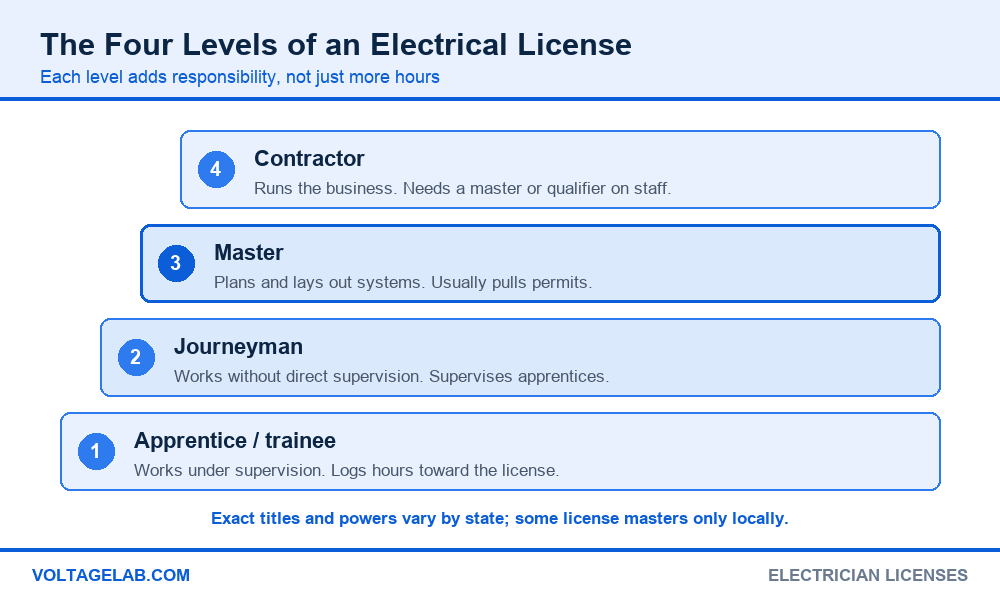
Most states use a ladder of licenses. Each rung adds responsibility, not just hours.
- Apprentice or trainee. Registered with the state or a program. Works under a licensed electrician and logs hours toward the license.
- Journeyman. Has the hours and has passed the exam. Installs and repairs to the NEC without direct supervision, and in most states can supervise apprentices.
- Master. A journeyman with more experience and a harder exam. Plans and lays out systems, and in most states pulls permits and answers for the work.
- Electrical contractor. A business license. Most states require a master, or a qualifying agent, on staff before a company can contract for electrical work.
Decoding the titles
“Journeyman” and “journeyworker” mean the same thing; Minnesota uses journeyworker. Some states add letters for scope, such as Minnesota’s Class A master and Class A journeyworker. Others split licenses by type of work, such as Texas’s separate journeyman industrial license. The words “master” and “contractor” are often confused. A master is a person. A contractor is a business that needs a master, or a qualifier, behind it.
Journeyman vs master electrician — side by side
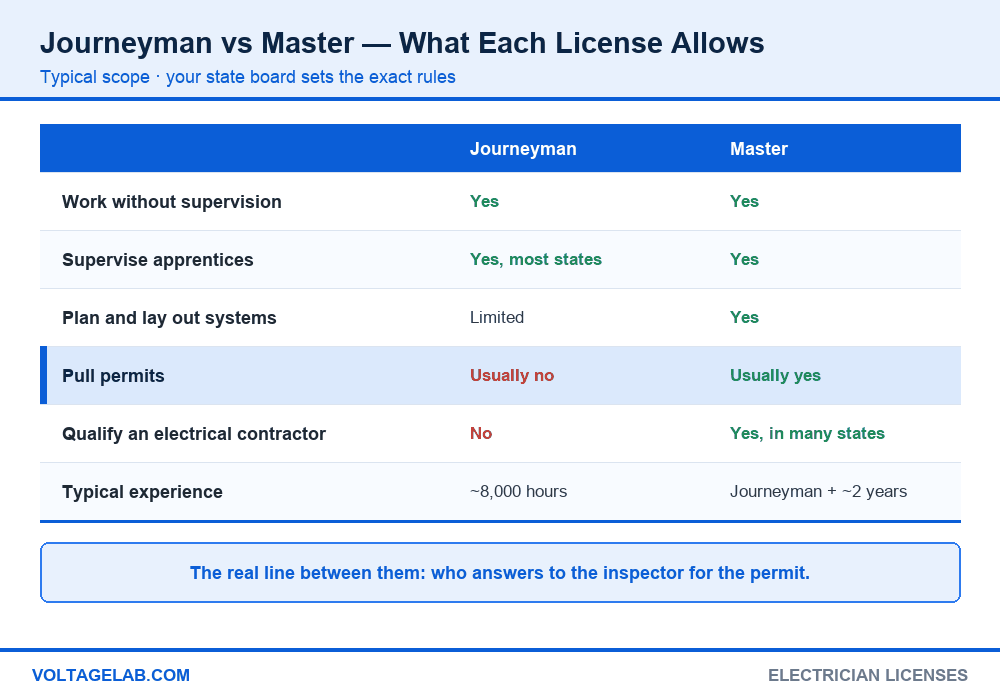
Here is how the two licenses typically compare. Your state board’s rules decide the details.
| What you can do | Journeyman | Master |
|---|---|---|
| Work without direct supervision | Yes | Yes |
| Supervise apprentices | Yes, in most states | Yes |
| Plan and lay out systems | Limited | Yes |
| Pull permits | Usually no | Usually yes |
| Qualify an electrical contractor | No | Yes, in many states |
| Typical experience | About 8,000 hours | Journeyman plus about 2 years |
The highlighted row is the one that matters day to day. A journeyman can build an entire service, but the permit, and the responsibility that comes with it, usually sits with a master or the contractor’s qualifier. The NEC itself does not license anyone. Under NEC 90.4, the authority having jurisdiction enforces the Code, and your state and local rules decide who may sign for the work.
How much experience each license takes
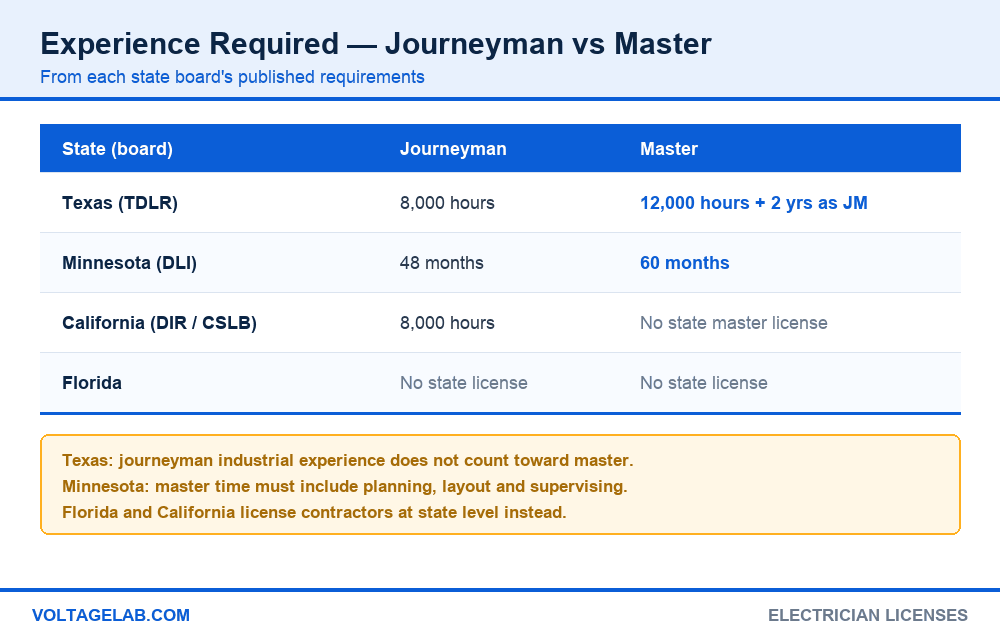
There is no national electrician license, so the numbers come from each state board. These four show the range.
| State and board | Journeyman | Master |
|---|---|---|
| Texas (TDLR) | 8,000 hours of supervised training | 12,000 hours and at least 2 years holding a journeyman license |
| Minnesota (DLI) | Class A journeyworker: 48 months | Class A master: 60 months, including planning, layout and supervising |
| California (DIR / CSLB) | General electrician certification: 8,000 hours | No state master license; contractors hold a C-10 license |
| Florida | No statewide journeyman license | No state master license; the state certifies electrical contractors |
For the full timeline from apprentice to journeyman, see our guide to how long it takes to become an electrician. If your state licenses contractors instead of masters, our guide to Florida electrical contractor license requirements shows what that route looks like.
How to plan the step from journeyman to master
Step 1 — read your board’s master requirements now. Note the total hours or months, any minimum time as a journeyman, and any required categories such as planning or supervising.
Step 2 — check what kind of work counts. Some licenses do not feed the master. Make sure your journeyman hours are the type your board credits.
Step 3 — ask for design and layout work. Tell your master you want to do load calculations, service sizing and panel schedules under their review. That is the work the master exam and the license expect you to know.
The one that catches everyone: not every hour counts toward a master license. In Texas, experience as a journeyman industrial electrician cannot be used to qualify for the master license. In Minnesota, the 60 months must include at least two months each of planning, laying out and supervising work. Years of installation alone can leave you short.
What changes in your NEC responsibilities as a master
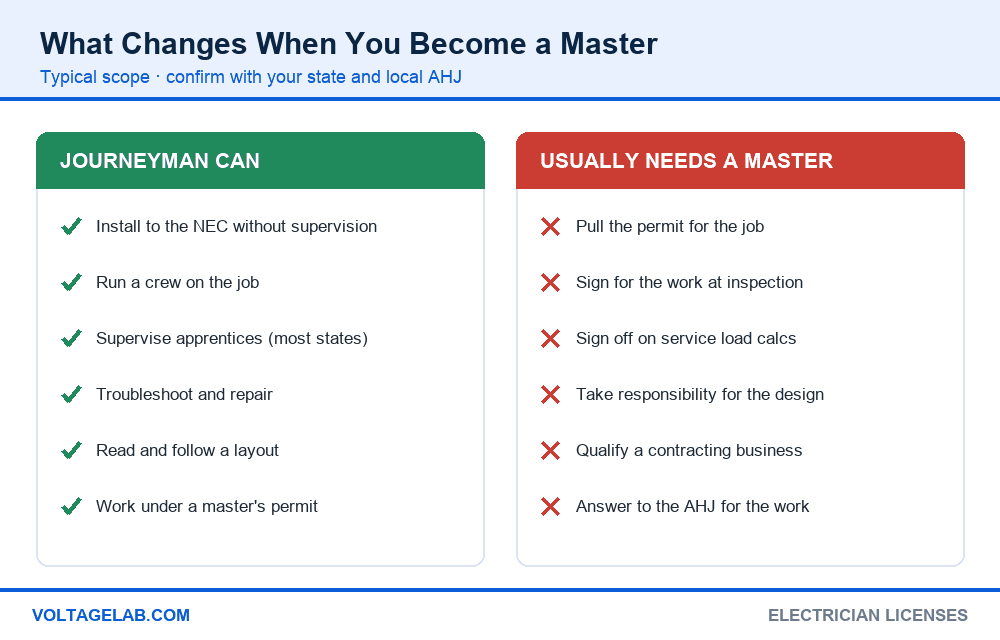
As a journeyman, you are expected to install correctly. As a master, you are expected to decide what gets installed and to answer for it. That shifts which parts of the NEC you live in.
Study smarter with VoltageLab
Built for electricians, apprentices, and electrical engineers who want faster practice and better exam prep.
⭐️ Join thousands of electricians upgrading their skills
What a journeyman typically does
- Installs branch circuits, feeders and services to the NEC without supervision
- Runs a crew and supervises apprentices, in most states
- Applies installation rules such as box fill in NEC 314.16 and working space in NEC 110.26
- Troubleshoots and repairs existing systems
- Works under a permit pulled by a master or contractor
What usually needs a master
- Pulling the permit and signing for the work at inspection
- Signing off on service and feeder load calculations under NEC Article 220
- Choosing service equipment under NEC Article 230 and feeders under Article 215
- Confirming equipment interrupting ratings meet the available fault current, per NEC 110.9 and 110.10
- Qualifying a contracting business with the state
Load calculations are the clearest example. A journeyman can install a 400-amp service. The master decides that 400 amps is the right size, from a calculation under Article 220. Our guides to range demand calculations under NEC 220.55 and 400-amp service wire size show the kind of work involved.
Common inspection mistake: service equipment in a commercial building with no available fault current marking. NEC 110.24(A) requires service equipment at other than dwelling units to be legibly field-marked with the maximum available fault current, including the date the calculation was done. The journeyman sets the gear; the master is the one the inspector holds responsible when the label is missing or the number does not match the utility’s data.
Journeyman vs master exam — what is different
Both exams are built on the edition of the NEC your state has adopted, and most are open book. The difference is depth. The journeyman exam centers on installation: wiring methods, conductor sizing from Table 310.16, box and conduit fill, grounding under Article 250, and motors under Article 430. The master exam adds more design work: service and feeder load calculations, overcurrent protection, special occupancies and, in some states, business and law questions.
Question counts, time limits and passing scores vary by state and testing vendor, so we have not listed them here. Check the candidate bulletin from your board’s exam provider. Our NEC exam prep guide covers how to study for both, and our free NEC practice test shows where you stand.
Pay: what is and is not known
The Bureau of Labor Statistics reports a median annual wage of $63,190 for electricians in May 2025, and it projects employment to grow 9% from 2025 to 2035. It does not publish separate figures for journeymen and masters, so any precise “master pay” number you see online comes from other surveys. A master license usually pays more because it carries more responsibility, and because it is the route to running your own shop, but how much more depends on your state, your employer and whether you work union.
Is a master license worth it for you?
Pros
- Lets you pull permits and sign for the work
- Required to qualify a contracting business in many states
- Opens estimating, design and supervisory roles
- Usually comes with higher pay
Cons
- More legal responsibility for work you may not have installed
- A harder exam with more calculation
- Not needed if you plan to stay on the tools for a contractor
Moving from journeyman to master
Do
- Keep logging your hours after you get your journeyman card
- Ask to do load calcs and panel schedules under review
- Learn Articles 215, 220 and 230 as working tools, not exam topics
- Read your board’s master rules before you change jobs
- Keep your journeyman license renewed and your CE current
Avoid
- Assuming every hour you work counts toward the master
- Spending years only installing, with no planning or layout
- Studying the newest NEC when your state adopted an older one
- Letting a contractor use your license without being involved
- Waiting until the exam to learn fault current and interrupting ratings
Your next step
Take a practice exam in the Electrician App. Use it to find the design topics, such as Article 220 load calculations and service sizing, that your daily work has not covered yet, then study those first. Available on iPhone and Android.
Frequently asked questions
What is the difference between a journeyman and a master electrician?
A journeyman can do electrical work without direct supervision. A master has more experience, has passed a harder exam, and in most states can pull permits, take responsibility for the design and qualify a contracting business.
How long after journeyman can you become a master electrician?
Usually at least two years. Texas requires two years holding a journeyman license and 12,000 total hours. Minnesota requires 60 months of experience for a Class A master, compared with 48 for a journeyworker.
Can a journeyman electrician pull permits?
Usually not. In most jurisdictions permits are pulled by a master electrician or a licensed contractor. Some local jurisdictions allow it for limited work, so check with your local building department.
Do master electricians make more than journeymen?
Usually, but there is no official figure. The BLS reports a single median wage of $63,190 for all electricians in May 2025 and does not split it by license level.
Is the master electrician exam harder than the journeyman exam?
Yes, in most states. It covers the same NEC but adds more design and calculation, such as service and feeder load calculations under Article 220, and sometimes business and law.
Is a master electrician the same as an electrical contractor?
No. A master license belongs to a person. A contractor license belongs to a business, which in many states needs a master or qualifying agent on staff. Florida and California license contractors without a state master license.
Does a master license transfer to another state?
Only where the states have a reciprocity agreement, and often only for the same license level. Our guide to electrician license reciprocity by state lists the agreements, and license renewal and CE hours by state covers keeping it active.
The bottom line
The journeyman license proves you can install to the Code. The master license makes you the person who answers for it: the permit, the load calculation and the inspection. Most states ask for at least two more years and a harder, more design-heavy exam to get there.
Two things decide how smoothly you get there: making sure your hours are the kind your board counts, and asking for design work long before the exam. For the full path from the start, see how long it takes to become an electrician.
FREE PRACTICE TOOL
Think you'd pass this on a real exam?
Test what you just read with instant-feedback quizzes built around real code questions — not generic trivia.
5
Code standards
10,000+
Active learners
100%
Free to start
Instant explanations on every answer, right or wrong
NEC, BS7671, AS/NZS, CEC, and DIN VDE covered
Bite-sized quizzes you can finish in 5 minutes
No signup required to try your first quiz
No account needed · Takes less than 2 minutes