



 Scan to install
Open a consumer unit fitted in 2010 and you will usually find two big RCDs, each with a row of MCBs under it. Open one fitted this year and every way may have its own RCBO, with a few wider devices on the socket circuits that have an extra test button and a little LED. They do similar jobs, but each one is guarding against a different fault. Knowing which fault each one covers is how you choose between them, and how you explain the quote to the customer.
People get this wrong in both directions. Some assume an RCD protects a circuit from overload, which it doesn’t. Others assume a modern board with RCBOs already guards against fire from a loose terminal, which it also doesn’t. Then there are RCD types. A Type AC device on a circuit full of LED drivers and inverter appliances can be blinded by DC leakage and fail to trip when it is needed.
This guide explains what an RCD, an RCBO and an AFDD each detect and how they work. It covers where BS 7671 requires each one as of Amendment 4:2026, which RCD type to choose and how to lay out a board. It ends with how to test them.
Quick Answer
An RCD (residual current device) trips when current leaks to earth, which is what protects people from electric shock. An RCBO combines an RCD and an MCB in one device, so it trips on earth leakage and on overload and short circuit, for one circuit only. An AFDD (arc fault detection device) watches the current waveform and trips on the electrical arcing that comes before a fire, which neither an RCD nor an MCB can see.
In practice, most new UK domestic boards use a Type A RCBO on every circuit. BS 7671 Regulation 421.1.7 adds AFDDs on socket circuits up to 32 A in high-rise residential buildings, HMOs, purpose-built student accommodation and care homes, and recommends them everywhere else.
Key Takeaways
- An RCD on its own gives no protection against overload or short circuit. It must have an MCB or fuse with it.
- An RCBO is an RCD and an MCB in one device. A fault on one circuit trips only that circuit.
- An AFDD is the only device that detects series arcs, such as a loose terminal or a crushed flex, because those never raise the current.
- 30 mA additional protection is required for sockets up to 32 A, domestic lighting circuits, most concealed cables in walls and every circuit in a room with a bath or shower.
- Type A is the normal choice for domestic circuits. Type AC is restricted to fixed loads known to produce no DC component.
- A4:2026 adds a note to Regulation 531.3.3 warning against putting a lower RCD type upstream of a higher one.
- BS 7671 requires an RCD test at its rated residual current. The test button should be pressed every six months.
What an RCD, RCBO and AFDD actually are
All three are DIN-rail devices that sit in the consumer unit, and they can look almost identical. What differs is what each one measures before it opens its contacts.
RCD (RCCB)
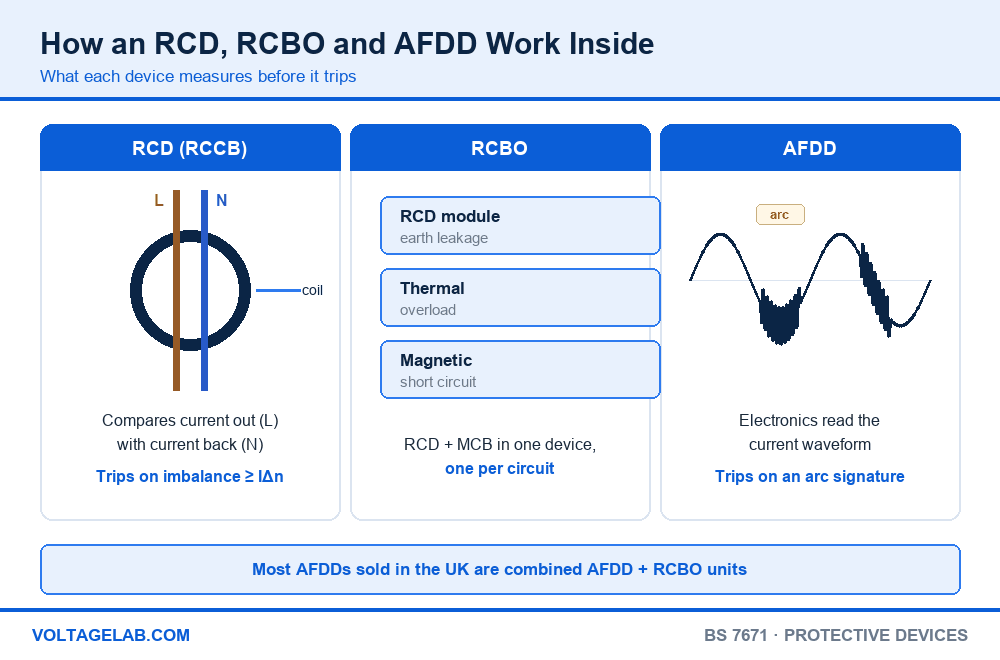
An RCD passes the line and neutral conductors through a toroidal core. In a healthy circuit, the current going out on the line equals the current coming back on the neutral, so their magnetic fields cancel. If some current leaks to earth, through a damaged cable, a wet appliance or a person, the currents no longer balance and the difference induces a current in a sensing coil. When the imbalance reaches the device’s rated residual operating current (IΔn), it trips. The device sold on its own as an “RCD” is strictly an RCCB to BS EN 61008. It has no overcurrent protection, so every circuit behind it still needs an MCB or a fuse.
RCBO
An RCBO to BS EN 61009 is a residual current breaker with overcurrent protection. It contains the same residual current sensing as an RCD, plus the thermal and magnetic trip elements of an MCB. The thermal element handles overload and the magnetic element handles short circuit. It is fitted one per circuit and is marked with both ratings, for example B32 30 mA Type A. Because each circuit has its own, an earth fault on the kitchen sockets does not black out the lights.
AFDD
An AFDD to BS EN 62606 contains electronics that analyse the current waveform for the high-frequency noise and distortion that an electrical arc produces. A loose terminal, a nail through a cable or a flex crushed under furniture can arc for weeks, heating the insulation until it ignites, without ever drawing more current than a normal load. An AFDD trips on that signature. Almost all AFDDs sold in the UK are combined AFDD-RCBO units, so one device gives arc, earth leakage and overcurrent protection on the circuit.
Decoding the names
RCD is the family name for any device that trips on residual current. RCCB is a residual current circuit breaker with no overcurrent protection. RCBO is a residual current breaker with overcurrent protection. AFDD is an arc fault detection device. In the US, an RCD is called a GFCI and an AFDD is called an AFCI, but the trip levels and rules are different. Our guide to GFCI vs AFCI covers the NEC version.
RCD vs RCBO vs AFDD: what each one protects against
| RCD (RCCB) | RCBO | AFDD (combined unit) | |
|---|---|---|---|
| Product standard | BS EN 61008 | BS EN 61009 | BS EN 62606 |
| Earth leakage and shock | Yes | Yes | Yes (through the RCBO part) |
| Overload and short circuit | No | Yes | Yes |
| Series and low-level arcs | No | No | Yes |
| Circuits covered | Every MCB downstream of it | One circuit | One circuit |
| Relative cost per circuit | Lowest (shared) | Moderate | Highest, several times an RCBO |
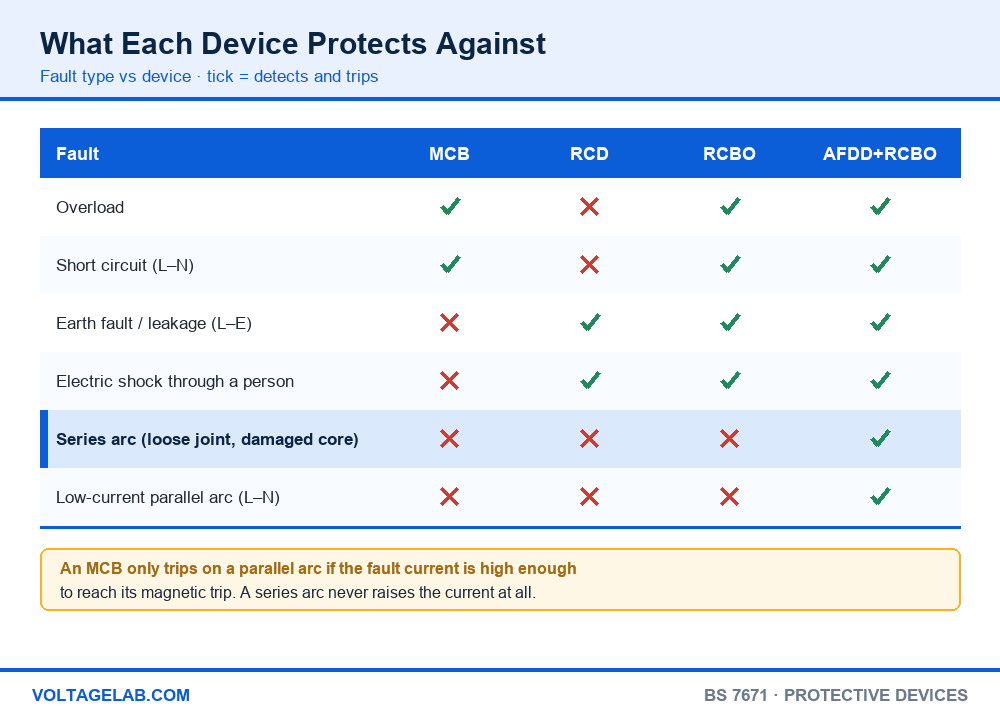
The row that matters most is the arc row. A parallel arc between line and neutral may draw enough current to trip an MCB magnetically, but only if the fault current is high. A parallel arc from line to earth will trip an RCD. A series arc is a break in one conductor that is still arcing across the gap. It sits in series with the load, so the current can only stay the same or fall. No overcurrent device will ever see it, and since nothing leaks to earth, no RCD will either.
An RCD is not overcurrent protection: on older split-load boards it is common to find a circuit fed straight off an RCD with no MCB, often an added shower or a garage feed someone “put on the RCD”. The RCD will trip on earth leakage, but a 63 A or 80 A RCCB will happily carry 60 A through 2.5 mm² cable until it burns. Regulation 433.1 requires overload protection on every circuit, so an RCCB must always have an MCB, fuse or RCBO with it. On an EICR, a circuit with no overcurrent device is a C2 at least.
RCD types and ratings: choosing AC, A, F or B
Every RCD and RCBO has a type as well as a rating. The type says which shapes of residual current it is designed to detect. Modern loads are full of rectifiers, switch-mode power supplies and inverters, and their earth leakage is not a clean sine wave. An RCD of the wrong type can fail to trip, or be “blinded” by DC so that it no longer trips on an ordinary AC fault.
| Rating (IΔn) | Time delay | Typical use | Required test result at IΔn |
|---|---|---|---|
| 10 mA | None | Special locations where the maker or a designer calls for it, e.g. some medical and pool equipment | Trips within 300 ms |
| 30 mA | None (general type) | Additional protection: sockets, lighting, cables in walls, bathrooms, outdoor equipment | Trips within 300 ms |
| 100 mA | S-type (time-delayed) | Upstream device on a TT installation, discriminating with 30 mA RCBOs downstream | Trips between 130 ms and 500 ms |
| 300 mA | S-type or none | Fire protection on sub-mains and agricultural installations | S-type: 130–500 ms; general: within 300 ms |
How to choose the type, step by step
- List the loads on the circuit. Note anything with electronics: LED drivers, induction hobs, washing machines, heat pumps, EV chargers, PV or battery inverters.
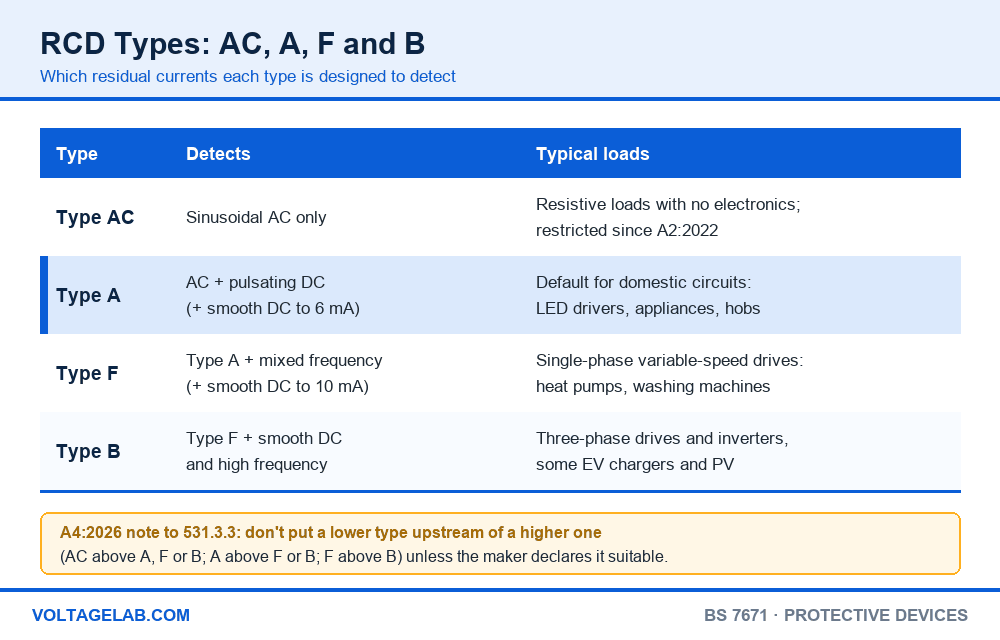
- Start from Type A. Type A suits almost every domestic circuit, and Regulation 531.3.3 restricts Type AC to fixed equipment known to have no DC component in its leakage.
- Check for single-phase variable-speed drives. Heat pumps and some modern washing machines use frequency inverters. Where the maker says so, use Type F.
- Check for smooth DC. Three-phase inverters, many EV chargers and some PV systems can leak smooth DC. Use Type B, or the arrangement the equipment maker specifies. An EV charger with its own 6 mA DC detection can sit behind Type A.
- Read the equipment instructions. Manufacturers state the RCD type their product needs. That instruction overrides your default.
- Check the devices in series. Under the A4:2026 note to 531.3.3, don’t put a lower type upstream of a higher one. That means no AC above A, F or B, no A above F or B and no F above B, unless the RCD maker declares the arrangement suitable.
- Check the direction marking. A4 notes that some RCCBs, RCBOs and AFDDs are unidirectional and marked line and load. Where a battery or PV can backfeed, use a bidirectional device.
The one that catches everyone: fitting a Type B RCBO for a heat pump or EV charger on a board whose main switch is a Type A or AC RCCB. The smooth DC leakage the Type B was chosen for passes straight through the upstream Type A or AC device and can saturate its core, so the upstream RCD may no longer trip on an ordinary fault. This is the “RCD blinding” that the A4:2026 note to Regulation 531.3.3 warns about. Feed the Type B circuit from a non-RCD way, or make sure everything upstream is rated for it.
Where BS 7671 requires an RCD, RCBO or AFDD
30 mA RCD additional protection is required for
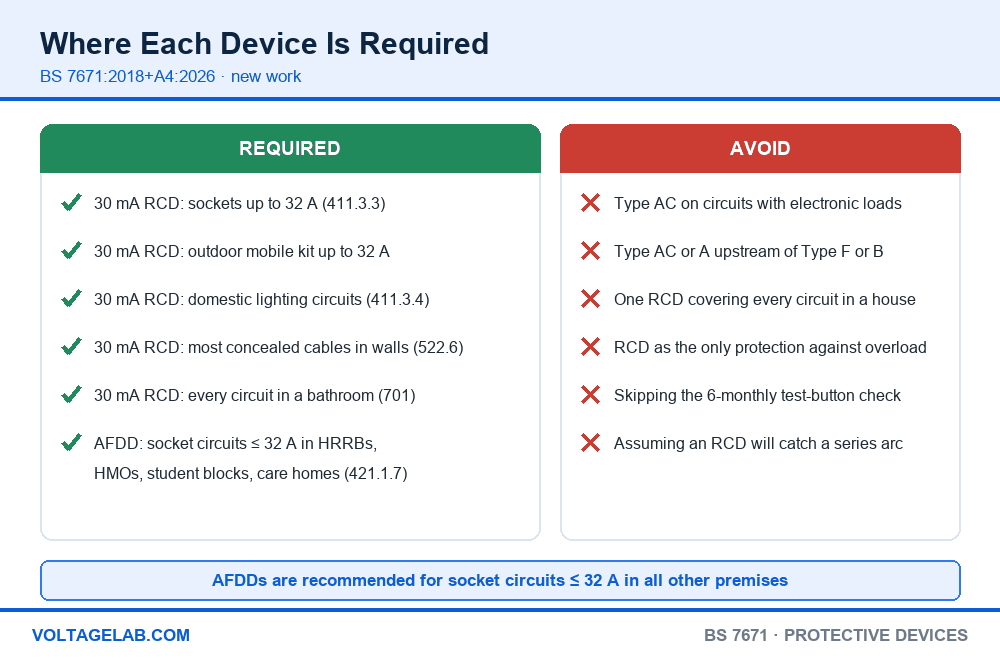
- Socket-outlets rated up to 32 A (Regulation 411.3.3). Outside dwellings, a documented risk assessment can justify leaving a specific socket out. In a dwelling it cannot.
- Mobile equipment rated up to 32 A for use outdoors (Regulation 411.3.3).
- AC final circuits supplying luminaires in domestic premises (Regulation 411.3.4).
- Cables concealed in walls and partitions under the conditions set out in Table 52.1, which A4:2026 introduced to bring the old 522.6.202 and 522.6.203 rules together. In practice, that covers most concealed cables in domestic walls.
- Every circuit of a room containing a bath or shower (Regulation 701.411.3.3), and the other special locations in Part 7 that call for it.
AFDDs are required for
Regulation 421.1.7 requires AFDDs to BS EN 62606 on single-phase AC final circuits supplying socket-outlets rated up to 32 A in:
- High-rise residential buildings. A4:2026 changed the wording from “higher risk” to “high-rise”. The new term broadly matches the building regulations’ “high rise domestic building”: a domestic building with any storey more than 18 m above the ground.
- Houses in multiple occupation (HMOs).
- Purpose-built student accommodation.
- Care homes.
In all other premises, including ordinary houses, AFDDs on those circuits are recommended rather than required. The rule is not retrospective. An existing installation without AFDDs is not non-compliant on that ground alone, and an EICR should not code it as a defect.
RCD board or RCBO board?
Regulation 314.1 asks you to divide an installation so that a single fault causes as little inconvenience and danger as possible. Regulation 531.3.2 also asks you to arrange RCDs so that normal protective conductor currents from many appliances don’t add up and cause unwanted tripping. A board with one or two RCDs covering every circuit meets the letter of the requirement for 30 mA protection, but a single tripping fridge takes out half the house. An all-RCBO board gives every circuit its own protection. It costs more but is easier to fault-find, and it is now the normal choice for a consumer unit change.
Consumer unit layouts compared
| Layout | What one earth fault trips | Arc protection | Cost | Where you see it |
|---|---|---|---|---|
| Single RCD main switch | Whole house | None | Low | Older TT installations; not good practice now |
| Split-load, dual RCD | Half the circuits | None | Low to moderate | Most boards from 2008 to about 2020 |
| All RCBO | That circuit only | None | Moderate | Most domestic board changes today |
| RCBO + AFDD on sockets | That circuit only | Socket circuits | Higher | HMOs, student blocks, care homes, high-rise flats |
| AFDD on every circuit | That circuit only | Every circuit | Highest | Timber-framed and heritage properties, by client choice |
For the MCB curve inside an RCBO, B, C or D, see our guide to the types of MCB, and for the breaker family as a whole, what a circuit breaker is and how it works. RCDs depend on a sound earth path to protect against indirect contact, which our article on the importance of earthing rules explains. Before you open a board to change a device, follow the safe isolation procedure.
Are AFDDs worth fitting where they are only recommended?
AFDDs: pros
- The only protection against series arcs from loose terminals and damaged flexes.
- Combined units replace the RCBO, so you don’t need extra board space.
- Many log the trip cause, which helps you find intermittent faults.
- Covers the circuits behind furniture where a fire starts unseen.
AFDDs: cons
- Several times the price of an RCBO per circuit.
- Some older appliances and tools with brushed motors can cause unwanted trips.
- Most models are wider than an RCBO, so they need more space in the enclosure.
On a standard house rewire, the honest answer is that AFDDs are a client choice. Explain what they detect and what they cost, and let the customer decide. Where the building is timber-framed, thatched, or holds sleeping occupants who may not escape quickly, recommend them firmly and record the advice on the certificate.
Testing and fitting RCDs, RCBOs and AFDDs in the field
Regulation 643.7.3 requires the effectiveness of every RCD providing fault protection or additional protection to be verified with an RCD tester at its rated residual operating current. A general-type 30 mA device should trip within 300 ms. The test button only checks the mechanism, not the trip time, and the label required by Regulation 514.12.2 tells the user to press it every six months. An AFDD also has a test button, and most run a self-test. Check the manufacturer’s instructions for any functional test it needs at commissioning.
Do
- Read the RCD type the equipment maker asks for before you choose a device.
- Connect the RCBO’s flying neutral or neutral terminal to the right circuit.
- Test each RCD at IΔn with a tester, not just the button.
- Fit the six-monthly test label at or near the board.
- Check line and load markings where there is a battery or PV.
Avoid
- Borrowing a neutral from another circuit, which trips RCBOs at random.
- Fitting Type AC on any new circuit with electronic loads.
- Putting a Type B circuit behind a Type A or AC main RCD.
- Leaving any circuit on an RCCB without an MCB.
- Insulation testing through an AFDD or RCBO without checking the maker’s advice.
Keep the device rules in your pocket
VoltageLab: Electrician App has BS 7671 lessons on protective devices and a Quick Reference section covering RCD types, ratings, trip times and the regulations that call for 30 mA protection, so you can check them on site. Choose BS 7671 as your standard when you open it.
Frequently asked questions
What is the difference between an RCD and an RCBO?
An RCD (RCCB) only trips on earth leakage and usually protects several circuits. An RCBO also trips on overload and short circuit and protects a single circuit, so it replaces both the RCD and the MCB for that circuit.
Does an AFDD replace an RCBO?
A combined AFDD-RCBO does, because it contains arc detection, residual current protection and overcurrent protection in one device. A standalone AFDD module does not, and must be paired with an RCBO or MCB plus RCD.
Are AFDDs mandatory in the UK?
Only on socket-outlet circuits up to 32 A in high-rise residential buildings, HMOs, purpose-built student accommodation and care homes, under Regulation 421.1.7. In other premises they are recommended, and the rule does not apply retrospectively to existing installations.
Can I still use a Type AC RCD?
Only for fixed equipment where you know the leakage current has no DC component. Most domestic circuits now include LED drivers or electronic appliances, so Type A is the normal choice, and Type AC should never sit upstream of a Type A, F or B device.
Why does my RCD keep tripping?
The usual causes are a genuine earth fault in an appliance or circuit, moisture in an outdoor accessory, a neutral-earth fault, or too many appliances’ normal leakage adding up on one RCD. Unplug everything, reset, and add loads back one at a time. If it trips with everything unplugged, insulation test the fixed wiring.
What does 30 mA mean on an RCD?
It is the rated residual operating current, IΔn. The device must trip when the difference between line and neutral current reaches 30 mA. That level is low enough to give additional protection against a fatal shock, which is why 30 mA is the value BS 7671 specifies for additional protection in Regulation 415.1.1.
How often should an RCD be tested?
The user should press the test button every six months, as the label at the board says. An electrician tests it with an RCD tester at installation, and again at each periodic inspection and on any EICR.
The bottom line
Each device answers a different fault. The RCD covers earth leakage and shock. The RCBO adds overload and short circuit, one circuit at a time. The AFDD adds the arcing faults that start fires without ever raising the current. That is why a modern board usually has RCBOs throughout and AFDDs on the socket circuits where the regulations or the client call for them.
Two decisions matter most on any job. Choose the RCD type from the loads, not from habit, and never put a lower type upstream of a higher one. Then lay the board out so a single fault trips a single circuit. Before you work on any of it, run through the safe isolation procedure, and for why the earth path decides whether an RCD can protect anyone, see grounding and bonding essentials.