


Open a motor control center bucket and the device on the line side looks exactly like a breaker. Molded case, three poles, a toggle you can rack out. But there is a dial on the front, the label says MCP instead of an amp rating you recognise, and nothing about it is stamped with an interrupting rating. Put that same device in a lighting panel and you have created a code violation and a fire hazard in one move.
That confusion costs people money. An MCP and an ordinary molded-case circuit breaker share a housing and almost nothing else. One of them protects a motor from overload. The other will happily let a jammed motor cook itself until the windings let go, because it was never built to notice.
Study smarter with VoltageLab
Built for electricians, apprentices, and electrical engineers who want faster practice and better exam prep.
⭐️ Join thousands of electricians upgrading their skills
This guide covers what a motor circuit protector actually is, the four differences that separate it from a circuit breaker, how NEC Table 430.52(C)(1) sets its ceiling, where the Code permits it, and the single installation mistake that fails more motor-circuit inspections than any other.
Quick Answer
A motor circuit protector (MCP) is an instantaneous-trip circuit breaker with a magnetic trip element only and no thermal element. It clears short circuits and ground faults on a motor branch circuit and does nothing else. A standard circuit breaker has both a magnetic element and an inverse-time thermal element, so it responds to sustained overload as well as to faults.
The practical consequence is that an MCP is never a complete device. NEC 430.52(C)(3) permits it only where the trip is adjustable and the MCP is part of a listed combination motor controller that also carries coordinated overload protection in each conductor. Buy it as a starter, not as a breaker.
Key Takeaways
- An MCP is magnetic-only: it senses fault current instantly and ignores overload entirely
- A standard inverse-time breaker carries a thermal element, which is what gives it overload protection
- NEC 430.52(C)(3) allows an MCP only if it is adjustable and part of a listed combination motor controller
- The overload relay next to the MCP is what satisfies NEC 430.32 — the MCP never does
- Table 430.52(C)(1) caps an instantaneous-trip device at 800% of full-load current for most motors, 1100% for Design B energy-efficient motors
- Where starting current demands it, 430.52(C)(3) permits 1300%, or 1700% on Design B energy-efficient motors — and no further
- MCPs are UL recognized components, not UL 489 listed breakers, and carry no standalone interrupting rating
What a motor circuit protector actually is
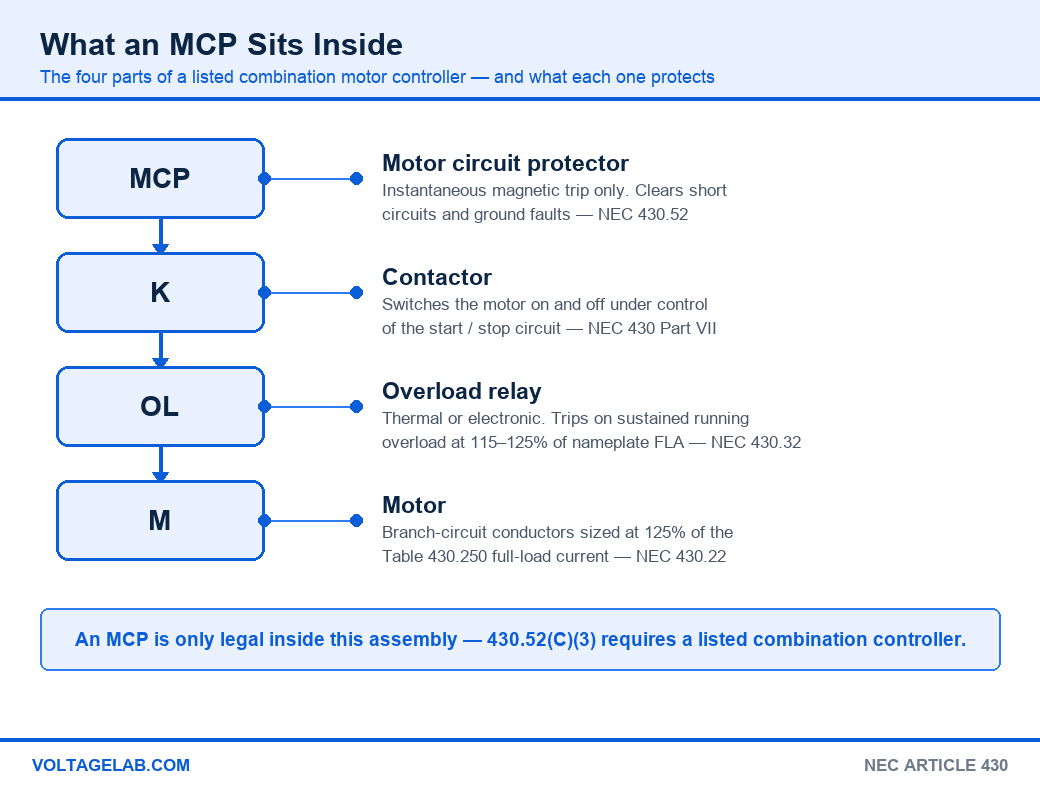
A motor circuit protector is one quarter of a motor starter. Four components sit in series between the feeder and the motor, and each one has a job the others cannot do:
Pass your electrical exam the first time
Practice real NEC exam questions with full code-referenced explanations and progress tracking — built for journeyman, master and apprentice exam prep.
Thousands of NEC practice questions with code-referenced answers
- The MCP. An adjustable magnetic trip in each pole. It opens in milliseconds on a bolted fault or a ground fault, which is what protects the conductors and the starter from a short circuit.
- The contactor. The switching element. A magnetic contactor makes and breaks the motor current under command of the control circuit, thousands of times over its life.
- The overload relay. A thermal or electronic element that models the motor’s heating curve. It trips on the slow, sustained overcurrent that an MCP cannot see.
- The motor. Fed by conductors sized at 125% of the table full-load current under NEC 430.22.
Split that way, the logic is obvious. A motor draws six to eight times its running current every time it starts, for a second or two. A device sensitive enough to protect against overload would trip on every start. A device set high enough to ride through the start cannot see an overload at all. So the Code lets you use two devices instead of one, each tuned to the thing it is good at.
MCP, MCCB, MMP, MSCP — decoding the acronyms
- MCP — Motor Circuit Protector. Instantaneous trip only, adjustable, used inside a listed combination controller. The subject of this article.
- MCCB — Molded Case Circuit Breaker. The ordinary inverse-time breaker: thermal plus magnetic, UL 489 listed, legal on its own.
- MCB — Miniature Circuit Breaker. The small DIN-rail or panel breaker. Our guide to the types of MCB circuit breaker covers the B, C and D curves.
- MMP — Manual Motor Protector. A manually operated controller with both magnetic and overload elements, common in control panels.
- MSCP — Motor Short-Circuit Protector. A fuse-like device permitted under NEC 430.52(C)(7), again only as part of a listed combination controller.
Manufacturers add their own trade names on top of this — Mag-Gard, HMCP and others — but every one of them is the same animal: an instantaneous-trip breaker sold to be assembled into a starter.
MCP vs circuit breaker — the differences that matter
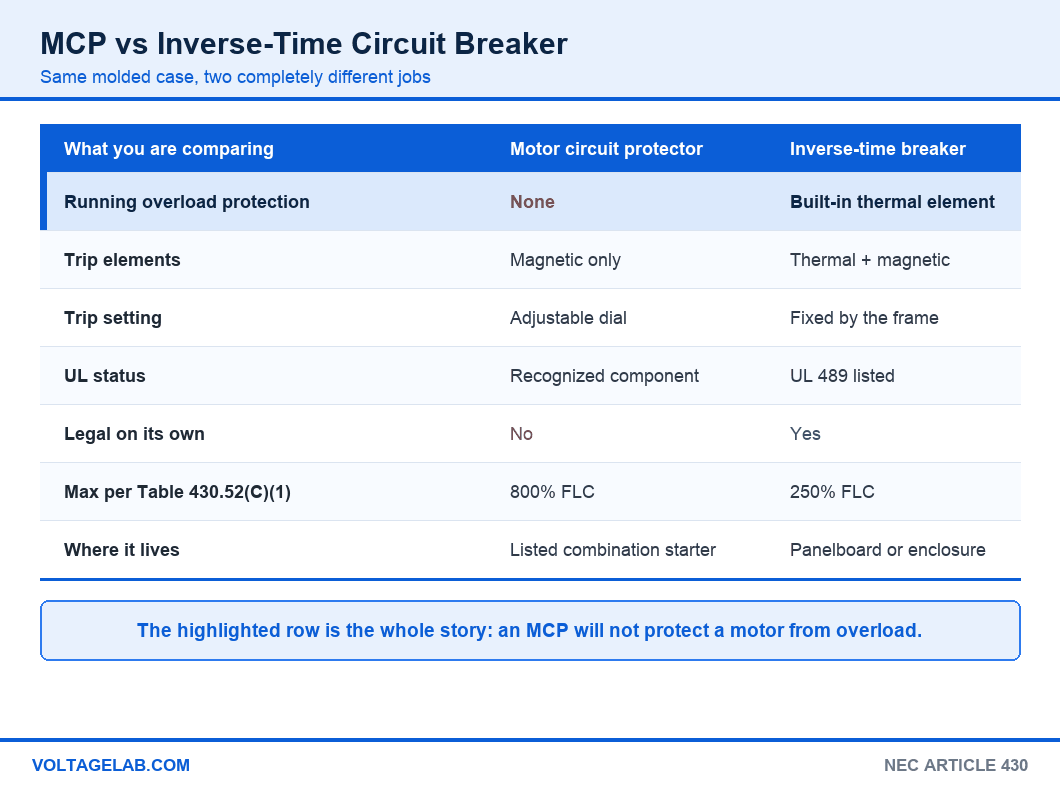
Put the two devices side by side and the differences are not matters of degree. They are differences of kind:
| What you are comparing | Motor circuit protector | Inverse-time circuit breaker |
|---|---|---|
| Running overload protection | None — separate relay required | Built into the thermal element |
| Trip elements | Magnetic only | Thermal and magnetic |
| Trip setting | Field-adjustable dial, required by 430.52(C)(3) | Fixed by the frame rating |
| UL status | Recognized component | UL 489 listed |
| Legal as a standalone device | No | Yes |
| Max per Table 430.52(C)(1) | 800% of FLC | 250% of FLC |
| Fault rating on the label | None — the assembly carries an SCCR | Its own interrupting rating |
The last row is the one engineers miss. An MCP is short-circuit tested in combination with a specific controller and overload relay, so it has no interrupting rating of its own. The short-circuit current rating belongs to the assembled starter, and swapping in a different contactor or relay voids it.
The trap that fails inspections: buying an MCP, a contactor and an overload relay as three loose parts and bolting them into an enclosure. That is a field-assembled starter, not a listed combination motor controller, and NEC 430.52(C)(3) does not permit an instantaneous-trip breaker in it. The combination has to arrive as a listed assembly, or be built from a manufacturer’s published combination that carries the listing. An MCP dropped into a panelboard as a general-purpose breaker is the same violation in a more obvious costume.
Sizing an MCP — NEC Table 430.52(C)(1) and the 1300% ceiling
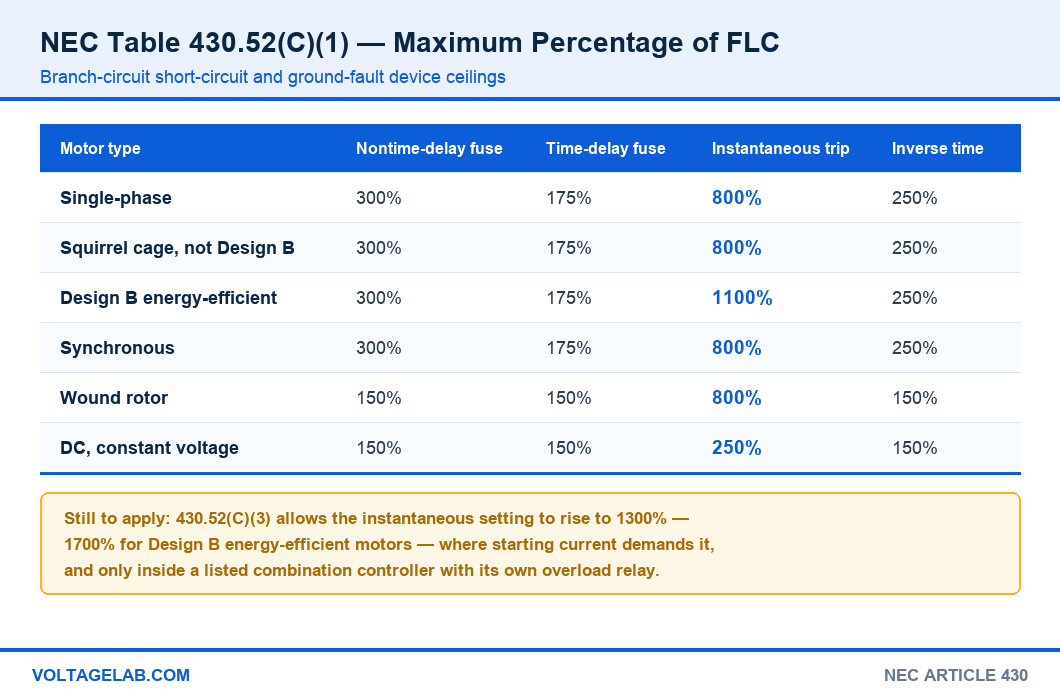
Every motor branch-circuit protective device is sized as a percentage of full-load current, and the percentage depends on both the device type and the motor type. Note the word maximum: Table 430.52(C)(1) is a ceiling, not a target.
| Motor type | Nontime-delay fuse | Time-delay fuse | Instantaneous trip breaker | Inverse time breaker |
|---|---|---|---|---|
| Single-phase | 300% | 175% | 800% | 250% |
| AC polyphase squirrel cage, other than Design B | 300% | 175% | 800% | 250% |
| Design B energy-efficient | 300% | 175% | 1100% | 250% |
| Synchronous | 300% | 175% | 800% | 250% |
| Wound rotor | 150% | 150% | 800% | 150% |
| Direct current, constant voltage | 150% | 150% | 250% | 150% |
The five-step method
Step 1 — get the full-load current from the table, not the nameplate. NEC 430.6(A)(1) requires you to use the values in Tables 430.247 through 430.250 when sizing conductors and branch-circuit protection. Our walkthrough of NEC Table 430.250 full-load currents for three-phase motors covers the table itself. The nameplate value is used for overload sizing only, under 430.6(A)(2).
Step 2 — identify the motor type. Design B energy-efficient motors get the 1100% column instead of 800%. The design letter is printed on the motor nameplate, and if it is not there, you do not have a Design B motor for Code purposes.
Step 3 — multiply. A 25 hp, 460 V, three-phase squirrel-cage motor has a table full-load current of 34 amps. At 800%, the instantaneous trip may be set as high as 272 amps.
Step 4 — set the dial as low as the motor will tolerate. Start well below the ceiling, start the motor, and raise the setting only if it trips on inrush. A setting that rides through the start with the least margin gives you the fastest fault clearing.
Step 5 — raise it only under the exception, and check the manufacturer’s table. Where 800% is genuinely not enough for the starting current, 430.52(C)(3) permits the setting to be increased to no more than 1300% of full-load current, or 1700% for Design B energy-efficient motors. Then read 430.52(C)(2): where the controller manufacturer’s overload relay table shows a maximum branch-circuit device rating, that lower number governs, even though the Code table would allow more.
The one that catches everyone: the number printed on the MCP is its continuous current rating, not its trip point. A 50 A MCP does not trip at 50 amps — the dial sets the magnetic trip somewhere in a range that may run to several hundred amps. Sizing the MCP as if that printed number were a breaker size produces a device that is far too small for the motor, and an installer who then winds the dial to maximum to stop the tripping. Pick the frame from the motor’s full-load current, then set the dial by calculation.
Study smarter with VoltageLab
Built for electricians, apprentices, and electrical engineers who want faster practice and better exam prep.
⭐️ Join thousands of electricians upgrading their skills
Where an MCP is permitted — and where it is not
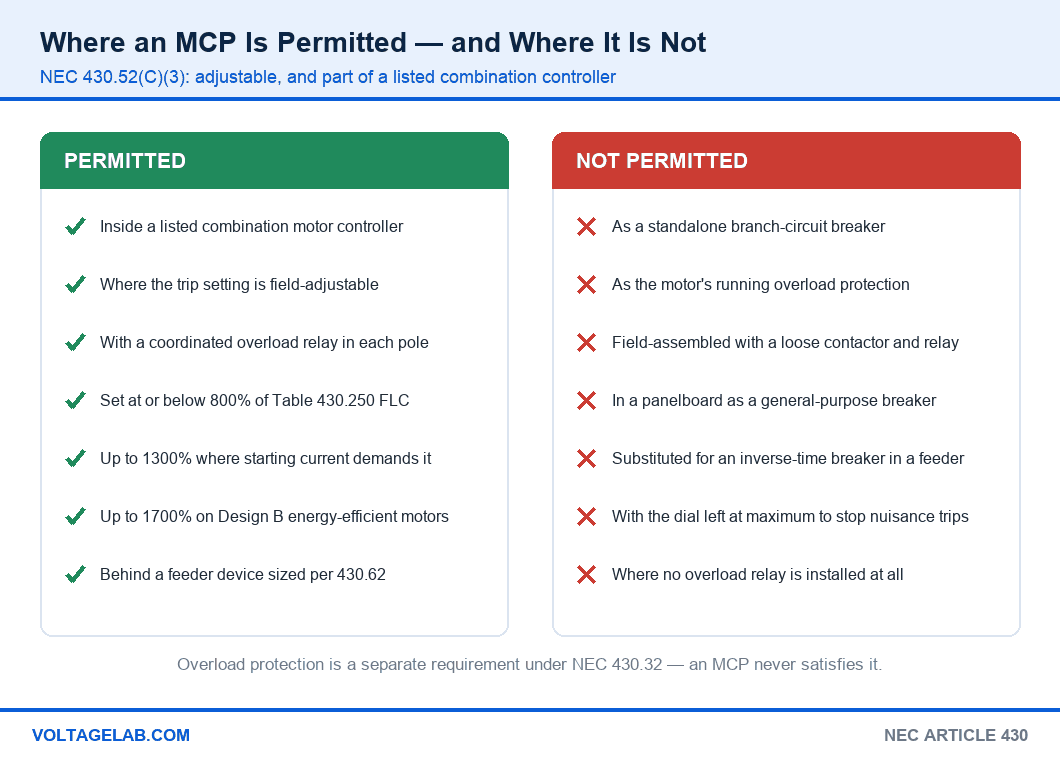
The permission in 430.52(C)(3) is unusually narrow. Three conditions have to be true at once: the breaker is adjustable, it is part of a listed combination motor controller, and that controller provides coordinated overload and short-circuit and ground-fault protection in each conductor.
Permitted
- Inside a listed combination motor controller — an MCC bucket or a factory-listed combination starter
- Where the magnetic trip is field-adjustable and has actually been set
- With a coordinated overload relay providing protection in each conductor
- Set at or below 800% of the table full-load current for most motors, 1100% for Design B energy-efficient
- Up to 1300%, or 1700% on Design B energy-efficient motors, where the starting current genuinely requires it
- As the motor’s disconnecting means under 430.109(A)(6), but only because it is part of that listed combination controller
Not permitted
- As a standalone branch-circuit breaker anywhere
- As the motor’s running overload protection — that is a separate requirement
- Field-assembled from a loose MCP, contactor and relay
- In a panelboard serving general-purpose circuits
- As the feeder device protecting several motors
- With the dial wound to maximum as a cure for nuisance tripping
Sizing the overload relay that sits beside it
Because the MCP contributes nothing here, the overload relay carries the entire burden of NEC 430.32. For a continuous-duty motor rated more than 1 hp with a separate overload device, 430.32(A)(1) sets the trip at not more than 125% of the nameplate full-load amperes where the motor has a marked service factor of 1.15 or higher, or a marked temperature rise of 40 °C or less. Every other motor gets 115%. Note the switch back to the nameplate: branch-circuit sizing uses the Code tables, overload sizing uses the motor in front of you.
MCP vs the other ways to protect a motor branch circuit
| Option | Overload included? | Adjustable? | Standalone? | Code basis |
|---|---|---|---|---|
| Motor circuit protector | No | Yes — required | No | 430.52(C)(3) |
| Inverse-time breaker | Yes | Usually not | Yes | Table 430.52(C)(1) |
| Dual-element time-delay fuse | Partial, if sized for it | No | Yes | Table 430.52(C)(1) |
| Self-protected combination controller | Yes | Yes | Yes, one motor | 430.52(C)(6) |
| Motor short-circuit protector | No | No | No | 430.52(C)(7) |
The self-protected combination controller — the Type E starter — is the closest thing to an all-in-one device. It combines an adjustable magnetic trip with an adjustable overload in one listed package and is permitted in place of the devices in Table 430.52(C)(1), but only on a single motor circuit.
If you are comparing fuses instead, our guide to the types of fuse and their characteristics explains why a dual-element fuse rides through inrush where a nontime-delay fuse will not. And if you are weighing a soft start or a drive against across-the-line starting, inverters, star-delta and soft starters compares the starting methods directly.
Is an MCP the right choice for your motor circuit?
Pros
- Adjustable trip lets you tune the setting to the actual motor rather than the frame
- Clears bolted faults in milliseconds, limiting damage to the starter and conductors
- Far more compact than a fused disconnect of equivalent capability
- No fuses to stock, and resettable after a fault is cleared
- Serves as the disconnecting means under 430.109(A)(6) within the listed controller
Cons
- Useless on its own — no overload protection whatsoever
- Legal only inside a listed combination controller, which limits your sourcing
- The adjustable dial invites the wrong fix when a motor trips on start
- No standalone interrupting rating, so substituting parts voids the assembly’s SCCR
Working with MCPs in the field
Do
- Calculate the ceiling from Table 430.52(C)(1) before you touch the dial
- Use the Code table full-load current for the MCP and the nameplate FLA for the overload
- Check the manufacturer’s overload relay table for a lower maximum under 430.52(C)(2)
- Record the final dial setting on the starter and in the panel schedule
- Verify the assembly’s short-circuit current rating against the available fault current
Avoid
- Treating the MCP’s printed amp rating as a trip point
- Building a starter from loose parts and calling it a combination controller
- Winding the dial to maximum to stop a motor tripping on start
- Swapping the contactor or overload relay for a different brand
- Assuming the MCP covers overload because it looks like a breaker
Frequently asked questions
What is a motor circuit protector?
An instantaneous-trip circuit breaker with an adjustable magnetic trip element and no thermal element. It provides short-circuit and ground-fault protection for a motor branch circuit, and NEC 430.52(C)(3) permits it only as part of a listed combination motor controller.
What is the difference between an MCP and a circuit breaker?
A standard circuit breaker has a thermal element and a magnetic element, so it protects against both overload and short circuit and is legal on its own. An MCP has the magnetic element only, offers no overload protection, and must be installed inside a listed combination controller with a separate overload relay.
Can a motor circuit protector be used as a regular breaker?
No. It is a UL recognized component rather than a UL 489 listed breaker, it carries no standalone interrupting rating, and 430.52(C)(3) restricts it to a listed combination motor controller. Installing one in a panelboard is a violation.
Does an MCP provide overload protection?
No. Overload protection is a separate requirement under NEC 430.32 and is provided by the overload relay in the starter, set at 115% or 125% of the motor’s nameplate full-load amperes depending on its service factor and temperature rise.
What percentage of FLC can an instantaneous-trip breaker be set to?
Table 430.52(C)(1) allows up to 800% of full-load current for most motors and 1100% for Design B energy-efficient motors. Where that is not enough for the starting current, 430.52(C)(3) permits an increase to 1300%, or 1700% on Design B energy-efficient motors.
Can an MCP be the motor disconnecting means?
Yes. NEC 430.109(A)(6) recognises an instantaneous-trip circuit breaker as a disconnecting means, but only where it is part of a listed combination motor controller — the same condition that governs its use as a protective device.
Why does my motor trip the MCP on starting?
Because the magnetic trip is set below the motor’s inrush current. Raise the setting in steps, staying within the Table 430.52(C)(1) ceiling and the 430.52(C)(3) exception, and check the manufacturer’s overload relay table for a lower limit. If the motor draws more than expected, the mechanical load or the motor itself may be the problem rather than the setting — our guide to why a circuit breaker keeps tripping covers the diagnosis.
Is a manual motor protector the same as an MCP?
No. A manual motor protector includes an overload element as well as a magnetic trip, which an MCP does not. Whether an MMP can stand alone depends on how it is listed, so check the marking rather than assuming.
The bottom line
A motor circuit protector earns its place because a motor asks two contradictory things of its protection: ride through six to eight times running current on every start, and open instantly on a fault. An MCP does the second job properly precisely because it has been relieved of the first. The adjustable dial then lets you set the trip for the motor actually installed rather than accepting whatever a fixed breaker frame gives you.
Two restraints keep you out of trouble. Never install an MCP outside a listed combination motor controller, and never let the amp rating printed on the case pass for a trip point. Calculate the ceiling from Table 430.52(C)(1), set the dial as low as the motor tolerates, and let the overload relay do the job the MCP was never built for. For the branch-circuit sizing that sits underneath all of this, start with NEC Table 430.250 full-load currents.
FREE PRACTICE TOOL
Think you'd pass this on a real exam?
Test what you just read with instant-feedback quizzes built around real code questions — not generic trivia.
5
Code standards
10,000+
Active learners
100%
Free to start
Instant explanations on every answer, right or wrong
NEC, BS7671, AS/NZS, CEC, and DIN VDE covered
Bite-sized quizzes you can finish in 5 minutes
No signup required to try your first quiz
No account needed · Takes less than 2 minutes