


Walk into a laundry room in a house built before 1970 and you will usually find one receptacle behind the washer, fed off the same circuit as the hallway lights and a bedroom. It worked, right up until somebody put a second-hand dryer next to the washer and started tripping the breaker every Sunday. The fix is not a bigger breaker. It is the circuit the Code has required since long before that dryer showed up.
Laundry trips people up because there are two separate questions hiding inside one word. The laundry circuit is a specific 20-amp circuit the NEC requires in every dwelling unit. The dryer circuit is a different animal entirely — 240 volts, 30 amps, its own receptacle — and the Code never lets the two share. Homeowners and more than a few electricians treat “dedicated laundry circuit” as one thing.
Study smarter with VoltageLab
Built for electricians, apprentices, and electrical engineers who want faster practice and better exam prep.
⭐️ Join thousands of electricians upgrading their skills
This guide covers what NEC 210.11(C)(2) and 210.52(F) actually require, how the washer, electric dryer and gas dryer differ, how to size each circuit, where GFCI and AFCI apply after the recent code changes, and the wiring mistake that fails laundry rough-in inspections.
Quick Answer
A dedicated laundry circuit is required by NEC 210.11(C)(2): at least one additional 20-ampere branch circuit supplying the laundry receptacle outlet(s) required by 210.52(F), and that circuit is permitted to have no other outlets. A washer and a gas dryer may both plug into it. Lights, a bathroom receptacle or anything outside the laundry area may not.
An electric dryer is a separate circuit entirely — 120/240 volts, a 30-amp two-pole breaker, 10 AWG copper and a four-wire NEMA 14-30R receptacle. It cannot share the 20-amp laundry circuit, so in practice it always lands on an individual branch circuit of its own.
Key Takeaways
- NEC 210.11(C)(2) requires at least one 20-amp laundry branch circuit in every dwelling unit, with no outlets outside the laundry area
- NEC 210.52(F) requires at least one receptacle outlet in the area designated for laundry equipment
- The washer does not need a circuit to itself — it may share the laundry circuit with a gas dryer
- An electric dryer needs 30 amps at 120/240 volts on 10 AWG copper, which no 20-amp circuit can supply
- New dryer circuits are four-wire with a NEMA 14-30R receptacle; the three-wire 10-30R survives only on existing installations under the 250.140 exception
- Laundry-area receptacles need GFCI under 210.8(A)(10), and the 2023 NEC added clothes dryers to the appliance list in 210.8(D)
- The 120-volt laundry circuit also needs AFCI protection, so a dual-function breaker is the usual answer
What the NEC actually requires in a laundry area
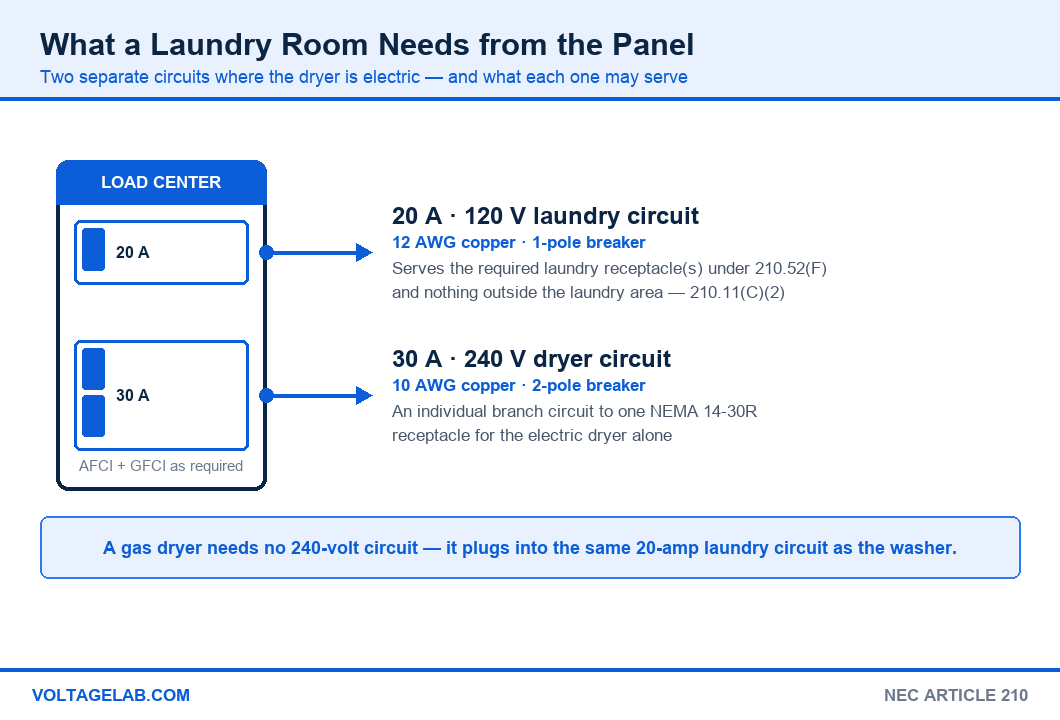
Two sections do the work, and they point at each other. Read either one alone and you get half the rule.
Pass your electrical exam the first time
Practice real NEC exam questions with full code-referenced explanations and progress tracking — built for journeyman, master and apprentice exam prep.
Thousands of NEC practice questions with code-referenced answers
- 210.52(F) — Laundry Areas. In dwelling units, at least one receptacle outlet shall be installed in areas designated for the installation of laundry equipment. This is the outlet requirement.
- 210.11(C)(2) — Laundry Branch Circuits. At least one additional 20-ampere branch circuit shall be provided to supply the laundry receptacle outlet(s) required by 210.52(F). This circuit shall have no other outlets. This is the circuit requirement.
The word additional matters. The laundry circuit is on top of the general lighting and receptacle circuits, not carved out of them. And no other outlets is the phrase that gets violated most often — it means the circuit serves the laundry receptacles and stops there.
What “dedicated” does and does not mean here
People use “dedicated circuit” to mean two different things, and the NEC only recognises one of them. An individual branch circuit, defined in Article 100, supplies only one piece of utilization equipment. The laundry circuit is not that — it can feed several receptacles and more than one appliance. What it is, is a circuit restricted by location: nothing outside the laundry area may be connected to it. Our breakdown of general purpose, appliance and individual branch circuits covers the distinction, and NEC Article 210 covers how branch circuits are rated.
So you may put the washer and a gas dryer on the laundry circuit. You may put two or three receptacles on it. You may not put the laundry room light, the hall receptacle or the bathroom fan on it — and that last one is the mistake inspectors find.
When the laundry receptacle is not required at all
210.52(F) carries exceptions. In a dwelling unit within a multifamily building where laundry facilities are provided on the premises and available to all occupants, the in-unit laundry receptacle is not required. There is also relief in other than one-family dwellings where laundry facilities are not to be installed or permitted. Outside those cases, every dwelling unit gets the circuit and the receptacle — including units where the owner has no intention of putting a washer in.
Washer vs electric dryer vs gas dryer
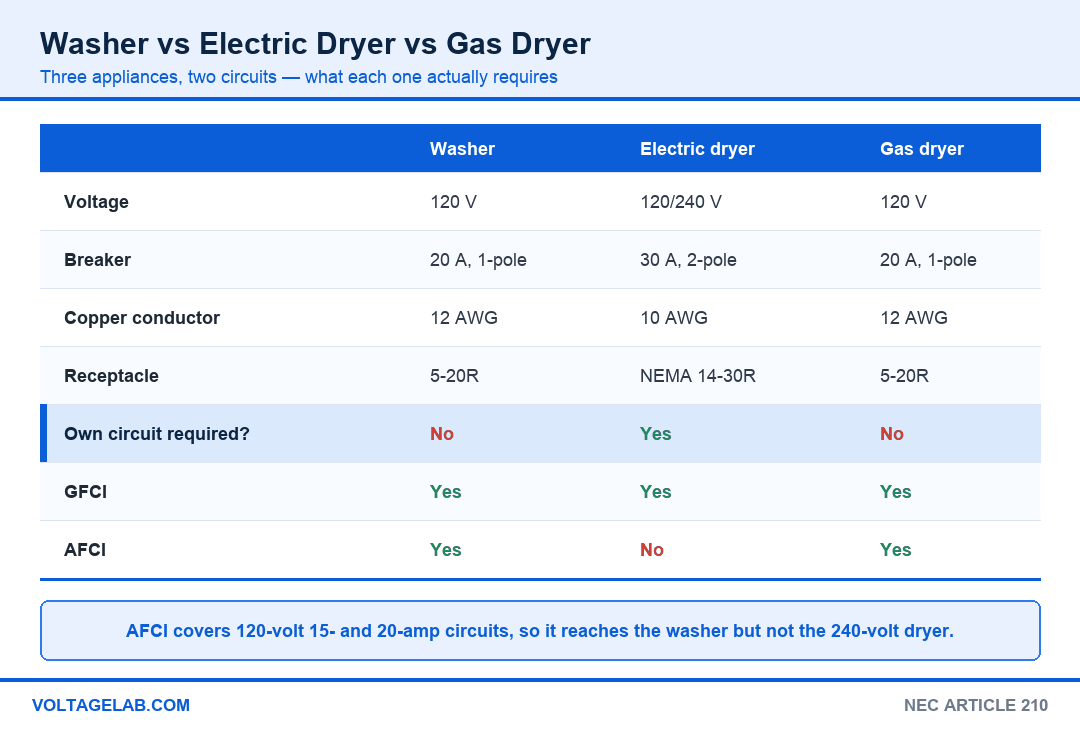
Three appliances, two circuits. Which two depends entirely on how the dryer makes heat:
| Requirement | Washer | Electric dryer | Gas dryer |
|---|---|---|---|
| Voltage | 120 V | 120/240 V | 120 V |
| Breaker | 20 A, single pole | 30 A, two pole | 20 A, single pole |
| Copper conductor | 12 AWG | 10 AWG | 12 AWG |
| Receptacle | 5-20R | NEMA 14-30R | 5-20R |
| Circuit of its own? | No — shares the laundry circuit | Yes, in practice | No — shares the laundry circuit |
| GFCI | Yes | Yes | Yes |
| AFCI | Yes | No — 240 V | Yes |
The electric dryer row is the one worth reading twice. The NEC has no sentence reading “a clothes dryer shall have a dedicated circuit.” It gets there by elimination: the laundry circuit is 20 amps and may serve no other outlets, a 30-amp 240-volt load cannot live on it, and nothing else in a dwelling wants a 30-amp 240-volt receptacle. The dryer ends up alone on its own branch circuit because there is nowhere else for it to go.
The trap that fails inspections: picking up the laundry room light, the ceiling fan or a nearby bathroom receptacle from the laundry circuit because the cable is right there. NEC 210.11(C)(2) says that circuit “shall have no other outlets,” and a lighting outlet is an outlet. The same applies in reverse — do not feed the laundry receptacle from a bedroom circuit to save a home run. Both versions are cheap to avoid at rough-in and expensive to fix after drywall.
Sizing the circuits — conductors, breakers and receptacles
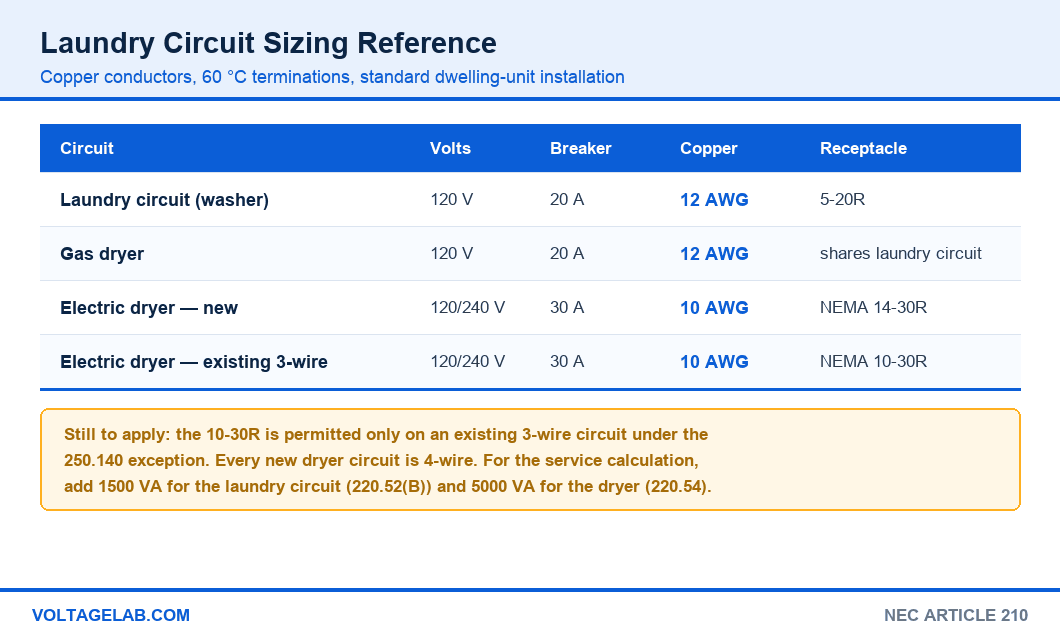
Both circuits are ordinary branch circuits, so the sizing is conventional. What changes is the receptacle and the number of conductors.
| Circuit | Volts | Breaker | Copper conductor | Receptacle |
|---|---|---|---|---|
| Laundry circuit (washer) | 120 V | 20 A | 12 AWG | 5-20R |
| Gas dryer | 120 V | 20 A | 12 AWG | Shares the laundry circuit |
| Electric dryer — new installation | 120/240 V | 30 A | 10 AWG | NEMA 14-30R (4-wire) |
| Electric dryer — existing 3-wire | 120/240 V | 30 A | 10 AWG | NEMA 10-30R (existing only) |
The four-step method
Step 1 — run the laundry circuit first. A 20-amp home run in 12/2 with ground, landing on a single-pole breaker. Terminate it on the laundry receptacle or receptacles and nothing else. Receptacle placement follows the general rules in NEC 210.52 — and behind a washer, put it where you can still reach the plug.
Step 2 — decide the receptacle type. A single receptacle on an individual 20-amp branch circuit must be rated 20 amps. Where the circuit supplies two or more receptacles, NEC 210.21(B)(3) permits 15-amp or 20-amp receptacles, so a standard 5-15R duplex is legal on a 20-amp laundry circuit with more than one outlet. Our guide to how many outlets go on a 20-amp circuit covers the counting.
Step 3 — run the dryer circuit if the dryer is electric. 10/3 with ground, two hots, a neutral and an equipment grounding conductor, on a 30-amp two-pole breaker. The neutral is genuinely needed: the drum motor, timer and controls run at 120 volts while the heating element runs at 240.
Step 4 — set the receptacle to match. NEMA 14-30R for anything new. Under NEC 250.140, the frame of a clothes dryer must be connected to an equipment grounding conductor, with an exception that lets existing three-wire branch-circuit installations continue to use the grounded conductor for that job. That exception covers what is already in the wall — it does not authorise a new three-wire circuit.
Study smarter with VoltageLab
Built for electricians, apprentices, and electrical engineers who want faster practice and better exam prep.
⭐️ Join thousands of electricians upgrading their skills
The one that catches everyone: the 240-volt dryer circuit now needs GFCI protection, and a lot of people have not caught up. The 2020 NEC rewrote 210.8(A) to cover “125-volt through 250-volt receptacles” supplied by single-phase circuits rated 150 volts or less to ground — which captures a 14-30R dryer receptacle in a laundry area, because each leg is 120 volts to ground. The 2023 NEC then added clothes dryers to the appliance list in 210.8(D), closing the gap for hardwired units. Check which edition your jurisdiction has adopted before you quote the job, because a two-pole 30-amp GFCI breaker is not a cheap part.
GFCI and AFCI in the laundry area
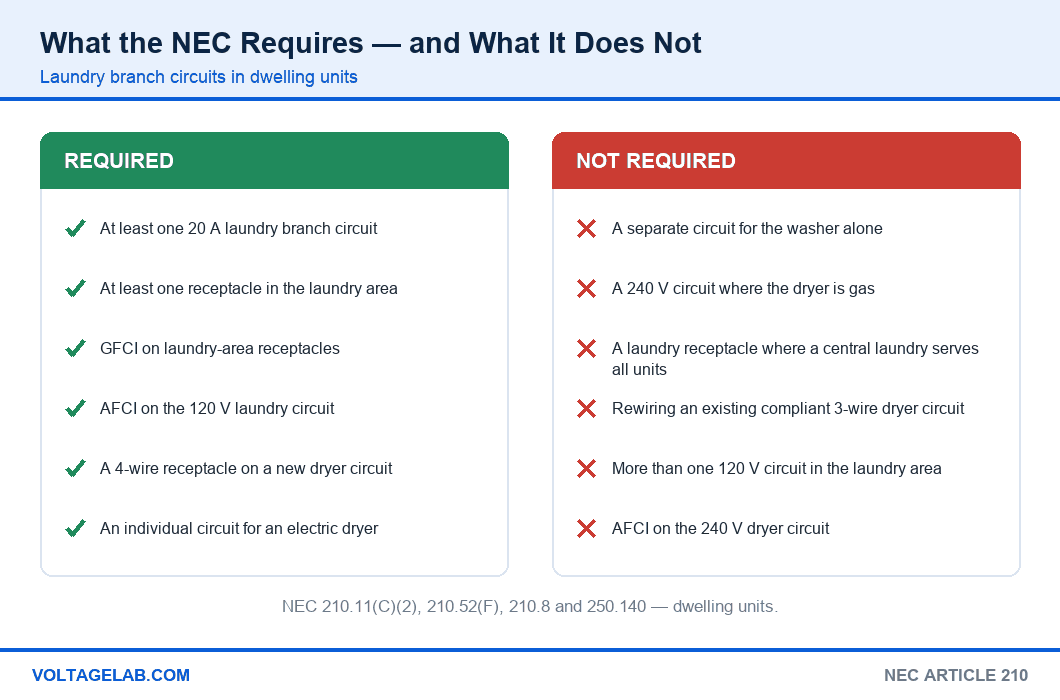
Laundry areas now attract both kinds of protection, from two different sections that do not line up neatly. GFCI follows the receptacle and the appliance. AFCI follows the circuit voltage and rating.
Required
- At least one 20-amp laundry branch circuit per dwelling unit — 210.11(C)(2)
- At least one receptacle outlet in the laundry area — 210.52(F)
- GFCI protection on laundry-area receptacles — 210.8(A)(10)
- GFCI protection for a clothes dryer as a listed appliance — 210.8(D), 2023 NEC onward
- AFCI protection on 120-volt, single-phase, 15- and 20-amp circuits in laundry areas — 210.12
- A four-wire receptacle and an equipment grounding conductor on any new dryer circuit — 250.140
Not required
- A separate circuit for the washer by itself
- Any 240-volt circuit where the dryer is gas
- An in-unit laundry receptacle where a central laundry serves all occupants of a multifamily building
- Rewiring an existing, compliant three-wire dryer circuit that is not being disturbed
- More than one 120-volt circuit in the laundry area
- AFCI on the 240-volt dryer circuit, which falls outside the 120-volt scope of 210.12
Because the 120-volt laundry circuit needs both, a dual-function AFCI/GFCI breaker is the practical answer — one device, one slot. Our comparison of GFCI vs AFCI protection explains what each one is actually watching for, and they are not the same hazard.
Adding laundry to the service calculation
Both circuits show up in the dwelling service calculation, with fixed values rather than measured loads. NEC 220.52(B) requires 1500 VA for each two-wire laundry branch circuit. NEC 220.54 requires 5000 watts, or the nameplate rating if it is larger, for each household electric clothes dryer, with the demand factors of Table 220.54 available where there are several. For a single-family home with one dryer, no demand factor applies and you carry the full 5000 VA. If you are checking whether the service can absorb a new dryer alongside other additions, our walkthrough of calculating your home’s electrical load sets out the method.
How laundry compares to other dedicated-circuit appliances
| Appliance | Typical circuit | Receptacle | Circuit to itself? | Code basis |
|---|---|---|---|---|
| Washer | 20 A, 120 V | 5-20R | No | 210.11(C)(2) |
| Electric dryer | 30 A, 120/240 V | 14-30R | Yes | 220.54, 250.140 |
| Electric range | 40–50 A, 120/240 V | 14-50R | Yes | 220.55, 250.140 |
| Refrigerator | 15–20 A, 120 V | 5-15R / 5-20R | Not required | 210.52(B) |
| EV charger | 40–60 A, 240 V | 14-50R or hardwired | Yes | Article 625 |
The dryer and the range are the two appliances in a typical home that pull 240 volts through a cord and plug, which is why they share the four-wire grounding rule in 250.140. If you are wiring the range side as well, our guide to the NEMA 14-50 outlet covers the larger cousin of the 14-30R. And for the appliance people most often assume needs its own circuit but does not, see whether a refrigerator needs a dedicated circuit.
Is a separate washer circuit worth running anyway?
The Code lets a washer and a gas dryer share the laundry circuit. Plenty of electricians run them separately regardless. Here is the honest trade-off:
Pros
- A gas dryer’s motor and igniter no longer share a circuit with the washer’s motor
- A nuisance trip takes out one appliance instead of the whole laundry
- Troubleshooting is faster when each appliance maps to one breaker
- Leaves headroom if the room later gains a utility sink pump or a steam unit
- Costs almost nothing extra at rough-in, when the walls are still open
Cons
- Consumes a second panel slot, and dual-function breakers are not cheap
- Adds another 1500 VA to the service calculation under 220.52(B)
- Buys nothing at all in a house whose dryer is electric, since it is already separate
Working in the laundry room
Do
- Confirm which NEC edition the jurisdiction has adopted before pricing GFCI breakers
- Ask whether the dryer is gas or electric before you rough in
- Mount the dryer receptacle where it clears the appliance depth and stays reachable
- Match the cord to the receptacle — a 14-30 cord for a 14-30R, every time
- Label both breakers clearly in the panel schedule
Avoid
- Picking up a light or a nearby receptacle from the laundry circuit
- Installing a new three-wire 10-30R dryer receptacle
- Bonding the dryer frame to the neutral on a new four-wire circuit
- Upsizing the dryer breaker to stop a trip instead of finding the fault
- Assuming a 240-volt circuit is outside the GFCI rules
Frequently asked questions
Does a washer need a dedicated circuit?
Not to itself. NEC 210.11(C)(2) requires a 20-amp laundry branch circuit that serves the laundry receptacles and nothing outside the laundry area. A washer and a gas dryer may both plug into it.
Does a dryer need a dedicated circuit?
An electric dryer effectively does. It needs 30 amps at 120/240 volts, which the 20-amp laundry circuit cannot supply, and the laundry circuit may have no other outlets — so the dryer ends up on its own branch circuit. A gas dryer needs only a 120-volt receptacle and shares the laundry circuit.
Can a washer and dryer be on the same circuit?
Yes if the dryer is gas — both are 120-volt loads on the 20-amp laundry circuit. No if the dryer is electric, because a 240-volt 30-amp load cannot share a 120-volt 20-amp circuit.
What size breaker and wire does an electric dryer need?
A 30-amp two-pole breaker on 10 AWG copper for a standard residential dryer. NEC 240.4(D) caps 10 AWG copper at 30 amps regardless of what the ampacity table shows. Always check the nameplate — a large-capacity or commercial unit may call for more.
Does a dryer outlet need GFCI protection?
Under current editions, yes. The 2020 NEC extended 210.8(A) to receptacles rated 125 through 250 volts on circuits 150 volts or less to ground, which includes a dryer receptacle in a laundry area. The 2023 NEC added clothes dryers to the appliance list in 210.8(D), so hardwired units are covered too. Older adopted editions may not require it.
Can I still use a 3-prong dryer outlet?
Only where it already exists. NEC 250.140 requires the dryer frame to be connected to an equipment grounding conductor, with an exception permitting existing three-wire installations to keep using the grounded conductor. Any new circuit is four-wire with a NEMA 14-30R.
Can the laundry circuit feed the laundry room light?
No. 210.11(C)(2) states the circuit shall have no other outlets, and a lighting outlet is an outlet. Feed the light from a general lighting circuit instead.
Do stacked or all-in-one washer-dryer units change anything?
Only in that you follow the nameplate rather than the assumption. Some ventless and compact combination units run entirely on 120 volts and a 20-amp circuit; others still want a 30-amp 240-volt supply. Read the nameplate before you pull cable, because the two installations are not interchangeable.
The bottom line
The laundry rules are simpler than they look once you separate the two circuits. One 20-amp circuit is required in every dwelling unit, it serves the laundry receptacles and nothing else, and a washer and gas dryer are welcome to share it. An electric dryer is a different circuit — 30 amps, 240 volts, four wires, its own receptacle — and it is separate not because a code section names it, but because nothing else in the house could share it.
The two things that catch people are both recent. The 240-volt dryer receptacle is inside the GFCI rules now, and the three-wire 10-30R is a legacy fitting that no new circuit may use. Confirm the adopted code edition, read the appliance nameplate, and run the two circuits as two circuits. For the wider set of changes in the current cycle, see our summary of what changed in the 2026 NEC.
FREE PRACTICE TOOL
Think you'd pass this on a real exam?
Test what you just read with instant-feedback quizzes built around real code questions — not generic trivia.
5
Code standards
10,000+
Active learners
100%
Free to start
Instant explanations on every answer, right or wrong
NEC, BS7671, AS/NZS, CEC, and DIN VDE covered
Bite-sized quizzes you can finish in 5 minutes
No signup required to try your first quiz
No account needed · Takes less than 2 minutes