


On most new residential jobs the grounding electrode system is finished before the framer shows up. A rebar cage sits in the footing trench, someone ties a length of bare copper to the bottom mat, the inspector looks at it for ninety seconds, and the concrete truck buries it for the life of the building. That buried connection is the Ufer ground, and it is almost always the lowest-resistance electrode the structure will ever have.
It also gets missed more often than any other electrode in Article 250. The rule is not “install one if you want a better ground” — it is that if a qualifying concrete-encased electrode is present, it has to be bonded into the system. On a new footing pour it is always present, which means skipping it is a violation, not an option. And once the concrete sets, the fix is a jackhammer.
Study smarter with VoltageLab
Built for electricians, apprentices, and electrical engineers who want faster practice and better exam prep.
⭐️ Join thousands of electricians upgrading their skills
This guide covers what the NEC actually requires in 250.52(A)(3), the two constructions the Code permits, how to size the grounding electrode conductor under 250.66(B), the vapor barrier and epoxy-coating problems that disqualify a footing, and where a Ufer ground does and does not remove the need for a ground rod.
Quick Answer
A Ufer ground is the trade name for the concrete-encased electrode described in NEC 250.52(A)(3). It is at least 20 ft of either 1/2 in. or larger bare or zinc-galvanized steel reinforcing bar, or at least 20 ft of bare copper conductor no smaller than 4 AWG, encased in at least 2 in. of concrete, located horizontally near the bottom of — or vertically within — a foundation or footing that is in direct contact with the earth.
On any new footing pour the electrode is considered present, so 250.50 requires it to be bonded into the grounding electrode system. It does not need a supplemental ground rod, and where it is the sole connection, 250.66(B) caps the grounding electrode conductor at 4 AWG copper no matter how large the service is.
Key Takeaways
- “Ufer ground” and “concrete-encased electrode” are the same thing — the NEC only uses the second term, in 250.52(A)(3)
- Two permitted constructions: 20 ft of 1/2 in. bare or zinc-galvanized rebar, or 20 ft of bare 4 AWG or larger copper conductor
- Multiple pieces of rebar may be joined by ordinary steel tie wires, welding or exothermic welding to reach the 20 ft length
- The metal needs at least 2 in. of concrete cover, and the concrete itself must be in direct contact with earth
- A continuous vapor barrier under the footing breaks that earth contact and disqualifies the electrode
- Epoxy-coated rebar is not an electrically conductive coating and does not qualify — zinc galvanizing does
- A concrete-encased electrode never needs a supplemental electrode; the 25-ohm rule in 250.53(A)(2) applies only to rod, pipe and plate electrodes
- Where multiple concrete-encased electrodes exist at one building, only one has to be bonded into the grounding electrode system
On this page
Study smarter with VoltageLab
Built for electricians, apprentices, and electrical engineers who want faster practice and better exam prep.
Join thousands of electricians upgrading their skills
- What a Ufer ground actually is
- What qualifies under NEC 250.52(A)(3) — rebar or bare copper
- Sizing the grounding electrode conductor — NEC 250.66(B)
- Where the Ufer ground is required — and where it does not count
- Ufer ground vs the other grounding electrodes
- Is the Ufer ground the right electrode?
- Installing a Ufer ground in the field
- Frequently asked questions
- The bottom line
What a Ufer ground actually is
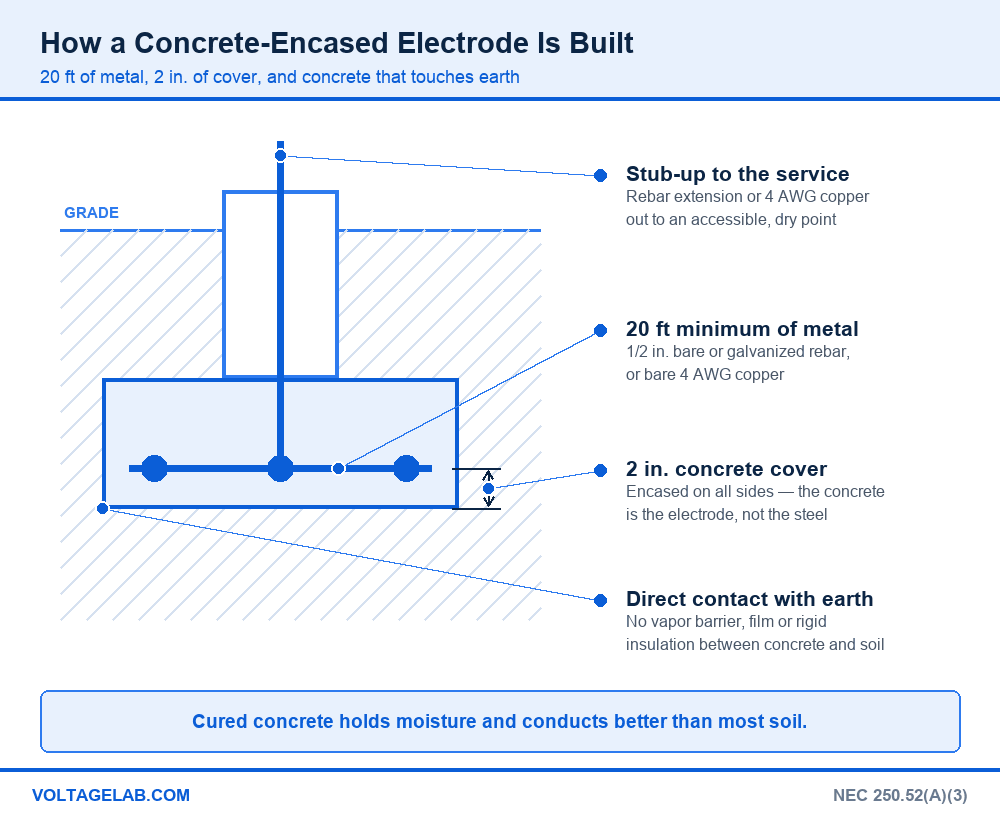
A Ufer ground is not a device you buy. It is a length of metal deliberately placed inside a concrete footing so that the footing itself becomes the electrode. The concrete does the work, and it is worth understanding why, because it is the only electrode in the eight grounding electrodes of NEC 250.52 that gets better with age rather than worse.
Cured concrete is porous and hygroscopic. It pulls moisture out of the surrounding soil and holds it, and the pore water is heavily alkaline — a pH around 12 to 13 from the calcium hydroxide released as the cement hydrates. That electrolyte makes concrete a far better conductor than the dry soil around it, and it also spreads current over the entire surface area of the footing instead of the few square feet of a driven rod. The result is a large, stable, low-impedance connection to earth.
Three things have to be true for the footing to count as an electrode under the Code:
- Enough metal. At least 20 ft (6.0 m) of qualifying rebar or bare copper.
- Enough cover. The metal must be encased by at least 2 in. (50 mm) of concrete on all sides.
- Earth contact. The portion of the foundation or footing holding that metal must be in direct contact with the earth — horizontally near the bottom of the footing, or vertically within a foundation element that touches soil.
Miss any one of the three and there is no concrete-encased electrode present, and you are back to driving rods. For the wider picture of how this fits with the other electrodes, see our overview of what a grounding electrode is and what it does.
Where the name comes from
In 1942 the U.S. Army needed grounding for bomb and ammunition storage vaults near Tucson and Flagstaff, Arizona. Driven rods were useless there — no water table, almost no rainfall, and soil resistivity high enough that conventional electrodes read in the hundreds or thousands of ohms. Herbert G. Ufer, then a consulting engineer working with Underwriters Laboratories, was asked to find something that would work.
His answer was to stop fighting the soil and use the concrete instead: 20 ft lengths of 1/2 in. rebar laid near the bottom of the 2 ft deep footings the buildings already required. Follow-up measurements taken over roughly two decades came back in the 2 to 5 ohm range — better than the rods would have managed in wet soil, in the driest ground in the country. The concept was published in the 1960s, entered the NEC in 1968, and electricians have called it a Ufer ground ever since (the background on Ufer’s original Arizona work is worth a read). The Code itself has never used the name.
What qualifies under NEC 250.52(A)(3) — rebar or bare copper
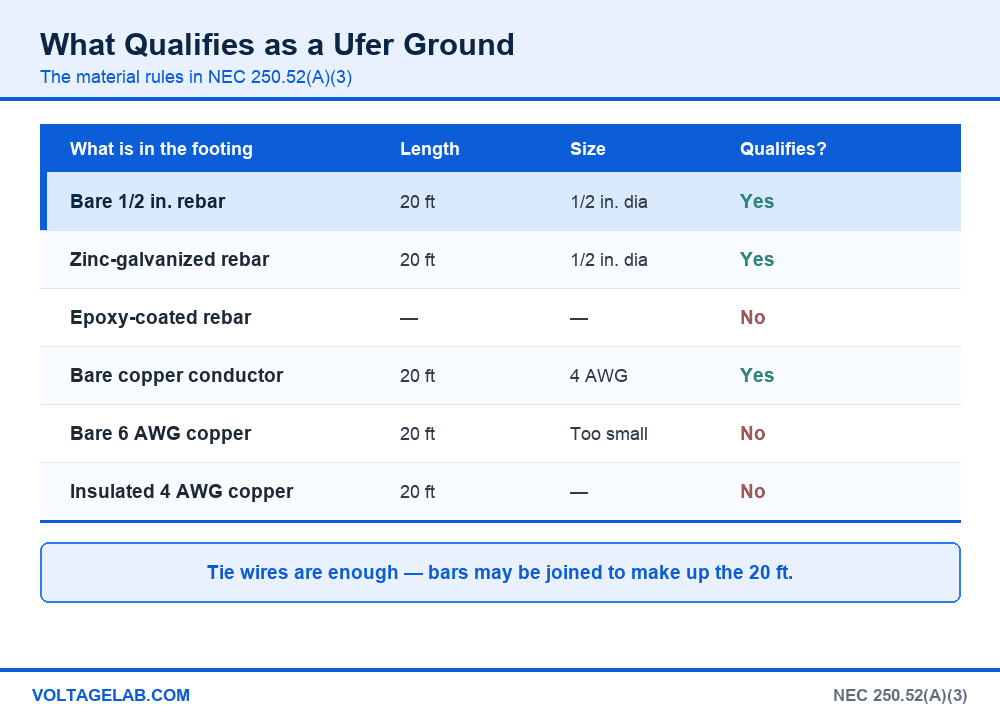
The Code permits exactly two constructions, and the material details are where installations fail:
| What is in the footing | Minimum length | Minimum size | Qualifies? |
|---|---|---|---|
| Bare steel reinforcing bar | 20 ft | 1/2 in. diameter | Yes — the usual case |
| Zinc-galvanized rebar | 20 ft | 1/2 in. diameter | Yes |
| Epoxy-coated rebar | — | — | No — coating is not conductive |
| Bare copper conductor | 20 ft | 4 AWG | Yes |
| Bare 6 AWG copper | 20 ft | Too small | No |
| Insulated 4 AWG copper | 20 ft | — | No — must be bare |
The 20 ft may be one continuous piece, or several shorter bars joined to make up the length. 250.52(A)(3) specifically accepts the usual steel tie wires the rod busters already use, along with welding, exothermic welding, or other effective means. You do not need a special connection between bars — the tie wires that hold the cage together are enough, which is why a normal reinforced footing usually satisfies the rule without anyone doing anything extra.
If the footing has no rebar at all — a plain concrete pour, or a footing reinforced with fiber instead of steel — the 4 AWG bare copper option is how you create the electrode. Twenty feet of bare copper laid in the bottom of the trench, held up on chairs so it gets its 2 in. of cover, and stubbed up where the service will land. Our guide to bare copper ground wire sizing and code rules covers the conductor itself in more detail.
Wording in 250.52(A)(3) has shifted slightly between the 2017, 2020 and 2023 cycles, so read the edition your jurisdiction has adopted before you rely on any summary — including this one. NFPA publishes free read-only access to NFPA 70 if you do not have the book in front of you.
The two traps that kill a Ufer ground: first, the informational note to 250.52(A)(3) states that concrete installed with insulation, vapor barriers, films or similar items separating it from the earth is not considered to be in direct contact with the earth. A continuous poly vapor barrier run under the footings — increasingly common under current energy codes — wipes out the electrode. Second, epoxy-coated rebar is not “bare or zinc galvanized or other electrically conductive coated,” so an epoxy-coated cage does not qualify no matter how much of it is down there. Both problems are invisible once the concrete is poured, and both are found at the service inspection.
The practical answer on a vapor-barrier job is to check the footing detail before the pour. Some barriers stop at the footing edge and only run under the slab, which leaves the footing in earth contact and the electrode intact. Where the barrier is genuinely continuous beneath the footings, there is no concrete-encased electrode present and you plan for rods or a ground ring instead.
Study smarter with VoltageLab
Built for electricians, apprentices, and electrical engineers who want faster practice and better exam prep.
⭐️ Join thousands of electricians upgrading their skills
Sizing the grounding electrode conductor — NEC 250.66(B)
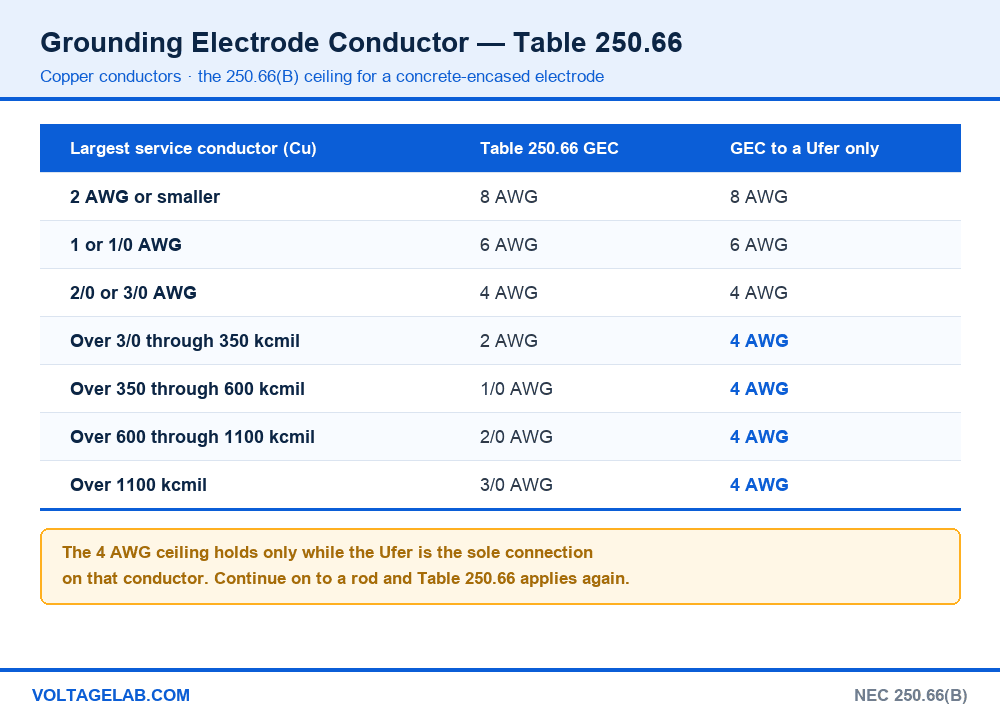
Grounding electrode conductors are normally sized from Table 250.66 against the largest ungrounded service-entrance conductor. The concrete-encased electrode gets its own relief in 250.66(B): where the grounding electrode conductor or bonding jumper connected to concrete-encased electrodes does not extend on to another type of electrode requiring a larger conductor, it is not required to be larger than 4 AWG copper.
| Largest ungrounded service conductor (copper) | GEC per Table 250.66 (copper) | GEC to a concrete-encased electrode only |
|---|---|---|
| 2 AWG or smaller | 8 AWG | 8 AWG |
| 1 or 1/0 AWG | 6 AWG | 6 AWG |
| 2/0 or 3/0 AWG | 4 AWG | 4 AWG |
| Over 3/0 through 350 kcmil | 2 AWG | 4 AWG |
| Over 350 through 600 kcmil | 1/0 AWG | 4 AWG |
| Over 600 through 1100 kcmil | 2/0 AWG | 4 AWG |
| Over 1100 kcmil | 3/0 AWG | 4 AWG |
That cap is the reason a 1200-amp service can land on a 4 AWG conductor at the Ufer connection while everything else in the room is enormous. It is not an oversight — it reflects that the electrode is already a very low-impedance path and that a larger conductor buys nothing. Our full walkthrough of Table 250.66 and grounding electrode conductor sizing covers the rest of the table.
The four-step method
Step 1 — find the largest ungrounded service-entrance conductor. Per phase, including parallel sets added together. That figure is the only input Table 250.66 takes.
Step 2 — read Table 250.66 for the base size. This is the size the grounding electrode conductor would be if it were serving any electrode.
Step 3 — apply the 250.66(B) cap, but only if it applies. If that conductor runs to the concrete-encased electrode and stops there, 4 AWG copper is the ceiling. If it continues on to a rod, a water pipe or a ground ring, the cap is gone and the whole run reverts to the Table 250.66 size.
Step 4 — protect and terminate it. A 4 AWG grounding electrode conductor must be protected where exposed to physical damage under 250.64(B), and the termination has to be made with a fitting listed for the purpose. Where that fitting will be encased in concrete or buried, 250.70 requires it to be listed for concrete encasement or direct soil burial. Working through GEC sizing questions the way exams ask them is a fast way to make the table automatic.
The one that catches everyone: the 4 AWG ceiling in 250.66(B) only holds while the concrete-encased electrode is the sole connection on that conductor. Run one continuous grounding electrode conductor from the service to the Ufer and then on to a driven rod or a metal water pipe, and the exemption no longer applies — you are back to the full Table 250.66 size for the whole conductor. Land the Ufer on its own conductor, or on a busbar, if you want to keep the 4 AWG.
Where the Ufer ground is required — and where it does not count
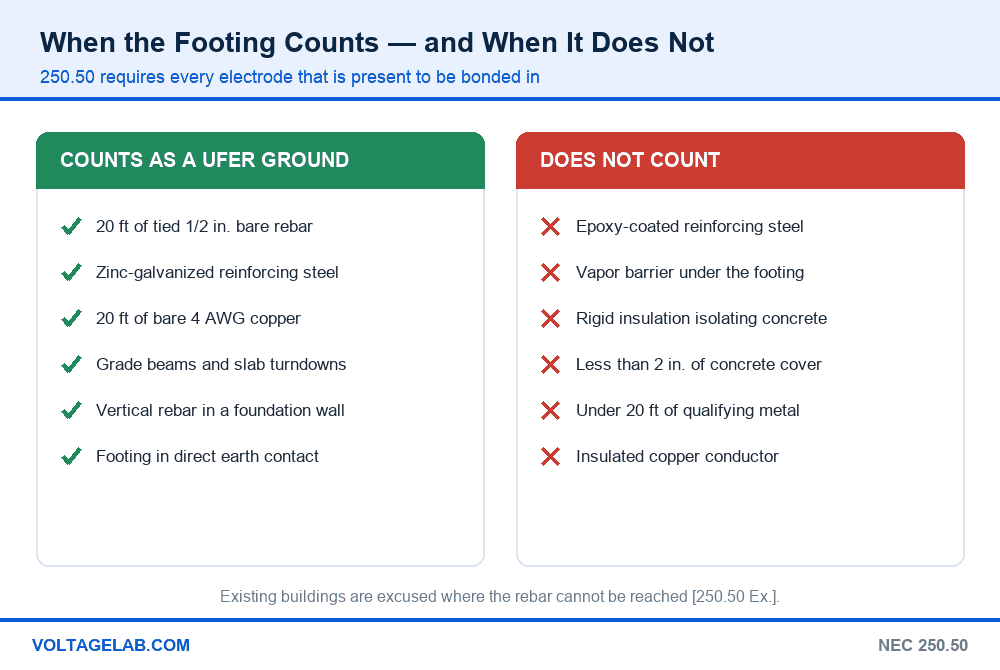
The requirement is written around a single word. NEC 250.50 says that all grounding electrodes described in 250.52(A)(1) through (A)(7) that are present at each building or structure shall be bonded together to form the grounding electrode system. On new construction the rebar is present before the concrete goes in, so a qualifying footing means a required electrode.
It counts, and must be bonded in
- New footings with 20 ft or more of tied 1/2 in. bare or galvanized rebar in earth contact
- Slab-on-grade turndowns and grade beams reinforced with qualifying steel
- Vertical foundation walls or piers with qualifying rebar where the concrete touches soil
- Plain footings where you install 20 ft of bare 4 AWG copper before the pour
- Detached structures with their own qualifying footing — the electrode is present there too
It does not count
- Footings isolated from soil by a continuous vapor barrier, film or rigid insulation
- Epoxy-coated reinforcing steel
- Rebar with less than 2 in. of concrete cover, or exposed at the bottom of the pour
- Less than 20 ft of qualifying metal in a single tied assembly
- Footings poured above grade with no earth contact
- Existing buildings where the rebar cannot be reached without disturbing the concrete — the exception to 250.50 excuses these
Does a Ufer ground still need a ground rod?
No. The supplemental electrode requirement in 250.53(A)(2) — the familiar rule that a single rod, pipe or plate electrode must be supplemented unless it measures 25 ohms or less — applies only to rod, pipe and plate electrodes. A concrete-encased electrode stands on its own, and there is no resistance test attached to it.
What still applies is 250.50. If a rod, a metal underground water pipe, a ground ring or in-ground metal support structure is also present at that building, it has to be bonded into the same grounding electrode system — you do not get to pick the best one and ignore the rest. The one relief the Code gives is inside 250.52(A)(3) itself: where multiple concrete-encased electrodes are present at a building or structure, it is permissible to bond only one of them in. On a job with a dozen separate footings, that sentence saves a great deal of copper. Where each electrode lands is covered in our guide to grounding an electrical panel to NEC requirements, and the communications side belongs on an intersystem bonding termination.
Ufer ground vs the other grounding electrodes
| Question | Concrete-encased | Ground rod | Ground ring | Metal water pipe |
|---|---|---|---|---|
| NEC reference | 250.52(A)(3) | 250.52(A)(5) | 250.52(A)(4) | 250.52(A)(1) |
| Needs a supplemental electrode | No | Yes, unless 25 ohms or less | No | Yes, always |
| Maximum GEC required | 4 AWG Cu | 6 AWG Cu | Size of the ring | Full Table 250.66 |
| Added cost on new work | Near zero | Low | High | None |
| Can be added later | No | Yes | Yes | N/A |
| Typical earth resistance | Low and stable | Varies with season | Low | Low while metallic |
For the full set and how they interact, start with NEC Article 250 grounding and bonding basics, then the detail on bonding jumper types and sizing. If the building has a transformer or generator downstream, the electrode question repeats itself in grounding and bonding separately derived systems.
Is the Ufer ground the right electrode?
Pros
- Lowest and most stable earth resistance of any common electrode
- Uses steel the footing already contains — near-zero added material cost
- No supplemental electrode and no 25-ohm test required
- Grounding electrode conductor capped at 4 AWG copper under 250.66(B)
- Nothing above grade to be cut, stolen or driven over
- Performs where driven rods do not — dry, rocky or high-resistivity soil
Cons
- One shot only — it has to be right before the concrete truck arrives
- Requires coordinating with the concrete crew, who are not electricians
- Vapor barriers and epoxy-coated rebar silently disqualify it
- A direct lightning strike can spall concrete around the electrode, which is why lightning protection systems use their own down conductors
Installing a Ufer ground in the field
Do
- Get on site before the pour and confirm the rebar is bare or galvanized
- Check the footing detail for a vapor barrier or under-footing insulation
- Use chairs to hold the electrode off the trench bottom so it gets 2 in. of cover
- Use a connector listed for concrete encasement or direct burial per 250.70
- Photograph the tie-in before the pour — it is the only record that will exist
Avoid
- Assuming the footing qualifies without looking at what is actually in it
- Using insulated conductor for the 20 ft copper option — it must be bare
- Running the GEC on to a rod and losing the 4 AWG ceiling by accident
- Leaving a rebar stub-up in earth contact with no corrosion protection
- Letting the concrete crew cut or reposition your stub-up after you leave
On rebar-type electrodes, 250.68(C)(3) permits an additional rebar section to be extended from the electrode inside the concrete to an accessible location that is not subject to corrosion, and used for the grounding electrode conductor connection. The extension has to be continuous with the electrode rebar or joined to it by tie wires, welding or exothermic welding, and it must not be exposed to earth contact without corrosion protection. Bringing the stub up inside a stem wall and out above the sill plate satisfies that; bringing it out through soil does not.
Where the grounding electrode conductor terminates on the electrode inside the concrete, 250.68(A) Exception No. 1 means the connection does not have to remain accessible — but the fitting itself must be listed for concrete encasement under 250.70. An ordinary split-bolt or acorn clamp is not.
Frequently asked questions
What is a Ufer ground?
A Ufer ground is the trade name for a concrete-encased electrode: at least 20 ft of qualifying rebar or bare 4 AWG copper encased in at least 2 in. of concrete within a foundation or footing that is in direct contact with the earth. The NEC describes it in 250.52(A)(3) and never uses the name Ufer.
Is a Ufer ground required by the NEC?
Yes, when one is present. NEC 250.50 requires every electrode described in 250.52(A)(1) through (A)(7) that is present at a building to be bonded into the grounding electrode system, and on new construction a qualifying footing means the electrode is present before the concrete is poured.
How much rebar does a Ufer ground need?
At least 20 ft of bare or zinc-galvanized steel reinforcing bar not smaller than 1/2 in. in diameter. It can be one continuous length or multiple bars connected by the usual steel tie wires, welding, exothermic welding or other effective means to make up 20 ft or more.
Does a Ufer ground need a ground rod too?
Not as a supplement. The supplemental electrode rule in 250.53(A)(2) applies only to rod, pipe and plate electrodes. But if a rod, water pipe or other electrode is already present at the building, 250.50 still requires it to be bonded into the same grounding electrode system.
Can a vapor barrier disqualify a concrete-encased electrode?
Yes. The informational note to 250.52(A)(3) states that concrete installed with insulation, vapor barriers, films or similar items separating it from the earth is not considered to be in direct contact with the earth. A continuous barrier beneath the footing means no electrode is present.
Does epoxy-coated rebar work as a Ufer ground?
No. The Code permits bare, zinc-galvanized, or other electrically conductive coated reinforcing steel. Epoxy coating is applied specifically to electrically isolate the steel from its environment, so it fails the requirement. Galvanized rebar is fine.
What size wire goes to a Ufer ground?
Size it from Table 250.66, but 250.66(B) says the conductor is not required to be larger than 4 AWG copper where it serves concrete-encased electrodes and does not continue on to another electrode requiring a larger size. Smaller services may still land on 8 or 6 AWG per the table.
What resistance should a Ufer ground read?
The NEC sets no resistance limit for a concrete-encased electrode — the 25-ohm figure belongs to 250.53(A)(2) and applies to rods, pipes and plates. In practice a properly built Ufer ground commonly reads in the low single digits to low tens of ohms, and it is usually the best electrode at the building.
Can you add a Ufer ground to an existing building?
Not practically. The exception to 250.50 recognises this: concrete-encased electrodes in existing buildings are not required to be part of the grounding electrode system where the reinforcing steel is not accessible without disturbing the concrete. On a retrofit you use rods, a ground ring, or another electrode that is present.
The bottom line
The Ufer ground earns its place because it costs almost nothing and outperforms everything else. The steel is already in the footing, the concrete is a better electrolyte than most soil, and the electrode gets more stable over the years instead of drying out or corroding away. That is why the NEC stopped treating it as an option and made it mandatory wherever it is present.
The two restraints that matter are both about timing and attention. Verify before the pour that the rebar is bare or galvanized and that nothing is isolating the footing from the earth, because after the pour you cannot fix either one. And keep the grounding electrode conductor to the Ufer on its own path if you want the 4 AWG ceiling in 250.66(B). For what shifted in the current cycle, see our summary of the key changes in the 2026 NEC.
FREE PRACTICE TOOL
Think you'd pass this on a real exam?
Test what you just read with instant-feedback quizzes built around real code questions — not generic trivia.
5
Code standards
10,000+
Active learners
100%
Free to start
Instant explanations on every answer, right or wrong
NEC, BS7671, AS/NZS, CEC, and DIN VDE covered
Bite-sized quizzes you can finish in 5 minutes
No signup required to try your first quiz
No account needed · Takes less than 2 minutes