


Walk the roof of any commercial building and you will find the same short grey whips running from the disconnect into every rooftop unit — corrugated, flexible, unmistakably not EMT. Half the crew calls it liquid tight. The other half calls it Sealtite, and a fair number write sealtight on the material list. Everyone means the same shelf at the supply house.
The problem is that none of those words tell you what you actually bought. The Code recognises two entirely separate wiring methods here, in two separate articles, with different rules on length, support and whether the conduit itself can carry a ground fault back to the panel. Grab the wrong one for a 40-foot exposed run and you have a violation that a plan reviewer will spot in seconds.
Study smarter with VoltageLab
Built for electricians, apprentices, and electrical engineers who want faster practice and better exam prep.
⭐️ Join thousands of electricians upgrading their skills
This guide covers what liquidtight flexible conduit is, why Sealtite is a brand and not a type, how LFMC and LFNC differ under NEC Articles 350 and 356, how to size and fill it from Chapter 9, where each one is permitted, and the two mistakes that cause most of the failed inspections involving it.
Quick Answer
Liquid tight and Sealtite are not two different products. “Liquidtight” is the generic description, Sealtite® is Anamet Electrical’s registered trade name for their liquidtight conduit line, and “sealtight” is simply a common misspelling of that brand. The real choice is between the two wiring methods the NEC actually recognises: LFMC (liquidtight flexible metal conduit, Article 350) and LFNC (liquidtight flexible nonmetallic conduit, Article 356).
The difference that matters on the job: LFMC has an interlocked metal core, so it can serve as the equipment grounding conductor under the five conditions in NEC 250.118, and trade sizes 1/2″ through 4″ have no length limit at all. LFNC is nonmetallic, always needs a wire-type EGC pulled inside it, and 356.12(3) caps it at 6 ft unless it is a listed prewired assembly or the AHJ approves a longer run.
Key Takeaways
- Sealtite® is a registered trade name owned by Anamet Electrical, not an NEC wiring method; “sealtight” is a misspelling of it
- LFMC is covered by NEC Article 350 and has a helically wound interlocked metal core inside a sunlight-resistant thermoplastic jacket
- LFNC is covered by NEC Article 356 and comes in three constructions — LFNC-A, LFNC-B and LFNC-C — with LFNC-B being what most supply houses stock
- LFNC is limited to 6 ft by NEC 356.12(3), but LFMC in trade sizes 1/2 inch through 4 inch has no NEC length limit whatsoever
- LFMC counts as an equipment grounding conductor only when every condition in NEC 250.118 is met, including a 6 ft total ground return path
- LFMC must be secured within 12 in of a box and supported every 4½ ft; LFNC-B over 6 ft long needs support every 3 ft
- Neither type may be used where subject to physical damage, and standard liquidtight conduit is rated to a maximum of 80 °C
What liquidtight flexible conduit actually is
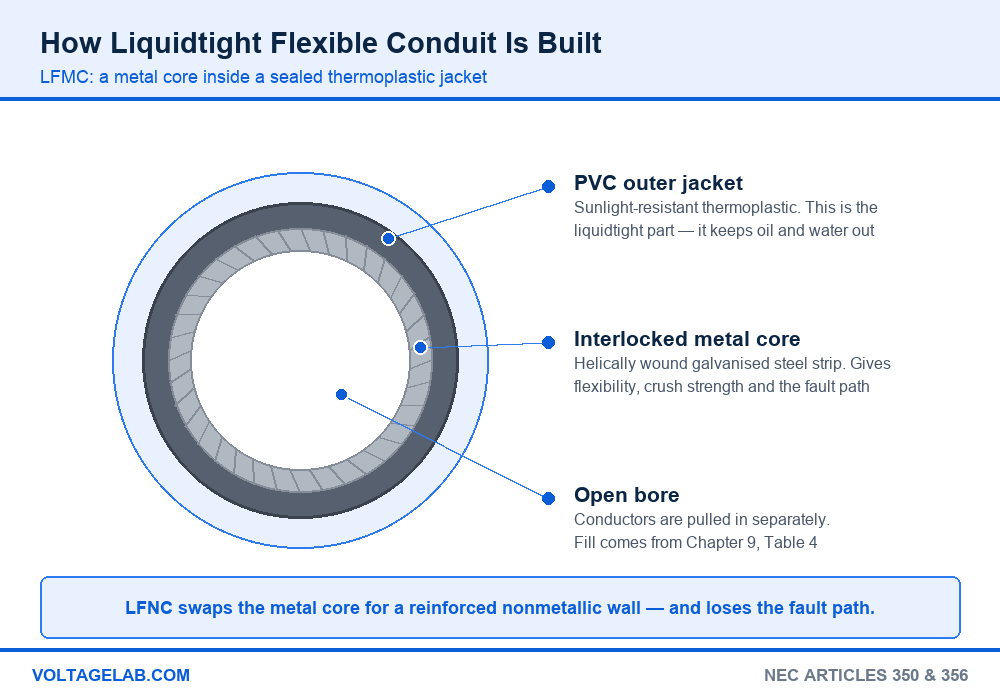
Liquidtight flexible conduit is a raceway built to bend and to keep water out at the same time. Those two jobs pull in opposite directions, which is why the product is layered rather than extruded in one piece. In the metallic version, LFMC, there are three parts:
Pass your electrical exam the first time
Practice real NEC exam questions with full code-referenced explanations and progress tracking — built for journeyman, master and apprentice exam prep.
Thousands of NEC practice questions with code-referenced answers
- The interlocked metal core. A helically wound strip of galvanised steel, folded so each turn locks into the next. It bends without kinking, resists crushing, and — because it is continuous metal — it can carry fault current.
- The thermoplastic jacket. A sunlight-resistant PVC cover extruded over the core. This is the “liquidtight” part. It keeps water, machine oils, coolant and vapours out of the raceway.
- The bore. Empty. Conductors are pulled in separately, which means fill is governed by Chapter 9 rather than by anything printed on the conduit.
LFNC keeps the jacket idea and throws away the metal. Instead of a steel core it uses a reinforced nonmetallic wall — and with the metal gone, so is the fault-current path. That single construction difference drives almost every rule that separates the two articles.
Sealtite, sealtight, and where the confusion comes from
Anamet Electrical manufactures liquidtight conduit under the Anaconda Sealtite® name, and like Romex or Greenfield, the brand became the word people use for the whole category. Anamet’s own catalogue splits its Sealtite types by construction: types such as UA, HTUA and ZHUA are LFMC, while types such as CNP and NMUA are LFNC. So “Sealtite” on its own does not even tell you whether the product is metallic.
The spelling “sealtight” has no official standing at all. It is what happens when a spoken brand name meets a plausible-looking English word. Write either one on a submittal and an engineer will send it back asking which article you intend to install under — because that is the only question that has a code answer.
LFMC vs LFNC — NEC Article 350 against Article 356
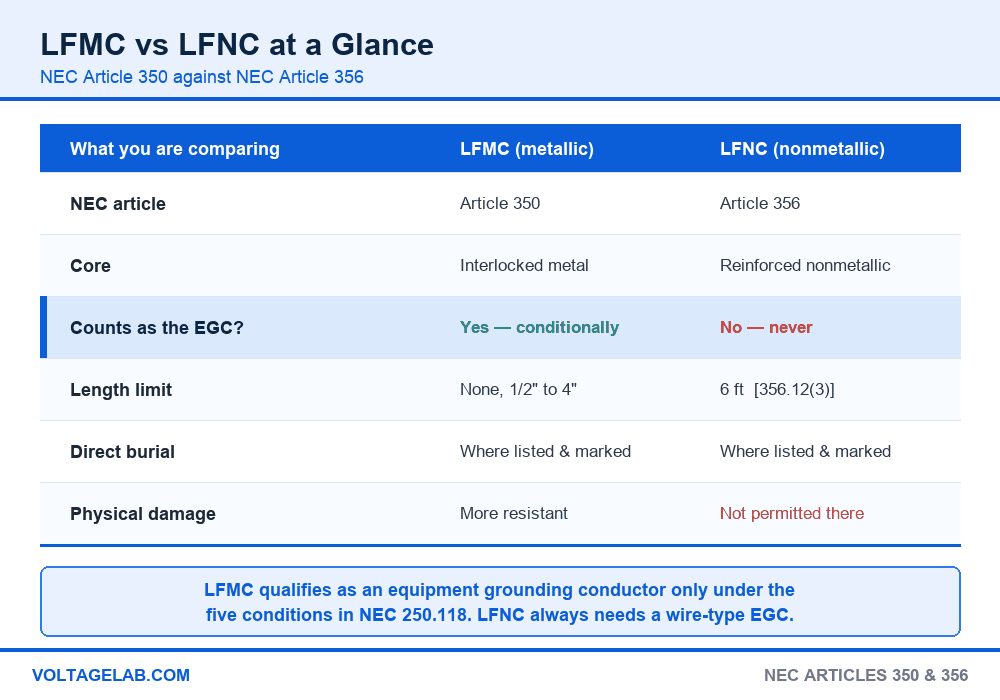
These are two distinct wiring methods with their own articles, not two grades of the same thing:
| What you are comparing | LFMC (metallic) | LFNC (nonmetallic) |
|---|---|---|
| NEC article | Article 350 | Article 356 |
| Core construction | Interlocked metal strip | Reinforced nonmetallic wall |
| Can it be the EGC? | Yes — if 250.118 is satisfied | No — never |
| NEC length limit | None for 1/2″–4″ | 6 ft [356.12(3)] |
| Support interval | 4½ ft [350.30] | 3 ft for LFNC-B over 6 ft [356.30] |
| Direct burial | Where listed and marked | Where listed and marked |
| Hazardous locations | Where Chapter 5 permits | Not a Chapter 5 method |
| Corrosion resistance | Good, but the core can corrode if the jacket is cut | Nothing in it to corrode |
The three LFNC constructions
Article 356 recognises three types, and they are not interchangeable:
- LFNC-A — a smooth seamless inner core and cover bonded together, with one or more reinforcement layers between them.
- LFNC-B — a smooth inner surface with the reinforcement built into the conduit wall itself. This is the one most supply houses stock, and the only type the Code allows to run past 6 ft as a listed prewired assembly.
- LFNC-C — corrugated inside and out, with no integral reinforcement in the wall.
Code trap: The 6 ft limit belongs to LFNC, not to LFMC — and a lot of electricians apply it backwards. NEMA Bulletin No. 93 was published specifically to settle this: there is no NEC length limitation on FMC or LFMC in trade sizes 1/2″ through 4″. The 6 ft figure people remember comes from NEC 250.118, and it limits the ground return path, not the conduit. Run LFMC 60 ft if the job needs it — just pull a wire-type EGC, because past 6 ft the conduit no longer qualifies as the ground.
Sizing liquidtight conduit — NEC Chapter 9, Table 4
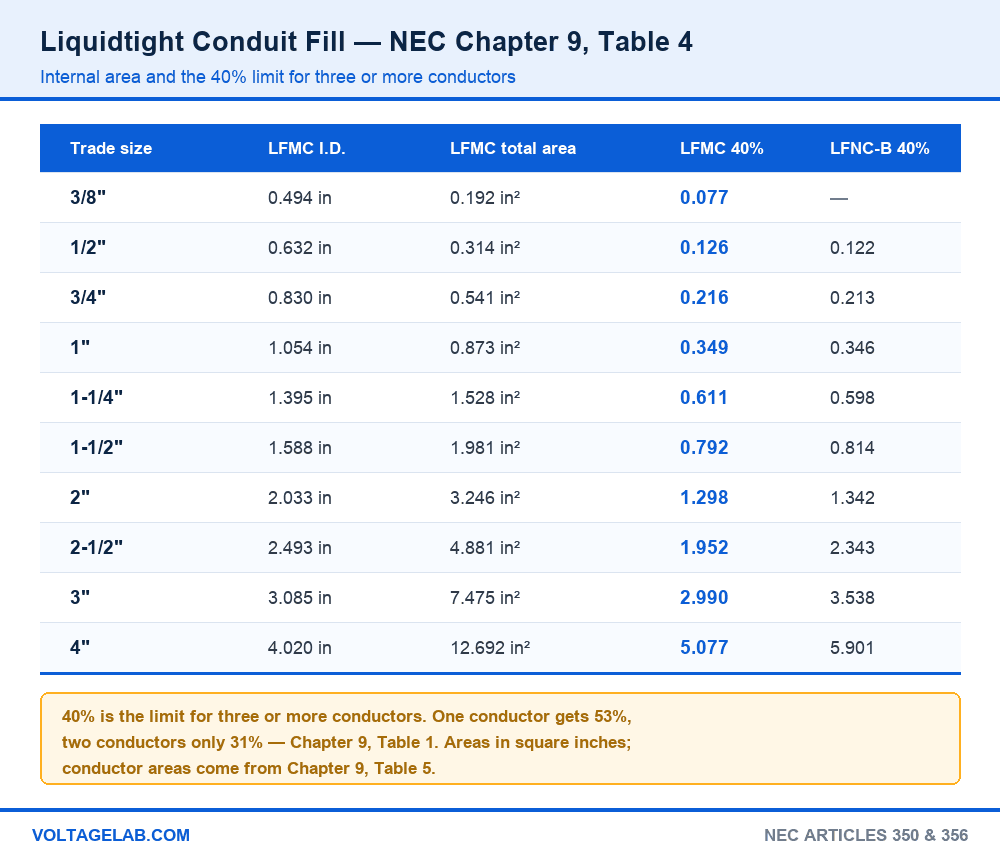
Liquidtight has its own columns in Chapter 9, Table 4, and they are not the same as EMT. LFMC and LFNC-B have different internal diameters from each other at almost every trade size, and at 1-1/2″ and above LFNC-B is actually the roomier of the two. Sizing a whip off an EMT chart will cost you a size sooner or later.
| Trade size | LFMC I.D. | LFMC total area | LFMC 40% fill | LFNC-B 40% fill |
|---|---|---|---|---|
| 3/8″ | 0.494 in | 0.192 in² | 0.077 in² | — |
| 1/2″ | 0.632 in | 0.314 in² | 0.126 in² | 0.122 in² |
| 3/4″ | 0.830 in | 0.541 in² | 0.216 in² | 0.213 in² |
| 1″ | 1.054 in | 0.873 in² | 0.349 in² | 0.346 in² |
| 1-1/4″ | 1.395 in | 1.528 in² | 0.611 in² | 0.598 in² |
| 1-1/2″ | 1.588 in | 1.981 in² | 0.792 in² | 0.814 in² |
| 2″ | 2.033 in | 3.246 in² | 1.298 in² | 1.342 in² |
| 2-1/2″ | 2.493 in | 4.881 in² | 1.952 in² | 2.343 in² |
| 3″ | 3.085 in | 7.475 in² | 2.990 in² | 3.538 in² |
| 4″ | 4.020 in | 12.692 in² | 5.077 in² | 5.901 in² |
How to size a liquidtight whip in five steps
- Count the conductors, including the EGC. If you are running LFNC, or LFMC longer than 6 ft, the equipment grounding conductor is a wire in the pipe and it takes up fill like any other.
- Pick the fill percentage from Chapter 9, Table 1. One conductor gets 53%, two conductors get 31%, and three or more get 40%. The two-conductor case catches people out — it is the most restrictive of the three.
- Look up each conductor’s area in Chapter 9, Table 5. Use the actual insulation type. THWN-2 is noticeably slimmer than XHHW-2 in the same gauge.
- Add the areas together and compare the total against the correct column for your conduit type in Table 4 — LFMC and LFNC-B are separate columns.
- Go up a trade size if you are close. Liquidtight is corrugated and it bends; a fill that works on paper can still be a fight to pull through two 90s on a rooftop.
For conductor sizing itself, nothing about liquidtight changes the ampacity rules — you still work from NEC Table 310.16 and the conductor properties in Chapter 9, Table 8. If you would rather not run the arithmetic, the pre-worked combinations in NEC Annex C cover the common cases.
The one that catches everyone: trade size 3/8″ liquidtight is not a general-purpose size. NEC 350.20 sets 1/2″ as the minimum and only permits 3/8″ for the specific uses listed in 348.20(A) — enclosing motor leads per 430.245(B), and lengths not exceeding 6 ft for utilization equipment, as part of a listed assembly, or for luminaire tap connections under 410.117(C). That 6 ft is a real conduit length limit, and it is the only one in Article 350. Maximum size is 4″.
Where liquidtight conduit is allowed — NEC 350.10 and 356.10
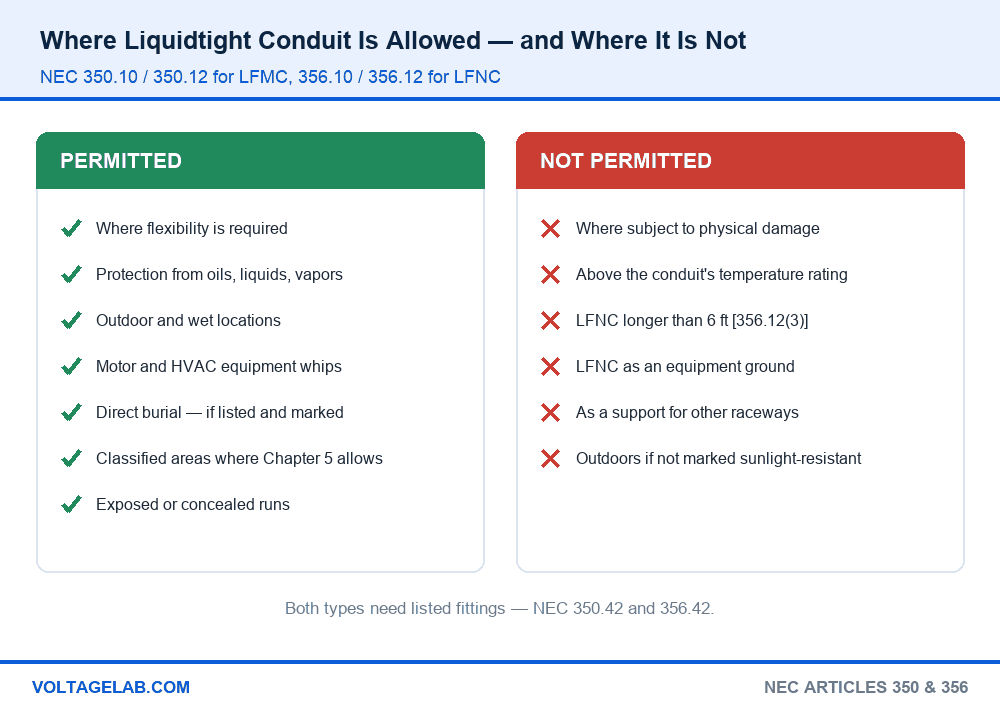
Uses permitted
NEC 350.10 permits LFMC in exposed or concealed locations where conditions require flexibility or protection from machine oils, liquids, vapours or solids; in hazardous (classified) locations where Chapter 5 specifically permits it; and for direct burial where the conduit is listed and marked for the purpose. The 2020 Code added language confirming that conductors rated above the conduit’s own temperature rating may be installed, provided they do not actually operate above it.
NEC 356.10 gives LFNC a similar but distinct list: where flexibility is required for installation, operation or maintenance; where the conductors need protection from vapours, liquids or solids; outdoors where listed and marked as suitable; for direct burial where listed and marked; as a listed manufactured prewired assembly in trade sizes 1/2″ through 1″ for LFNC-B; and for encasement in concrete where listed for direct burial.
Uses not permitted
- Where subject to physical damage. This is the first item in both 350.12 and 356.12, and it is the most commonly cited of the two. A whip crossing a forklift aisle at knee height is a violation no matter how well it is supported.
- Above the temperature rating. Both articles prohibit any combination of ambient and conductor operating temperature that exceeds what the conduit is approved for. Standard liquidtight tops out at 80 °C (176 °F); high-temperature constructions exist but must be specified.
- LFNC longer than 6 ft. Per 356.12(3), except as permitted by 356.10(5) for prewired assemblies or where a longer length is approved as essential for the required degree of flexibility.
- LFNC as an equipment ground. There is no metal in the raceway, so a wire-type equipment grounding conductor is always required.
When LFMC counts as the equipment ground
NEC 250.118 permits listed LFMC as an equipment grounding conductor, but only when every one of these is true: the conduit is terminated in fittings listed for grounding; for trade sizes 3/8″ and 1/2″, the circuit conductors are protected at 20 A or less; for trade sizes 3/4″ through 1-1/4″, they are protected at 60 A or less; the combined length of FMC, FMT and LFMC in the same ground return path does not exceed 6 ft; and the conduit is not installed for flexibility.
Study smarter with VoltageLab
Built for electricians, apprentices, and electrical engineers who want faster practice and better exam prep.
⭐️ Join thousands of electricians upgrading their skills
That last condition is the one people miss. A motor whip is installed specifically to absorb vibration and allow adjustment — which is exactly the case the Code carves out. Pull a separate EGC to every motor and HVAC connection and you sidestep the whole question. For the underlying principles, see our guide to NEC Article 250 grounding and bonding, and where a raceway transitions to a concentric knockout, grounding and bonding bushings.
Support, bends and fittings
NEC 350.30 requires LFMC to be secured within 12 in of every box, cabinet or fitting and supported at intervals not exceeding 4½ ft. Where flexibility is needed after installation, the unsecured length from the last fastening point may not exceed 3 ft for trade sizes 1/2″ through 1-1/4″, 4 ft for 1-1/2″ through 2″, or 5 ft for 2-1/2″ and larger. Fished runs and 6 ft luminaire drops in accessible ceilings are excepted.
NEC 356.30 is tighter: LFNC-B installed in lengths over 6 ft must be fastened every 3 ft and within 12 in of each box or fitting. Both articles limit you to the equivalent of four quarter bends — 360° total — between pull points, and both require listed fittings. Note that 350.42 prohibits angle connectors in concealed raceway installations, because you cannot pull conductors through a 90° fitting without taking it apart.
Liquidtight vs FMC, EMT and PVC
Liquidtight is rarely the cheapest answer. It earns its place when a run has to move, get wet, or both:
| Need | LFMC | LFNC | FMC (Greenfield) | EMT | PVC (Art. 352) |
|---|---|---|---|---|---|
| Flexes after install | Yes | Yes | Yes | No | No |
| Wet / outdoor rated | Yes | Yes, if marked | No | Yes | Yes |
| Can be the EGC | Conditionally | No | Conditionally | Yes | No |
| Long runs | Yes | 6 ft | Yes | Yes | Yes |
| Resists physical damage | Moderate | Low | Moderate | Good | Good |
| Cost per foot | Highest | High | Moderate | Low | Low |
In practice liquidtight is a transition method: EMT or PVC carries the run, and the last few feet into the equipment are liquidtight. If the whole run is buried, check the cover depths in NEC 300.5 before you commit. Where a flexible cable assembly would serve better than a raceway, compare MC cable or, for genuinely portable loads, Type W portable power cable. Whatever you pull inside it is usually THHN/THWN-2, and for motor circuits the starting point is NEC Table 430.250.
Is liquidtight the right choice for your run?
Pros
- Absorbs vibration, so motor and compressor terminations stay tight
- Sealed against water, machine oil, coolant and washdown
- Lets equipment be moved or aligned without recutting the raceway
- LFMC works in classified areas where Chapter 5 permits it
- Both types can be direct buried when listed and marked for it
Cons
- The most expensive raceway per foot, and fittings cost more again
- Not permitted anywhere it is subject to physical damage
- Corrugated bore makes long pulls harder than the fill table suggests
Working with liquidtight in the field
Do
- Pull a wire-type EGC in every whip — it costs pennies and settles the 250.118 argument before it starts
- Cut the jacket square and deburr the metal core so it does not shave the insulation on the pull
- Leave a drip loop below the equipment connection so water runs off instead of into the fitting
- Use fittings listed for the conduit type, and grounding-listed fittings if the conduit is the EGC
- Check the printed marking for “sunlight resistant” and “direct burial” before using it that way
Avoid
- Running LFNC past 6 ft and hoping the inspector reads it as LFMC
- Bending past four quarter bends between pull points
- Concealing an angle connector — 350.42 prohibits it outright
- Using liquidtight as a support for other raceways or boxes
- Making the whip so short that it transmits vibration straight into the terminations
Frequently asked questions
Is there a difference between liquid tight and Sealtite?
No. “Liquid tight” is the generic description of the product and Sealtite® is Anamet Electrical’s registered trade name for their liquidtight conduit line. The meaningful distinction is not between the two words but between LFMC under NEC Article 350 and LFNC under NEC Article 356.
Is it spelled sealtite or sealtight?
The registered trademark is spelled Sealtite. “Sealtight” is a widespread misspelling with no official standing — though it appears on enough material lists that most supply house counters will hand you the same coil either way.
How long can a liquidtight run be?
LFMC in trade sizes 1/2″ through 4″ has no NEC length limit, a point NEMA published Bulletin No. 93 to confirm. LFNC is capped at 6 ft by 356.12(3) unless it is a listed prewired assembly or a longer length is approved. Trade size 3/8″ LFMC is limited to 6 ft for the specific uses in 348.20(A).
Do I need a ground wire inside liquidtight conduit?
Always in LFNC, because nonmetallic conduit cannot carry fault current. In LFMC you can omit it only when every condition of 250.118 is met — listed grounding fittings, the right overcurrent rating for the trade size, a total ground return path of 6 ft or less, and the conduit not installed for flexibility. On a motor whip that last condition usually fails, so pull the wire.
Can liquidtight conduit be buried?
Yes, but only where the conduit is listed and marked for direct burial — 350.10(3) for LFMC and 356.10(4) for LFNC. Standard indoor liquidtight is not marked for it. Burial depths come from NEC Table 300.5, not from Article 350 or 356.
What temperature can liquidtight conduit handle?
Standard liquidtight is rated to a maximum of 80 °C (176 °F). Both 350.12 and 356.12 prohibit any combination of ambient and conductor operating temperature that exceeds the rating of the conduit, so on a hot rooftop the raceway, not the conductor, can become the limiting factor. High- and low-temperature constructions are manufactured, but you have to specify them.
What is the difference between LFNC-A, LFNC-B and LFNC-C?
LFNC-A has a smooth bonded core and cover with reinforcement layers between them. LFNC-B has a smooth inner surface with reinforcement integral to the wall, and it is the type stocked almost everywhere and the only one 356.10(5) allows as a prewired assembly past 6 ft. LFNC-C is corrugated inside and out with no integral reinforcement.
Can liquidtight be used in a hazardous location?
LFMC can, but only where a Chapter 5 article specifically permits it for that class and division — 350.10(2) defers entirely to Chapter 5 rather than granting blanket permission. LFNC is not a recognised hazardous-location method.
The bottom line
Liquidtight flexible conduit earns its price in exactly one situation: the connection has to move or get wet, and a rigid raceway would either crack a termination or let water in. Stop asking whether to buy liquid tight or Sealtite — they are the same shelf — and start asking whether the job needs Article 350 or Article 356.
Two restraints decide almost every one of those calls. Length: if the run is over 6 ft, LFNC is off the table and LFMC is the answer. Grounding: LFNC always needs a wire-type EGC, and LFMC needs one too the moment the run passes 6 ft or is installed for flexibility — which covers most whips. Pull the ground wire, use listed fittings, keep it out of harm’s way, and the inspection takes thirty seconds. For the grounding side of that decision, start with our guide to equipment grounding conductors.
FREE PRACTICE TOOL
Think you'd pass this on a real exam?
Test what you just read with instant-feedback quizzes built around real code questions — not generic trivia.
5
Code standards
10,000+
Active learners
100%
Free to start
Instant explanations on every answer, right or wrong
NEC, BS7671, AS/NZS, CEC, and DIN VDE covered
Bite-sized quizzes you can finish in 5 minutes
No signup required to try your first quiz
No account needed · Takes less than 2 minutes