

An electrician sees the letter W stamped on a cable jacket and usually thinks one thing: water. That instinct is right for cord suffixes like SOOW or SJOW, where the trailing W means the cable is listed for wet locations. But Type W — a type designation all by itself, not a suffix — is something different, and confusing the two on an industrial job can cost you a rejected inspection or a failed cable.
Type W is a heavy-duty, 2000-volt portable power cable listed under NEC Article 400. It is what feeds the temporary distribution on a construction site, the trailing cable on a crane, the shore power on a dock, and the generator taps at a concert. It is built to be dragged, coiled, run over, rained on, and re-terminated — none of which the branch-circuit wiring methods in Chapter 3 are designed to survive.
Study smarter with VoltageLab
Built for electricians, apprentices, and electrical engineers who want faster practice and better exam prep.
⭐️ Join thousands of electricians upgrading their skills
This guide covers what Type W actually is, how it is constructed, what the NEC permits and prohibits, how to size it, and where electricians most often get it wrong.
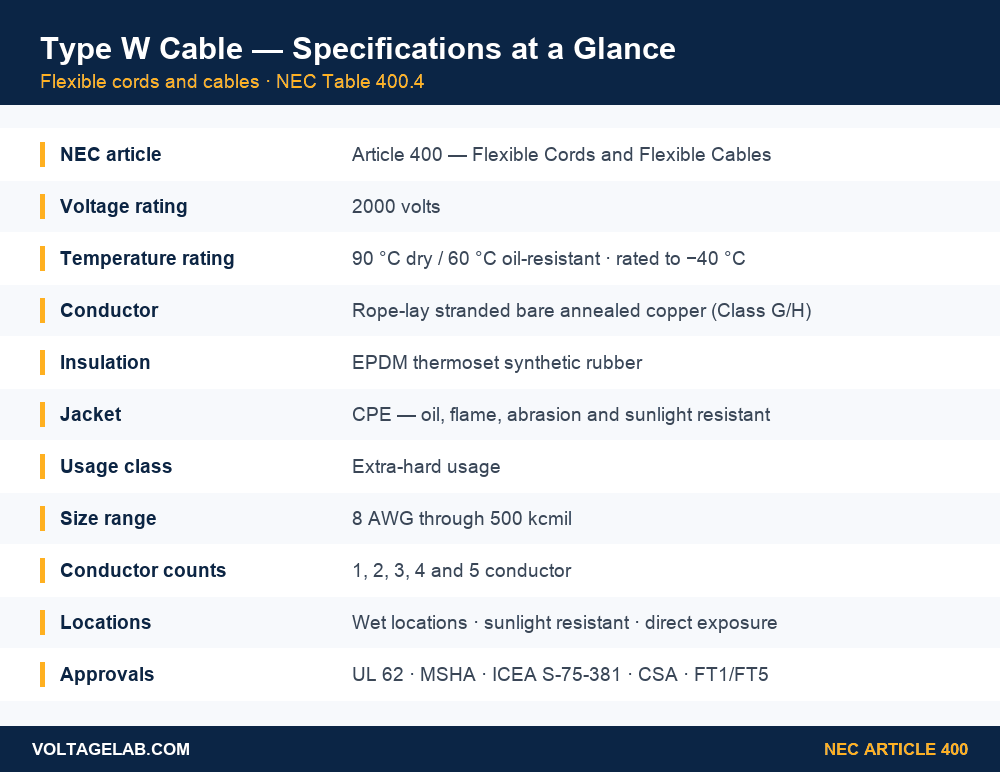
Type W cable at a glance
| Attribute | Type W |
|---|---|
| NEC article | Article 400 (Flexible Cords and Flexible Cables) |
| Voltage rating | 2000 V |
| Temperature rating | 90 °C dry / 60 °C oil-resistant; rated to −40 °C |
| Conductor | Rope-lay stranded bare (or tinned) annealed copper |
| Insulation | EPDM thermoset synthetic rubber |
| Jacket | CPE (chlorinated polyethylene), oil- and flame-resistant |
| Usage class | Extra-hard usage |
| Size range | 8 AWG through 500 kcmil |
| Conductor counts | 1, 2, 3, 4 and 5 conductor |
| Locations | Wet locations, sunlight resistant, direct exposure |
| Common approvals | UL 62, MSHA, ICEA S-75-381, CSA, FT1/FT5 flame test |
What “Type W” actually means
Type W is a listed cable designation, not a wet-location suffix. The distinction matters:
- In SOOW, SJOW, or SEOOW, the final W is a suffix meaning the cable is approved for wet locations and is sunlight resistant. The base type is S (extra-hard service cord), SJ (junior hard service), and so on.
- Type W is its own entry in Table 400.4, the table that lists every flexible cord and cable the Code recognizes. It is classified as a portable power cable for extra-hard usage, rated at 2000 volts — well above the 600-volt ceiling of ordinary S-series cord.
The practical shorthand electricians use: S-cord is for equipment, Type W is for power distribution. If you are moving hundreds of amps to a distribution panel that will be picked up and moved to the next job, you are in Type W territory.
Because Type W appears in Table 400.4, the governing rule of Article 400 applies without exception: if a cord or cable type is not in Table 400.4, do not use it. There is no “close enough” substitute. For a wider view of how the Code classifies conductors, see our guide to electrical cable types and standards.
Type W vs. SOOW, Type G and Type G-GC
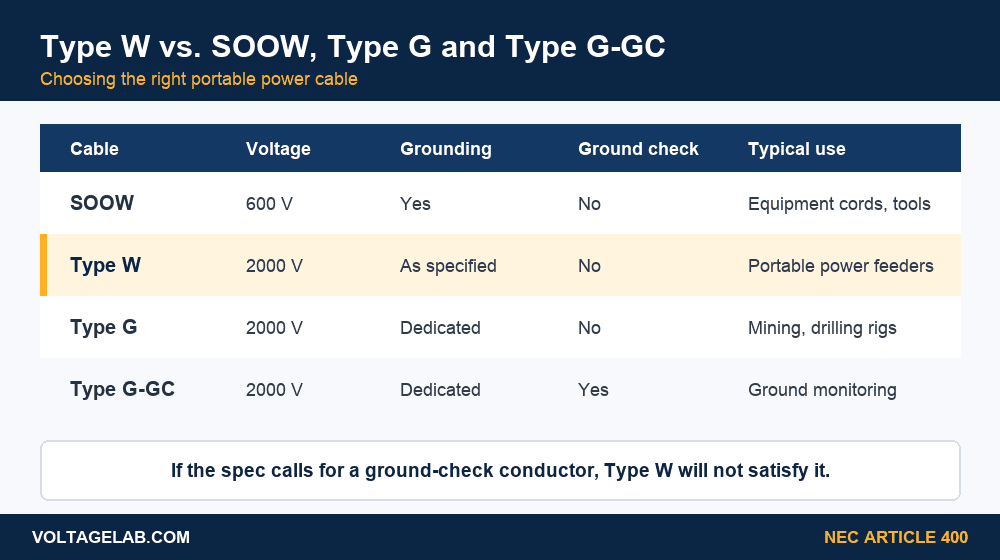
Type W is one of several 2000-volt portable power cables, and they are not interchangeable:
| Type | Voltage | Grounding conductor | Ground-check conductor | Typical use |
|---|---|---|---|---|
| SOOW | 600 V | Yes | No | Equipment cords, portable tools |
| W | 2000 V | As specified — a ground is one of the numbered conductors when the circuit is designed that way | No | Portable power feeders, temporary distribution, entertainment, marine |
| G | 2000 V | Dedicated grounding conductors | No | Mining, drilling rigs, portable equipment feeders |
| G-GC | 2000 V | Dedicated grounding conductors | Yes (pilot/ground-check) | Mining and applications requiring continuous ground monitoring |
The takeaway: if the specification calls for a ground-check conductor, Type W will not satisfy it. Substituting W where G-GC was engineered removes a safety monitoring circuit.
Study smarter with VoltageLab
Built for electricians, apprentices, and electrical engineers who want faster practice and better exam prep.
Join thousands of electricians upgrading their skills
Type W construction, layer by layer
Conductor. Rope-lay stranded bare annealed copper, typically Class G or Class H stranding. This is the reason Type W bends where THHN would not. The finer the stranding, the more flex cycles the cable survives — and the more attention terminations require, because standard set-screw lugs are often listed only for Class B stranding.
Insulation. EPDM (ethylene propylene diene monomer) thermoset rubber over each conductor, rated 90 °C and 2000 V. EPDM is chosen for its ozone resistance and its ability to stay flexible in cold weather instead of cracking.
Assembly. Conductors are cabled together with fillers so the finished cable is round. Round matters more than it sounds: an out-of-round cable does not seat properly in strain-relief grips and wears unevenly when dragged.
Jacket. A black CPE (chlorinated polyethylene) thermoset jacket — flame retardant, oil resistant, abrasion resistant, and sunlight resistant. CPE is what lets Type W lie in a puddle of hydraulic fluid on a job site and still be serviceable next week.
Optional constructions. Tinned copper for corrosive and marine environments, orange or yellow jackets for high-visibility temporary power, and MSHA-approved builds for mining.
Field note: because the jacket is thermoset, not thermoplastic, Type W will not soften and deform under a hot lamp or a warm generator enclosure the way a PVC-jacketed cord will. That heat behaviour is the single biggest practical reason Type W outlasts cheaper cable in temporary power service.
Where the NEC permits Type W — NEC 400.10
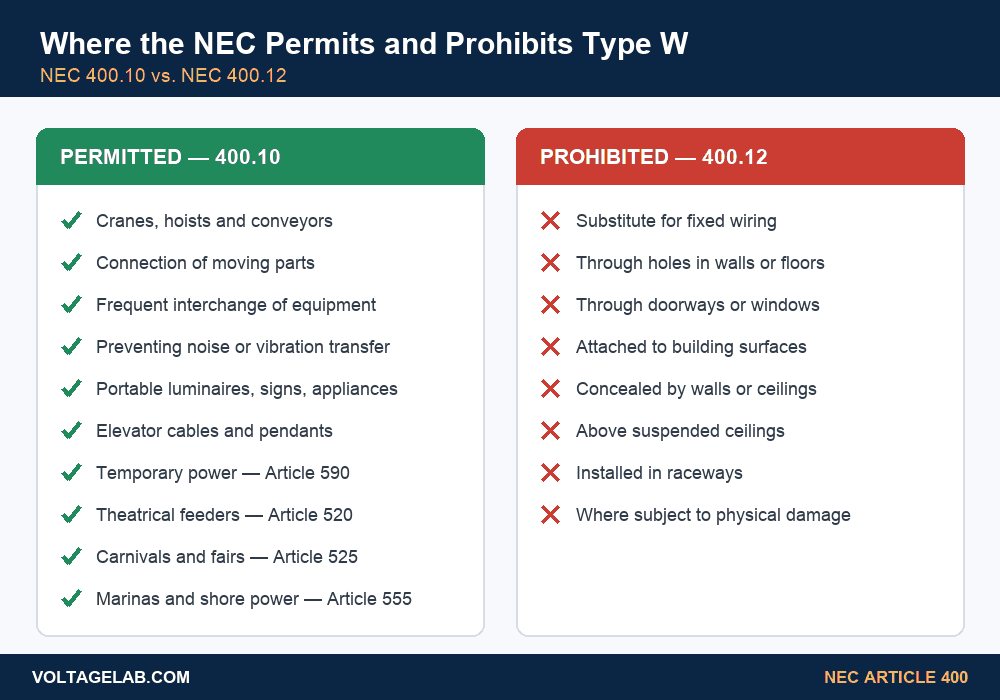
Article 400 is a permission-based article. Flexible cords and cables may be used only where flexibility is functionally necessary. NEC 400.10(A) lists the permitted uses; the ones Type W typically falls under are:
- Pendants and wiring of luminaires
- Connection of portable luminaires, portable and mobile signs, or appliances
- Elevator cables
- Wiring of cranes and hoists
- Connection of utilization equipment to facilitate frequent interchange
- Prevention of the transmission of noise or vibration
- Appliances where the fastening means and mechanical connections are specifically designed to permit ready removal for maintenance and repair
- Connection of moving parts
- Where specifically permitted elsewhere in the Code — the hook that pulls in Article 590 temporary power, Article 520 theatrical, Article 525 carnivals and fairs, and Article 555 marinas
That last bullet does the heavy lifting for most real-world Type W installations. Temporary construction power under Article 590 and entertainment feeders under Article 520 are where Type W lives.
Common real-world applications
- Temporary construction power — generator to spider box to distribution panel
- Entertainment and live events — stage lighting feeders, camlock feeder runs, mobile production trucks
- Mining and heavy industry — shovel trail cables, portable crushers, drilling equipment
- Marine and shore power — dock pedestals, vessel shore ties
- Cranes, hoists and conveyors — festoon systems and reeling drums
- Portable generators and load banks — 200 A to 800 A service connections
- Motor connections where vibration isolation is required
Where the NEC prohibits Type W — NEC 400.12
This is the section that fails inspections. NEC 400.12 prohibits flexible cords and cables — Type W included — from being used:
- As a substitute for the fixed wiring of a structure
- Run through holes in walls, structural ceilings, suspended ceilings, dropped ceilings, or floors
- Run through doorways, windows, or similar openings
- Attached to building surfaces (with a narrow exception in 368.56(B) for busway taps)
- Concealed by walls, floors, or ceilings, or located above suspended or dropped ceilings
- Installed in raceways, except where specifically permitted elsewhere in the Code
- Where subject to physical damage
Numbers 1, 2 and 5 are the ones that catch contractors. Running a Type W feeder through a knockout in a wall to reach a temporary panel on the other side is a violation, no matter how heavy the cable is. Type W being tougher than NM cable does not make it a wiring method.
Where crews get burned: a “temporary” Type W feeder that stayed in place for eighteen months and got drywalled around. The moment it stops being temporary and starts being concealed, it is a 400.12 violation and an insurance problem.
Type W ampacity — using NEC Table 400.5
Type W is not sized from Table 310.16. Portable power cables have their own ampacity tables in NEC 400.5, and the values are higher than equivalent building wire because the cable is in free air and built for 90 °C.
- Table 400.5(A)(1) and (A)(2) cover flexible cords and smaller flexible cables.
- Table 400.5(B) covers portable power cables 8 AWG and larger — this is the table for Type W.
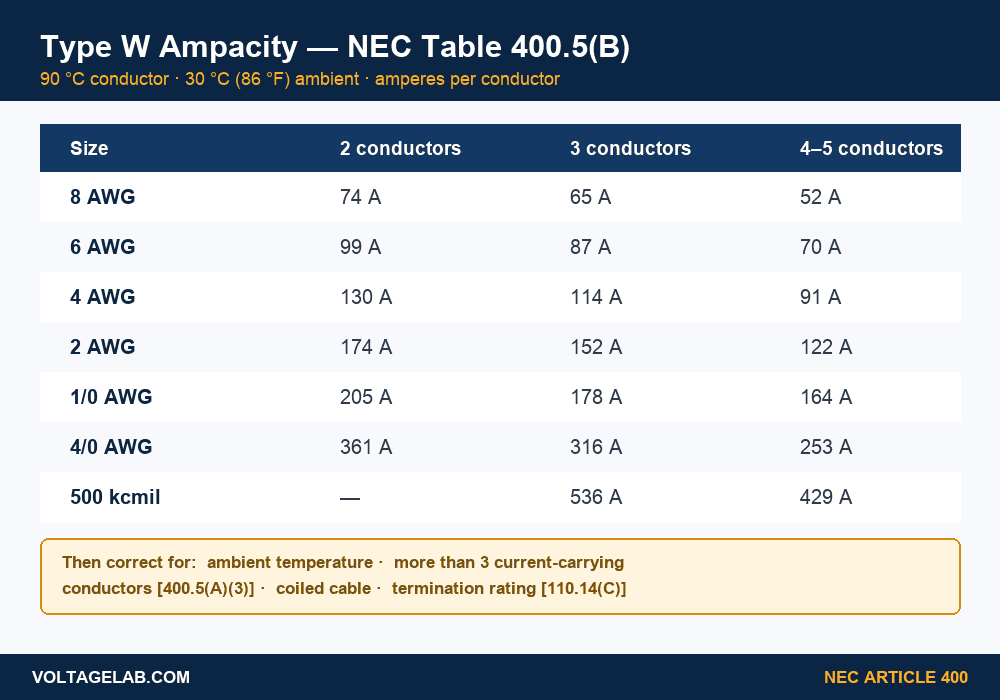
| Size | 2 conductors | 3 conductors | 4–5 conductors |
|---|---|---|---|
| 8 AWG | 74 A | 65 A | 52 A |
| 6 AWG | 99 A | 87 A | 70 A |
| 4 AWG | 130 A | 114 A | 91 A |
| 2 AWG | 174 A | 152 A | 122 A |
| 1/0 AWG | 205 A | 178 A | 164 A |
| 4/0 AWG | 361 A | 316 A | 253 A |
| 500 kcmil | — | 536 A | 429 A |
The three corrections you must not skip
1. Ambient temperature. Where the ambient is other than 30 °C, apply the correction factors from Table 310.15(B)(1) matched to the 90 °C rating of the cable. A cable coiled in a hot generator bay is not at 30 °C.
2. More than three current-carrying conductors. Per 400.5(A)(3), ampacity is reduced when the number of current-carrying conductors exceeds three. In a 4-conductor or 5-conductor Type W run, the neutral counts as current-carrying if the load is nonlinear — which, on a job site full of LED lighting and VFDs, it usually is.
Study smarter with VoltageLab
Built for electricians, apprentices, and electrical engineers who want faster practice and better exam prep.
⭐️ Join thousands of electricians upgrading their skills
3. Coiled or stacked cable. Free-air ampacity assumes the cable can shed heat. A Type W feeder left coiled on a reel and run at full load will overheat regardless of what the table says. Uncoil the cable, or derate hard.
Terminations still govern. The 90 °C ampacity is the cable’s rating, not the circuit’s. Under NEC 110.14(C), the termination temperature rating at the lug, breaker or connector limits the final ampacity — commonly 75 °C. Size the conductor for the cable’s installed conditions, then verify the termination does not drag you back down. The same principle governs conductor properties throughout the Code — see NEC Chapter 9 Table 8 explained.
Terminating and protecting Type W in the field
Strain relief is required. Per NEC 400.14, flexible cords and cables must be connected so that tension is not transmitted to joints or terminals. Use listed cord grips (Kellems-style mesh grips or compression cord connectors) at every entry and exit. A cable hanging on its own terminations is a failure waiting to happen.
Fine-strand terminations need listed lugs. Class G/H rope-lay stranding does not seat correctly in a lug listed only for Class B compact stranding. Use lugs and connectors listed for fine-stranded conductors, and torque them to the manufacturer’s value — NEC 110.14(D) requires terminations to be torqued with a calibrated tool where a value is provided. This is one of the changes worth reviewing in our summary of what changed in the 2026 NEC.
Camlock and single-conductor runs. Single-conductor Type W with cam-type connectors is the standard for entertainment and portable generator feeders. Keep all conductors of a circuit grouped together — separating single conductors of an AC circuit induces heating in surrounding metal and creates impedance imbalance.
Overcurrent protection. Per NEC 240.5, flexible cords and cables must be protected against overcurrent by their ampacity. Do not land a 200 A feeder on a 400 A breaker because the cable “looks big enough.”
GFCI on temporary power. NEC 590.6 requires GFCI protection for personnel on temporary construction power receptacles. Type W feeding a temporary panel does not change that obligation downstream. If you are working out the difference between protection types, see GFCI vs AFCI requirements.
Bonding and grounding. Where a grounding conductor is carried in the cable, size it like any other equipment grounding conductor — our guide to bare copper ground wire sizing covers the NEC rules.
Inspect before every deployment. Look for jacket cuts, embedded debris, flat spots from vehicle traffic, and pulled terminations. A damaged 2000 V cable in a wet trench is a shock hazard, not a nuisance.
Type W vs. other cables: a quick decision table
| Requirement | Use this |
|---|---|
| Fixed wiring in a building | THHN in conduit, MC cable, or NM — never Type W |
| Portable distribution 600 V and below, moderate abuse | SOOW / SEOOW cord |
| Portable power feeders, extra-hard usage, up to 2000 V | Type W |
| Mining equipment requiring grounding conductors | Type G |
| Applications requiring continuous ground monitoring | Type G-GC |
| Direct burial branch or feeder | USE-2 / direct-burial rated cable |
| Wet-location conduit installation | THWN-2 |
For medium- and high-voltage work above the portable power range, see our guide to high voltage cable types, ratings and NEC installation requirements.
Frequently asked questions
Is Type W cable rated for wet locations?
Yes. Type W is listed for wet locations and is sunlight resistant, with a CPE jacket that handles oil, ozone and weather. It can be used outdoors and in damp industrial environments. It is not rated for direct burial as a permanent wiring method.
What does the W in Type W stand for?
On Type W the letter is the type designation itself, not an abbreviation for “water.” It identifies a 2000-volt portable power cable in NEC Table 400.4. The trailing W in cord types such as SOOW is the wet-location suffix — two different meanings of the same letter.
Can Type W be run in conduit?
Generally no. NEC 400.12(6) prohibits flexible cords and cables in raceways unless specifically permitted elsewhere in the Code. Short sleeves for physical protection are sometimes accepted by an AHJ; a conduit run used as a wiring method is not.
What is the voltage rating of Type W cable?
2000 volts. That is the reason it is used for portable power distribution rather than the 600 V S-series cords.
How do I size Type W cable?
Use NEC Table 400.5(B) for sizes 8 AWG and larger, then apply the ambient temperature correction from Table 310.15(B)(1) and the adjustment of 400.5(A)(3) if more than three conductors are current-carrying. Finally, check the termination temperature limit under 110.14(C).
Can I use Type W as permanent wiring if it is larger than the Code requires?
No. NEC 400.12(1) prohibits flexible cords and cables as a substitute for the fixed wiring of a structure regardless of size or ruggedness. Ampacity is not the issue — the wiring method is.
Is Type W the same as SOOW?
No. SOOW is a 600 V extra-hard service cord for equipment connection. Type W is a 2000 V portable power cable for feeders and distribution. They are separate entries in Table 400.4 with different constructions and different ampacity tables.
Does Type W include a ground wire?
Not inherently. In a multiconductor Type W the grounding conductor is one of the numbered conductors when the circuit is designed that way. If the application requires dedicated grounding conductors or a ground-check conductor, specify Type G or Type G-GC instead.
Key takeaways
- Type W is a 2000 V, extra-hard-usage portable power cable under NEC Article 400 — not a wet-location suffix.
- Construction is EPDM insulation with a CPE jacket over rope-lay copper, 90 °C, 8 AWG through 500 kcmil.
- It is permitted where flexibility is functionally necessary (400.10) and by the articles covering temporary, theatrical, marine and carnival power.
- It is prohibited as fixed wiring, through walls and openings, concealed, or in raceways (400.12) — the most common violation.
- Size from Table 400.5(B), then correct for ambient, conductor count, coiling and the 110.14(C) termination rating.
- Use listed fine-strand lugs and strain relief, and torque terminations per 110.14(D).
FREE PRACTICE TOOL
Think you'd pass this on a real exam?
Test what you just read with instant-feedback quizzes built around real code questions — not generic trivia.
5
Code standards
10,000+
Active learners
100%
Free to start
Instant explanations on every answer, right or wrong
NEC, BS7671, AS/NZS, CEC, and DIN VDE covered
Bite-sized quizzes you can finish in 5 minutes
No signup required to try your first quiz
No account needed · Takes less than 2 minutes