


Pull the cover off any commercial panel in the United States and you will find the same wire staring back at you: black, white, red and green single conductors with a slick, slightly glossy finish, each one stamped THHN/THWN-2. It is the default building wire for conduit work, and most electricians handle miles of it before anyone explains what those seven characters actually mean.
That gap matters, because the letters are not branding. Each one is a listing in NEC Table 310.4(1), and they decide whether the wire is legal in a wet location, what column of the ampacity table you are allowed to use, and whether an inspector signs off on the run.
Study smarter with VoltageLab
Built for electricians, apprentices, and electrical engineers who want faster practice and better exam prep.
⭐️ Join thousands of electricians upgrading their skills
This guide covers what THHN is, how it differs from THWN and THWN-2, how to size it correctly through NEC Table 310.16, where the Code permits it, and the two mistakes that cause most of the failed inspections involving it.
Quick Answer
THHN stands for Thermoplastic High Heat-resistant Nylon-coated. It is a 600-volt single conductor with PVC insulation and a nylon jacket, rated 90 °C in dry locations, and it must be installed inside a raceway or enclosure — it is a conductor, not a cable assembly.
Nearly all of it sold today is dual-marked THHN/THWN-2, which adds a 90 °C wet rating. Size it from NEC Table 310.16, but use the 90 °C column only for derating — your final ampacity is limited by the termination rating in 110.14(C), and 14, 12 and 10 AWG are capped at 15, 20 and 30 amps by 240.4(D).
Key Takeaways
- THHN is rated 90 °C dry only; THWN adds a 75 °C wet rating and THWN-2 raises the wet rating to 90 °C
- Dual-marked THHN/THWN-2 is one wire that satisfies both listings, and it is what almost every supply house stocks
- The nylon jacket is what lets THHN pull through conduit without the insulation tearing
- THHN must be run in a raceway or enclosure — it cannot be used as exposed fixed wiring or direct buried
- The 90 °C column of Table 310.16 is a derating starting point, not the ampacity you may terminate on
- NEC 240.4(D) caps 14, 12 and 10 AWG copper at 15, 20 and 30 amps no matter what the table says
- Plain THHN with no wet marking cannot be used in underground conduit, which is treated as a wet location
What THHN wire actually is
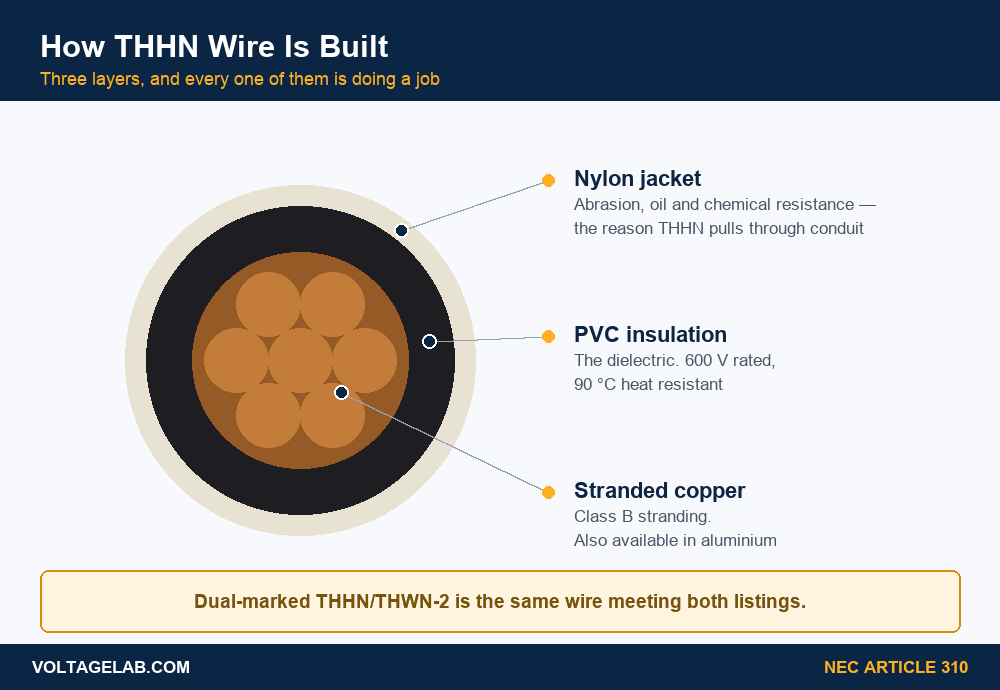
THHN is a single insulated conductor built in three layers, and each layer has a job:
Pass your electrical exam the first time
Practice real NEC exam questions with full code-referenced explanations and progress tracking — built for journeyman, master and apprentice exam prep.
Thousands of NEC practice questions with code-referenced answers
- The conductor. Annealed copper, usually Class B stranded above 10 AWG and solid below it. Aluminium THHN exists and is common in larger feeder sizes.
- PVC insulation. Polyvinyl chloride thermoplastic. This is the dielectric — it holds back 600 volts and carries the 90 °C heat rating.
- A nylon jacket. A thin, tough outer skin that resists abrasion, oil, gasoline and most solvents.
That nylon jacket is the whole reason THHN dominates conduit work. PVC on its own scuffs and tears when you drag several hundred feet of it around bends. The nylon lets the conductor slide, keeps the insulation intact through the pull, and lets manufacturers use thinner insulation — which is why more THHN fits in a given conduit than most alternatives.
What the letters mean
- T — Thermoplastic insulation
- H — Heat resistant (75 °C)
- HH — High heat resistant (90 °C)
- W — Suitable for wet locations
- N — Nylon outer jacket
- -2 — Rated 90 °C in both wet and dry locations
Read that way, THHN is thermoplastic, high-heat, nylon-jacketed. THWN is thermoplastic, heat-resistant, wet-rated, nylon-jacketed. The suffix -2 is the piece most people skip, and it is the one that matters most on a job site.
THHN vs THWN vs THWN-2 — NEC Table 310.4(1)
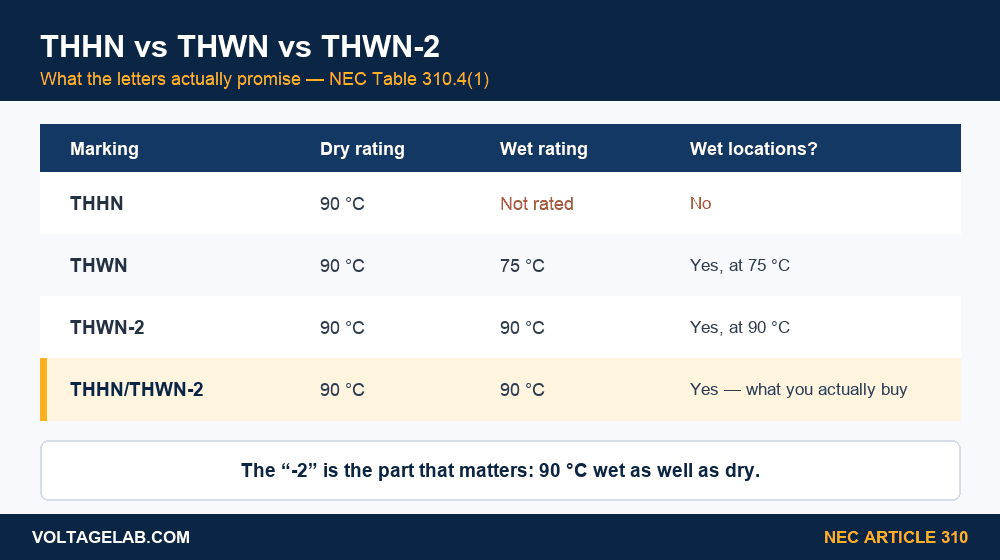
These are three separate listings in Table 310.4(1), not three brand names for the same product:
| Marking | Dry rating | Wet rating | Legal in wet locations? |
|---|---|---|---|
| THHN | 90 °C | Not rated | No |
| THWN | 90 °C | 75 °C | Yes, at 75 °C |
| THWN-2 | 90 °C | 90 °C | Yes, at 90 °C |
| THHN/THWN-2 | 90 °C | 90 °C | Yes — the dual-marked wire you actually buy |
A conductor printed THHN/THWN-2 meets both listings simultaneously. It is not a compromise or a lesser product; it is one wire that has been tested and listed twice. Buying it means you never have to stop and ask whether this particular run counts as a wet location.
The wet location trap: the interior of a raceway installed underground, or in a concrete slab in direct contact with earth, is a wet location under the NEC definition — even though it looks dry when you pull the wire. Plain THHN with no wet marking is not permitted there. This is one of the most common violations found on underground feeder runs.
The same logic applies to raceways exposed to weather and to conduit run in damp basements, car washes and food processing areas. If there is any chance of water reaching the inside of the raceway, the conductor needs a W in its marking.
THHN ampacity — how to read NEC Table 310.16
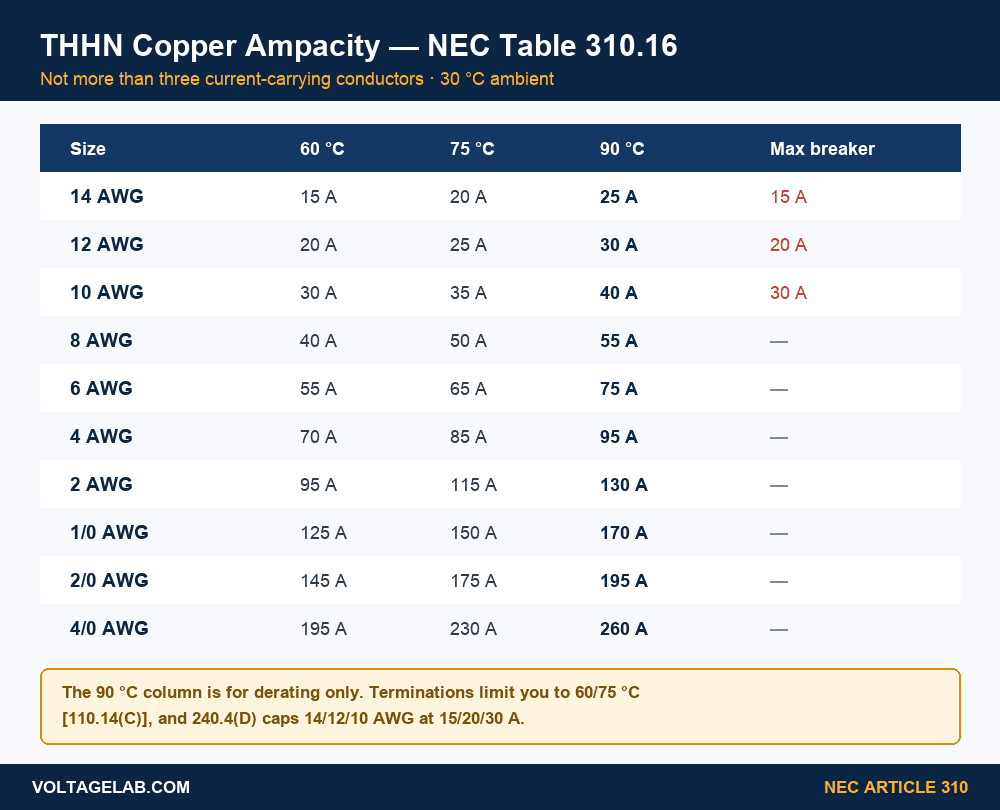
THHN ampacity comes from NEC Table 310.16, the table for conductors in a raceway, cable or earth. The table assumes not more than three current-carrying conductors and a 30 °C (86 °F) ambient. Our full walkthrough of how to read NEC Table 310.16 covers the table itself in detail.
| Copper size | 60 °C | 75 °C | 90 °C | Max OCPD per 240.4(D) |
|---|---|---|---|---|
| 14 AWG | 15 A | 20 A | 25 A | 15 A |
| 12 AWG | 20 A | 25 A | 30 A | 20 A |
| 10 AWG | 30 A | 35 A | 40 A | 30 A |
| 8 AWG | 40 A | 50 A | 55 A | — |
| 6 AWG | 55 A | 65 A | 75 A | — |
| 4 AWG | 70 A | 85 A | 95 A | — |
| 2 AWG | 95 A | 115 A | 130 A | — |
| 1/0 AWG | 125 A | 150 A | 170 A | — |
| 2/0 AWG | 145 A | 175 A | 195 A | — |
| 4/0 AWG | 195 A | 230 A | 260 A | — |
The three-step method that keeps you out of trouble
Step 1 — start in the 90 °C column. Because THHN is a 90 °C conductor, you begin with the 90 °C value and apply every correction and adjustment factor to it. Starting high is legitimate; it is the finish that is restricted.
Step 2 — correct and adjust. Apply the ambient temperature correction factor if the ambient is above or below 30 °C, then the adjustment factor if more than three current-carrying conductors share the raceway. Our guide to Table 310.15(B)(3)(a) adjustment factors covers the conductor-count reductions. On a circuit with significant nonlinear load, the neutral counts as a current-carrying conductor — see multi-wire branch circuits for when that applies.
Step 3 — check the terminations. Under NEC 110.14(C), the temperature rating of the termination limits the final ampacity. For equipment rated 100 amps or less, that is generally the 60 °C column unless the equipment and lugs are listed for 75 °C. Most modern breakers and panels are 75 °C rated, but you have to confirm it rather than assume it.
The one that catches everyone: 12 AWG THHN shows 30 amps in the 90 °C column, but NEC 240.4(D) caps 12 AWG copper at a 20-amp overcurrent device. The 30-amp figure exists so you have headroom to derate from — it is never the breaker size. The same applies to 14 AWG (15 A) and 10 AWG (30 A).
Where the NEC allows THHN — and where it does not
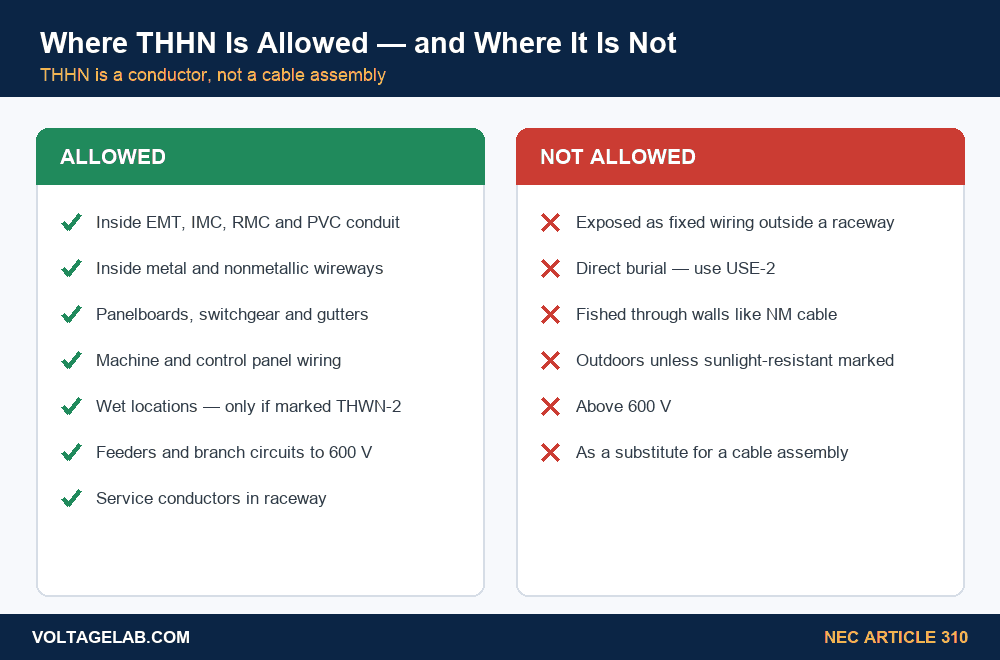
The single most important thing to understand about THHN is structural, not electrical: THHN is a conductor, not a cable assembly. NM cable (Romex), MC cable and UF cable are complete wiring methods with an outer sheath rated to protect the conductors inside. THHN has no such sheath. It only becomes a legal wiring method once it is inside something the Code recognises.
Study smarter with VoltageLab
Built for electricians, apprentices, and electrical engineers who want faster practice and better exam prep.
⭐️ Join thousands of electricians upgrading their skills
Permitted
- Inside EMT, IMC, RMC, PVC and other recognised raceways
- Inside metal and nonmetallic wireways, auxiliary gutters and cable trays where permitted
- Inside panelboards, switchboards, control panels and enclosures
- Machine tool and industrial control wiring
- Wet locations and underground raceway — only when marked THWN or THWN-2
- Branch circuits, feeders and service conductors up to 600 volts
Not permitted
- Exposed as fixed wiring outside a raceway or enclosure
- Direct burial — that requires USE-2 or a listed direct-burial cable
- Fished through stud bays the way NM cable is run
- Outdoors in sunlight unless the conductor is marked sunlight resistant
- Any circuit above 600 volts
- Anywhere a complete cable assembly is required
Conduit fill
Because THHN is installed in raceway, fill calculations are part of the job. Chapter 9 Table 1 sets the limits — 53% for one conductor, 31% for two, and 40% for three or more. Table 5 gives each conductor’s approximate area, and Annex C gives you the finished answer for a raceway filled with conductors that are all the same size. Our guide to sizing conduits and raceways using NEC Annex C works through the method, and NEC Chapter 9 Table 8 covers the underlying conductor properties.
THHN vs other building wire
| Requirement | THHN/THWN-2 | NM (Romex) | XHHW-2 | USE-2 |
|---|---|---|---|---|
| Run in conduit | Yes | No | Yes | Yes |
| Exposed without raceway | No | Yes | No | No |
| Wet locations | Yes (-2) | No | Yes | Yes |
| Direct burial | No | No | No | Yes |
| Smallest conduit fill | Best | N/A | Larger | Larger |
For a wider comparison of insulation types and their standards, see our overview of electrical cable types and standards. If your work moves into portable and temporary distribution rather than fixed raceway, Type W portable power cable is the equivalent workhorse under Article 400.
Is THHN the right choice for your run?
Pros
- Thin insulation means more conductors fit in a given conduit
- Nylon jacket resists abrasion, oil and solvents during long pulls
- 90 °C rating gives real headroom when derating for conductor count
- Cheapest building wire per foot and stocked everywhere
- Dual THHN/THWN-2 marking removes the wet location question
Cons
- Requires a raceway, so material and labour cost rise on long runs
- PVC insulation stiffens noticeably in cold weather
- Plain THHN with no wet marking is easy to install in the wrong place
Working with THHN in the field
Do
- Read the printing on the jacket before you pull, not after
- Use listed pulling lubricant on long runs and multiple bends
- Ream every conduit end so the nylon is not cut on a burr
- Torque terminations to the manufacturer’s value with a calibrated tool
- Confirm the equipment termination rating before using 75 °C ampacities
Avoid
- Sizing a breaker off the 90 °C column
- Using plain THHN in underground or outdoor raceway
- Running THHN outside a raceway because the run is short
- Overfilling conduit and damaging insulation on the pull
- Forgetting to count the neutral on nonlinear circuits
Frequently asked questions
What does THHN stand for?
Thermoplastic High Heat-resistant Nylon-coated. T is thermoplastic insulation, HH is the 90 °C high-heat rating, and N is the nylon outer jacket.
Can THHN wire be used outside?
Only inside a raceway, and only if it is marked THWN or THWN-2 for the wet location. Plain THHN is not wet rated. If the conductor will see direct sunlight it also needs to be marked sunlight resistant.
Can THHN be direct buried?
No. Direct burial requires a conductor listed for it, such as USE-2, or a listed direct-burial cable. THWN-2 may be run underground, but only inside a raceway.
Is THHN the same as THWN?
They are separate listings, but most wire sold today is dual-marked THHN/THWN-2 and satisfies both. Check the printing on the jacket — if there is no W, the conductor has no wet rating.
What is the ampacity of 12 AWG THHN?
30 amps in the 90 °C column of Table 310.16, but that value is a derating starting point. NEC 240.4(D) limits 12 AWG copper to a 20-amp overcurrent device, and terminations usually restrict you to the 60 °C or 75 °C column anyway.
Why does THHN need to be in conduit?
Because it is a single conductor, not a cable assembly. It has no outer sheath providing mechanical protection, so the Code only recognises it as a wiring method when it is installed inside a raceway or enclosure.
What voltage is THHN rated for?
600 volts. Building wire above 600 volts uses medium-voltage cable listed under a different article.
Does THHN come in aluminium?
Yes. Aluminium THHN/THWN-2 is common in larger feeder and service sizes. It carries lower ampacity than copper of the same size, so use the aluminium columns of Table 310.16 and terminations listed for aluminium conductors.
The bottom line
THHN earns its place as the default building wire because of the nylon jacket: it survives the pull, takes up less room in the conduit, and costs less than the alternatives. The two things that get electricians in trouble with it are both about restraint — not using the 90 °C column as a breaker size, and not assuming a conductor is wet rated without reading the printing on the jacket.
Buy dual-marked THHN/THWN-2, size it in three steps, and check the termination rating before you land it. For the code changes worth knowing in the current cycle, see our summary of what changed in the 2026 NEC.
FREE PRACTICE TOOL
Think you'd pass this on a real exam?
Test what you just read with instant-feedback quizzes built around real code questions — not generic trivia.
5
Code standards
10,000+
Active learners
100%
Free to start
Instant explanations on every answer, right or wrong
NEC, BS7671, AS/NZS, CEC, and DIN VDE covered
Bite-sized quizzes you can finish in 5 minutes
No signup required to try your first quiz
No account needed · Takes less than 2 minutes