


Pull the cover off a 1970s 100-amp panel and you will usually find two black conductors the size of a pencil landing on the main lugs. Measure them and they come out at 4 AWG copper. Then somebody asks the obvious question on the way out the door — is that actually big enough for 100 amps, when NEC Table 310.16 says 4 AWG copper is only good for 85 amps?
It is a fair question, and the answer is the reason this topic generates so many arguments in supply houses. The conductor really is rated below the service, and it really is legal. There is a specific allowance in the Code that makes it work, it only applies to a narrow set of installations, and applying it where it does not belong is one of the more common ways a service upgrade fails inspection.
Study smarter with VoltageLab
Built for electricians, apprentices, and electrical engineers who want faster practice and better exam prep.
⭐️ Join thousands of electricians upgrading their skills
This guide covers what size wire a 100-amp service needs in copper and aluminum, where the 83% rule in NEC 310.12 comes from, how to size the neutral and the grounds that go with it, when 4 AWG copper is not enough, and the termination trap that quietly invalidates the whole thing.
Quick Answer
The wire size for a 100-amp service is 4 AWG copper or 2 AWG aluminum for the ungrounded (hot) conductors, taken straight from NEC Table 310.12(A). Those sizes are smaller than a straight 100-amp reading of Table 310.16 because NEC 310.12 lets service conductors for a one-family dwelling be sized at 83% of the service rating — 100 × 0.83 = 83 amps, and 4 AWG copper carries 85 amps at 75 °C.
That allowance is only for services and for feeders carrying the entire load of a one-family dwelling on a 120/240 V single-phase system. For any other 100-amp feeder — a subpanel, a detached garage, a commercial service — you size to the full 100 amps, which means 3 AWG copper or 1 AWG aluminum.
Key Takeaways
- A 100-amp dwelling service takes 4 AWG copper or 2 AWG aluminum ungrounded conductors per NEC Table 310.12(A)
- NEC 310.12 permits 83% of the service rating for one-family dwelling services, so the sizing target is 83 amps, not 100
- #4 copper wire for 100 amp service is legal only because Table 310.12(A) is built on the 75 °C column of Table 310.16
- A 100-amp feeder to a subpanel gets no 83% allowance and needs 3 AWG copper or 1 AWG aluminum
- The grounded (neutral) conductor is sized by NEC 220.61 load and may not be smaller than Table 250.102(C)(1) requires
- The grounding electrode conductor for 4 AWG service conductors is 8 AWG copper, or 6 AWG where it only serves ground rods
- Type SE cable run through thermal insulation drops to the 60 °C column, where 4 AWG copper is only 70 amps
What a 100-amp service actually consists of
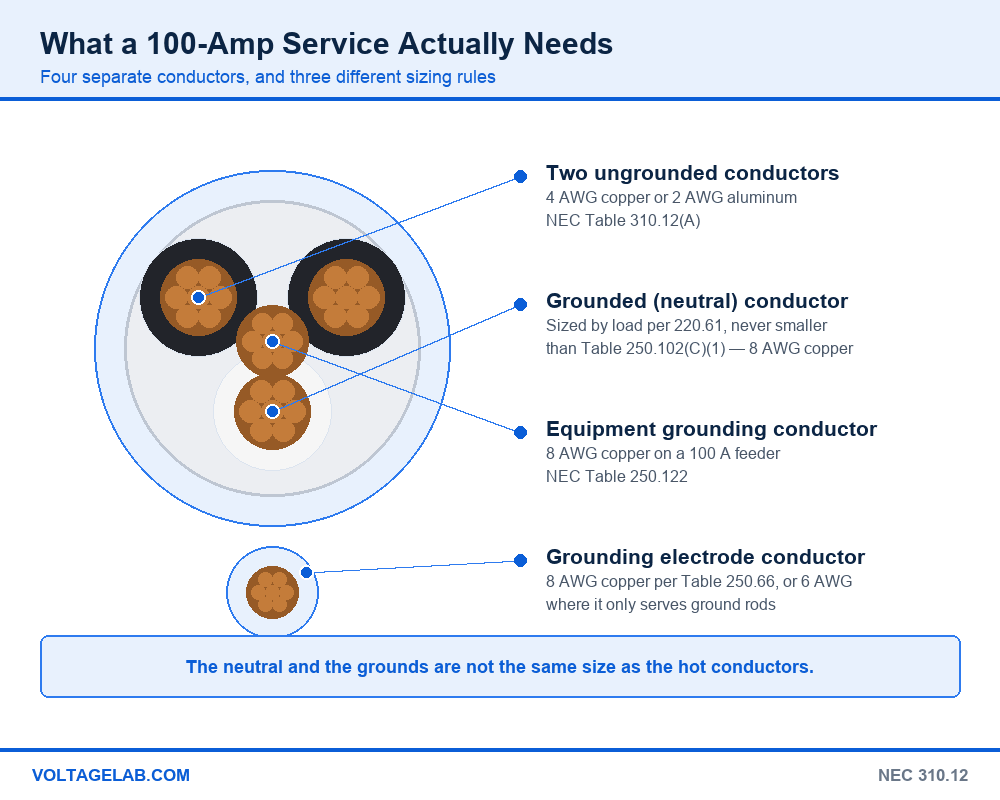
“What size wire for a 100 amp service” is really four questions, because four different conductors leave the meter and land in the panel, and each one is sized by a different rule:
Pass your electrical exam the first time
Practice real NEC exam questions with full code-referenced explanations and progress tracking — built for journeyman, master and apprentice exam prep.
Thousands of NEC practice questions with code-referenced answers
- Two ungrounded conductors. The hots. 4 AWG copper or 2 AWG aluminum, from Table 310.12(A).
- One grounded conductor. The neutral. Sized to the unbalanced load calculated under NEC 220.61, but never smaller than Table 250.102(C)(1) requires for the service conductor size you used.
- One equipment grounding conductor. Only on a feeder, not on service-entrance conductors. Table 250.122 gives 8 AWG copper for a 100-amp overcurrent device.
- One grounding electrode conductor. A separate run from the service enclosure to the electrode system, sized from Table 250.66.
Buy a reel of SER and you get the first three in one jacket. The fourth is always a separate pull, and it is the one most often forgotten on a rush change-out.
Why the number on the panel is not the number you size to
A 100-amp main breaker sets the maximum the service can deliver. It does not describe what the house draws. The Code writers recognised decades ago that a dwelling service never runs at its full rating for the three hours it would take to reach the conductor’s steady-state temperature — the diversity of a house, where the range and the dryer and the air conditioner do not all peak together, does that work for you.
NEC 310.12 turns that observation into a number. Service conductors for a one-family dwelling supplied by a single-phase 120/240 V system are permitted an ampacity of not less than 83% of the service rating. On a 100-amp service that is 83 amps, and that is the number you take to the ampacity table.
NEC Table 310.12(A) — the 83% rule in table form
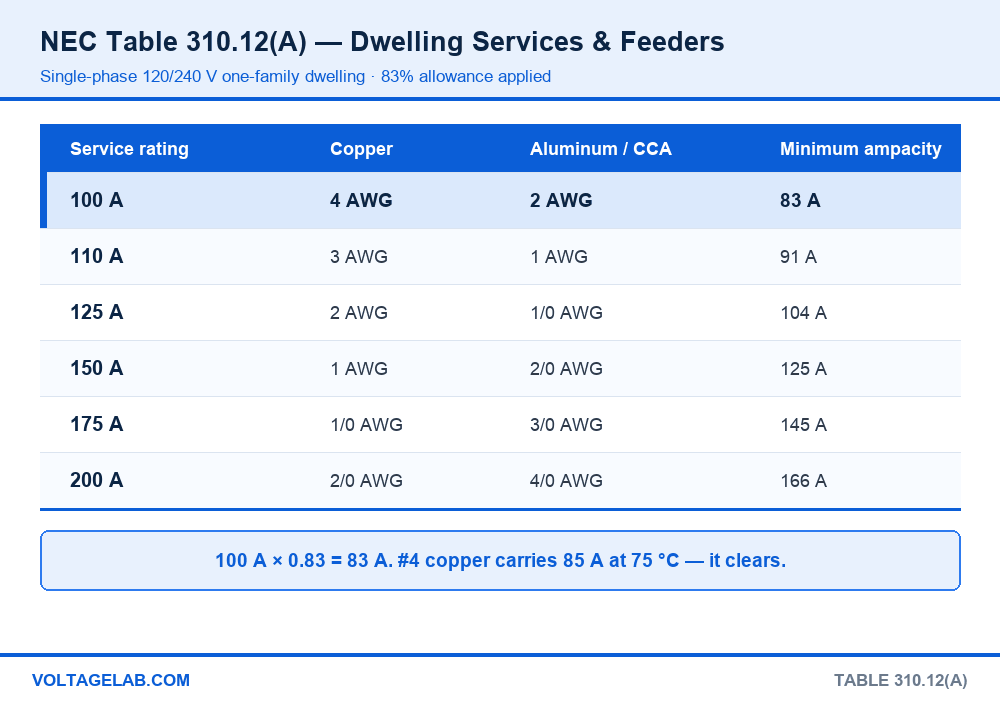
You do not have to do the arithmetic. The Code publishes the finished answers in Table 310.12(A), and for a one-family dwelling service you can read your conductor size straight out of it:
| Service or feeder rating | Copper | Aluminum or copper-clad aluminum | Ampacity the size must meet (83%) |
|---|---|---|---|
| 100 A | 4 AWG | 2 AWG | 83 A |
| 110 A | 3 AWG | 1 AWG | 91 A |
| 125 A | 2 AWG | 1/0 AWG | 104 A |
| 150 A | 1 AWG | 2/0 AWG | 125 A |
| 175 A | 1/0 AWG | 3/0 AWG | 145 A |
| 200 A | 2/0 AWG | 4/0 AWG | 166 A |
| 225 A | 3/0 AWG | 250 kcmil | 187 A |
| 250 A | 4/0 AWG | 300 kcmil | 208 A |
Note the shape of the table. Every row is roughly one trade size smaller than a full-ampacity reading would give you, and the aluminum column sits two sizes above copper throughout — that is the ratio you should expect any time you swap materials on a service.
Code trap: Table 310.12(A) is derived from the 75 °C column. If the meter socket, the panel or the lugs are not listed and marked for 75 °C conductors, NEC 110.14(C) forces you back to the 60 °C column — where 4 AWG copper is 70 amps, short of the 83 amps you need. Modern service equipment is almost always marked 75 °C, but on an old meter can or a re-used panel, read the label before you cut the wire.
Sizing it the long way — NEC Table 310.16 and 110.14(C)
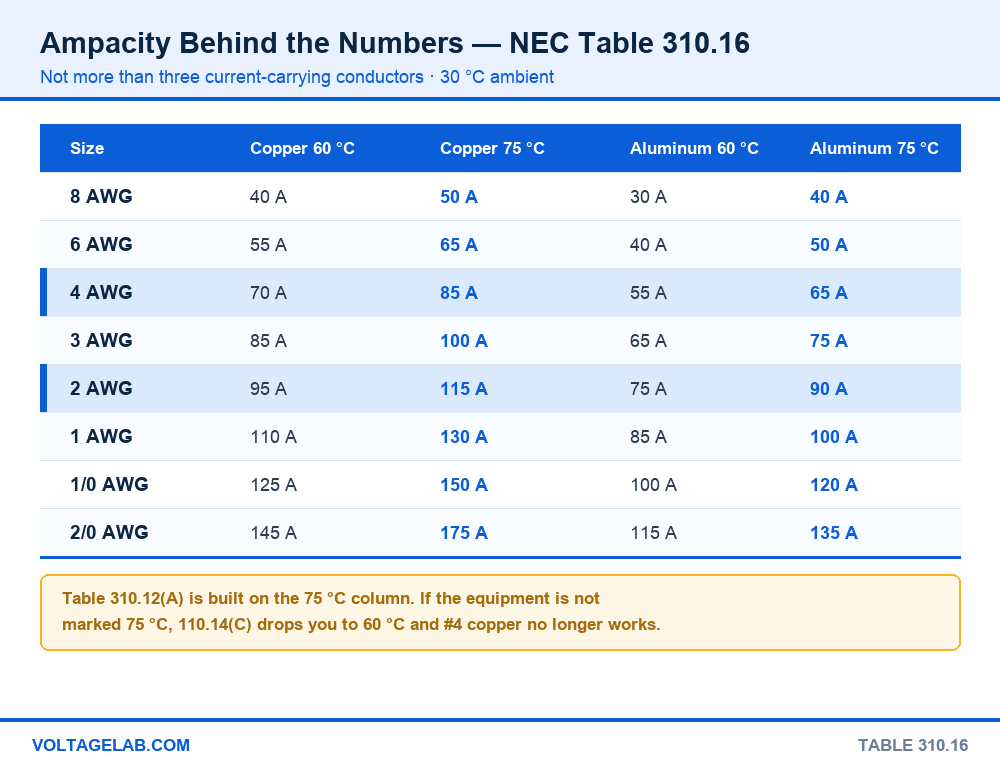
Table 310.12(A) covers the standard dwelling case. The moment your job steps outside it — a long underground run, a hot attic, a commercial panel, a feeder to part of the load — you go back to first principles and work the ampacity yourself from NEC Table 310.16.
These are the sizes that sit on either side of a 100-amp decision, at 30 °C ambient with not more than three current-carrying conductors:
| Size | Copper 60 °C | Copper 75 °C | Aluminum 60 °C | Aluminum 75 °C |
|---|---|---|---|---|
| 6 AWG | 55 A | 65 A | 40 A | 50 A |
| 4 AWG | 70 A | 85 A | 55 A | 65 A |
| 3 AWG | 85 A | 100 A | 65 A | 75 A |
| 2 AWG | 95 A | 115 A | 75 A | 90 A |
| 1 AWG | 110 A | 130 A | 85 A | 100 A |
| 1/0 AWG | 125 A | 150 A | 100 A | 120 A |
The five-step method
- Establish the target ampacity. For a one-family dwelling service or a whole-load feeder, 100 × 0.83 = 83 amps. For anything else, 100 amps.
- Pick the column. Read the termination temperature off the equipment label. 75 °C on modern gear; 60 °C if the label says so or says nothing.
- Read the table. Find the smallest size in that column that meets the target. At 75 °C copper, 4 AWG at 85 amps clears 83; at 60 °C it does not, and you move to 3 AWG.
- Correct for conditions. Ambient above 30 °C under 310.15(B), and more than three current-carrying conductors under 310.15(C)(1). Derate from the 90 °C column if the conductor is 90 °C rated, then compare the result against the termination limit from step 2.
- Check voltage drop on long runs. Not a requirement, but the informational notes to 210.19(A) and 215.2(A) recommend 3% on a feeder and 5% overall.
The one that catches everyone: you cannot round 4 AWG copper up to a 100-amp breaker using the next-size-up rule in NEC 240.4(B). That rule lets you go to the next standard overcurrent size above the conductor ampacity — 85 amps rounds to 90, not 100. The only thing that makes 4 AWG legal on a 100-amp main is 310.12, and that is a dwelling-service allowance, not a general rounding permission.
Where the 83% allowance applies — and where it does not
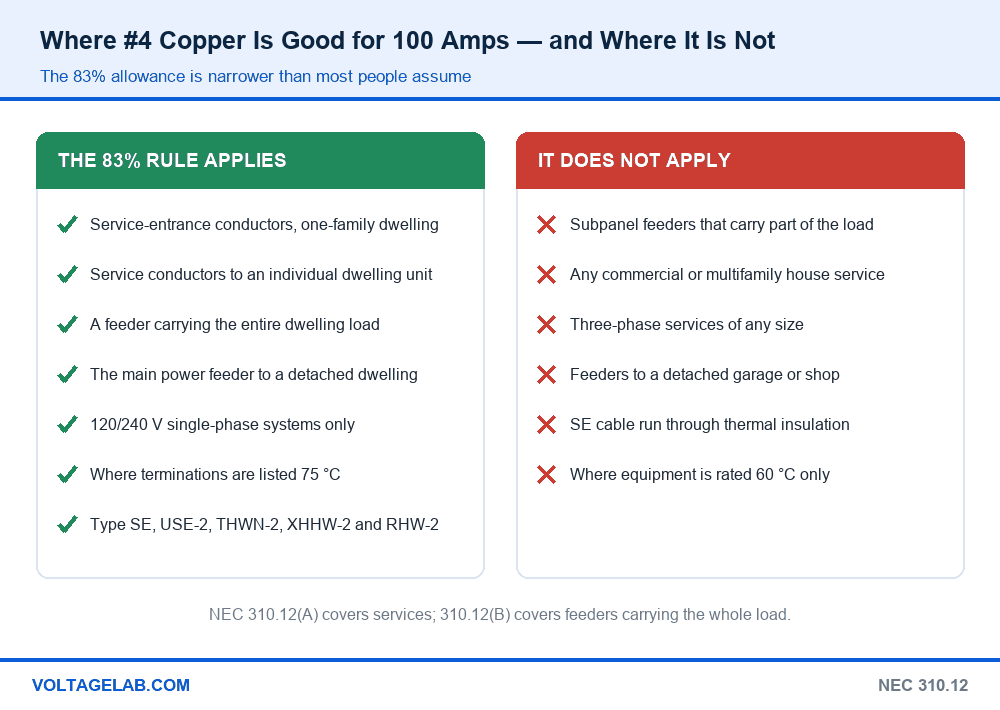
This is the part that decides whether a job passes. The allowance is written narrowly, and the wording matters.
Where 4 AWG copper is permitted for 100 amps
- Service-entrance conductors for a one-family dwelling on a 120/240 V single-phase system, under 310.12(A)
- Service conductors supplying an individual dwelling unit in a two-family or multifamily building, under the same subsection
- Feeder conductors carrying the entire load associated with a one-family dwelling, under 310.12(B) — the classic case being a meter-main on a pole feeding the house panel
- The main power feeder to a detached single-family dwelling that has no other supply
- Only where the terminations at both ends are listed and marked for 75 °C conductors
Where it is not permitted
- A 100-amp feeder to a subpanel that carries part of the dwelling load, not all of it — size to 100 amps, so 3 AWG copper or 1 AWG aluminum
- A 100-amp feeder to a detached garage, shop or barn, for the same reason
- Any commercial, industrial or house-panel service, regardless of size
- Three-phase services, including 120/208 V single-phase taken from a three-phase system where the local AHJ reads 310.12 strictly
- Type SE cable passing through thermal insulation, where 338.10(B)(4)(a) limits ampacity to the 60 °C column
That last one deserves a sentence of its own. Running SER up a wall cavity and packing fibreglass around it is normal construction practice, and it converts a legal 4 AWG copper feeder into a 70-amp conductor. If the SER for a 100-amp feeder will be buried in insulation, move to 2 AWG copper, which is 95 amps at 60 °C.
Voltage drop on a long 100-amp run
4 AWG stranded uncoated copper is 0.308 ohms per 1,000 feet of dc resistance in Chapter 9, Table 8. On a 120/240 V service pulling 83 amps over a 100-foot one-way run, the drop is 2 × 0.308 × 83 × 100 ÷ 1,000 = 5.1 volts, or 2.1% of 240 V. Comfortable. Stretch the same conductor to 200 feet and you are at 4.3%, past the 3% the informational note suggests for a feeder, and it is worth going up a size. Work the arithmetic for your own run with the method in our voltage drop calculation guide.
Study smarter with VoltageLab
Built for electricians, apprentices, and electrical engineers who want faster practice and better exam prep.
⭐️ Join thousands of electricians upgrading their skills
100-amp service conductor types compared
Size is half the decision. The other half is which wiring method carries it from the weatherhead or the lateral to the panel.
| Method | Where it is used | Copper | Aluminum | Watch out for |
|---|---|---|---|---|
| Type SER cable | Meter to panel, interior feeders | 4 AWG | 2 AWG | 60 °C limit in thermal insulation |
| Type SEU cable | Weatherhead to meter, overhead | 4 AWG | 2 AWG | No EGC — service conductors only |
| THWN-2 in conduit | Risers, underground, exposed runs | 4 AWG | 2 AWG | Underground raceway is a wet location |
| USE-2 direct buried | Service laterals | 4 AWG | 2 AWG | 24 in. cover per Table 300.5 |
| Overhead triplex | Utility drop to the weatherhead | — | 2 AWG typical | Utility-owned; their spec, not the NEC |
Each of these has its own rules worth reading before you order material. The conductor itself is covered in our guide to THHN and THWN-2 ratings, the utility drop in triplex vs quadruplex service cable, and the electrode side of the job in our breakdown of Table 250.66 grounding electrode conductor sizing and grounding an electrical panel. If you are weighing whether 100 amps is enough at all, start with a dwelling load calculation before you buy a single foot of wire.
Copper or aluminum for a 100-amp service?
2 AWG aluminum does the same job as 4 AWG copper for a fraction of the material cost, and it is what most utilities and most production builders use. It is not a compromise — it is the default on new work. But it changes what you have to do at the terminations.
2 AWG aluminum — pros
- Roughly a third the material cost of the copper equivalent
- Far lighter, which matters on a long riser or a ladder
- Modern AA-8000 series alloy has none of the creep behaviour of 1960s aluminum branch wiring
- Every current service panel and meter socket is listed for it
2 AWG aluminum — cons
- Two trade sizes larger, so conduit and cable clamps go up with it
- Terminations are unforgiving — they must be torqued to the listed value and, where the listing calls for it, given an antioxidant compound
- Higher voltage drop per foot, which bites on long runs
The reputation aluminum carries comes from small solid branch-circuit conductors in mid-century houses, a different product with a different failure mode — the background is in our article on aluminum wiring in older homes. For service and feeder sizes, aluminum is a sound choice as long as the connection is made properly.
Installing 100-amp service conductors in the field
Do
- Read the termination temperature off the equipment label before you pick a size
- Torque every lug to the value printed on the panel, with a calibrated tool
- Run the grounding electrode conductor as a separate, continuous pull to the electrode system
- Use THWN-2 or USE-2 anywhere the raceway can see water, including underground
- Do the 220 load calculation first — a 100-amp service is often the wrong answer on a house with an EV charger
Avoid
- Carrying the 83% allowance over to a subpanel feeder
- Packing insulation around SER and assuming the 75 °C ampacity still holds
- Sizing the neutral the same as the hots by habit without checking 220.61 and 250.102(C)(1)
- Bonding the neutral to ground at a detached structure’s subpanel — 250.32(B) requires four wires and separate bars
- Guessing at lug torque, which is now an explicit requirement under 110.14(D)
That last item is not a best practice any more. NEC 110.14(D) requires listed torque tools where a torque value is provided, and inspectors are checking for them — the detail is in our guide to torque screwdrivers and NEC 110.14(D). While the panel is open, confirm the working space in front of it still meets NEC 110.26 clearance, because a service change is when that gets fixed or never.
Frequently asked questions
Is #4 copper wire good for a 100 amp service?
Yes, for a one-family dwelling service on a 120/240 V single-phase system. NEC Table 310.12(A) lists 4 AWG copper for a 100-amp service because 310.12 permits 83% of the rating, and 4 AWG copper carries 85 amps in the 75 °C column of Table 310.16. It is not good for a general 100-amp feeder — that takes 3 AWG copper.
What size aluminum wire do I need for a 100 amp service?
2 AWG aluminum or copper-clad aluminum, from the same Table 310.12(A) row. It carries 90 amps at 75 °C, clearing the 83-amp target. For a 100-amp feeder that does not qualify for the 83% allowance, step up to 1 AWG aluminum, which is 100 amps at 75 °C.
What size neutral does a 100 amp service need?
Calculate the maximum unbalanced load under NEC 220.61 and size the grounded conductor to that, then check it against Table 250.102(C)(1), which sets the floor. With 4 AWG copper ungrounded conductors that floor is 8 AWG copper. Most SER cable is sold with a full-size or one-size-reduced neutral, so in practice you are usually well above the minimum.
What size ground wire for a 100 amp service?
Two different conductors, two different tables. The grounding electrode conductor comes from Table 250.66 — 8 AWG copper for 4 AWG service conductors, and 250.66(A) caps it at 6 AWG copper where it only connects to ground rods. The equipment grounding conductor on a 100-amp feeder comes from Table 250.122 and is 8 AWG copper or 6 AWG aluminum.
Can I use 4 AWG copper for a 100 amp subpanel feeder?
Not unless that feeder carries the entire load of the dwelling. NEC 310.12(B) extends the 83% allowance to feeders only where they supply the whole dwelling load. A subpanel taking part of the load is sized at the full 100 amps, which means 3 AWG copper or 1 AWG aluminum.
What size conduit for 100 amp service conductors?
Three 4 AWG THWN-2 conductors plus an 8 AWG equipment ground total about 0.284 square inches from Chapter 9, Table 5. The 40% fill allowance for 1-inch Schedule 40 PVC is 0.333 square inches, so 1 inch is legal. Most electricians run 1¼ inch anyway for pulling room, and you will want it on a long riser with bends.
How deep does a 100 amp service lateral have to be buried?
Table 300.5 gives 24 inches of cover for direct-buried service conductors, 18 inches in rigid nonmetallic conduit, and 6 inches in rigid metal or intermediate metal conduit. Those are minimums to the top of the conductor or raceway, and the local utility often specifies deeper.
Is a 100 amp service still enough for a modern house?
For a small house with gas heat, gas water heating and no EV, often yes — run the NEC Article 220 calculation and see. Add a heat pump, an induction range or a NEMA 14-50 EV circuit and 100 amps runs out quickly. The calculation is cheap; discovering the answer after the meter is set is not.
The bottom line
4 AWG copper or 2 AWG aluminum is the answer to what size wire a 100-amp service needs, and it comes from one table — NEC Table 310.12(A). The reason those sizes look small is the 83% allowance in 310.12, which exists because a dwelling service never sustains its full rating long enough to heat the conductor to its limit.
Two restraints decide whether that answer survives the inspection. The first is the termination temperature: the table assumes 75 °C, and equipment marked 60 °C takes 4 AWG copper down to 70 amps. The second is scope — the allowance covers services and whole-load dwelling feeders, and nothing else, so a subpanel or a detached garage at 100 amps needs 3 AWG copper. Get those two right and the rest is pulling wire. If you want the ampacity side of this cold before your next service change, work through our full explainer on how to read NEC Table 310.16.
FREE PRACTICE TOOL
Think you'd pass this on a real exam?
Test what you just read with instant-feedback quizzes built around real code questions — not generic trivia.
5
Code standards
10,000+
Active learners
100%
Free to start
Instant explanations on every answer, right or wrong
NEC, BS7671, AS/NZS, CEC, and DIN VDE covered
Bite-sized quizzes you can finish in 5 minutes
No signup required to try your first quiz
No account needed · Takes less than 2 minutes