

Ten years ago the only thing plugged into a 50-amp outlet in a garage was a welder, and most houses did not have one. Now it is the single most requested circuit in residential work, because every EV owner who does not want a hardwired charger asks for the same thing by name — and half of them ask for it by the wrong name.
The NEMA 14-50 outlet is the 125/250-volt, 50-amp, four-wire receptacle that sits behind most electric ranges and most plug-in Level 2 chargers. It looks simple. What catches people is that it lands in the middle of three separate Code conversations at once: branch-circuit sizing under Article 210, GFCI protection under 210.8, and the EV rules in Article 625.
Study smarter with VoltageLab
Built for electricians, apprentices, and electrical engineers who want faster practice and better exam prep.
⭐️ Join thousands of electricians upgrading their skills
This guide covers what the configuration actually is, how it differs from the 6-50 and the obsolete 10-50, how to size the circuit and conductors, when GFCI protection is mandatory and when it is not, and when you should talk the customer out of a receptacle and into a hardwired charger instead.
Quick Answer
A NEMA 14-50 outlet is a 50-ampere, 125/250-volt receptacle with four terminals — two hots, a neutral and an equipment grounding conductor. It is fed by a 2-pole 50-amp breaker on 6 AWG copper (or 4 AWG aluminium) for normal work, and it serves electric ranges, RV pedestals and plug-in Level 2 EV chargers.
On a 50-amp circuit the maximum continuous load is 40 amps, which is why every 14-50 EV charger is a 40-amp charger. Under the 2023 NEC a 14-50 in a garage needs GFCI protection under 210.8(A), and any 14-50 feeding a plug-in charger needs it under 625.54 regardless of where it is.
Key Takeaways
- A NEMA 14-50 is a 4-wire, 50-amp, 125/250-volt receptacle — the “14” means four wires and the “50” means 50 amperes
- 6 AWG copper or 4 AWG aluminium on a 2-pole 50-amp breaker is the normal circuit; 8 AWG copper meets the Code but leaves no headroom
- A 50-amp circuit supports only 40 amps of continuous load, so a 14-50 EV charger tops out at 40 amps of charging
- NEC 625.40 requires an individual branch circuit for any EV outlet above 16 amperes or 120 volts — nothing else on the run
- The 2023 NEC 210.8(A) extended dwelling GFCI protection to 250-volt receptacles, which brought garage 14-50s in scope
- NEC 625.54 requires GFCI protection for any receptacle supplying cord-and-plug EVSE, and hardwiring the charger avoids that requirement entirely
- The 3-wire NEMA 10-50 cannot be installed on a new circuit — NEC 250.140 requires a separate equipment grounding conductor
Calculate it: Use the free EV Charger Load Calculator to check whether your service can carry a new EV charger load under the 2026 NEC.
Pass your electrical exam the first time
Practice real NEC exam questions with full code-referenced explanations and progress tracking — built for journeyman, master and apprentice exam prep.
Thousands of NEC practice questions with code-referenced answers
What a NEMA 14-50 outlet is
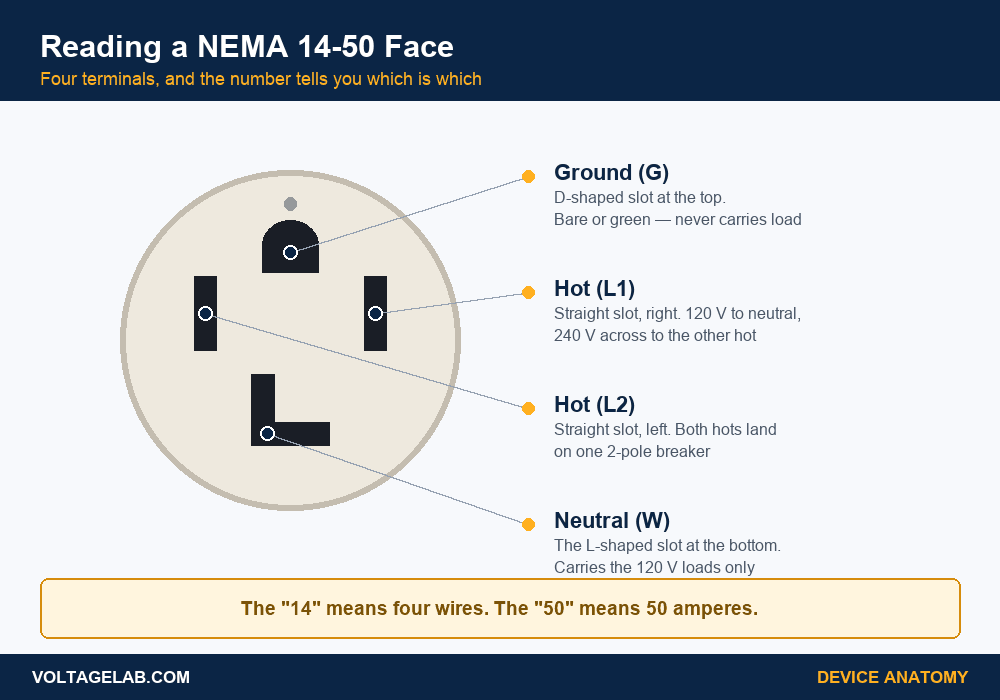
Four terminals, and each one has exactly one job:
- Two hot conductors. Straight slots left and right. Each is 120 volts to neutral and 240 volts to the other, and both land on a single 2-pole breaker.
- A neutral. The L-shaped slot at the bottom. It carries only the 120-volt portion of the load — the oven light and clock on a range, the controls on a charger.
- An equipment grounding conductor. The D-shaped slot at the top. It never carries load current, only fault current.
That neutral is the whole reason the 14-50 exists rather than a simpler three-wire device. A pure 240-volt load does not need one. An appliance with 120-volt internals does, and the Code has required it to be separate from the ground on new work since the 1996 edition.
What the numbers mean
- 14 — the NEMA configuration number: 125/250 volts, three poles, four wires including ground
- 50 — the current rating in amperes
- R — receptacle. A 14-50P is the matching plug
Read that way the family makes sense. A 14-30 is the same four-wire arrangement at 30 amps, which is the electric dryer configuration. A 6-50 drops the neutral. A 10-50 is the old three-wire range outlet with no separate ground at all.
NEMA 14-50 vs 6-50 vs 10-50 vs 14-30
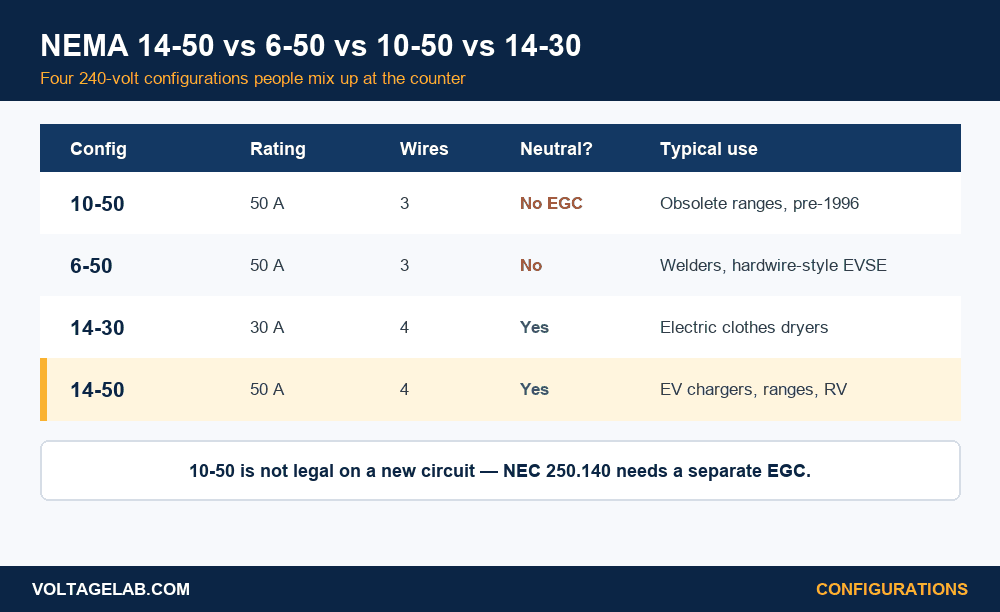
These are four different devices, and swapping one for another is not a matter of preference:
| Configuration | Rating | Conductors | Separate EGC? | Legal on new work? |
|---|---|---|---|---|
| NEMA 10-50 | 50 A, 125/250 V | 2 hot + neutral | No | No — 250.140 |
| NEMA 6-50 | 50 A, 250 V | 2 hot + ground | Yes | Yes, no neutral |
| NEMA 14-30 | 30 A, 125/250 V | 2 hot + neutral + ground | Yes | Yes — dryers |
| NEMA 14-50 | 50 A, 125/250 V | 2 hot + neutral + ground | Yes | Yes — ranges, EV, RV |
The 6-50 deserves a note. It carries the same 50 amperes with one fewer conductor, and for an EV charger that is genuinely all you need, because charging is a pure 240-volt load. Where the 14-50 wins is flexibility: the same outlet takes a range, an RV cord and a charger, and the equipment manufacturers standardised on it.
The retrofit that fails inspection: swapping a 14-50 onto an existing three-wire 10-50 range circuit by landing the ground and neutral on the same terminal. That bonds the appliance frame to a current-carrying conductor. NEC 250.140 permits frame grounding through the neutral only on existing branch circuits that already had no equipment grounding conductor, and only under specific conditions — it never permits creating that arrangement on a new device. If the cable is three-wire, either pull a new four-wire run or leave the 10-50 alone.
Sizing the circuit — breaker and conductors
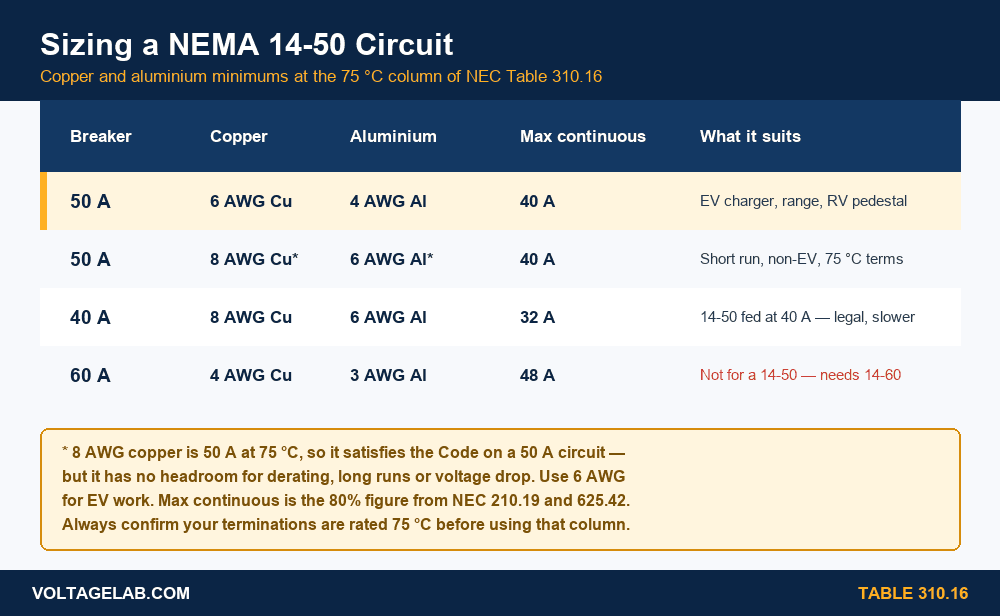
A NEMA 14-50 is normally fed by a 2-pole 50-amp breaker. Conductor size comes out of the 75 °C column of NEC Table 310.16, because that is almost always the termination rating of the breaker and the receptacle under 110.14(C).
| Conductor | Copper 60 °C | Copper 75 °C | Aluminium 75 °C | Use on a 14-50 circuit |
|---|---|---|---|---|
| 10 AWG | 30 A | 35 A | 30 A | Too small — not a 50 A circuit |
| 8 AWG | 40 A | 50 A | 40 A | Copper meets 50 A exactly; aluminium is a 40 A circuit |
| 6 AWG | 55 A | 65 A | 50 A | The normal choice — copper with headroom, aluminium at the limit |
| 4 AWG | 70 A | 85 A | 65 A | Long runs, voltage drop, or aluminium with headroom |
The 8 AWG copper question comes up on every job. At 75 °C it is rated exactly 50 amperes, so it satisfies the Code on a 50-amp circuit. What it does not have is margin — no room for a derate if the run shares a conduit, nothing left for voltage drop on a long garage run, and no headroom if the customer later wants a bigger charger. For EV work, run 6 AWG. Our walkthrough of voltage drop calculations is the quick way to check whether a long run pushes you to 4 AWG.
How to size a NEMA 14-50 circuit, step by step
- Confirm the panel can carry it. Run a load calculation before you promise a 50-amp circuit — our guide to calculating home electrical load before adding an EV charger covers the method, and an undersized service is the most common reason the job stops.
- Pick the breaker. Two-pole 50 amp for a full 14-50. A 40-amp breaker is permitted and gives a 32-amp continuous charging limit, which is a legitimate answer on a tight panel.
- Size the conductors from the 75 °C column. 6 AWG copper or 4 AWG aluminium for 50 amps in normal conditions.
- Size the equipment grounding conductor. From NEC Table 250.122, a 50-amp circuit takes 10 AWG copper — see our notes on bare copper ground wire sizing.
- Check derating and voltage drop. Ambient temperature, conductor count, and run length all reduce what the table gives you.
- Choose the box and the device. A 14-50 needs real box volume, and a commercial-grade receptacle rather than the cheapest one on the shelf.
- Torque every termination. NEC 110.14(D) requires the manufacturer’s marked value — see our guide to torque screwdrivers and NEC 110.14(D). Loose 50-amp terminations are the number one cause of burned 14-50 receptacles.
The one that catches everyone: the 80% rule. EV charging is a continuous load, so NEC 625.42 sizes the circuit at 125% of the charger’s rating — which means a 50-amp circuit supports 40 amps of continuous draw, not 50. That is not a manufacturer being conservative; it is why every 14-50 charger on the market is a 40-amp unit. A range is not a continuous load and gets demand factors from NEC 220.55 instead.
GFCI protection — 210.8(A) and 625.54
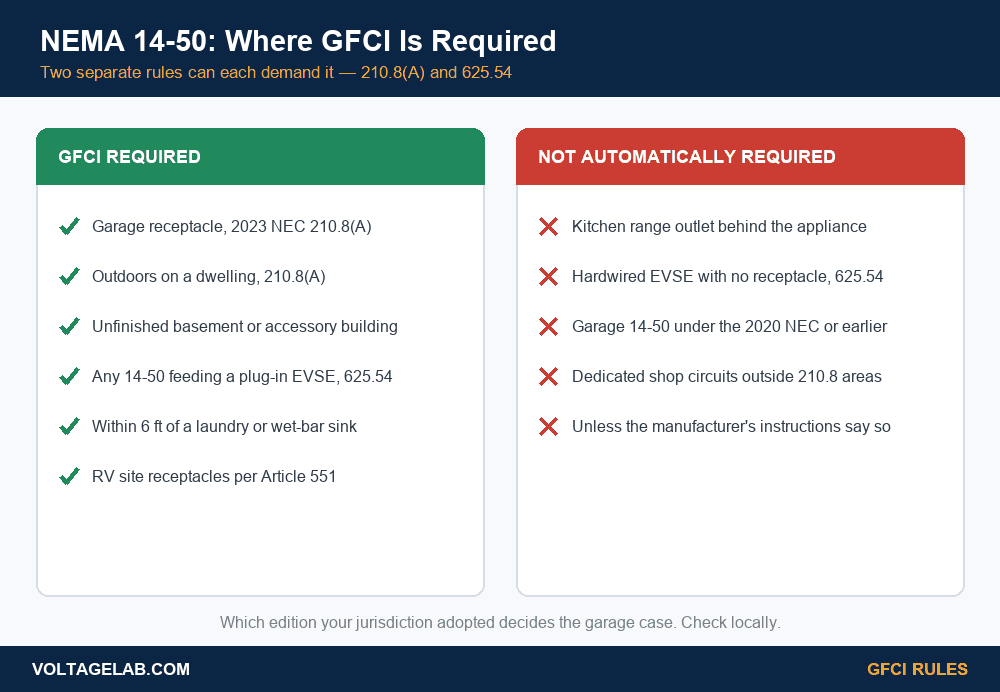
Two independent rules can each require GFCI protection on a 14-50, and people argue about this because they are reading only one of them.
Where 210.8(A) requires it
The 2020 NEC applied dwelling-unit GFCI protection to 125-volt, 15- and 20-ampere receptacles, which left a 250-volt 14-50 outside the rule. The 2023 edition rewrote 210.8(A) to cover 125-volt through 250-volt receptacles supplied by single-phase branch circuits rated 150 volts or less to ground, at 50 amperes or less. A garage 14-50 is squarely inside that. So are outdoor, unfinished basement and accessory building locations.
Where 625.54 requires it
NEC 625.54 is about the equipment, not the room. It requires GFCI protection for receptacles that supply cord-and-plug-connected EVSE, in all configurations. That applies whether the outlet is in a garage, a carport or a detached shop. The outlet supplying direct-connected EVSE is not required to be GFCI protected unless the manufacturer’s instructions say so — which is the strongest practical argument for hardwiring.
Study smarter with VoltageLab
Built for electricians, apprentices, and electrical engineers who want faster practice and better exam prep.
⭐️ Join thousands of electricians upgrading their skills
The nuisance tripping problem
Level 2 chargers contain their own ground-fault detection — a CCID20 device — and stacking a 5 mA Class A GFCI breaker in front of it produces false trips on some combinations of charger and breaker. It is a real and well-documented conflict, and it is not a reason to leave the protection out. The fixes are to use a breaker the charger manufacturer lists as compatible, to check for firmware updates, or to hardwire the unit so 625.54 no longer applies. If you are chasing an intermittent trip, our guide to testing a GFCI the right way and the breakdown of GFCI vs AFCI requirements are the place to start.
NEMA 14-50 receptacle vs a hardwired charger
| Consideration | NEMA 14-50 receptacle | NEMA 6-50 receptacle | Hardwired EVSE |
|---|---|---|---|
| Max continuous charging | 40 A | 40 A | 48 A or more |
| GFCI required by 625.54 | Yes | Yes | No |
| Neutral needed | Yes | No | Usually no |
| Charger swaps without an electrician | Yes | Yes | No |
| Also serves a range or RV | Yes | No | No |
| Outdoor exposure | Needs a weatherproof in-use cover | Needs a weatherproof in-use cover | Best option |
The honest recommendation is that the receptacle wins on flexibility and the hardwired unit wins on everything else. If the customer wants faster than 40 amps, or the charger lives outdoors, or the GFCI conflict has already bitten once, hardwire it. Either way the circuit is an individual branch circuit under 625.40 — see branch circuit types explained for what that term means in the Code, and NEC Article 210 for how the rating is set.
Is a NEMA 14-50 the right choice?
Pros
- One outlet serves an EV charger, an electric range and an RV cord
- The customer can swap or take the charger with them without an electrician
- Every Level 2 charger manufacturer offers a 14-50 plug version
- Cheaper and faster to install than a hardwired unit on a first visit
- Adds resale value as a general-purpose 50-amp outlet, not just a charger
Cons
- Caps charging at 40 amps, where a hardwired unit reaches 48 and above
- GFCI is mandatory under 625.54 and can conflict with the charger’s own protection
- Cheap receptacles overheat under daily 40-amp cycling
- Needs a neutral you may not otherwise have to pull
Installing a 14-50 in the field
Do
- Buy a commercial or industrial grade receptacle for daily EV cycling
- Torque every terminal to the marked value with a calibrated tool
- Mount it 18 to 48 inches up so the cord does not hang on the plug
- Use a weatherproof in-use cover on anything outdoors
- Run the load calculation before you quote the job
Avoid
- Landing the ground and neutral on the same terminal
- Feeding a 14-50 from a shared circuit — 625.40 requires an individual one
- Using 8 AWG on a long EV run because it technically passes
- Leaving GFCI protection out because the charger has its own
- Reusing a three-wire range cable for a new four-wire device
Frequently asked questions
What wire size do I need for a NEMA 14-50 outlet?
6 AWG copper or 4 AWG aluminium on a 50-amp breaker for normal work. 8 AWG copper is rated exactly 50 amperes at 75 °C so it meets the Code, but it leaves no margin for derating, long runs or a future upgrade. For EV charging, run 6 AWG.
Can a NEMA 14-50 be on a 40-amp breaker?
Yes. NEC 210.21(B)(1) requires a single receptacle on an individual branch circuit to have a rating not less than the circuit, and a 50-amp receptacle on a 40-amp circuit satisfies that. The practical result is a 32-amp continuous charging limit, which is a reasonable answer when the panel cannot carry more.
How many amps can I actually draw from a 14-50?
50 amps intermittently, 40 amps continuously. Anything running more than three hours is a continuous load and is limited to 80% of the circuit rating, which is why 14-50 EV chargers are 40-amp units.
Does a NEMA 14-50 outlet need GFCI protection?
If it feeds a plug-in EV charger, yes — NEC 625.54, anywhere. If it is in a garage, outdoors, an unfinished basement or another 210.8(A) location and your jurisdiction is on the 2023 NEC or later, yes. A range outlet in a kitchen is generally not in either category.
Is a NEMA 14-50 the same as a range outlet?
It is the modern range outlet. Ranges installed before the 1996 Code change often use the three-wire NEMA 10-50, which has no separate equipment grounding conductor and cannot be installed on new work.
Can I convert a 10-50 range outlet to a 14-50?
Only by pulling a four-wire circuit. The existing three-wire cable has no equipment grounding conductor, and bonding the ground terminal to the neutral to make the device fit is a violation and a shock hazard. There is no compliant adapter for this.
Can I put two 14-50 outlets on one circuit?
Not for EV charging. NEC 625.40 requires an individual branch circuit for each EV outlet above 16 amperes or 120 volts, with nothing else on it. For non-EV use two 50-amp receptacles on one circuit is possible but rarely sensible, since either one can draw the full rating.
Why do NEMA 14-50 receptacles burn up?
Almost always a loose or under-torqued termination, or a residential-grade device being cycled at 40 amps for hours every night. The contact heats, the plastic degrades, and the resistance climbs. A commercial-grade receptacle and a correctly torqued connection eliminate nearly all of it.
The bottom line
The NEMA 14-50 earns its place because one 50-amp outlet covers three jobs — an EV charger, a range and an RV cord — and because the customer can change chargers without calling you back. The cost of that flexibility is a neutral you have to pull, a 40-amp ceiling on continuous charging, and GFCI protection that 625.54 does not let you skip.
The two restraints that matter are both about not cutting the margin too fine: run 6 AWG rather than the 8 AWG that technically passes, and buy a commercial-grade device rather than the cheapest one on the shelf. Both cost very little on the day and both are what separate a 14-50 that runs for twenty years from one that comes back discoloured. Before you quote any of it, run the numbers with our guide to calculating your home’s electrical load.
FREE PRACTICE TOOL
Think you'd pass this on a real exam?
Test what you just read with instant-feedback quizzes built around real code questions — not generic trivia.
5
Code standards
10,000+
Active learners
100%
Free to start
Instant explanations on every answer, right or wrong
NEC, BS7671, AS/NZS, CEC, and DIN VDE covered
Bite-sized quizzes you can finish in 5 minutes
No signup required to try your first quiz
No account needed · Takes less than 2 minutes