


Open the door on a two-year-old panel that has been running a rooftop unit and you can usually find the bad lug without a meter. The insulation nearby has gone amber, the lug body is discoloured, and the conductor slides in the barrel when you tug it. Nobody installed the wrong wire. Somebody tightened that terminal by feel, and the connection had been slowly cooking ever since.
That is the failure a torque screwdriver exists to prevent, and it is the reason the Code stopped treating one as optional equipment. NEC 110.14(D) makes tightening to the manufacturer’s marked value a requirement, not a best practice — and inspectors in a growing number of jurisdictions now ask to see the tool.
Study smarter with VoltageLab
Built for electricians, apprentices, and electrical engineers who want faster practice and better exam prep.
⭐️ Join thousands of electricians upgrading their skills
This guide covers what a torque screwdriver actually does, exactly what 110.14(D) says in each Code edition, where the torque number comes from when the equipment does not carry one, which terminations the rule reaches, and how to pick and maintain a tool that will still be accurate a year from now.
Quick Answer
A torque screwdriver is a screwdriver with a clutch that releases at a preset value, so a terminal screw is tightened to a measured number instead of to how the handle feels. NEC 110.14(D) requires that wherever the equipment or its installation instructions give a numeric tightening torque, an approved means is used to reach it — and a torque tool is the approved means almost everyone uses.
For panel and device work you want a tool covering roughly 10–50 lb-in with a 1/4 in hex drive and an insulated blade. Larger lugs run well past that and need a torque wrench instead. If the equipment carries no numeric value at all, 110.14(D) has nothing to enforce — fall back to NEC Informative Annex I, which reprints the default tables from UL 486A-486B.
Key Takeaways
- NEC 110.14(D) has required torqued terminations since the 2017 edition, and every edition since has kept the rule
- The 2017 text demanded a calibrated torque tool; the 2020 edition broadened it to “an approved means,” which also covers shear-bolt and breakaway indicators
- The rule is triggered by a numeric value on the equipment or in the instructions — no number, no 110.14(D) obligation
- A torque screwdriver covering 10–50 lb-in handles breakers, device screws and small mechanical lugs; bigger lugs need a torque wrench
- NEC Informative Annex I reprints the UL 486A-486B default torque tables for use only when the manufacturer gives no value
- Under-torquing causes resistance, heat and eventual failure; over-torquing crushes strands and cracks lug bodies, and both fail inspection
- Torque tools drift — most manufacturers specify recalibration every 12 months or 5,000 cycles, whichever comes first
What a torque screwdriver is
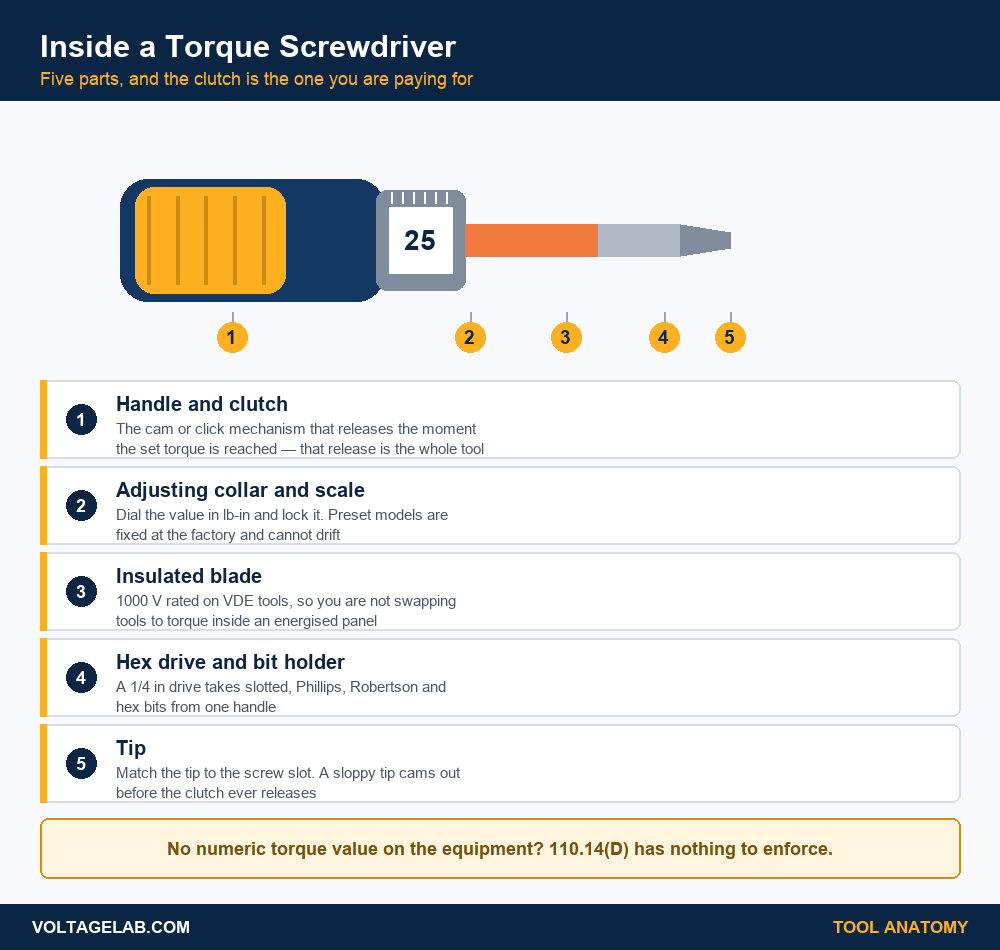
Mechanically it is an ordinary screwdriver with a clutch between the handle and the blade. You set a value on the collar, drive the screw, and at the set point the clutch either cams over with a distinct slip or clicks and breaks away. Keep turning and nothing more goes into the screw. The tool is not measuring torque so much as refusing to deliver more than the amount you dialled in.
Study smarter with VoltageLab
Built for electricians, apprentices, and electrical engineers who want faster practice and better exam prep.
Join thousands of electricians upgrading their skills
- Adjustable. A collar you dial between roughly 10 and 50 lb-in, then lock. One tool covers most panel and device work.
- Preset. Fixed at the factory to a single value. Faster and impossible to knock off setting, which is why production shops buy them in sets.
- Cam-over. Physically cannot exceed the set value, because the drive disengages. The safest choice for anyone still building the habit.
- Click / breakaway. Signals the set point but will keep driving if you push through the click. Faster to work with, less forgiving.
Reading the scale: lb-in, in-lb and N·m
Equipment labels in North America are usually marked lb-in (also written in-lb or inch-pounds); the Code tables and most European tools use N·m. One newton metre is about 8.85 lb-in, so a 4.0 N·m lug is a 35 lb-in lug. The trap is lb-ft: mistake 35 lb-in for 35 lb-ft and you have applied twelve times the intended torque, which will destroy the terminal. Read the unit before you read the number.
What NEC 110.14(D) actually says
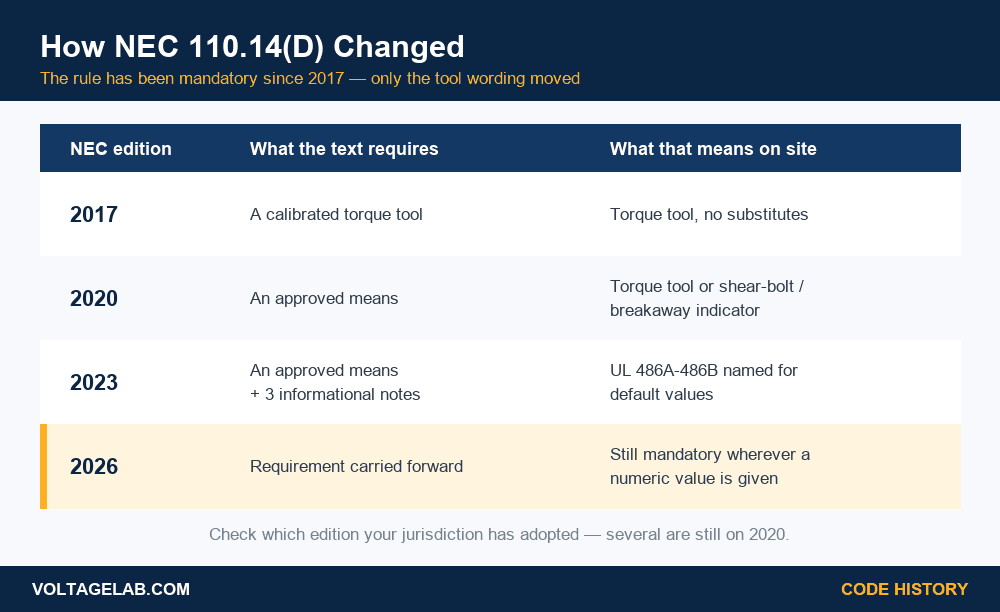
The requirement first appeared in the 2017 NEC as 110.14(D) Installation, and it was blunt: where a tightening torque is indicated as a numeric value on the equipment or in the manufacturer’s installation instructions, a calibrated torque tool must be used to achieve it, unless the manufacturer provides instructions for an alternative method.
The 2020 edition renamed the section Terminal Connection Torque and softened the tool language to “an approved means,” a wording the 2023 edition keeps. Three informational notes came with it: approved means include torque tools and devices such as shear bolts or breakaway indicators; the manufacturer can be contacted when no numeric value is available, with UL 486A-486B cited for defaults; and NFPA 70B is cited for further guidance on torquing threaded terminations.
| NEC edition | Section title | Tool language | Practical effect |
|---|---|---|---|
| 2017 | 110.14(D) Installation | A calibrated torque tool | Torque tool required, no substitutes |
| 2020 | 110.14(D) Terminal Connection Torque | An approved means | Torque tool, or a shear-bolt or breakaway indicator |
| 2023 | 110.14(D) Terminal Connection Torque | An approved means, plus notes | UL 486A-486B named as the default source |
| 2026 | 110.14(D) Terminal Connection Torque | Requirement carried forward | Still mandatory wherever a value is given |
Adoption is what decides which of those rows applies to you. States and cities adopt Code editions on their own schedule, so plenty of jurisdictions are still enforcing the 2020 text while their neighbours have moved on — our summary of the NEC 2026 code book changes is a useful starting point, but confirm locally. The rest of Article 110, general requirements for electrical installations, is where the surrounding termination rules live.
The trap that fails inspections: going back over a finished panel with a torque screwdriver and “checking” every lug. Connections relax in service, so a re-check does not tell you what was applied at installation — and each extra pass adds torque the terminal was never designed to see. NEC Informative Annex I says so explicitly. Torque each terminal once, correctly, and record it.
Where the torque value comes from
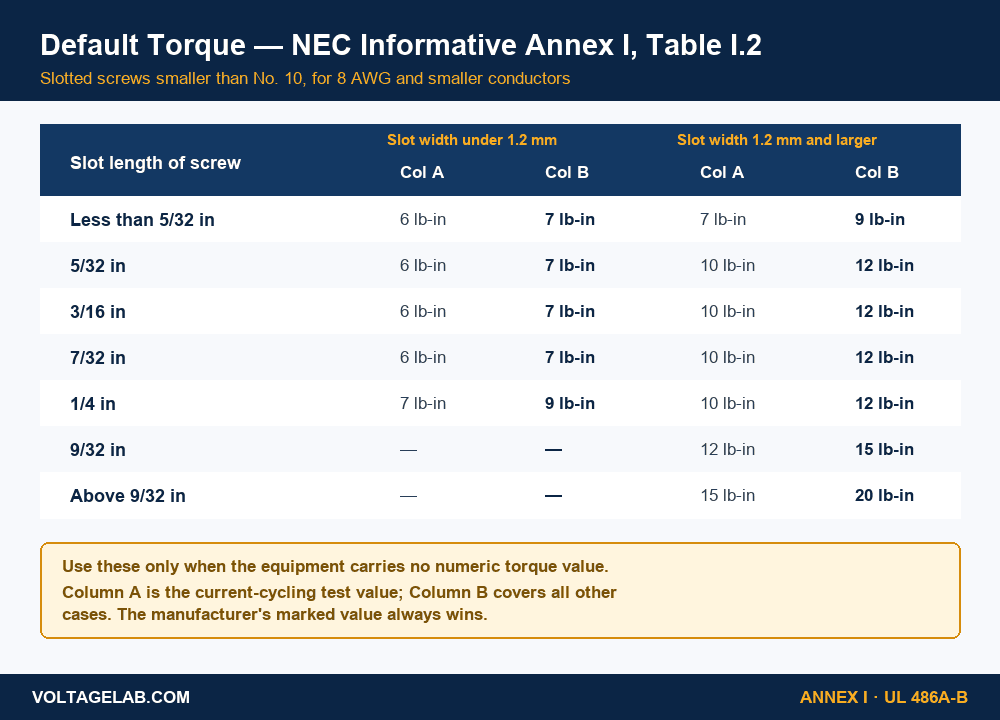
The manufacturer’s number always wins. It is printed on the lug, stamped inside the breaker door, moulded into the device body, or listed in the instruction sheet in the carton — and 110.14(D) points at that number and nothing else. Only when there is genuinely no value anywhere do you fall back to the defaults reprinted in NEC Informative Annex I from UL 486A-486B.
| Slot length of screw | Slot under 1.2 mm — Col A | Slot under 1.2 mm — Col B | Slot 1.2 mm and over — Col A | Slot 1.2 mm and over — Col B |
|---|---|---|---|---|
| Less than 5/32 in | 6 lb-in | 7 lb-in | 7 lb-in | 9 lb-in |
| 5/32 in | 6 lb-in | 7 lb-in | 10 lb-in | 12 lb-in |
| 3/16 in | 6 lb-in | 7 lb-in | 10 lb-in | 12 lb-in |
| 7/32 in | 6 lb-in | 7 lb-in | 10 lb-in | 12 lb-in |
| 1/4 in | 7 lb-in | 9 lb-in | 10 lb-in | 12 lb-in |
| 9/32 in | — | — | 12 lb-in | 15 lb-in |
| Above 9/32 in | — | — | 15 lb-in | 20 lb-in |
Annex I carries two more tables. Table I.1 covers slotted head screws No. 10 and larger and hexagonal head external drive screws, running from 15 lb-in on a small slotted screw up to 1,100 lb-in on a split-bolt connector for 800–1000 kcmil. Table I.3 covers recessed Allen and square drives by socket width across flats, from 35 lb-in at 1/8 in up to 600 lb-in at 9/16 in. A torque screwdriver only reaches the bottom of that range; everything above roughly 50 lb-in belongs to a torque wrench.
How to torque a termination correctly
- Find the number and its unit. Check the lug, the label inside the door, and the instruction sheet, in that order. Confirm whether it reads lb-in, lb-ft or N·m.
- Confirm the conductor is right for the terminal. Torque does not rescue a conductor the lug is not listed for, or a run sized off the wrong column of NEC Table 310.16.
- Set the tool and lock the collar. Approach the setting upward from a lower value, never wind down onto it, and lock the ring before you start.
- Seat the conductor fully. Strip to the marked length, push the conductor to the back of the barrel, and check no strands sit outside the pressure plate.
- Drive smoothly to the release. Steady pressure, square to the screw, and stop at the cam-over or click. Do not add “one more nudge.”
- Mark and record it. A torque-seal stripe or a paint marker shows the next person the terminal was done, and a note in the job file gives you a record when the panel is investigated years later.
The one that catches everyone: aluminium conductors. They creep under sustained pressure far more than copper, so the marked torque and an antioxidant compound are both part of a listed installation — and a lug that was guessed at will loosen on its own. This is the mechanism behind most of the trouble in aluminum wiring in older homes.
Which terminations 110.14(D) reaches
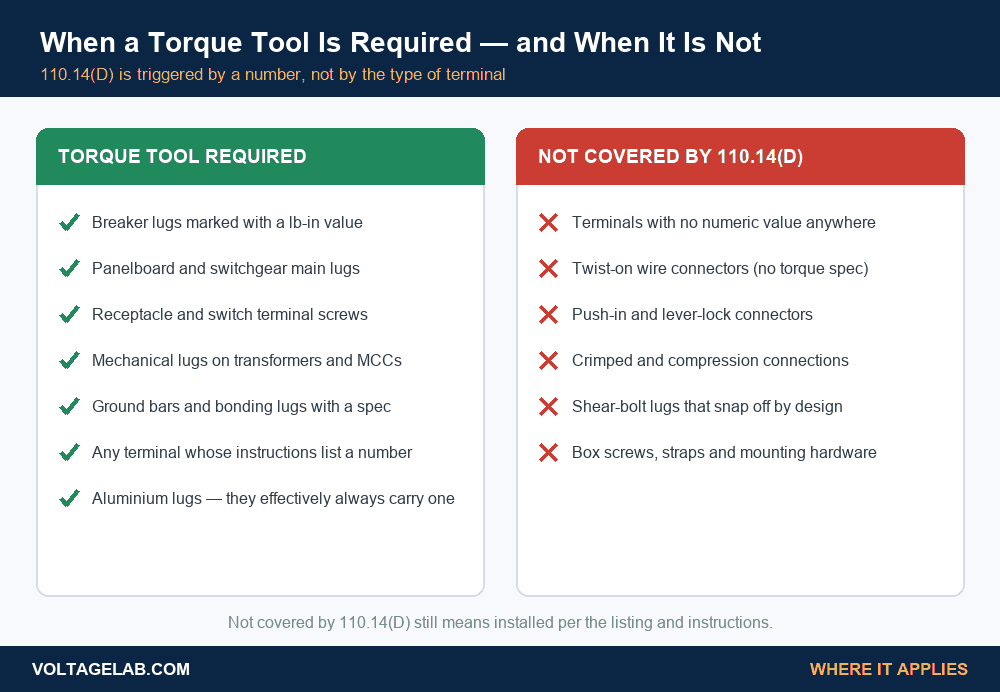
The rule is triggered by a number, not by the kind of terminal. If a numeric torque value exists anywhere the manufacturer put it, you owe an approved means of reaching it.
Terminations that need a torque tool
- Breaker load lugs, which almost always carry a lb-in value on the body or the door label — see our overview of circuit breaker types and working principles
- Panelboard and switchgear main lugs, neutral bars and ground bars
- Receptacle and switch terminal screws, which are the small-screw case in Annex I Table I.2
- Mechanical lugs on transformers, disconnects and motor control centres
- Bonding lugs and grounding terminations that carry a marked value, including the ones covered when you ground an electrical panel
- Any terminal whose installation instructions list a number, however obscure the sheet
Connections 110.14(D) does not reach
- Twist-on wire connectors, which are listed to be tightened by hand and carry no torque value
- Push-in and lever-lock connectors, where the spring supplies the force
- Crimped and compression connections, governed by die and tool selection instead
- Shear-bolt lugs, where the bolt head snaps off at the design torque — the indicator the 2020 informational note describes
- Box screws, straps, covers and mounting hardware, which are not conductor terminations
Outside 110.14(D) still means installed per the listing and the instructions under 110.3(B). The rule narrows what must be torqued; it does not make anything else optional.
Torque and the termination temperature rating
110.14 is one section, and its parts work together. 110.14(C) limits you to the temperature rating of the termination — usually 60 °C or 75 °C — no matter what the conductor’s insulation is rated for, which is why the 90 °C column of the ampacity table is a derating starting point rather than a breaker size. That interaction is worked through in detail in our guide to THHN / THWN-2 wire ratings and uses. A correctly torqued lug is what keeps the connection at the temperature the listing assumed.
Torque screwdriver vs the other torque tools
| Need | Torque screwdriver | T-handle torque driver | Torque wrench | Shear-bolt lug |
|---|---|---|---|---|
| Typical range | 10–50 lb-in | 40–250 lb-in | 100–1,100 lb-in | Fixed by design |
| Device and breaker screws | Yes | Overkill | No | No |
| Feeder and service lugs | No | Some | Yes | Yes |
| Available insulated to 1000 V | Yes | Yes | Limited | N/A |
| Needs periodic recalibration | Yes | Yes | Yes | No |
| Best single first purchase | Yes | Second tool | Second tool | Not a tool |
Most electricians end up carrying two: an insulated torque screwdriver for devices and breakers, and a 3/8 in drive torque wrench for anything with a hex socket lug. If you are assembling a Code-focused kit, the torquing rule sits alongside the working-space rules in NEC 110.26 electrical panel clearance and the protective equipment covered in PPE for electrical work — all three come up on the same inspection.
Study smarter with VoltageLab
Built for electricians, apprentices, and electrical engineers who want faster practice and better exam prep.
⭐️ Join thousands of electricians upgrading their skills
Is a torque screwdriver worth buying?
Pros
- Satisfies 110.14(D) with a tool an inspector recognises on sight
- Removes the single most common cause of loose-connection heating
- Insulated 1000 V versions mean no tool swap on an energised panel
- Cheaper than one callback on a burned lug
- Gives you something defensible to say when a failure is investigated
Cons
- Needs recalibration, which is an ongoing cost most tools do not have
- One driver will not cover the whole range from device screws to service lugs
- Slower than a cordless driver on a panel full of terminations
Using a torque screwdriver in the field
Do
- Wind the setting up to the value rather than down onto it
- Return an adjustable tool to its lowest setting before it goes in the bag
- Match the bit to the screw so the tip cannot cam out early
- Mark torqued terminals and note the values in the job file
- Send the tool for recalibration at 12 months or 5,000 cycles
Avoid
- Reading lb-ft off a label that says lb-in
- Pushing through the click for a bit of extra bite
- Re-torquing terminals you already tightened on an earlier visit
- Using the tool as a breaker bar to loosen a seized screw
- Reaching for Annex I when the manufacturer’s value is on the label
Frequently asked questions
Does the NEC require a torque screwdriver?
Effectively, yes, wherever a numeric torque value is given. NEC 110.14(D) requires an approved means of reaching the manufacturer’s marked value, and for device screws and breaker lugs a torque screwdriver is the practical way to do it. If the equipment carries no numeric value, the section does not apply.
What torque range should an electrician’s torque screwdriver cover?
Roughly 10 to 50 lb-in covers receptacle and switch screws, breaker load lugs and small mechanical lugs. Anything above that — feeders, service lugs, split bolts — needs a torque wrench, since Annex I values there run into the hundreds of lb-in.
How often does a torque screwdriver need calibration?
Most manufacturers and ISO 6789 practice put it at 12 months or 5,000 cycles, whichever comes first, and sooner if the tool is dropped or used outside its range. An uncalibrated torque tool is not an approved means of anything.
What happens if you over-torque a terminal?
You crush and fracture strands, deform the lug body, and can strip or crack the screw. The contact area drops instead of rising, so an over-torqued connection heats for the same reason a loose one does. Over-torquing is not the safe side of the error.
Can I torque a terminal by feel if I have been doing it for years?
Not where a numeric value is marked — 110.14(D) does not have a competence exemption. The industry testing behind the rule found experienced electricians scattering widely around the target when working by hand, in both directions — too loose about as often as too tight.
Where do I find the torque value if the label is missing?
Check the instruction sheet, then the manufacturer’s published documentation, then contact the manufacturer — that is the order the informational notes to 110.14(D) set out. Only when none of that yields a value do you use the default tables in NEC Informative Annex I.
Do wire nuts need to be torqued?
No. Twist-on wire connectors are listed to be installed by hand and carry no numeric torque value, so 110.14(D) has nothing to enforce. They still have to be installed per their listing, including the conductor count and combination the connector is rated for.
Is a cam-over or a click torque screwdriver better?
Cam-over is the safer choice, because the drive physically disengages and cannot deliver more than the set value. Click models are faster but will keep applying torque if you push past the click, which is the most common way a torque tool gets misused.
The bottom line
A torque screwdriver earns its place because it converts the one step in a termination that used to be pure judgement into a number anyone can check. NEC 110.14(D) has required that since 2017, the 2020 edition only widened which tools count, and inspectors are asking about it far more than they were five years ago.
The two restraints that matter are both about discipline rather than technique: use the manufacturer’s marked value and treat Annex I strictly as a fallback, and torque each terminal once instead of going back over a finished panel. Keep the tool calibrated, buy the insulated version, and pair it with the sizing habits in the NEC 310.16 ampacity chart — the conductor and the connection are what fail together.
FREE PRACTICE TOOL
Think you'd pass this on a real exam?
Test what you just read with instant-feedback quizzes built around real code questions — not generic trivia.
5
Code standards
10,000+
Active learners
100%
Free to start
Instant explanations on every answer, right or wrong
NEC, BS7671, AS/NZS, CEC, and DIN VDE covered
Bite-sized quizzes you can finish in 5 minutes
No signup required to try your first quiz
No account needed · Takes less than 2 minutes