


Walk a commercial site a week before the slab pour and you will usually find it coiled on a reel next to the rebar: a few hundred feet of heavy bare copper, waiting to go in the perimeter trench. The crew calls it the ground ring, the engineer drew it on E-001, and almost nobody on site can tell you what the NEC actually requires it to be.
That gap costs money. A ground ring is one of the few electrodes you get exactly one chance at — once the trench is backfilled and the sidewalk is poured, a ring that used 4 AWG instead of 2 AWG, or that stopped 30 feet short of closing, is not something you fix with a service call. The inspector who catches it is asking you to dig.
Study smarter with VoltageLab
Built for electricians, apprentices, and electrical engineers who want faster practice and better exam prep.
⭐️ Join thousands of electricians upgrading their skills
This guide covers what NEC 250.52(A)(4) requires of a ground ring, how deep 250.53(F) makes you bury it, how to size the grounding electrode conductor to it under the 250.66(C) allowance, where a ring beats a driven rod, and the four ways a “ground ring” on the plans turns out not to be one.
Quick Answer
A ground ring is a grounding electrode made of at least 20 ft of bare copper conductor, not smaller than 2 AWG, encircling the building or structure in direct contact with the earth. That is the whole of NEC 250.52(A)(4). NEC 250.53(F) adds the one installation rule: bury it not less than 30 in. (750 mm) below the surface of the earth.
Four words in that sentence do all the work — bare, copper, 2 AWG and encircling. Miss any one and what you buried is a length of wire in a trench, not an electrode. Unlike a ground rod, a qualifying ring never needs a supplemental electrode and never needs a 25-ohm resistance test.
Key Takeaways
- NEC 250.52(A)(4) defines a ground ring as at least 20 ft of bare copper conductor, 2 AWG or larger, encircling the building or structure in direct contact with earth
- NEC 250.53(F) requires the ground ring to be buried not less than 30 in. below the surface of the earth
- 4 AWG bare copper is the minimum for a concrete-encased electrode, not for a ground ring — a ring needs 2 AWG
- Aluminium is never a ground ring conductor: 250.52(A)(4) says copper, and 250.64(A) bars aluminium from direct earth contact
- The 25-ohm supplemental-electrode rule in 250.53(A)(2) applies only to a single rod, pipe or plate — a ground ring stands alone
- NEC 250.66(C) caps the grounding electrode conductor that is the sole connection to a ground ring at the size of the ring conductor itself
- Every electrode present at a building, ground ring included, must be bonded together into one grounding electrode system under 250.50
What a ground ring actually is — NEC 250.52(A)(4)
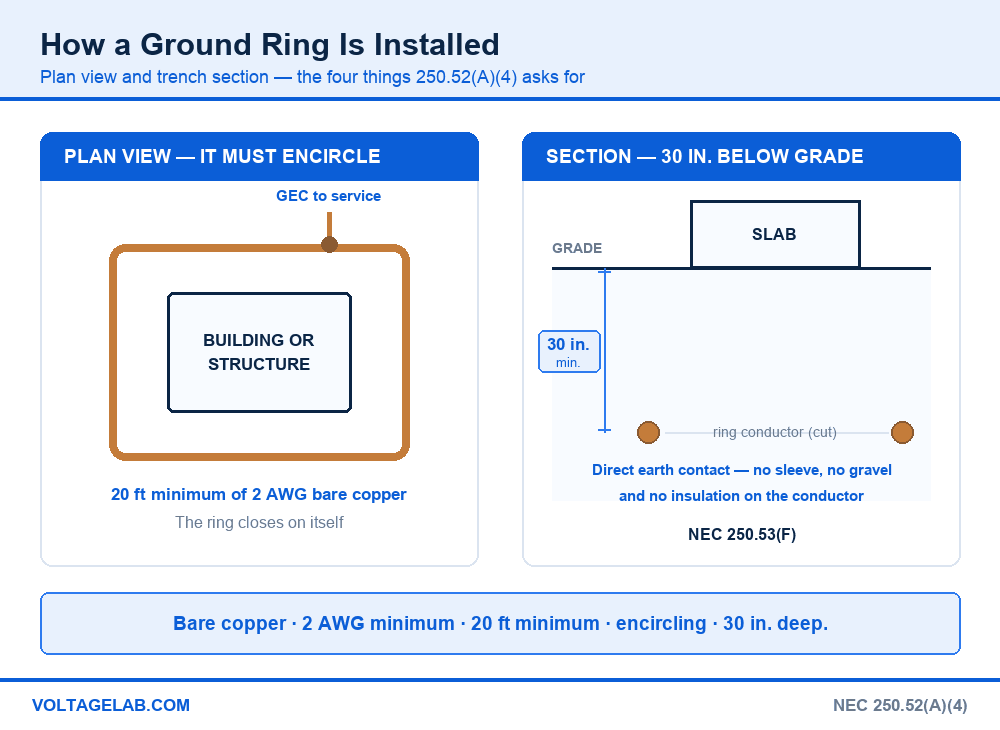
The Code spends one sentence on it. A ground ring is “a ground ring encircling the building or structure, in direct contact with the earth, consisting of at least 6.0 m (20 ft) of bare copper conductor not smaller than 2 AWG.” Everything an inspector can hold you to is inside that sentence, so it is worth taking apart clause by clause.
Pass your electrical exam the first time
Practice real NEC exam questions with full code-referenced explanations and progress tracking — built for journeyman, master and apprentice exam prep.
Thousands of NEC practice questions with code-referenced answers
The four requirements in the sentence
- Encircling the building or structure. The ring closes on itself around the perimeter. This is the clause people quietly skip, and it is the one that has no workaround.
- In direct contact with the earth. Soil against copper, the whole way around. No conduit sleeve, no gravel bed, no vapour barrier between the conductor and the dirt.
- At least 20 ft of conductor. A floor, not a target. On any real building the perimeter is far longer than 20 ft, so this only binds on small structures — a generator pad, a pump house, an equipment skid.
- Bare copper, not smaller than 2 AWG. Bare, so the metal touches soil. Copper, because the Code names copper. 2 AWG, which is a full two sizes heavier than what a concrete-encased electrode is allowed to use.
Note what is not in the sentence: no resistance target, no soil-type qualifier, no minimum distance from the foundation. The ring works by presenting a large surface of metal to a large volume of soil, which is why it performs in the conditions that defeat driven rods — thin soil over rock, sandy fill, and sites where you cannot get eight feet down.
One clause lives outside 250.52. NEC 250.53(F) is the installation rule: the ring shall be installed not less than 750 mm (30 in.) below the surface of the earth. That is deeper than the cover most underground branch circuits get under NEC 300.5, which is why the ring trench usually wants its own pass with the excavator.
Ground ring vs Ufer vs ground rods
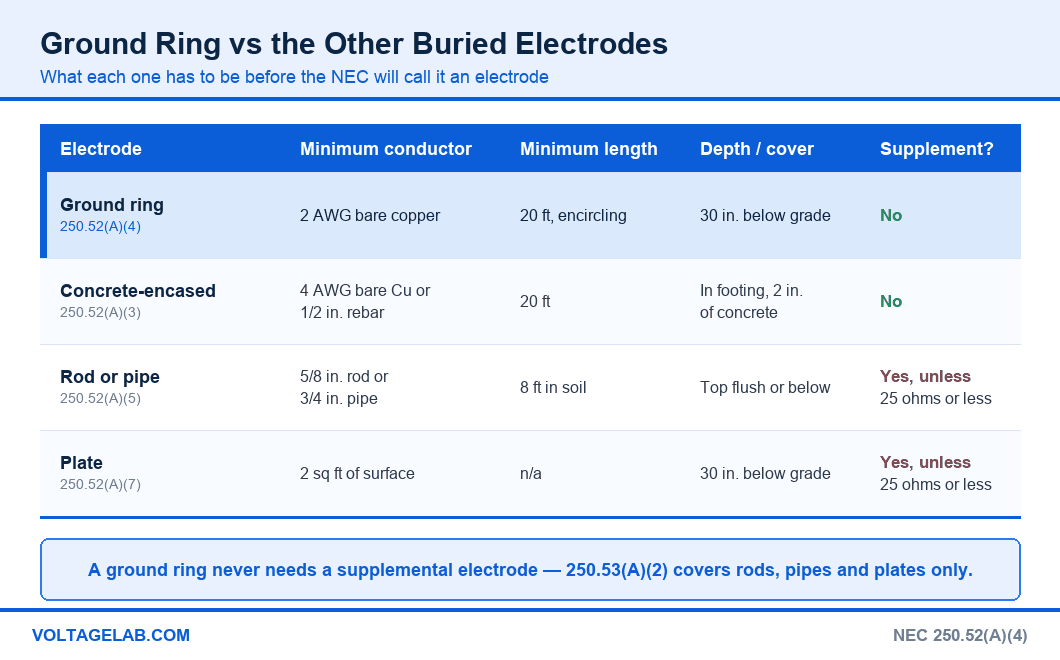
All three sit on the list of eight permitted electrodes in 250.52(A) and all three end up in the same grounding electrode system. What separates them is what the Code makes each one prove before it counts.
| Question | Ground ring 250.52(A)(4) | Concrete-encased 250.52(A)(3) | Rod or pipe 250.52(A)(5) |
|---|---|---|---|
| Minimum copper size | 2 AWG bare | 4 AWG bare | n/a — 5/8 in. rod |
| Minimum length | 20 ft, and it must encircle | 20 ft in the footing | 8 ft in contact with soil |
| Supplemental electrode required? | No | No | Yes, unless 25 ohms or less |
| GEC size capped by 250.66? | Capped at the ring conductor — 250.66(C) | Capped at 4 AWG — 250.66(B) | Capped at 6 AWG — 250.66(A) |
| Works in rocky or shallow soil | Yes | Yes | Often not |
The line that matters most in that table is the supplemental-electrode row. NEC 250.53(A)(2) requires a single rod, pipe or plate electrode to be supplemented by a second electrode unless it is proven to have a resistance to earth of 25 ohms or less. A ground ring is not a rod, pipe or plate, so that rule never reaches it. One compliant ring is a complete electrode on its own.
Code trap: 4 AWG bare copper is the minimum for a concrete-encased electrode under 250.52(A)(3). It is not the minimum for a ground ring. Crews who have run Ufer grounds for years pull 4 AWG off the reel out of habit, drop it in the perimeter trench, and hand the inspector a 20 ft loop of undersized wire. A ground ring is 2 AWG or larger, full stop — and once the sidewalk is over the trench, the fix is demolition.
Sizing the grounding electrode conductor — NEC 250.66(C)
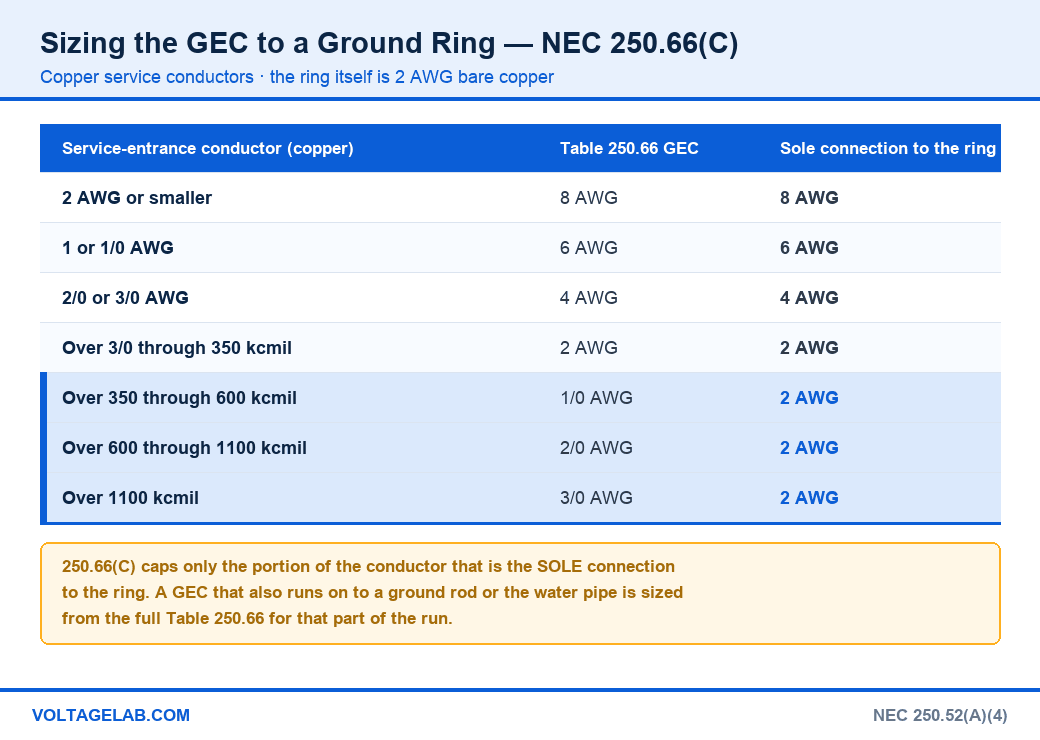
The ring is the electrode. The conductor running from the service enclosure out to it is the grounding electrode conductor, sized from Table 250.66 against the largest ungrounded service-entrance conductor — with one generous exception.
NEC 250.66(C) says that where the grounding electrode conductor is connected to a ground ring as permitted in 250.52(A)(4), the portion of that conductor which is the sole connection to the ring is not required to be larger than the conductor used for the ring itself. On a 2 AWG ring, that means the GEC to the ring tops out at 2 AWG no matter how large the service is.
| Largest service-entrance conductor (copper) | Table 250.66 GEC | Sole connection to a 2 AWG ground ring |
|---|---|---|
| 2 AWG or smaller | 8 AWG | 8 AWG |
| 1 or 1/0 AWG | 6 AWG | 6 AWG |
| 2/0 or 3/0 AWG | 4 AWG | 4 AWG |
| Over 3/0 through 350 kcmil | 2 AWG | 2 AWG |
| Over 350 through 600 kcmil | 1/0 AWG | 2 AWG |
| Over 600 through 1100 kcmil | 2/0 AWG | 2 AWG |
| Over 1100 kcmil | 3/0 AWG | 2 AWG |
The four-step method
- Find the largest ungrounded service-entrance conductor per phase, adding the cross-sectional area of parallel sets before you enter the table.
- Read the GEC out of Table 250.66. That is your baseline size, and it is the size you use if this conductor also serves any other electrode.
- Apply 250.66(C) only to the sole-connection portion. If the conductor from the service does nothing but land on the ring, cap it at the ring conductor size.
- Check the ring conductor itself. The cap is the size of the ring, so a ring built from 1/0 lets you cap at 1/0, not at 2 AWG. Never size the GEC below what Table 250.66 gives you for a smaller service.
The word doing the work is sole. Run one GEC that lands on the ring and then continues to the metal water pipe, and the portion feeding both is no longer a sole connection — size that run from the full table. If you want the 250.66(C) cap, give the ring its own conductor. Shaky on the table itself? Work through the GEC sizing exam questions first.
The one that catches everyone: the connection where the GEC meets the buried ring does not have to be accessible. The exception to 250.68(A) exempts encased or buried connections to buried electrodes — so an exothermic weld two and a half feet down is compliant and, in practice, is the right way to do it. What the connection does have to be is listed for the job: 250.70 requires exothermic welding, listed lugs, listed pressure connectors or listed clamps, and any clamp used on a buried electrode must also be listed for direct soil burial.
What counts as a ground ring — and what does not
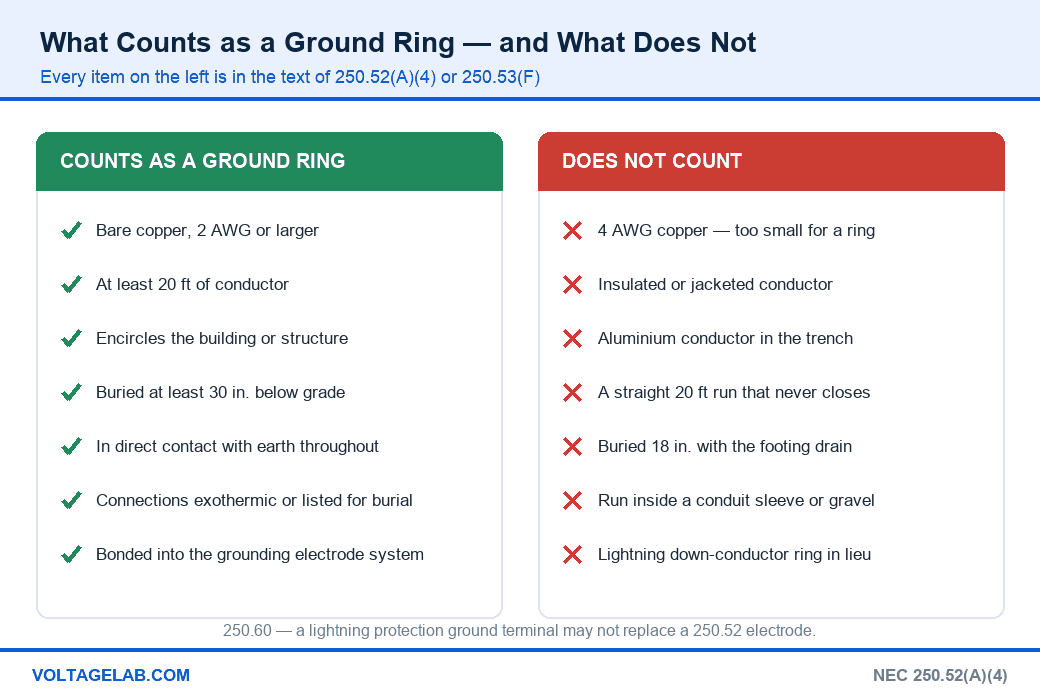
It qualifies when
- The conductor is bare copper, 2 AWG or larger, with no insulation and no jacket anywhere in the trench
- There is at least 20 ft of it, and it encircles the building or structure
- Every foot of it is in direct contact with earth — native soil or clean backfill, not gravel, sleeve or vapour barrier
- It sits 30 in. or more below finished grade per 250.53(F)
- Connections in the trench are exothermic or listed for direct soil burial per 250.70
- It is bonded into the grounding electrode system with every other electrode present, as 250.50 requires
It does not qualify when
- The conductor is 4 AWG. Correct for a Ufer, undersized for a ring.
- The conductor is insulated. Insulation is exactly what “in direct contact with the earth” rules out — this is the same reason electrode conductors in the trench are bare copper ground wire.
- The conductor is aluminium. 250.52(A)(4) names copper, and 250.64(A) separately prohibits aluminium or copper-clad aluminium in direct contact with earth. A “1/0 aluminium ground ring” is a myth that circulates widely online and fails on both counts.
- The run does not close. A straight 20 ft length of 2 AWG in a trench meets the size and length clauses and misses the word “encircling”. Some AHJs have accepted it; the text does not, and you are relying on an interpretation that the next inspector may not share.
- It is buried 18 in. Sharing the footing-drain or the service-lateral trench is convenient and 12 inches short.
- It is sleeved. Running the ring through PVC where it crosses a driveway breaks earth contact for that stretch.
Lightning protection rings are a separate system
Buildings with lightning protection often have their own counterpoise loop, and it looks identical in the trench. NEC 250.60 is explicit that a lightning protection system ground terminal shall not be used in lieu of the electrodes required by 250.52. The two systems get bonded together, but the LPS loop does not discharge your obligation. If that loop happens to be 2 AWG bare copper, encircling, at 30 in., it satisfies 250.52(A)(4) on its own merits — document it as both.
Where the ground ring sits in the grounding electrode system
A ground ring is never the whole story. NEC 250.50 requires every electrode described in 250.52(A)(1) through (A)(7) that is present at a building to be bonded together into the grounding electrode system. Present means present — you do not get to leave the metal water pipe out because the ring tests well.
| Electrode | NEC section | What makes it count |
|---|---|---|
| Ground ring | 250.52(A)(4) | 20 ft of 2 AWG bare copper, encircling, 30 in. deep |
| Metal underground water pipe | 250.52(A)(1) | 10 ft or more in direct earth contact |
| Metal in-ground support structure | 250.52(A)(2) | 10 ft or more vertically in earth contact |
| Concrete-encased electrode | 250.52(A)(3) | 20 ft of 4 AWG bare copper or 1/2 in. rebar in the footing |
| Rod, pipe or plate | 250.52(A)(5), (A)(7) | 8 ft rod in soil, or 2 sq ft of plate at 30 in. |
Bonding jumpers between electrodes are sized by 250.53(C), which points back to 250.66 — and the 250.66(C) ring allowance applies to that jumper too where it is the sole connection to the ring. If you want the full picture of how these pieces assemble, start with the eight grounding electrodes of NEC 250.52, then read what a grounding electrode is and does, how bonding jumpers are sized, and NEC Article 250 as a whole. On commercial work, the ring is also where the intersystem bonding termination ultimately gets its ground reference.
Study smarter with VoltageLab
Built for electricians, apprentices, and electrical engineers who want faster practice and better exam prep.
⭐️ Join thousands of electricians upgrading their skills
Is a ground ring the right electrode for your site?
Pros
- Complete on its own — no supplemental electrode, no 25-ohm test, no second rod
- Delivers a low, stable resistance because it presents a large copper surface to a large volume of soil
- Works where rods fail: thin soil over rock, sand, fill, and high-water-table sites
- Surrounds the structure, which flattens step and touch potential around the building during a fault or a strike
- 250.66(C) caps the GEC at the ring size, which saves real copper on large services
Cons
- Essentially impossible to retrofit — the trench has to be open, so it is a new-construction decision
- 2 AWG bare copper around a full perimeter is the most expensive electrode on the list by material cost
- A 30 in. trench around the whole building is excavation work that a pair of driven rods does not need
- Bare copper in the trench is a theft target on unsecured sites before backfill
For most one- and two-family dwellings the honest answer is no: the footing rebar is already there, a concrete-encased electrode costs almost nothing, and it carries the same “no supplement required” status. Rings earn their keep on commercial and industrial sites, on buildings full of sensitive electronics, and where you already know a rod will not go in.
Installing a ground ring in the field
Do
- Measure trench depth from finished grade, not from the stripped subgrade you are standing on
- Exothermically weld every splice and every tap in the trench — it is the only connection you never inspect again
- Bring the GEC tail up inside the building envelope and leave it long, labelled and protected until the service goes in
- Photograph the open trench with a tape in frame before backfill — it is the evidence that settles the inspection
- Bond the ring to the footing steel, the water pipe and any other electrode present, as 250.50 requires
Avoid
- Dropping the ring in the service-lateral trench to save a pass — that trench is 18 in., not 30 in.
- Backfilling with crushed stone or rubble against the conductor instead of soil
- Sleeving the ring through PVC under a drive or walk, which breaks earth contact for that run
- Bolted split-bolt connectors in the trench that are not listed for direct soil burial under 250.70
- Letting the ring stop at a loading dock or an addition and calling the open loop a ring
Frequently asked questions
What is a ground ring in the NEC?
A ground ring is one of the eight grounding electrodes permitted by NEC 250.52(A). Under 250.52(A)(4) it consists of at least 20 ft of bare copper conductor, not smaller than 2 AWG, encircling the building or structure in direct contact with the earth. It is installed in a trench around the perimeter and connected to the service through a grounding electrode conductor.
How deep does a ground ring have to be buried?
Not less than 30 in. (750 mm) below the surface of the earth, per NEC 250.53(F). That depth is measured to finished grade. Some jurisdictions amend it deeper in hard-frost regions, so check your local amendments before the excavator leaves the site.
What size wire is used for a ground ring?
2 AWG bare copper is the minimum. Larger is permitted and common on industrial sites, where 1/0 and 4/0 rings are routine. Anything smaller than 2 AWG does not qualify as a ground ring, regardless of how much of it you install.
Can a ground ring be aluminium?
No. NEC 250.52(A)(4) specifies bare copper conductor, and NEC 250.64(A) separately prohibits aluminium and copper-clad aluminium conductors where in direct contact with earth, masonry or corrosive conditions. Claims that 1/0 aluminium is an acceptable ground ring conductor appear on several code-summary sites and are wrong on both counts.
Does a ground ring need a supplemental ground rod?
No. The supplemental-electrode requirement in NEC 250.53(A)(2) applies only to a single rod, pipe or plate electrode. A compliant ground ring is a complete electrode by itself and never triggers the 25-ohm resistance test. If a rod is already present at the building, though, 250.50 still requires you to bond it into the system.
Does a ground ring have to fully encircle the building?
The text of 250.52(A)(4) says “encircling the building or structure”, so the compliant answer is yes. This is a long-running argument on contractor forums, and some inspectors accept 20 ft of buried 2 AWG in any configuration. Do not build a job around that reading — closing the loop costs conductor, and an open loop that a plan reviewer rejects costs the trench.
What size grounding electrode conductor connects to a ground ring?
Size it from Table 250.66 against the largest ungrounded service-entrance conductor, then apply NEC 250.66(C): the portion of the conductor that is the sole connection to the ring is not required to be larger than the ring conductor. On a 2 AWG ring, that caps the GEC at 2 AWG even on a 2000 A service.
Is a ground ring better than two ground rods?
Electrically, almost always — a ring puts far more copper in contact with far more soil, and it does not depend on getting eight feet down. Practically, two rods are a fraction of the cost and can be driven any time, including years after the building is finished. The ring wins when it is designed in before excavation and the site conditions are hostile to rods.
The bottom line
A ground ring earns its place by being the one electrode that does not need help. Twenty feet of 2 AWG bare copper, encircling the structure, 30 inches down, and you have a complete grounding electrode — no supplemental rod, no resistance test, and a GEC capped at the size of the ring itself. Where driven rods hit rock at four feet, that is worth the trench.
Two restraints decide whether you get it. The first is timing — the ring goes in while the trench is open or it does not go in at all, which makes it a design decision rather than a field one. The second is the four words in 250.52(A)(4): bare, copper, 2 AWG, encircling. Miss any of them and you have buried expensive wire that the inspector will not count. If you are weighing the ring against the cheaper option that is already sitting in your footing, read the Ufer ground and concrete-encased electrode guide next.
FREE PRACTICE TOOL
Think you'd pass this on a real exam?
Test what you just read with instant-feedback quizzes built around real code questions — not generic trivia.
5
Code standards
10,000+
Active learners
100%
Free to start
Instant explanations on every answer, right or wrong
NEC, BS7671, AS/NZS, CEC, and DIN VDE covered
Bite-sized quizzes you can finish in 5 minutes
No signup required to try your first quiz
No account needed · Takes less than 2 minutes