


You wire a 4,500 W water heater in a strip mall exactly the way you wired one in a house last week. Same element, same breaker, same conductors. The tenant calls a month later and says the water never gets hot enough. Nothing is loose, nothing is tripping, and your meter reads a healthy 208 volts across the two legs. The install is fine. The heater is only making about 3,380 watts.
The difference looks like a rounding error on a meter and behaves like anything but. 208 V is not a weak 240, and it is not a voltage drop you can chase down with bigger wire. The two numbers come out of two physically different transformer configurations, and once you know which one feeds the building, the rest follows — what nameplate you order, how much heat you get, and what current a motor pulls.
Study smarter with VoltageLab
Built for electricians, apprentices, and electrical engineers who want faster practice and better exam prep.
⭐️ Join thousands of electricians upgrading their skills
This guide covers where each voltage comes from, the arithmetic that turns 208 V into 75% of the heat you expected, and the field rules for putting 240 V equipment on a 208 V system without a callback.
Quick Answer
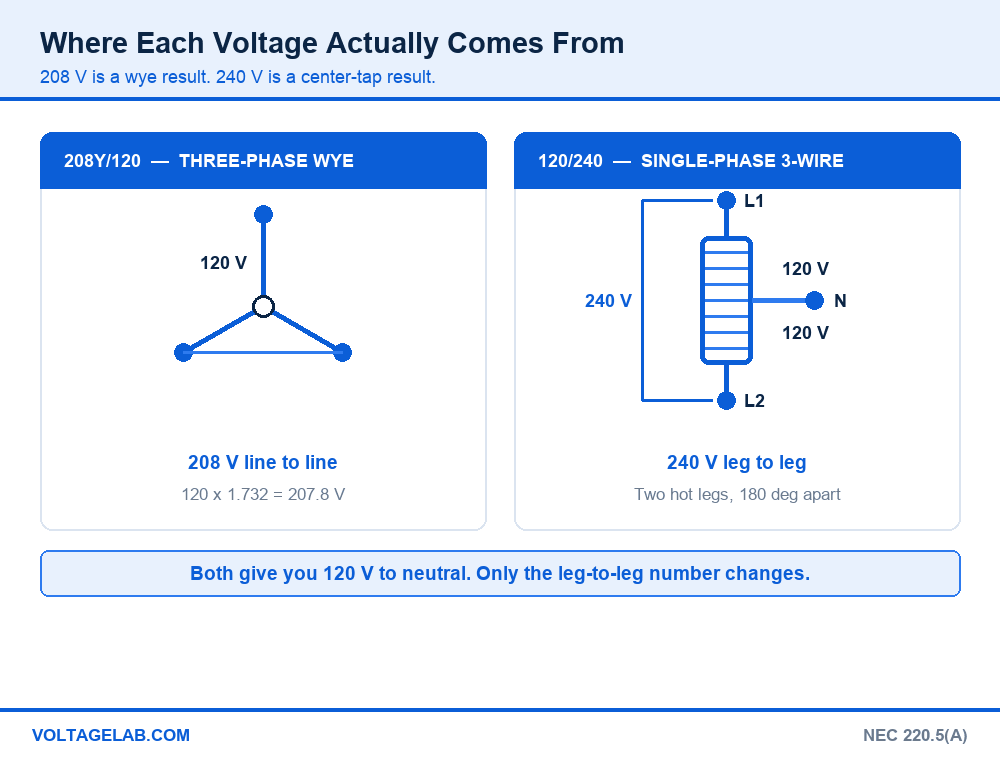
208 V and 240 V differ because they are produced by two different systems. 208 V is the line-to-line voltage of a three-phase wye system, where three 120 V legs sit 120 degrees apart — 120 × √3 = 207.8 V. 240 V is the leg-to-leg voltage of a single-phase, center-tapped transformer, where two 120 V halves sit 180 degrees apart and add directly: 120 + 120 = 240 V. Both give you 120 V to neutral; only the leg-to-leg number changes.
The practical consequence is power. A resistive load on 208 V produces (208 ÷ 240)² = 75.1% of its 240 V rating, so a 4,500 W element delivers about 3,380 W. Motors behave differently — they hold their power and draw more current instead. Use dual-rated 208–240 V equipment, or specify the 208 V version outright.
Key Takeaways
- 208 V is a three-phase wye product: 120 V × √3 = 207.8 V, rounded to 208 V. It cannot be raised to 240 V by changing conductors.
- 240 V is a single-phase, center-tapped product: two 120 V halves 180 degrees out of phase, added end to end.
- A resistive heater on 208 V makes 75.1% of its 240 V nameplate wattage, because power scales with the square of voltage.
- Motors do not lose power on 208 V — they draw roughly 10–15% more current, which is a heating problem, not an output problem.
- NEC 220.5(A) lists 208Y/120 and 120/240 as separate nominal system voltages for load calculations; you use the one that matches the service.
- NEC 110.4 requires equipment to have a voltage rating suitable for the circuit, so a 240 V-only nameplate on a 208 V circuit is a listing problem, not just a performance one.
- A 240/120 high-leg delta system has one leg at 208 V to ground, which NEC 110.15 requires to be marked orange or otherwise clearly identified.
What 208 V and 240 V actually are
Both voltages are measured between two ungrounded conductors. That is the only thing they have in common. What sits behind those conductors is a different transformer arrangement in each case, and the arrangement is what sets the number.
Pass your electrical exam the first time
Practice real NEC exam questions with full code-referenced explanations and progress tracking — built for journeyman, master and apprentice exam prep.
Thousands of NEC practice questions with code-referenced answers
In a three-phase wye secondary, three windings share a common point that becomes the neutral. Each winding produces 120 V between its line and that neutral. The three lines are 120 electrical degrees apart, so when you measure between any two of them, the two 120 V phasors do not add head to tail — they combine vectorially. The result is 120 × √3 = 207.85 V, which the industry calls 208 V. That is why the system is written 208Y/120: 208 V line to line, wye connected, 120 V line to neutral.
A single-phase 120/240 V service works differently. One transformer winding feeds the building, and that winding is tapped at its electrical midpoint. The midpoint becomes the grounded neutral. Each half produces 120 V to neutral, but the two halves are 180 degrees apart — directly opposed — so measuring across the full winding gives you the straight sum: 120 + 120 = 240 V. No square root, because there is no phase angle to account for.
Reading the notation: 208Y/120 vs 120/240
The order of the numbers tells you the configuration. For a three-phase system the line-to-line voltage is written first and the line-to-neutral second, with a Y marking the wye connection — 208Y/120, 480Y/277. For a single-phase system the convention flips: the line-to-neutral voltage comes first — 120/240. So 208Y/120 and 120/240 are not just different numbers, they are written in different orders on purpose, and reading the order correctly tells you how many hot legs you have before you open the panel.
You will also see 120/208 on single-phase panel schedules in commercial buildings. That is two legs of a wye feeding a single-phase load — still 120 V to neutral, still 208 V leg to leg, without the third phase. It is where the 208-versus-240 problem shows up most often.
208 V vs 240 V vs high-leg 240 V — the comparison
Three systems put voltage in this range on a panel, and the third catches anyone who assumes every 240 V system behaves like a house.
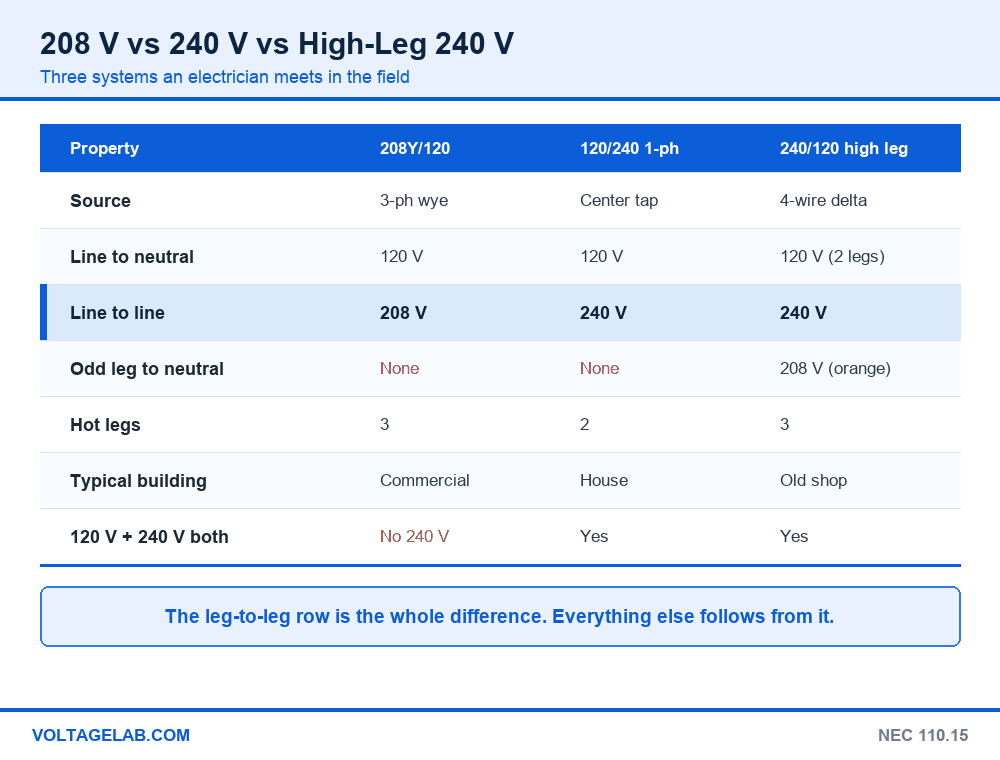
| Property | 208Y/120 wye | 120/240 single-phase | 240/120 high-leg delta |
|---|---|---|---|
| Transformer source | Three-phase wye | Center-tapped winding | 4-wire delta, one leg tapped |
| Line to line | 208 V | 240 V | 240 V |
| Line to neutral | 120 V, all three legs | 120 V, both legs | 120 V on two legs only |
| Odd leg to neutral | None | None | 208 V — the high leg |
| Ungrounded legs | 3 | 2 | 3 |
| Where you find it | Commercial, multifamily, offices | Houses, small residential services | Older shops with motor + 120 V load |
| Gives you true 240 V | No | Yes | Yes |
Code trap: On a 240/120 high-leg delta, the B phase measures 208 V to ground while the other two measure 120 V. Landing a 120 V circuit on that leg puts 208 V across a 120 V load and destroys it instantly. NEC 110.15 requires the high leg to be durably marked orange or identified by other effective means at every point where the neutral is present — and the orange conductor in that panel is not a spare. Meter every leg to ground before you land a single 120 V circuit in an unfamiliar delta panel.
The math: why 208 V gives you 75% of the heat
A resistive load — a water heater element, baseboard heat, a range coil — is a fixed resistance. It does not adjust to the voltage you feed it. Ohm’s law sets the current, and power follows.
Take a 4,500 W element rated at 240 V. Its resistance is fixed at R = V² ÷ P = 240² ÷ 4,500 = 12.8 Ω. Put that same element on 208 V and the resistance has not changed, so the power becomes P = 208² ÷ 12.8 = 3,380 W. The ratio is (208 ÷ 240)² = 0.751. Every resistive load loses the same 24.9%, regardless of size.
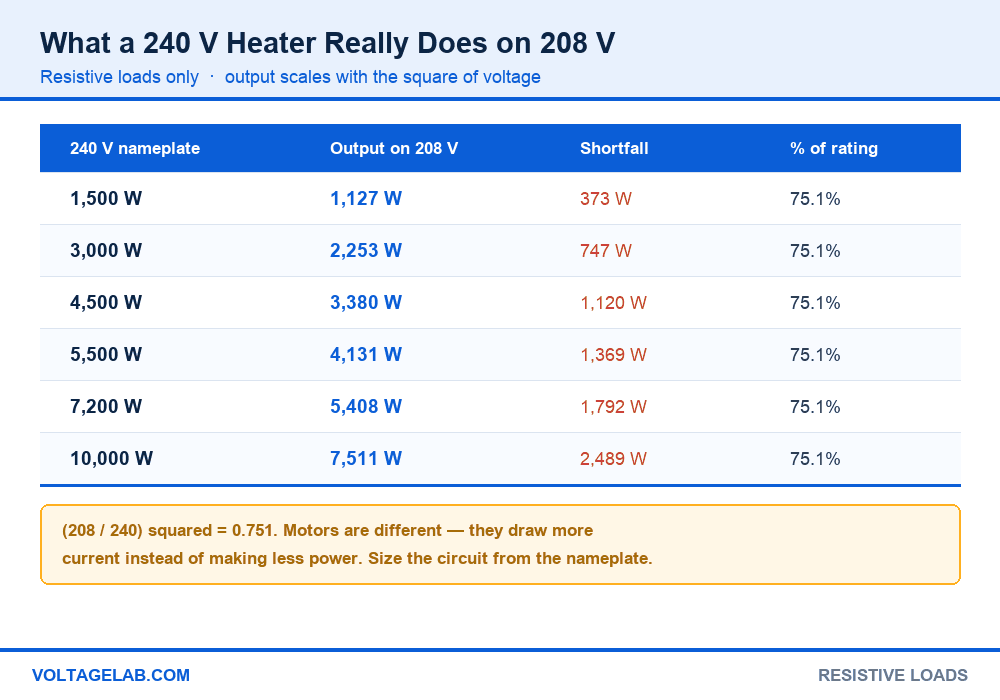
| Nameplate at 240 V | Actual output at 208 V | Shortfall | Current at 240 V | Current at 208 V |
|---|---|---|---|---|
| 1,500 W | 1,127 W | 373 W | 6.3 A | 5.4 A |
| 3,000 W | 2,253 W | 747 W | 12.5 A | 10.8 A |
| 4,500 W | 3,380 W | 1,120 W | 18.8 A | 16.3 A |
| 5,500 W | 4,131 W | 1,369 W | 22.9 A | 19.9 A |
| 7,200 W | 5,408 W | 1,792 W | 30.0 A | 26.0 A |
| 10,000 W | 7,511 W | 2,489 W | 41.7 A | 36.1 A |
How to size a resistive load for 208 V — step by step
- Start from the output the customer needs in watts, not the nameplate of whatever is on the shelf.
- Confirm the system voltage at the panel with a meter, leg to leg. Never assume from building type.
- If the service is 208 V, order a 208 V nameplate so the element makes full output at the voltage it sees.
- If only a 240 V unit is available, divide the required output by 0.751 to find the 240 V nameplate you need — 4,500 W of real output needs a 5,990 W unit, so you round up to the next stocked size.
- Calculate the branch-circuit current from the nameplate at the applied voltage: I = P ÷ V for single-phase.
- Apply the 125% continuous-load factor from NEC 210.19(A) and 210.20(A) if the load runs three hours or more, then size conductor and overcurrent device.
- Check the terminal temperature rating before reading the ampacity column — see NEC Table 310.16 and how to read ampacity the right way.
The one that catches everyone: lower voltage does not mean lower current for a motor. A resistive element draws less current at 208 V because its resistance is fixed. A motor does the opposite — it delivers the torque the load demands, so when voltage drops the current rises to keep the power up, typically 10–15% higher at 208 V than at 240 V. That extra current is heat in the windings. Size motor conductors and overloads from the nameplate current at the voltage the motor will actually see, never from the 240 V figure.
Running 240 V equipment on a 208 V system
NEC 110.4 puts it plainly: equipment voltage rating must not be less than the nominal voltage of the circuit. Putting 240 V-rated equipment on a 208 V circuit does not violate that rule — 208 is lower, not higher. But a unit marked 240 V only was evaluated at 240 V, and whether it performs is a separate question from whether it is legal.
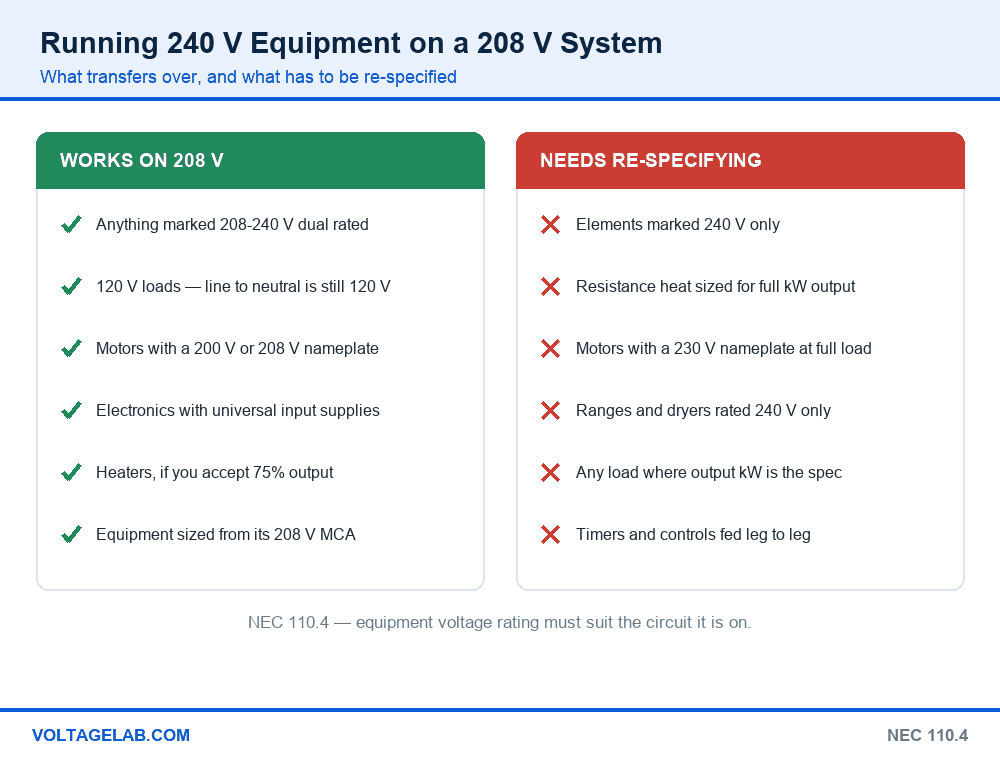
What transfers over without a problem
- Anything marked 208–240 V. Dual-rated equipment is evaluated across the whole band. Most modern HVAC, water heaters and appliances are marked this way.
- Every 120 V load in the building. Line to neutral is 120 V on both systems, so receptacles, lighting and general-purpose circuits are unaffected.
- Motors with a 200 V or 208 V nameplate. NEMA rates motors slightly below system nominal to allow for drop, so a 200 V motor is the correct part for a 208 V system.
- Electronics with universal-input power supplies. Anything marked 100–250 V does not care.
- Resistive heat, if the reduced output is acceptable. A 240 V heater on 208 V is safe — it simply runs at 75% and takes longer.
What has to be re-specified
- Anything marked 240 V only. Order the 208 V version rather than accepting degraded performance outside the listing.
- Resistance heat where output kW is the design spec. Electric furnaces and duct heaters sized for a heat load will not meet it at 75%.
- Motors with a 230 V nameplate running near full load. NEMA MG 1 allows ±10% of nameplate, which puts the floor for a 230 V motor at 207 V — 208 V clears it by one volt. That is technically inside tolerance and practically marginal, especially on a motor with a 1.0 service factor in warm ambient.
- Ranges, dryers and cooking equipment marked 240 V only. Element output drives the whole appliance.
- Control circuits and timers fed leg to leg. Coils and timing circuits rated 240 V may drop out at 208 V.
Calculating three-phase 208 V loads
Three-phase changes the formula. For a balanced load, P = √3 × V × I × PF, so I = P ÷ (1.732 × 208 × PF). At unity power factor 1.732 × 208 = 360.3, so a 10 kW three-phase load at 208 V draws 27.8 A per leg. The same 10 kW single-phase draws 48.1 A — that is the argument for three-phase on larger loads. For motor circuits take the current from NEC Table 430.250 full-load currents for three-phase motors, which lists a separate 208 V column, rather than calculating it.
How 208 V and 240 V sit among the other system voltages
NEC 220.5(A) fixes the nominal voltages you use for branch-circuit and feeder calculations: 120, 120/240, 208Y/120, 240, 347, 480Y/277, 600Y/347 and 600 volts. You calculate with the nominal figure for the system you are on, not with what the meter happened to read that morning.
Study smarter with VoltageLab
Built for electricians, apprentices, and electrical engineers who want faster practice and better exam prep.
⭐️ Join thousands of electricians upgrading their skills
| System | Line to neutral | Line to line | Phases | Typical use |
|---|---|---|---|---|
| 120/240 | 120 V | 240 V | 1 | Houses, small services |
| 208Y/120 | 120 V | 208 V | 3 | Offices, retail, multifamily |
| 240/120 high leg | 120 V (2 legs), 208 V (1 leg) | 240 V | 3 | Older shops and farms |
| 240 delta | No neutral | 240 V | 3 | Motor-only industrial loads |
| 480Y/277 | 277 V | 480 V | 3 | Large commercial, industrial |
The pattern repeats all the way up: every wye system multiplies line-to-neutral by √3. 277 × 1.732 = 480, just as 120 × 1.732 = 208. For where these sit overall, see low, medium and high voltage class boundaries; for the transformer side, how to size a transformer by kVA. Where a 208 V service feeds a 240 V load you cannot re-specify, a buck-boost transformer is the usual fix — see autotransformer structure and working principle. To check the service can take the load at all, start with calculating electrical load before adding a major appliance.
Is 208 V a problem, or just different?
Pros of 208Y/120
- Three-phase power for motors from the same service that feeds 120 V lighting
- Three 120 V legs instead of two, so single-phase load balances across more phases
- Three-phase motors start and run smoother, with no starting capacitor
- Same power on smaller conductors than single-phase at the same voltage
- No high leg to mismark, unlike a 240/120 delta
Cons of 208Y/120
- Resistive loads make only 75% of their 240 V rating
- Equipment must be ordered in the 208 V or dual-rated version, which narrows the catalogue
- 230 V motors sit at the very bottom of their tolerance band
Working with 208 V and 240 V in the field
Do
- Meter leg to leg and leg to ground before you quote equipment for an unfamiliar building
- Order the 208 V or 208–240 V dual-rated nameplate whenever the service is a wye
- Tell the customer in writing when a 240 V unit on 208 V will run at reduced output
- Use the nominal voltage from NEC 220.5(A) for calculations, and the nameplate for the circuit
- Label the panel with the system voltage so the next tech does not have to guess
Avoid
- Assuming a commercial building is 240 V because the equipment says 240 V
- Chasing a “low voltage” complaint on a 208 V system — 208 V is the design, not a fault
- Landing a 120 V circuit without metering every leg to ground in a delta panel
- Sizing motor conductors from 240 V current figures on a 208 V circuit
- Assuming a bigger breaker or heavier wire will raise the voltage — it will not
Frequently asked questions
Can I run a 240 V appliance on 208 V?
Usually yes, safely, but with reduced performance. A resistive appliance produces 75.1% of its rated output; a motor-driven one runs but draws more current. The exception is equipment marked 240 V only where output is the specification — electric furnaces, duct heaters and commercial cooking equipment should be ordered in the 208 V version.
Why is it 208 V and not 240 V on three-phase?
Because the legs of a wye are 120 degrees apart, not 180. Two 120 V phasors separated by 120 degrees combine to 120 × √3 = 207.8 V rather than adding to 240 V. The phase angle, not the transformer size or the wire, sets the number.
Is 208 V single-phase or three-phase?
It can be either. 208 V is always derived from a three-phase wye source, but if you take only two of the three legs you have a single-phase 208 V circuit. That is how most 208 V water heaters, dryers and EV chargers are fed in commercial and multifamily buildings.
Will a 240 V water heater work on 208 V?
It will heat water, just more slowly. A 4,500 W element rated 240 V delivers about 3,380 W at 208 V, stretching recovery time by roughly a third. Tolerable in a residence; usually not in a restaurant or salon. Order the 208 V element instead.
Does a 208 V circuit need a neutral?
Only if the equipment uses 120 V internally for controls, lights or a timer. A straight 208 V load across two legs needs two ungrounded conductors and an equipment grounding conductor. Where a neutral is run alongside two legs of a wye, the result is a multiwire branch circuit — see our guide to multiwire branch circuit code rules, because the handle-tie and neutral rules are strict.
Can I convert 208 V to 240 V?
Yes, with a buck-boost transformer raising 208 V to roughly 240 V for a specific load — the standard fix for one piece of 240 V-only equipment in a 208 V building. What you cannot do is change the building’s system voltage by upsizing conductors or breakers.
Why does my panel read 208 V on one leg and 120 V on the others?
That is a 240/120 high-leg delta, and the 208 V reading is leg to ground on the high leg. It is normal for that system and required by NEC 110.15 to be marked orange. Never land a 120 V circuit on it. Confirm by measuring leg to leg — all three pairs should read 240 V.
Which is better, 208 V or 240 V?
Neither — they solve different problems. 240 V single-phase suits buildings whose big loads are resistive, like houses with water heaters and dryers. 208Y/120 suits buildings needing three-phase motor power alongside heavy 120 V load. You rarely choose; the service you inherit chooses, and your job is to match the equipment to it.
The bottom line
208 V and 240 V are not two grades of the same supply. One is the √3 product of a three-phase wye, the other is the arithmetic sum of two halves of a center-tapped winding, and no amount of conductor upsizing moves one toward the other. Once you can name which system is in front of you, every downstream decision — nameplate, conductor, overcurrent device, expected output — falls out of that one fact.
Two restraints are worth carrying onto every job. First, resistive loads lose a quarter of their output at 208 V, so specify the 208 V nameplate rather than explaining the shortfall later. Second, motors move the opposite way — they pull more current at the lower voltage, so size conductors and overloads from the nameplate at the applied voltage, not from a 240 V figure you remember. When the load in question is a motor, work from what the motor nameplate is actually telling you before you pick a single conductor.
FREE PRACTICE TOOL
Think you'd pass this on a real exam?
Test what you just read with instant-feedback quizzes built around real code questions — not generic trivia.
5
Code standards
10,000+
Active learners
100%
Free to start
Instant explanations on every answer, right or wrong
NEC, BS7671, AS/NZS, CEC, and DIN VDE covered
Bite-sized quizzes you can finish in 5 minutes
No signup required to try your first quiz
No account needed · Takes less than 2 minutes