


A drawing lands on your desk marked “medium voltage switchgear,” and the room splits. The utility engineer means 13.8 kV. The panel builder is thinking 4160 V. Somebody who learned the trade in the nineties says anything over 600 volts is high voltage and always has been. All three are quoting a real standard — they are just quoting different ones.
That is why the low, medium and high voltage definition question keeps costing money. The class label decides which NEC articles apply, what working clearance the inspector measures, whether your cable needs shielding and stress cones, and what PPE the crew wears to open a door. Get the class wrong on a submittal and you do not find out at the design review — you find out when the gear shows up and the terminations do not match the cable.
Study smarter with VoltageLab
Built for electricians, apprentices, and electrical engineers who want faster practice and better exam prep.
⭐️ Join thousands of electricians upgrading their skills
This guide sets out where each boundary actually falls, which standard drew it, and what changes the moment a system crosses 1000 volts. It covers the ANSI C84.1 voltage classes, the NEC’s own dividing line and the articles that follow from it, the IEC and OSHA thresholds that disagree with both, and the nominal system voltages you meet on real nameplates.
Quick Answer
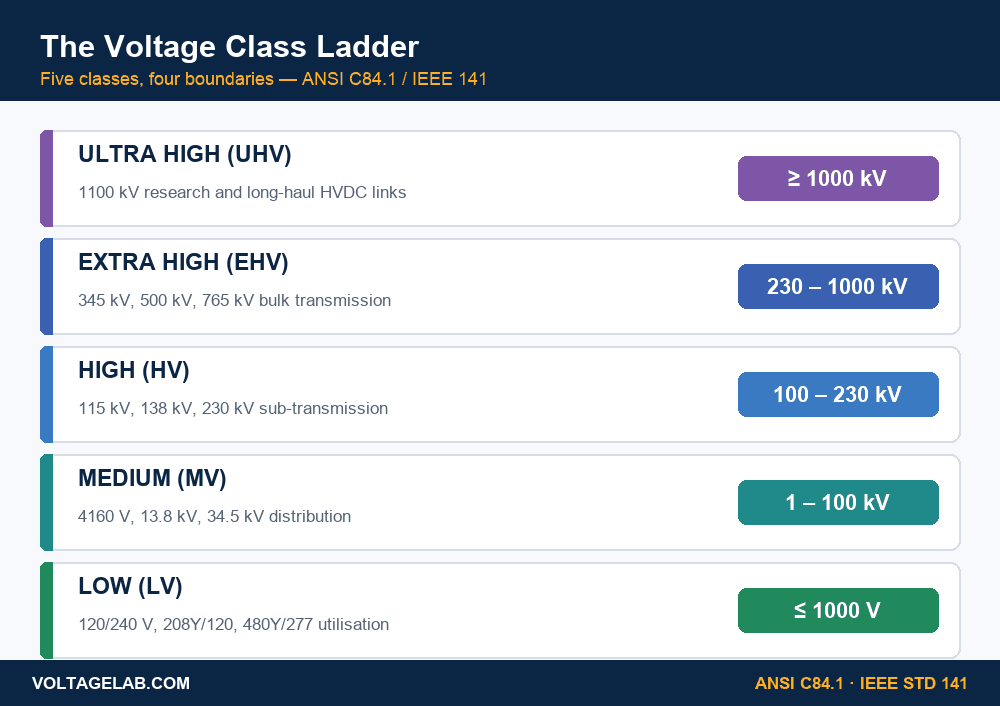
Low voltage is any nominal system voltage of 1000 V or less, medium voltage runs from just above 1000 V up to 100 kV, and high voltage covers 100 kV to 230 kV. Above that, ANSI C84.1 and IEEE Std 141 add extra-high voltage from 230 kV to 1000 kV and ultra-high voltage at 1000 kV and beyond.
The NEC does not use those five class names for systems. It draws one line — over 1000 volts ac or 1500 volts dc, nominal — and everything above it falls under Article 235 and Article 495. OSHA never moved off 600 volts, so a 480 V job can sit in one class under the NEC and a different one under an OSHA citation.
Key Takeaways
- ANSI C84.1 and IEEE Std 141 set the class boundaries at 1000 V, 100 kV, 230 kV and 1000 kV, giving five classes: low, medium, high, extra-high and ultra-high voltage.
- The NEC recognises one threshold — over 1000 volts ac or 1500 volts dc, nominal — and does not classify systems as “medium voltage” at all.
- Beginning with the 2014 NEC, the Code’s high-voltage threshold moved from 600 volts to 1000 volts, which is why older specifications and newer drawings disagree.
- OSHA 1910 Subpart S still uses “over 600 volts, nominal,” so the OSHA boundary and the NEC boundary are 400 volts apart.
- IEC 60038 defines low voltage as 1000 V ac or 1500 V dc and calls everything above it high voltage — the IEC has no formal medium voltage band.
- Type MV cable under NEC Article 315 is rated 2001 volts and up, which leaves a real gap between 1001 V and 2000 V where a system is over the NEC line but below the MV cable range.
- Voltage class is set by the nominal system voltage, not by the voltage your meter reads on the day.
What a voltage class actually is
A voltage class is a band of nominal system voltages that share a common set of design, insulation and safety rules. It is a filing system, not a physical property. Nothing changes about electricity at 1000 volts — what changes is which chapter of which book you have to open, and how far back you have to stand.
Pass your electrical exam the first time
Practice real NEC exam questions with full code-referenced explanations and progress tracking — built for journeyman, master and apprentice exam prep.
Thousands of NEC practice questions with code-referenced answers
The bands exist because equipment is built and tested to them. A 15 kV class load-break switch, a 5 kV class motor starter, a 600 V class fuse: the manufacturer designs the creepage distances, the basic impulse level and the interrupting duty around the class, then lists the product to it. Ask for something between classes and you will be told to go up to the next one.
Nominal voltage, not measured voltage
Every one of these boundaries is written against nominal system voltage. NEC Article 100 defines voltage, nominal as a value assigned to a circuit or system for the purpose of conveniently designating its voltage class, and it makes the point that the actual operating voltage can vary within a range that still permits satisfactory equipment performance. Our walk-through of NEC Article 100 definitions covers the wording in full.
That distinction matters on site. ANSI C84.1 Range A allows a 120 V service to sit anywhere between 114 V and 126 V and still be perfectly compliant. Reading 126 V at the meter socket does not make it a 126 V system. Likewise, a 13.8 kV feeder that happens to be running at 14.1 kV is still a 13.8 kV nominal system in the medium voltage class. Classify from the nameplate and the one-line, never from the meter.
Low, medium and high voltage boundaries — who draws the line
There is no single authority here, and pretending otherwise is how arguments start. Four bodies publish thresholds that matter to North American work, and they do not agree.
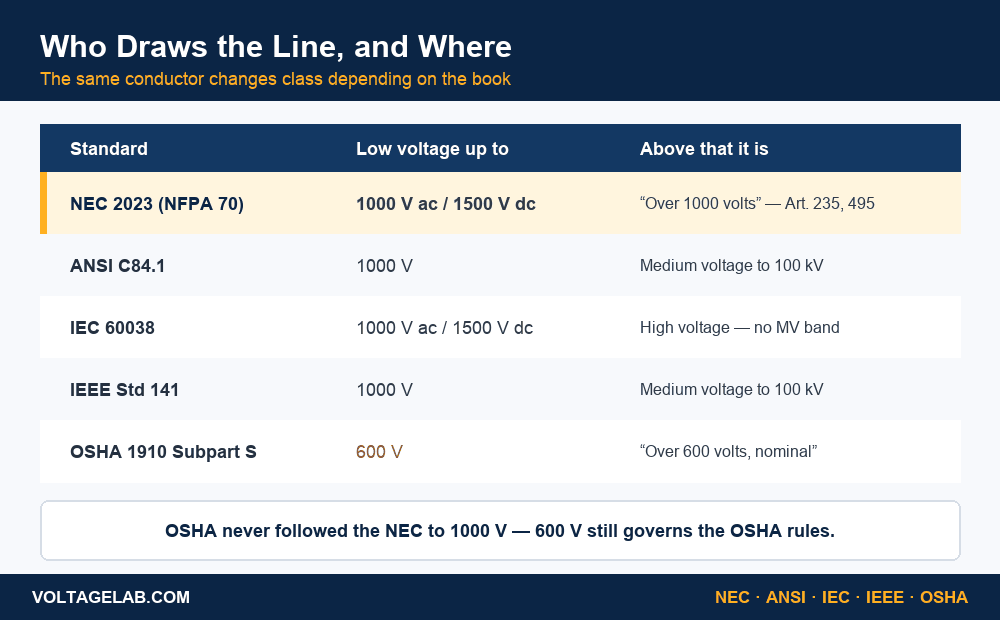
| Class | ANSI C84.1 / IEEE 141 | NEC 2023 | IEC 60038 |
|---|---|---|---|
| Low voltage | 1000 V and below | 1000 V ac / 1500 V dc and below | 1000 V ac / 1500 V dc and below |
| Medium voltage | Above 1000 V to 100 kV | Not defined for systems | Not defined |
| High voltage | 100 kV to 230 kV | Anything over 1000 V | Anything over 1000 V ac |
| Extra-high voltage | 230 kV to 1000 kV | — | — |
| Ultra-high voltage | 1000 kV and above | — | — |
Read that table the right way round. ANSI and IEEE give you the five-class vocabulary the industry speaks in. The NEC gives you the one boundary that determines which rules an inspector enforces. When a submittal says “medium voltage,” it is speaking ANSI. When a plan check says “over 1000 volts,” it is speaking NEC. They overlap, but they are not the same sentence.
Code trap: The NEC moved its threshold from 600 volts to 1000 volts starting with the 2014 edition — Article 490 was retitled “Equipment Over 1000 Volts, Nominal,” and Table 110.26(A)(1) gained a 601–1000 V row. Specifications written against older editions still say 600 volts, and copying that number forward onto a 2023 NEC job produces a document that contradicts the Code it claims to follow. Check which edition your jurisdiction has adopted before you quote any threshold.
The nominal system voltages you actually meet
Class boundaries are abstract until you map them onto real systems. ANSI C84.1 lists the preferred nominal voltages for 60 Hz systems, and in practice a small handful of them account for nearly everything you will ever terminate.
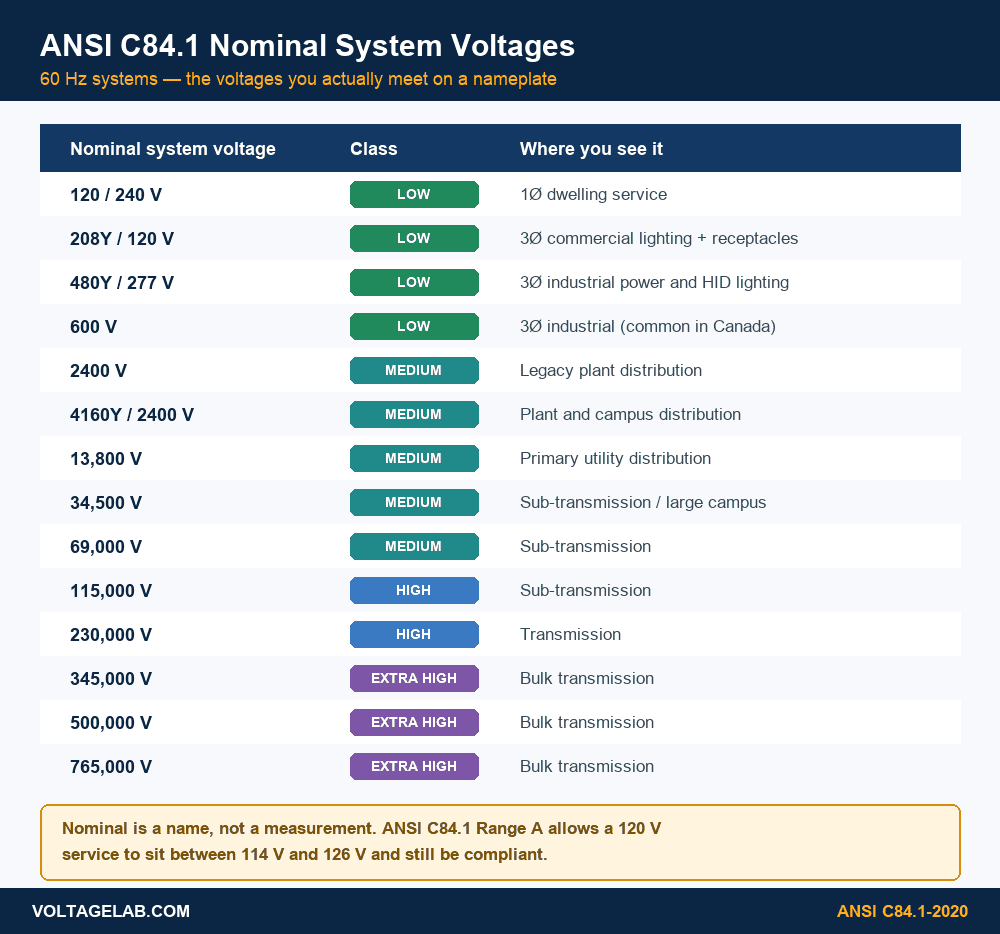
| Nominal system voltage | Class | Typical role |
|---|---|---|
| 120/240 V, 1Ø | Low | Dwelling service and branch circuits |
| 208Y/120 V, 3Ø | Low | Commercial lighting and receptacle loads |
| 480Y/277 V, 3Ø | Low | Industrial power, HID and LED lighting |
| 600 V, 3Ø | Low | Industrial utilisation, common in Canada |
| 2400 V | Medium | Legacy in-plant distribution |
| 4160Y/2400 V | Medium | Plant and campus distribution, large motors |
| 13,800 V | Medium | Primary utility distribution |
| 34,500 V | Medium | Sub-transmission and large campus primary |
| 69,000 V | Medium | Sub-transmission |
| 115,000 V | High | Sub-transmission |
| 230,000 V | High | Transmission |
| 345,000 V | Extra-high | Bulk transmission |
| 500,000 V | Extra-high | Bulk transmission |
| 765,000 V | Extra-high | Bulk transmission |
Notice how much ground the medium voltage class covers — 4160 V and 69,000 V sit in the same band despite a factor of sixteen between them. That is why “medium voltage” on its own is never a specification. Equipment is bought to a voltage class rating such as 5 kV, 15 kV, 25 kV or 35 kV class, and those ratings are what determine insulation thickness and BIL. The choice of which nominal voltage to distribute at is its own engineering exercise, covered in our guide to the selection of transmission and distribution voltage.
How to classify a system in four steps
- Find the nominal voltage, not the measured one. Take it from the transformer nameplate, the one-line diagram or the utility service agreement. Ignore what the meter reads.
- Decide whether it is ac or dc. The NEC line is 1000 V for ac and 1500 V for dc, and they are not interchangeable.
- Apply the NEC threshold first. At or below 1000 V ac, the ordinary Chapter 1–4 rules govern. Above it, Article 235 and Article 495 take over and the design is a different job.
- Then apply the ANSI class name for communication. Use low, medium, high, extra-high or ultra-high when you talk to vendors and engineers — but write the actual number next to it on every document.
The one that catches everyone: The NEC has two thresholds, not one — 1000 volts ac and 1500 volts dc. Photovoltaic and battery systems are the reason. A 1500 V dc PV array is below the NEC’s dc line and is therefore not an “over 1000 volts” installation, even though the number on the drawing is larger than 1000. Reading the ac threshold across to a dc system pushes you into Article 495 rules that do not apply.
What changes when a system crosses 1000 volts
The 2023 NEC reorganised its over-1000-volt content deliberately. Requirements that used to sit scattered through Articles 210, 215, 225 and 230 were pulled out into a single new Article 235, and Article 490 was renumbered to Article 495 as part of a convention where medium voltage articles end in the digit 5. Article 328 disappeared entirely, its Type MV cable content rebuilt and expanded as Article 315. If you learned the numbers from an older edition, they have moved.
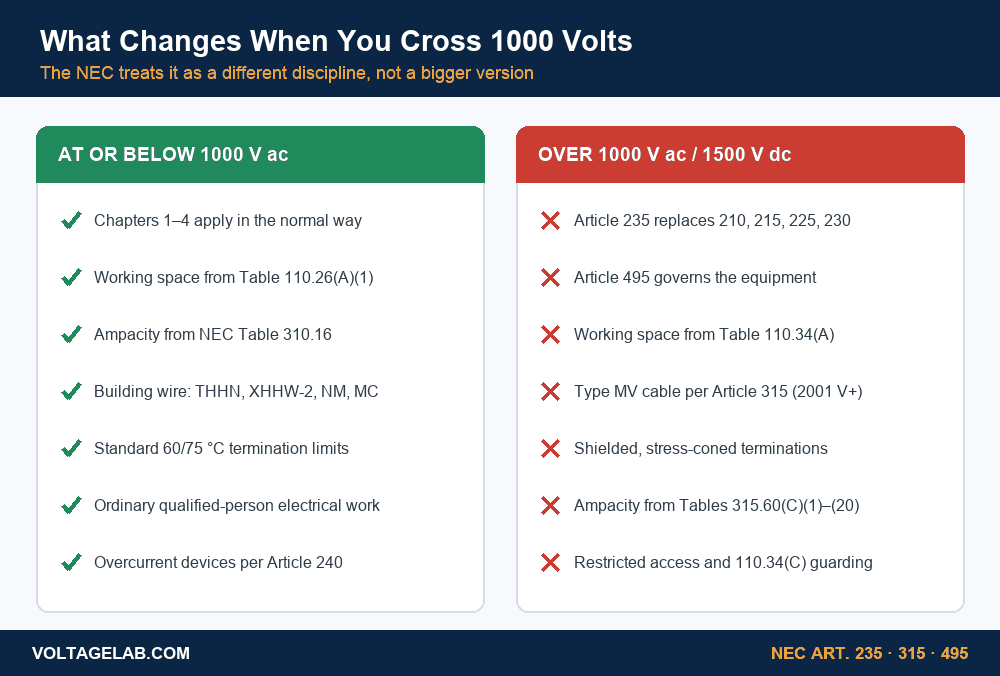
At or below 1000 volts ac
- Working space depth comes from Table 110.26(A)(1), which bands voltage to ground as 0–150 V, 151–600 V and 601–1000 V.
- Conductor ampacity comes from NEC Table 310.16 and the rest of Article 310.
- Ordinary building wire applies — THHN/THWN-2, XHHW-2, NM and MC cable.
- Terminations are limited to 60 °C or 75 °C ratings under 110.14(C).
- Overcurrent protection follows Article 240.
Over 1000 volts ac or 1500 volts dc
- Article 235 governs branch circuits, feeders and services; Article 495 governs the equipment.
- Working space comes from Table 110.34(A) instead, and 110.34(C) adds guarding and restricted-access requirements.
- Conductors move to Type MV cable under Article 315, rated 2001 V to 35,000 V ac.
- Terminations become shielded and stress-relieved — you are building a cable termination, not landing a lug.
- Ampacity comes from the Article 315 tables, which depend on installation configuration far more than Table 310.16 does.
There is a genuine seam here worth knowing about. The NEC’s threshold is 1000 V, but Type MV cable starts at 2001 V. A 1500 V or 2000 V ac system is over the Code’s line yet below the MV cable range, and you end up specifying 2 kV or 5 kV class cable on manufacturer listings rather than a clean Article 315 selection. It is rare, but it is exactly the sort of thing that stalls a submittal.
The shock threshold is lower than all of them
None of these class boundaries is a safety threshold. NFPA 70E works from 50 volts: below it, an electrically safe work condition generally is not required for shock protection; at or above it, shock risk assessment applies regardless of which class the system sits in. A 208 V panel is low voltage by every standard on this page and still carries an arc flash hazard capable of killing someone. Our summary of the NFPA 70E 2026 updates covers where those requirements are heading.
Study smarter with VoltageLab
Built for electricians, apprentices, and electrical engineers who want faster practice and better exam prep.
⭐️ Join thousands of electricians upgrading their skills
Voltage class versus equipment rating
Systems have classes; equipment has ratings. Confusing the two is the most common error on a submittal, because a piece of gear is almost never rated at the system voltage — it is rated at the class ceiling above it.
| System | Class | Typical cable | Typical switching device | Termination |
|---|---|---|---|---|
| 208Y/120 V | Low | 600 V building wire | Moulded-case breaker | Mechanical lug |
| 480Y/277 V | Low | 600 V building wire | Moulded-case or power breaker | Mechanical or compression lug |
| 4160 V | Medium | 5 kV class shielded MV | Vacuum contactor or breaker | Stress cone, shield grounded |
| 13.8 kV | Medium | 15 kV class shielded MV | Vacuum breaker, load-break switch | Stress cone or elbow |
| 115 kV | High | Utility HV cable or overhead | SF6 or oil circuit breaker | Porcelain / composite pothead |
Once you have the class fixed, the downstream selections follow. Sizing the supply transformer is covered in our transformer sizing chart by kVA, and picking conductors and protection on either side of it in cable size and circuit breaker selection for HT and LT. For the cable construction itself, see high voltage cable types, ratings and NEC installation requirements. If the class in question is set by a motor rather than a service, the numbers to read are on the plate — see motor nameplate specifications. And for what sits behind the primary breaker, our breakdown of the components of a substation is the place to start.
Is medium voltage distribution worth it for your site?
For a campus, plant or data centre with load spread across distance, the real design question is whether to distribute at medium voltage and step down locally, or run everything at 480 V from one service. The class boundary is where that trade-off lives.
Pros of distributing at medium voltage
- Current falls in proportion to voltage, so conductors get dramatically smaller for the same kW
- Voltage drop over long runs stops being the constraint that drives conductor size
- I²R losses drop with the square of the current reduction
- Load can be added at the far end of a campus without repulling the feeder
- Large motors above roughly 500 hp are often only available as medium voltage machines
Cons
- Terminations become a specialist skill — stress cones and shield grounding, not lugs
- Switchgear, working clearances and electrical room footprint all grow
- Maintenance requires qualified MV personnel and a testing programme
- Every step-down transformer adds cost, losses and floor space
Working with voltage classes in the field
Do
- Write the actual nominal voltage next to any class name on drawings and submittals
- Confirm which NEC edition your jurisdiction has adopted before quoting a threshold
- Name the standard when you use a class term — “medium voltage per ANSI C84.1”
- Treat 50 V as the safety threshold, not 1000 V
- Check dc systems against the 1500 V dc line, not the 1000 V ac line
Avoid
- Copying “over 600 volts” forward from a legacy specification onto a current-code job
- Classifying a system from a meter reading instead of the nameplate
- Assuming the OSHA and NEC boundaries are the same number
- Ordering “medium voltage” gear without stating the kV class rating
- Treating a low voltage classification as evidence that a panel is safe to open live
Frequently asked questions
What is the definition of low, medium and high voltage?
Low voltage is 1000 V and below, medium voltage is above 1000 V up to 100 kV, and high voltage is 100 kV to 230 kV, per ANSI C84.1 and IEEE Std 141. Above 230 kV the same standards add extra-high voltage to 1000 kV and ultra-high voltage at 1000 kV and above.
Is 480 V considered high voltage?
No. 480Y/277 V is low voltage under every standard on this page, including OSHA’s 600 V threshold. It is often called “high voltage” on job sites relative to 120 V, but that is shop slang, not a classification — and it is worth correcting, because it encourages people to think 208 V is harmless.
At what voltage does the NEC consider a system high voltage?
Over 1000 volts ac or 1500 volts dc, nominal. That is the single threshold the NEC works from, and crossing it moves the installation into Article 235 for circuits and feeders and Article 495 for equipment. The NEC does not use the term “medium voltage” for systems at all.
Why do some documents still say 600 volts?
Two reasons. The NEC only moved from 600 V to 1000 V beginning with the 2014 edition, so anything written earlier says 600 V. And OSHA never followed — 1910 Subpart S still uses “over 600 volts, nominal,” so OSHA-driven documents legitimately say 600 V today.
What voltage is Type MV cable rated for?
NEC Article 315 covers Type MV conductors and cable from 2001 volts to 35,000 volts ac, and 2001 volts to 2500 volts dc. Article 315 replaced Article 328 in the 2023 NEC and also brought MV cable joints, terminations and connectors under one article.
Does the IEC use the term medium voltage?
Not formally. IEC 60038 defines low voltage as 1000 V ac or 1500 V dc and below, and treats everything above that as high voltage. “Medium voltage” is used constantly in IEC-region distribution engineering, but it is industry usage rather than a band defined in IEC 60038.
Is 11 kV or 33 kV high voltage?
Under the ANSI/IEEE classes, both are medium voltage — they sit between 1 kV and 100 kV. Under IEC 60038 and under the NEC’s single threshold, both are simply above the low voltage boundary and get the high-voltage treatment. This is the single most common source of cross-border confusion on the topic.
What voltage is dangerous?
NFPA 70E works from 50 volts for shock risk, which is far below any of the class boundaries here. Arc flash energy depends on available fault current and clearing time rather than voltage, so a 208 V panel fed from a large transformer can present a serious incident energy while being low voltage by every definition.
Voltage Class Quick Answers
What is the voltage range of low, medium and high voltage?
Under ANSI C84.1 and IEEE Std 141: low voltage is 1000 V or less, medium voltage is above 1000 V up to 100 kV, and high voltage is 100 kV to 230 kV. Extra-high voltage runs from 230 kV to 1000 kV.
What classifies as high voltage?
It depends on the standard. ANSI/IEEE start high voltage at 100 kV, the NEC treats anything over 1000 V ac (1500 V dc) as its high-voltage category, IEC calls everything over 1000 V ac high voltage, and OSHA still uses over 600 V.
The bottom line
The class names are worth learning because the whole industry speaks them, but they are vocabulary rather than law. ANSI C84.1 and IEEE Std 141 give you the five bands at 1000 V, 100 kV, 230 kV and 1000 kV. The NEC gives you the one threshold that an inspector will actually hold you to — over 1000 volts ac or 1500 volts dc — and once you cross it, Articles 235, 315 and 495 replace most of what you knew about how a feeder gets designed and terminated.
Two restraints keep you out of trouble. Classify from the nominal voltage on the nameplate, never from a meter reading, and name the standard whenever you write a class term on a document. Do those two things and the argument in the opening paragraph never happens on your job. If your next step is picking the conductors that go with the class you have just established, start with high voltage cable types, ratings and NEC installation requirements, and keep an eye on what is shifting in the 2026 NEC code book.
FREE PRACTICE TOOL
Think you'd pass this on a real exam?
Test what you just read with instant-feedback quizzes built around real code questions — not generic trivia.
5
Code standards
10,000+
Active learners
100%
Free to start
Instant explanations on every answer, right or wrong
NEC, BS7671, AS/NZS, CEC, and DIN VDE covered
Bite-sized quizzes you can finish in 5 minutes
No signup required to try your first quiz
No account needed · Takes less than 2 minutes