



 Scan to install
Ask any electrician who failed a section of the AM2 what went wrong, and the answer is rarely that they couldn’t wire a ring. They skipped one combination on the safe isolation because their hands were shaking. Or they ran out of time on the composite because they started cutting cable before reading the drawings. Or they wrote “open circuit on the lighting” when the assessor wanted to know exactly where. The AM2 tests the same work you do every day, but under a clock and a pair of eyes that don’t miss anything.
That is why it catches good electricians. On site, nobody marks you down for leaving copper showing at a terminal you were going to tighten later, or for taking a shortcut on the testing sequence that your supervisor taught you. In the AM2 bay, each of those is a criterion you haven’t met, and a section you might have to re-sit.
This guide explains which version of the AM2 you will sit, what each section involves and how long you get, the safe isolation sequence assessors watch for, the errors NET itself says candidates make most, how results and re-sits work, and how to prepare in the weeks before.
Quick Answer
The AM2 is the practical end assessment for UK electricians, run by NET (National Electrotechnical Training) at approved centres. Over about two and a half to three days in an assessment bay, it covers six sections: safe isolation and risk assessment (A1), a composite installation (A2 onwards), inspection, testing and certification (B), safe isolation of circuits (C), fault diagnosis and rectification (D), and an online knowledge test (E). Passing it is a requirement for the ECS Gold Card as a qualified electrician.
The version depends on your route. Level 3 NVQ candidates sit the AM2. Apprentices on the Installation and Maintenance Electrician standard sit the AM2S (AM2S v1 if registered from September 2023). Experienced workers sit the AM2E and domestic apprentices the AM2D. Most failures come from safe isolation steps, loose terminations, time management on the composite and vague fault descriptions.
Key Takeaways
- There are five versions: AM2, AM2S, AM2S v1, AM2E and AM2D. Your training route decides which one you sit.
- The composite installation is the longest section: 8 h 30 on the AM2 and 10 h 30 on the AM2S v1.
- Safe isolation is observed twice, in A1 and C. Every one of the 10 test combinations on a three-phase board must be checked.
- A termination that pulls out between finger and thumb, or shows copper when viewed at 90°, is marked as a fail point.
- In fault diagnosis, you must give each fault’s type, its exact location between two points, the fix and how to prove the fix.
- The knowledge test is open book: 30 questions on the AM2 and AM2E, 45 on the AM2S v1 and AM2D.
- If you fail a section, you re-sit that section only. Once a section is finished, you cannot go back to it.
What the AM2 is, and which version you will sit
The AM2 is the industry’s practical competence assessment, set and run by NET Services. It is the last step of the Level 3 NVQ and the end-point assessment of the electrician apprenticeships, and it sits behind the ECS Gold Card for an installation electrician. You do it at an approved centre, in an assessment bay with a test rig, working from drawings, specifications and written instructions. You can take BS 7671, IET Guidance Note 3, the IET On-Site Guide and a guide to the Building Regulations in with you.
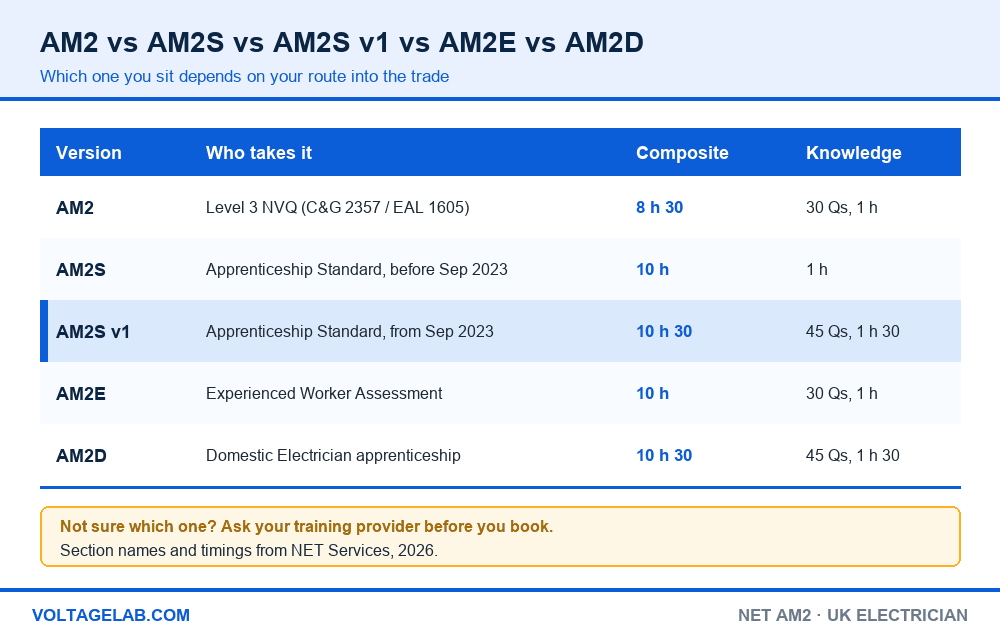
Decoding AM2, AM2S, AM2S v1, AM2E and AM2D
- AM2: for candidates on the Level 3 NVQ (City & Guilds 2357 or EAL 1605). It is the final unit of the NVQ, so finish the other units first.
- AM2S: for apprentices on the Installation and Maintenance Electrician Apprenticeship Standard who registered before September 2023.
- AM2S v1: the revised version for apprentices on that standard registered from September 2023. It has a longer composite and a 45-question knowledge test.
- AM2E: for experienced workers completing the Experienced Worker Assessment. Candidates who already hold an AM2 only need the AM2E supplementary unit.
- AM2D: the end-point assessment for the Domestic Electrician apprenticeship, with net-zero technology, a PV isolation and condition reporting.
Before you can book, most centres run a gateway check. Expect to send a registration form, a self-assessment checklist, proof of maths and English at grade 4 or level 2, and evidence that the rest of your qualification is complete. If you aren’t sure which version applies to you, ask your training provider before you book, not on the morning.
Every AM2 section compared: what you do and how long you get
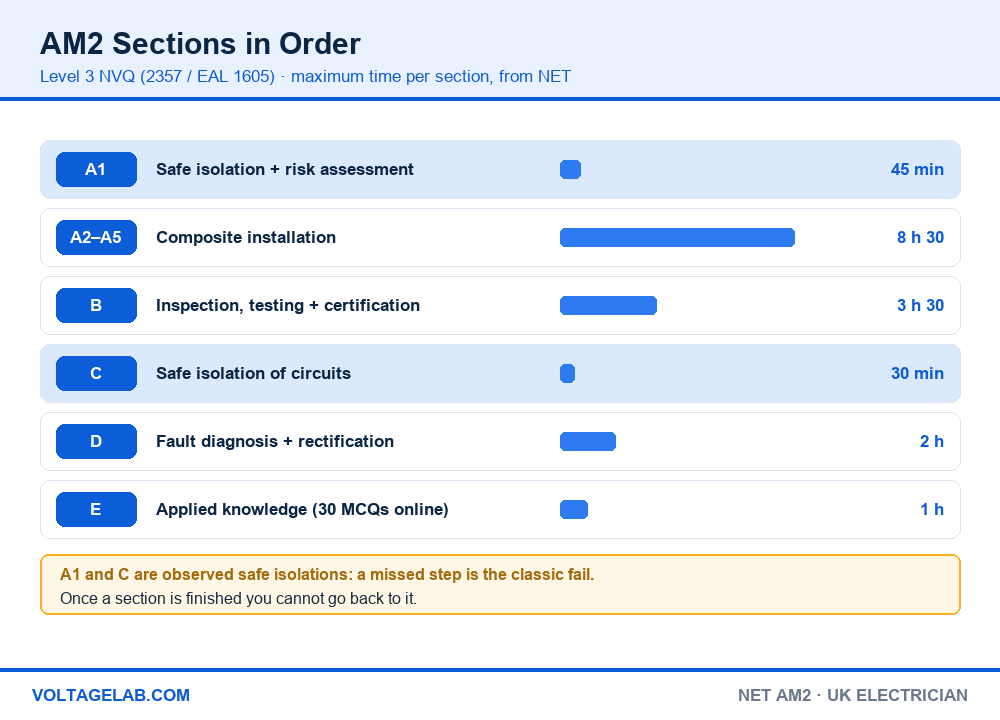
| Section | AM2 | AM2S | AM2S v1 | AM2E |
|---|---|---|---|---|
| A1 Safe isolation and risk assessment (v1: safe working practices and planning) | 45 min | 45 min | 1 h | 45 min |
| A2 onwards Composite installation | 8 h 30 | 10 h | 10 h 30 | 10 h |
| B Inspection, testing and certification | 3 h 30 | 3 h 30 | 3 h 30 | 3 h 30 |
| C Safe isolation of circuits | 30 min | 30 min | 30 min | 30 min |
| D Fault diagnosis and rectification | 2 h | 2 h | 2 h | 2 h |
| E Assessment of applied knowledge | 1 h, 30 Qs | 1 h | 1 h 30, 45 Qs | 1 h, 30 Qs |
A1: Safe isolation and risk assessment
You isolate the assessment unit’s distribution board in the correct sequence while the assessor watches, then complete a risk assessment. On the AM2S v1 this becomes “safe working practices and planning”, and you also plan the composite installation. It is short, but it sets the tone for the whole assessment.
A2 onwards: The composite installation
You install, connect and terminate conductors at a TP&N distribution board and the equipment outlets, working from drawings and a specification. On the AM2 it covers lighting and ring final circuits, three-phase circuits, a central heating control circuit, main protective bonding, a safety circuit and a data circuit. The AM2S v1 adds more containment work. Every sub-section is marked separately, and work must comply with BS 7671 so that it could be certified.
B: Inspection, testing and certification
You inspect your own installation, then carry out continuity, insulation resistance, polarity, earth fault loop impedance, RCD, prospective fault current, phase sequence and functional tests. You record the results and complete the certificate and schedules. Live testing is observed. You can correct faults in your own work within the time, which is the best reason to test carefully rather than quickly.
C: Safe isolation of circuits
Three observed tasks: isolate to replace a single-phase item of equipment, isolate to replace a three-phase item, and isolate the fault diagnosis distribution board. For the first two, every other circuit stays live. You must isolate only the circuit you are about to work on.
D: Fault diagnosis and rectification
Using test equipment and the information provided, you find faults in a set of circuits. For each one you record the type of fault, where it is, how you would put it right and how you would prove the repair. On the AM2D this section also includes condition reporting, coding defects using Electrical Safety First’s Best Practice Guide 4.
E: Assessment of applied knowledge
An invigilated online multiple-choice test on health and safety, BS 7671 and the Building Regulations. The AM2S v1 and AM2D add inspection and testing, installation practice, fault diagnosis, design and behaviours. It is open book, so the skill being tested is finding the answer quickly in the regulations, not memorising them.
The safe isolation that fails a good electrician: on site you might isolate, lock off and test between line and earth, and call it done. In A1 and C the assessor is watching for the full sequence. Identify the point of isolation, tell the person in charge, switch off and lock off, keep the key on you, fit a warning notice, prove the tester on a proving unit, test all 10 combinations on a three-phase board, then prove the tester again. Leave out any step, or test 9 of the 10 combinations, and the isolation is not safe in the assessor’s eyes. Practise the sequence until you can’t do it any other way.
Safe isolation and the 10-point test
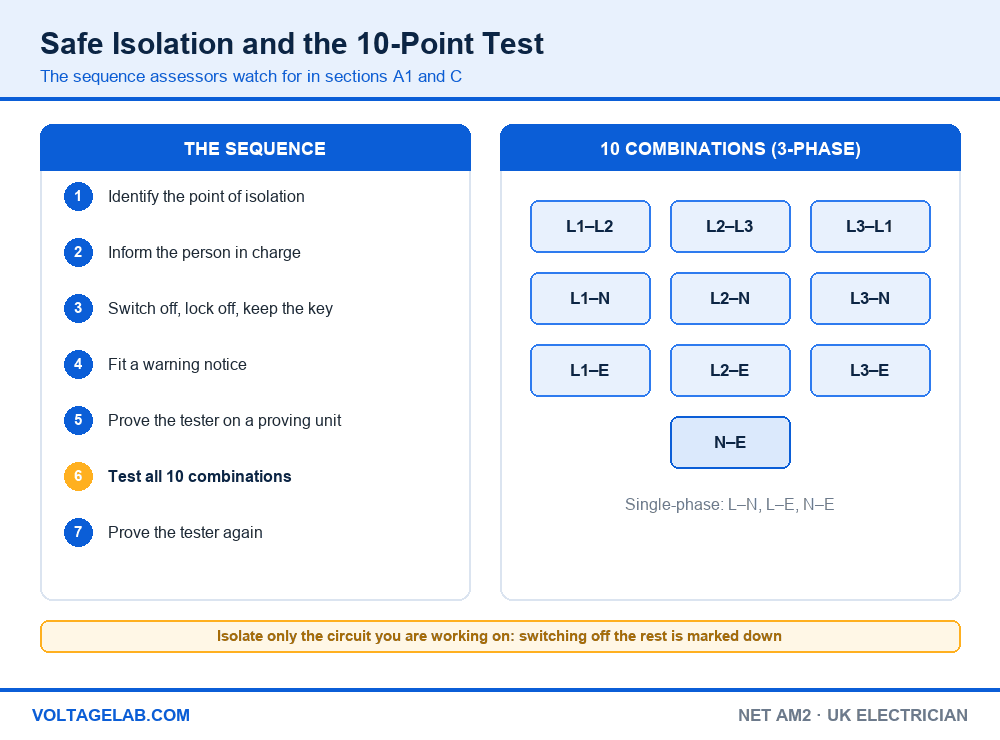
Our full safe isolation procedure goes through each step in detail. For the AM2, this is the version to drill until it is automatic:
- Identify the point of isolation for the circuit or equipment you have been asked to work on, and only that.
- Inform the person in charge, played by the assessor, that you are about to isolate.
- Switch off and lock off the device with your own lock, and keep the key in your pocket.
- Fit a warning notice at the point of isolation.
- Prove your voltage indicator on a proving unit.
- Test every combination: on a three-phase board, L1–L2, L2–L3, L3–L1, each line to neutral, each line to earth, and neutral to earth. That is 10 tests. On single-phase, test L–N, L–E and N–E.
- Prove the indicator again on the proving unit, so you know it didn’t fail during the test.
- Check that the thing is isolated, not just switched off. A local switch or a contactor is not a means of isolation.
The one that catches everyone: time on the composite. It is the longest section and the one most candidates run short on. People lose an hour at the start making cable runs before they have read the whole specification, then find a containment route or a circuit they hadn’t planned for. Use the reading time to plan the order of work, mark up the drawing, and set yourself checkpoints, such as halfway through the containment by the end of the first morning. A section that isn’t finished can’t be marked as complete, however neat the half you did.
Where candidates fail: NET’s common errors
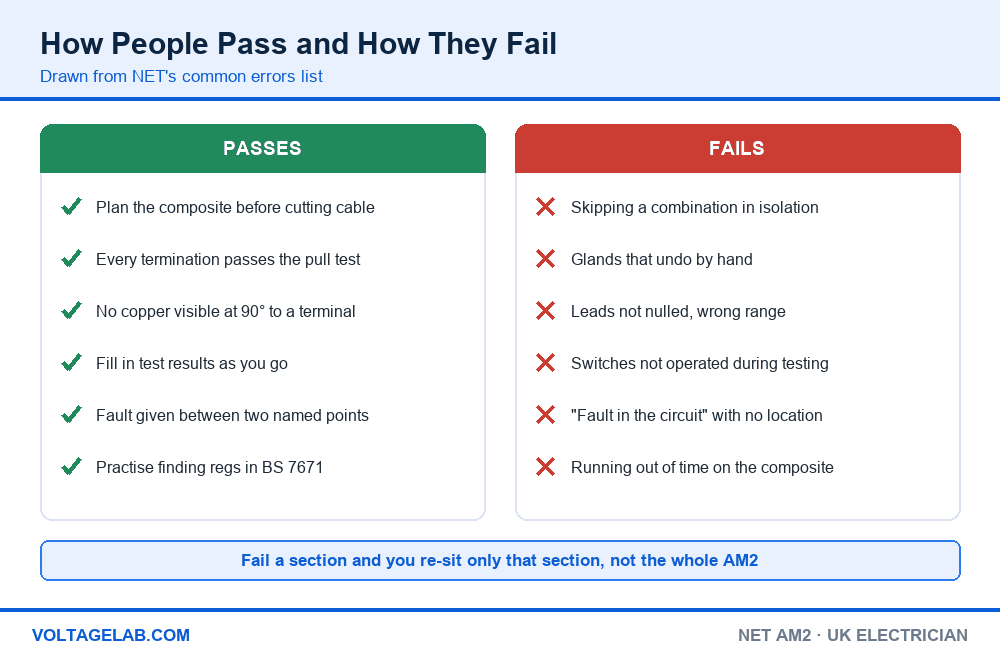
Things that pass
- Work that follows the installation specification exactly: the right cable, the right device type, the right route
- Glands and clamps that can’t be undone by hand
- Terminations that survive a firm finger-and-thumb pull
- No copper visible when a termination is viewed at 90°
- Every conductor identified to BS 7671 Chapter 51, with sleeving where needed
- ELV and LV cables in separate compartments of trunking
- Test results written on the schedule as each test is done, and checked against BS 7671
- A fault written as “open circuit on the cpc between socket 3 and socket 4”
Things that fail
- Missing a step or a combination in safe isolation
- Switching off circuits you weren’t asked to isolate
- Test leads not nulled, or the wrong range selected on the tester
- Not operating switches, isolators or contactors during testing, so part of the circuit is never tested
- Testing shortcuts learned on site that don’t follow Guidance Note 3
- Incomplete or inaccurate certificates and schedules
- A fault described as “fault on the lighting” with no type, location or fix
- Not re-terminating securely after testing
- Running out of time on the composite
For the testing section, it helps to know the expected values before you go in. Our explainer on open, short and closed circuits covers the fault patterns you will meet in section D. The device ratings and curves you will select in the composite are covered in the types of MCB, and why the earthing and bonding has to be right first time in the importance of earthing rules.
Results, re-sits and fees
NET doesn’t publish a pass mark, because the marking criteria are kept confidential. Results are sent about five working days after the assessor finishes marking. If you don’t meet the criteria in a section, you get a general feedback statement and re-sit only that section. Your employer decides how many re-sits you can take, and NET asks for an action plan after three.
| Section re-sit | NET fee, 1 Apr 2026 to 31 Mar 2027 (exc. VAT) |
|---|---|
| A1, C or E | £190 each |
| B or D | £265 each |
| Composite (A2–A6) | £250 for one section, £385 for two, £455 for three, £550 for four, £610 for five |
| Full AM2 (recommended fee) | £885 |
Centres set their own prices and some charge more for a first sitting, so check the figure with your centre. A re-sit booked after 1 April 2026 is charged at the new rate, even if the original assessment was earlier.
Is a pre-AM2 training course worth it?
Pre-AM2 course: pros
- You work on a rig like the real one, against the clock.
- A tutor watches your safe isolation and picks up the habits you can’t see.
- You practise the full testing sequence and paperwork in one go.
Pre-AM2 course: cons
- Costs money and time off work, often a few days.
- Less useful if your site work already covers three-phase, containment and full testing.
If your day job is mostly domestic and you haven’t done much three-phase, steel containment or full certification, a pre-AM2 course is usually worth the cost of one re-sit. If you test and certify every week, NET’s free Pre-Assessment Manual and readiness checklists, plus practice at home on safe isolation and BS 7671 lookups, may be enough. Our article on whether being an electrician is hard covers the wider road to qualification.
Preparing for the AM2 in the weeks before
Do
- Read NET’s Pre-Assessment Manual for your version.
- Drill safe isolation out loud until the sequence is automatic.
- Practise finding regulations in BS 7671 against a timer.
- Fill in a full set of test schedules from a real job.
- Check your insulated hand tools are to BS EN IEC 60900.
Avoid
- Bringing site shortcuts into the testing sequence.
- Starting the composite before you have read the whole specification.
- Leaving your test results to fill in at the end.
- Taking your phone into the bay. It must be handed in.
- Rushing a section to get to the next one. You can’t go back.
Keep learning the parts the AM2 tests
VoltageLab: Electrician App is built for learning the trade, not for one exam. With BS 7671 selected, you get quizzes on safe isolation, inspection and testing and earthing that explain every answer with its regulation number, timed practice papers on any topic, a circuit simulator that has you wire circuits level by level, and 18th Edition exam prep that gets you used to finding your way round the regulations.
Frequently asked questions
How long is the AM2?
The section times on the standard AM2 add up to about 16 hours plus reading time, which is spread over two and a half days. The AM2S v1 is longer, about three days in the bay, mainly because the composite installation and the knowledge test are longer.
What is the difference between the AM2 and the AM2S?
The AM2 is for Level 3 NVQ candidates and the AM2S is the end-point assessment for the Installation and Maintenance Electrician apprenticeship. The AM2S has a longer composite installation. Apprentices registered from September 2023 take the AM2S v1, which also has a 45-question knowledge test.
Can I take BS 7671 into the AM2?
Yes. BS 7671, IET Guidance Note 3, the IET On-Site Guide and a guide to the Building Regulations are permitted. The knowledge test is open book, so practise finding answers quickly.
What happens if I fail one section?
You re-sit only the sections you didn’t pass. Re-sit fees run from £190 for A1, C or E to £265 for B or D, with composite sub-sections charged on a sliding scale. Your employer decides how many re-sits you can take.
What is the 10-point test?
It is proving dead on a three-phase board by testing all 10 combinations: the three line-to-line pairs, each line to neutral, each line to earth, and neutral to earth, with the tester proved before and after.
How many faults are there in section D?
NET doesn’t publish the number, and it can vary between versions. Expect several faults across different circuits. For each one, record the type, the location between two named points, the fix and how you would prove it.
Do I need the AM2 for a Gold Card?
For the ECS Gold Card as an installation electrician, yes. The AM2, AM2S or AM2E is part of the qualified-electrician requirement, alongside the Level 3 qualification or apprenticeship and the ECS health and safety assessment.
The bottom line
The AM2 tests the work you already do: isolate, install, test, find faults and look things up in the regulations. What it adds is a clock, an assessor and no second chance at a finished section. Most people who fail a section fail it on habit rather than knowledge, through a skipped isolation step, a loose terminal, untidy timing or a vague fault description.
Two things make the biggest difference. Drill the full safe isolation procedure until it is automatic, and plan the composite before you cut a single cable. For the earthing and bonding that runs through every section, see grounding and bonding essentials.