



 Scan to install
Walk into any college open evening for electrical installation and you’ll hear the same question asked a dozen ways: do I need Level 2, or can I go straight to Level 3? And once I’ve got Level 3, am I an electrician? The honest answers are “usually yes”, “usually not” and “no, not yet”. That last one surprises a lot of people who’ve just paid for a course.
The confusion is understandable. There are several qualification codes in play (2365, 2366, 8202, 2357, 5357), training centres advertise “Level 3 electrician” courses that last a few weeks, and the difference between a diploma and an NVQ isn’t obvious until you’re halfway through one. People end up paying for the wrong course, or finishing a diploma and finding no employer treats them as qualified.
This guide explains what Level 2 and Level 3 electrical installation each cover, how they compare in content, entry, length and assessment, where they sit on the road to becoming a qualified electrician, what each one lets you do, and which one is right for where you are now.
Quick Answer
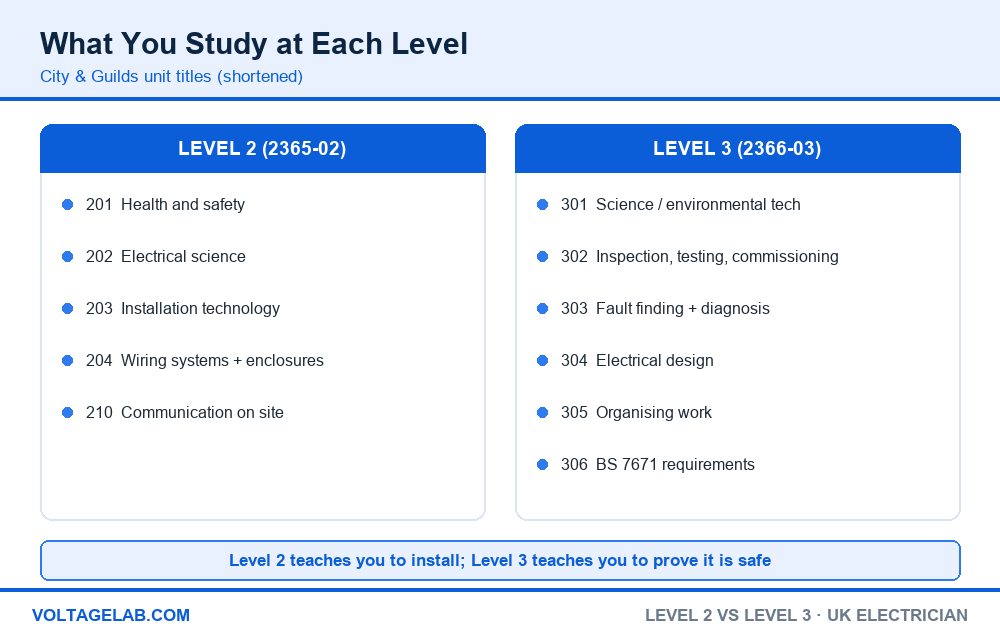
Level 2 electrical installation teaches the foundations: health and safety, electrical science, installation technology and how to install wiring systems and enclosures. Level 3 electrical installation builds on it with inspection and testing, fault diagnosis, design and BS 7671 requirements. Level 3 normally needs a Level 2 qualification first. The best-known versions are City & Guilds 2365-02 and 2365-03, with the newer 2366-03 now offered at Level 3.
Neither diploma makes you a qualified electrician on its own. To get an ECS Gold Card through the adult route you also need the Level 3 NVQ (2357), built from evidence of real site work, and a pass in the AM2. Apprentices follow a different package, the 5357 qualification and the AM2S.
Key Takeaways
- Level 2 covers safety, science and installation. Level 3 covers testing, fault finding and design.
- Level 3 normally requires a Level 2 qualification such as 2365-02 or 8202 Level 2.
- City & Guilds lists 2365-02 at 454 guided learning hours and 2365-03 at 480.
- The 2366-03 diploma is now offered at Level 3, and providers present it as the successor to 2365-03.
- A diploma is classroom and workshop learning. It is not an NVQ and doesn’t prove site competence.
- To qualify through the adult route you need Level 2, Level 3, the 18th Edition, the 2357 NVQ and the AM2.
What Level 2 and Level 3 electrical installation are
Both are technical diplomas: college or training-centre courses that teach the theory and the practical skills of electrical installation in a workshop. You don’t need a job to take them. That is what separates them from an NVQ or an apprenticeship, which assess your competence on real sites. The “Level” refers to the national qualification level, so Level 2 is roughly GCSE standard and Level 3 roughly A-level standard.
Decoding the codes: 2365, 2366, 8202, 2357 and 5357
- 2365-02 and 2365-03: City & Guilds’ Level 2 and Level 3 Diplomas in Electrical Installations (Buildings and Structures), the most common adult route for years. EAL offers equivalents.
- 2366-03: City & Guilds’ Level 3 Technical Occupational Entry in Electrical Installation (Diploma), available from August 2025. It has six mandatory units, and training providers offer it in place of 2365-03.
- 8202: City & Guilds’ Level 2 and Level 3 Technical qualifications, mostly taken by 16 to 18 year olds in full-time college.
- 2357: the Level 3 NVQ Diploma in Installing Electrotechnical Systems and Equipment. It’s work-based, built from a portfolio of site evidence, and its final unit is the AM2.
- 5357: the Electrotechnical Qualification inside the apprenticeship, which ends with the AM2S instead.
At Level 2 you start with safety and the basics: the safe isolation procedure, Ohm’s law, open, short and closed circuits, and installing cable, conduit and trunking. Level 3 moves on to proving installations are safe and designing them, including protective devices such as the types of MCB and the earthing rules every circuit depends on.
Level 2 vs Level 3 compared: content, entry, length and assessment
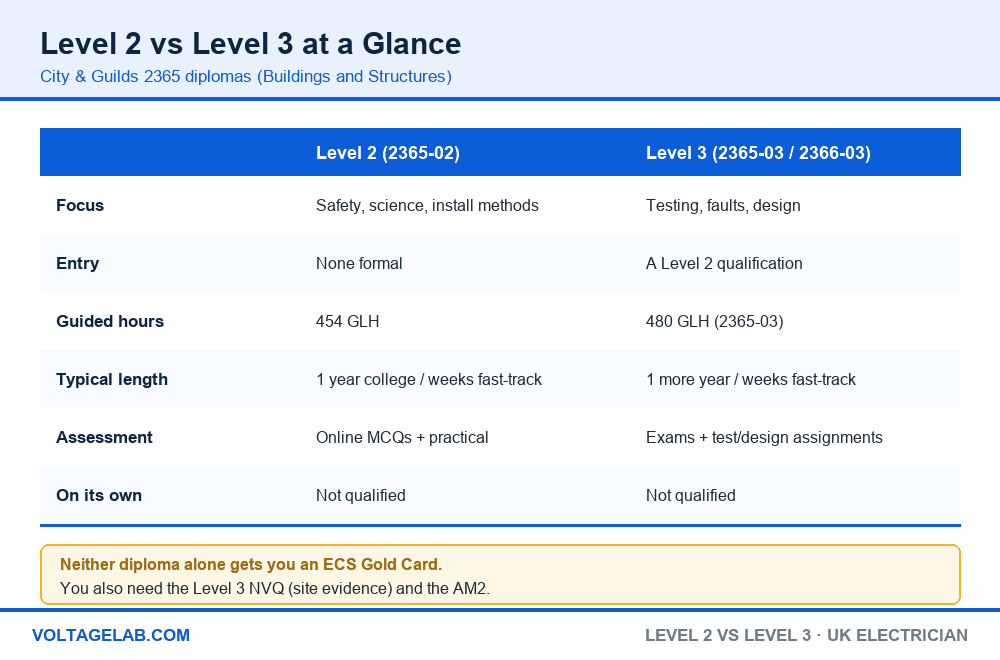
| Level 2 (2365-02) | Level 3 (2365-03 / 2366-03) | |
|---|---|---|
| Main content | Health and safety, electrical science, installation technology, wiring systems and enclosures | Inspection, testing and commissioning, fault diagnosis, design, BS 7671 requirements, organising work |
| Entry requirement | No formal requirement, though colleges may ask for GCSEs | A Level 2 electrical installation qualification (2365-02, 8202 or equivalent) |
| Guided learning hours | 454 | 480 (2365-03) |
| Typical length | About a year full-time in college, or up to two years part-time. Private centres run intensive blocks of several weeks plus home study. | About another year in college, or several weeks in an intensive centre course |
| Assessment | Online multiple-choice exams plus a practical installation assignment | Online and written exams plus practical assignments on inspection, testing, fault finding and design |
| Makes you a qualified electrician? | No | No, the NVQ and AM2 are still needed |
Guided learning hours come from City & Guilds’ published qualification list. Course length varies a lot between providers. A college runs the content across an academic year, while private centres compress the teaching into a few weeks and expect home study around it. Check what the price includes, especially exam fees and resits.
The Level 3 that isn’t a qualified electrician: courses advertised as “become a Level 3 electrician” usually mean the Level 3 diploma. That’s the theory and workshop half. It doesn’t include the NVQ, which needs months of evidence from real installations under a qualified electrician, and it doesn’t include the AM2. Without those, you can’t get an ECS Gold Card as an installation electrician, and most contractors won’t treat you as qualified. Before paying, ask the provider exactly which qualifications you’ll hold at the end and which ECS card that gets you.
Where Level 2 and Level 3 sit on the road to qualified
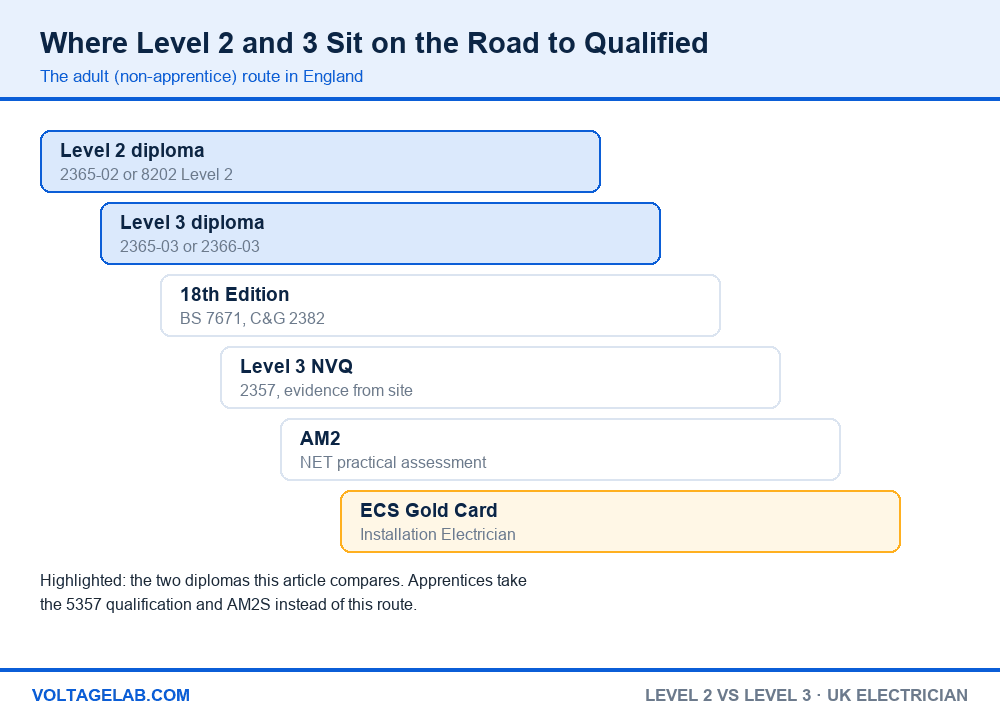
For an adult who isn’t on an apprenticeship, the usual route in England looks like this. The two diplomas are the first two steps, and the rest happens once you’re working in the trade.
The route from Level 2 to Gold Card, step by step
- Level 2 diploma (2365-02 or 8202 Level 2): the theory and practical basics.
- Level 3 diploma (2365-03 or 2366-03): testing, fault finding and design.
- 18th Edition (City & Guilds 2382): the current BS 7671 qualification. It isn’t part of the 2366-03 diploma, so it’s usually taken separately.
- Get a job in the trade as a mate or improver, so you can gather evidence.
- Level 3 NVQ (2357): build a portfolio of site work, with an assessor observing you on site.
- AM2: NET’s practical assessment, the final unit of the NVQ.
- Apply for the ECS Gold Card as an installation electrician, with the ECS health and safety assessment.
The one that catches everyone: step 4. Finishing both diplomas is the easy part to plan, because you can book it. Getting a job that gives you enough variety of work for the NVQ is the hard part, and you can’t complete the NVQ without it. People who finish Level 3 and then spend a year looking for work lose the momentum. Start building contacts with local contractors while you’re still on Level 2, and look for a firm that does testing and commercial work, not just domestic second fix.
What each level lets you do
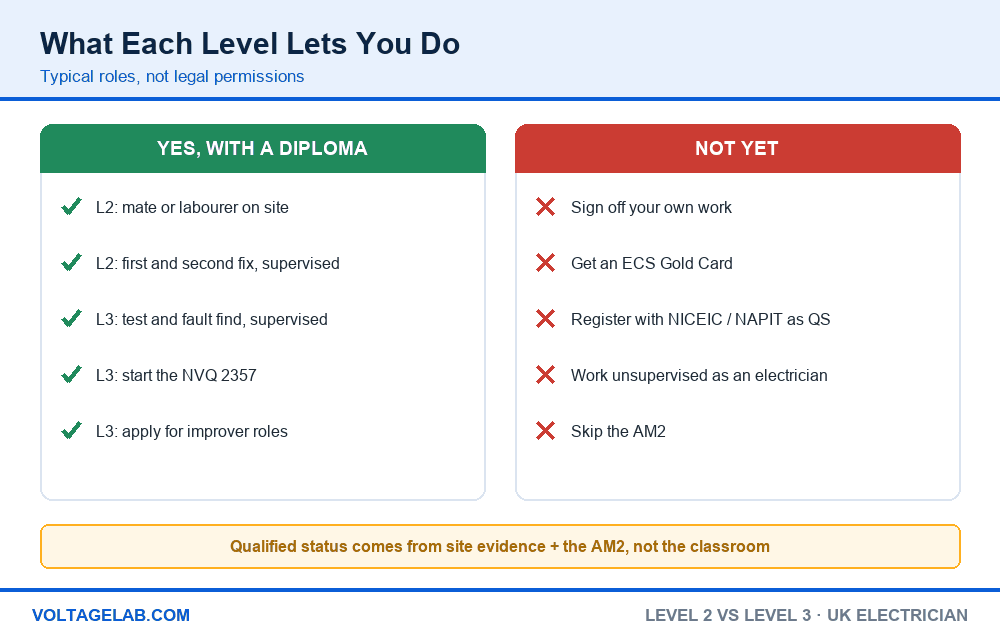
With Level 2 or Level 3
- Work as an electrician’s mate or labourer, with a better chance of being taken on than someone with no training
- Help with first and second fix under supervision
- With Level 3, assist with testing and fault finding under a qualified electrician
- With both, start the Level 3 NVQ once you have suitable work
- Apply for improver roles, which usually pay more than a mate
Not yet
- Work unsupervised as an electrician or sign off your own installations
- Hold an ECS Gold Card as an installation electrician
- Register as the qualified supervisor of a firm with a competent person scheme such as NICEIC or NAPIT
- Skip the NVQ or the AM2 because you have the diplomas
Diplomas vs the other ways to learn the trade
| Option | Need a job? | Who pays | Leads to Gold Card? | Best for |
|---|---|---|---|---|
| Level 2 + Level 3 diplomas | No | You, or free in college for many 16 to 18 year olds | Only with the NVQ and AM2 afterwards | Getting the theory before finding work |
| Apprenticeship (5357 + AM2S) | Yes, you’re employed | Employer and government | Yes | Anyone who can find an employer |
| Level 3 NVQ (2357) + AM2 | Yes | You or your employer | Yes | Adults working in the trade with diplomas |
| Experienced Worker Assessment + AM2E | Yes, years of it | Usually you | Yes | Long-serving workers with no formal qualification |
If you’re still deciding whether the trade is for you, our look at whether being an electrician is hard covers the physical side and the maths, and how long it takes to become an electrician sets out the timescales stage by stage. Getting comfortable with electrical symbols and the three-phase basics before you start will make both levels easier.
Should you do Level 2 and Level 3 diplomas?
Pros
- You can start without an employer.
- They give you a solid grounding in theory, testing and design.
- Employers are more likely to take on someone who has them.
- Part-time and evening options fit around another job.
Cons
- Adults usually pay for them, and private courses can be expensive.
- They don’t make you qualified. The NVQ and AM2 still lie ahead.
- Workshop practice isn’t the same as real site experience.
If you’re 16 to 18 or can find an employer, an apprenticeship covers the same ground and is paid, so it’s usually the better option. If you’re an adult career changer who can’t yet get taken on, Level 2 then Level 3 is a sensible way in, as long as you plan from day one how you’ll get the site experience the NVQ needs.
Getting through Level 2 and Level 3
Do
- Master the electrical science early. Level 3 builds directly on it.
- Practise multiple-choice questions against the clock.
- Learn your way round BS 7671 before the Level 3 testing and design units.
- Get any site experience you can, even weekends as a mate.
- Check whether exam fees and resits are included in the price.
Avoid
- Paying for packages that promise a fully qualified electrician in weeks.
- Skipping Level 2 because you’ve done some DIY wiring.
- Memorising answers instead of understanding the science.
- Leaving the job hunt until after Level 3.
- Treating the workshop bay as if it were a live installation.
Learn it properly, at Level 2 and Level 3
VoltageLab: Electrician App is built for people learning the trade. With BS 7671 selected, you can quiz yourself on electrical science, testing and earthing with answers that explain why and give the regulation number, turn any college topic into a study plan or flashcard deck, wire circuits level by level in the circuit simulator, and sit timed practice papers when you want to check where you are. Use it alongside your course, not instead of it.
Frequently asked questions
Can I go straight to Level 3 electrical installation?
Usually not. Level 3 diplomas expect a Level 2 electrical installation qualification first, such as 2365-02 or 8202 Level 2. Some providers will consider direct entry for people with substantial experience or older equivalent qualifications, so ask the centre.
Am I a qualified electrician with Level 3?
No. The Level 3 diploma covers the theory and workshop skills. To be recognised as a qualified installation electrician with an ECS Gold Card, you also need the Level 3 NVQ (2357) from real site work and a pass in the AM2, plus a current 18th Edition qualification.
What is the difference between 2365 and 2366?
2365-03 is City & Guilds’ long-running Level 3 Diploma in Electrical Installations. 2366-03, available from August 2025, is a newer Level 3 diploma with six mandatory units covering science, inspection and testing, fault finding, design, organising work and BS 7671. Training providers now offer it in place of 2365-03. Both expect a Level 2 qualification first.
What is the difference between 2365 and 8202?
Both are Level 2 and Level 3 electrical installation qualifications from City & Guilds. 8202 is mostly taken by 16 to 18 year olds on full-time college programmes, while 2365 has been the common choice for adults and part-time learners. Either works as the Level 2 entry to a Level 3 diploma.
How long do Level 2 and Level 3 take?
In college, each level usually takes about an academic year full-time, or longer part-time. Private training centres run each level as an intensive course of several weeks with home study. City & Guilds lists 454 guided learning hours for 2365-02 and 480 for 2365-03.
Is a diploma the same as an NVQ?
No. A diploma is taught and assessed in a college or training centre, and you don’t need a job to take it. An NVQ assesses your competence on real installations, using a portfolio of evidence and on-site observation, so you need to be working in the trade to complete one.
Do apprentices do Level 2 and Level 3 diplomas?
Not usually. Apprentices on the Installation and Maintenance Electrician standard take the 5357 Electrotechnical Qualification, which covers the same ground within the apprenticeship, and finish with the AM2S. The diplomas are mainly for people learning outside an apprenticeship.
The bottom line
Level 2 electrical installation teaches you to install safely. Level 3 teaches you to test, fault find and design, so you can prove an installation is safe. Most people need Level 2 before Level 3, and together they give an adult career changer a real foundation in the trade, with 2366-03 now offered as the Level 3 option alongside or in place of 2365-03.
Two things to keep in mind. The diplomas aren’t the finish line: the NVQ and AM2 are what make you qualified. And plan your route to site experience from the start, because that’s where most people stall. Whatever level you’re on, the habits that matter most start with the safe isolation procedure.