


Every storm season and every big data-center build, the same thing happens. Licensed journeymen load up their trucks and head for a job in another state. Then they find out at the board office, or worse, from an inspector, that the license in their wallet means nothing across the line. Some get a new license in a week for a $30 fee. Others sit a full exam, and some can’t work at all until they do.
The difference is electrician license reciprocity, and it is far patchier than most electricians assume. There is no national electrician license. Each state decides which other states it trusts, for which license level, and on what conditions. A state can accept your journeyman card and refuse your master license. Many states can’t reciprocate at all, because they don’t issue a statewide license in the first place.
Study smarter with VoltageLab
Built for electricians, apprentices, and electrical engineers who want faster practice and better exam prep.
⭐️ Join thousands of electricians upgrading their skills
This guide covers what reciprocity is, the conditions almost every agreement shares, which states have published agreements according to their own licensing boards, which states have no statewide license to transfer, and how to apply. Agreements change, and several were added in 2026. Every list here was checked against the state board’s own page on October 22, 2026.
Quick Answer
Electrician license reciprocity is an agreement between two states to issue each other’s licensed electricians an equivalent license without a new exam. It only works between states that both license electricians at the state level. Usually you must have earned your license by passing the state exam, held it for at least one year, and be in good standing. Texas, for example, reciprocates journeyman licenses with Alabama, Alaska, Arkansas, Idaho, Iowa, Nebraska, New Mexico, Oklahoma, South Dakota and Wyoming.
If there is no agreement between your state and the one you are moving to, you apply by examination like anyone else. Many large states — including Illinois, New York, Pennsylvania and Missouri — have no statewide journeyman license, so licensing there is handled by cities and counties.
Key Takeaways
- There is no national electrician license. Reciprocity only exists where two states have signed an agreement
- Most agreements require a license earned by state exam, held for at least one year, and in good standing
- A license you got through reciprocity usually cannot be carried on to a third state
- Journeyman and master agreements are separate. Texas has more journeyman partners than master partners
- The destination state’s hour requirement still applies. Texas wants 8,000 supervised hours for a journeyman license
- States with no statewide license, such as Illinois, New York and Pennsylvania, cannot sign journeyman reciprocity
- Agreements change often. Texas added Alabama and Ohio in 2026
What electrician license reciprocity actually is
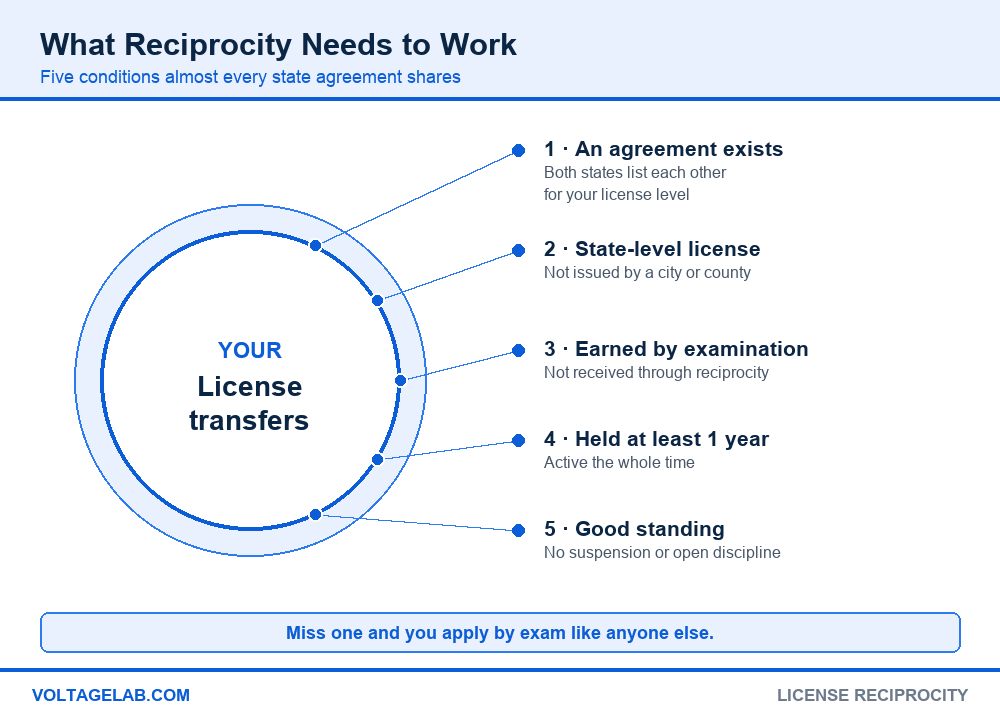
Reciprocity is a written agreement between two state licensing boards. Each agrees that the other’s exam and experience requirements are close enough to its own that it will issue a license without a new exam. To use it, five things have to line up:
Pass your electrical exam the first time
Practice real NEC exam questions with full code-referenced explanations and progress tracking — built for journeyman, master and apprentice exam prep.
Thousands of NEC practice questions with code-referenced answers
- An agreement exists. Your home state and the destination state are both on each other’s list, for your license level.
- A state-level license. The license was issued by the state, not a city or county. Minnesota says so outright: a license obtained through a reciprocal agreement with a city or other political subdivision does not qualify.
- Earned by examination. South Dakota and Minnesota both require that you passed the license exam in your home state.
- Held for at least a year. South Dakota, Minnesota and Texas all require at least one year with the license, and South Dakota requires it to be active for that year.
- Good standing. The license is current, with no suspension, revocation or open discipline.
Meet all five and the process is mostly paperwork: an application, a copy of your license, sometimes a letter of good standing, and a fee. Miss one and you are back to applying by exam.
Reciprocity, endorsement and the words boards use
- Reciprocity — a two-way agreement between specific states for specific license types
- Endorsement — the term some boards use for issuing a license based on one from another state. It may or may not depend on a formal agreement
- NERA — the National Electrical Reciprocal Alliance, a group of states with similar journeyman and master requirements. South Dakota lists Maine, Vermont and Wisconsin as members it has no direct agreement with
- Letter of good standing — a letter from your home board confirming your license and that you passed its statewide exam. Texas requires one for master reciprocity
- Equivalent license — the license in the new state that matches yours. Names differ: Minnesota’s journeyman license is the “journeyworker” license
Journeyman vs master reciprocity — which licenses actually transfer
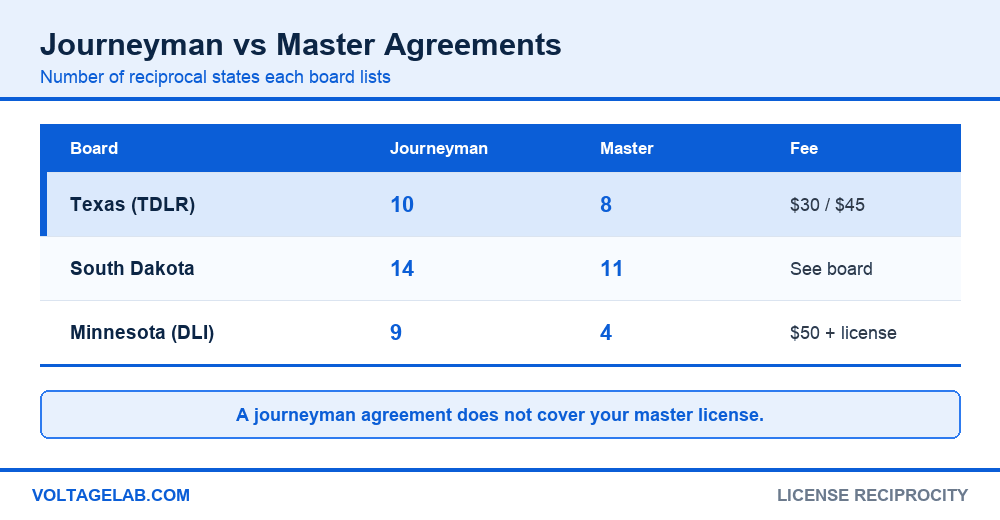
Boards sign agreements license level by license level. The journeyman list is almost always longer than the master list, because master and contractor requirements vary more between states. Here is how three boards that publish their lists compare:
| State board | Journeyman partners | Master / contractor partners | Fee |
|---|---|---|---|
| Texas (TDLR) | 10 states | 8 states | $30 journeyman, $45 master |
| South Dakota | 14 states | 11 states | See the board |
| Minnesota (DLI) | 9 states | 4 states | $50 application, then the license fee |
Master agreements can also cross license types. Texas accepts a Louisiana state contractor’s license, a Tennessee electrical contractor license and a North Carolina unlimited electrical contractor license toward its master electrician license. Those states license contractors at the state level but not journeymen. Texas also limits Iowa to Class A masters — Class B will not reciprocate — and requires Louisiana applicants to be Louisiana residents.
The chaining trap: you can’t stack agreements to reach a state that has none with your home state. South Dakota and Minnesota both require that you earned the license by examination, so a license you got through reciprocity does not qualify you for a third state. If you pass the Iowa exam, get a Texas license by reciprocity and then move to a state that partners with Texas but not Iowa, you test again. Plan your moves around the state where you actually sat the exam.
Electrician license reciprocity by state — the published agreements
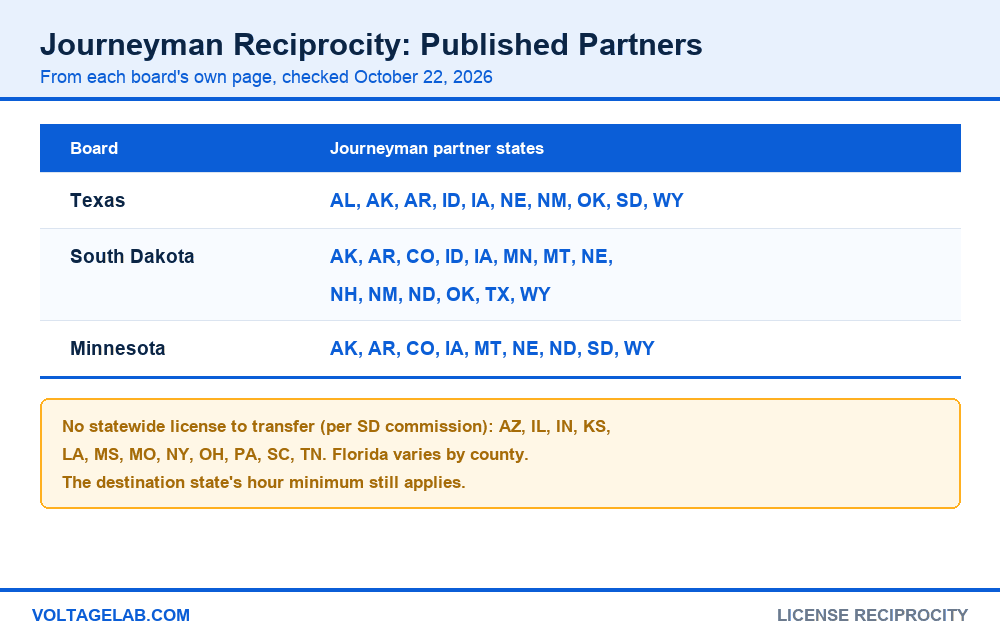
Only the boards themselves can say which agreements are in force. These are the lists the Texas, South Dakota and Minnesota boards publish:
| Board | License | Reciprocal states listed by the board |
|---|---|---|
| Texas (TDLR) | Journeyman | Alabama, Alaska, Arkansas, Idaho, Iowa, Nebraska, New Mexico, Oklahoma, South Dakota, Wyoming |
| Texas (TDLR) | Master | Alabama, Arkansas, Iowa (Class A), Louisiana (state contractor), Nebraska, North Carolina, Ohio, Tennessee (electrical contractor) |
| South Dakota | Journeyman | Alaska, Arkansas, Colorado, Idaho, Iowa, Minnesota, Montana, Nebraska, New Hampshire, New Mexico, North Dakota, Oklahoma, Texas, Wyoming |
| South Dakota | Master / contractor | Arkansas, Idaho, Iowa, Minnesota, Montana, Nebraska, New Hampshire, North Dakota, Oklahoma (unlimited EC), Texas, Wyoming |
| Minnesota (DLI) | Journeyworker | Alaska, Arkansas, Colorado, Iowa, Montana, Nebraska, North Dakota, South Dakota, Wyoming |
| Minnesota (DLI) | Master | Iowa, Nebraska, North Dakota, South Dakota |
Two patterns stand out. The northern plains and mountain states — the Dakotas, Iowa, Nebraska, Minnesota, Montana, Wyoming, Colorado and Idaho — reciprocate heavily with each other. And Texas has been adding partners. In 2026 TDLR announced a master agreement with Iowa in February, journeyman and master reciprocity with Alabama in March, and a master-level agreement with Ohio in June.
States with no statewide license to reciprocate
South Dakota’s commission lists these states as having no state-level electrician license comparable to its own: Arizona, Illinois, Indiana, Kansas, Louisiana, Mississippi, Missouri, New York, Ohio, Pennsylvania, South Carolina and Tennessee. It lists Florida as varying by county or municipality. In those states, journeyman licensing — where it exists — is handled by cities and counties, so moving there means meeting the local rules. Some of them license contractors at the state level. Our guide to Florida electrical contractor license requirements shows how that works.
How to transfer your license, step by step
Step 1 — check the destination board’s list. Find your home state and your license level on the new state’s reciprocity page. If it isn’t there, there is no agreement, whatever a third-party chart says.
Step 2 — confirm you meet the conditions. Check that the license was earned by exam, held at least a year, active and clean. Check the hour requirement too: Texas wants 8,000 supervised hours for a journeyman license and 12,000 for a master.
Step 3 — request a letter of good standing. Ask your home board for a letter confirming you passed its statewide exam, if the destination requires one. Texas requires it for master reciprocity.
Step 4 — apply and pay. Submit the reciprocity application, a copy of your license and the fee. That is $30 for a Texas journeyman, $45 for a Texas master, or $50 to apply in Minnesota.
Step 5 — keep both licenses alive. Once issued, the new license has its own renewal date and continuing education. Our CE hours by state guide lists what each state requires.
Study smarter with VoltageLab
Built for electricians, apprentices, and electrical engineers who want faster practice and better exam prep.
⭐️ Join thousands of electricians upgrading their skills
The one that catches everyone: one failed exam in the destination state can close the reciprocity door. Minnesota will not issue a license by reciprocity to anyone who has failed the same or a higher class of exam in Minnesota. If an agreement covers you, apply through it first. Don’t sit the local exam “just to try” while the paperwork is pending.
Who qualifies for reciprocity — and who doesn’t
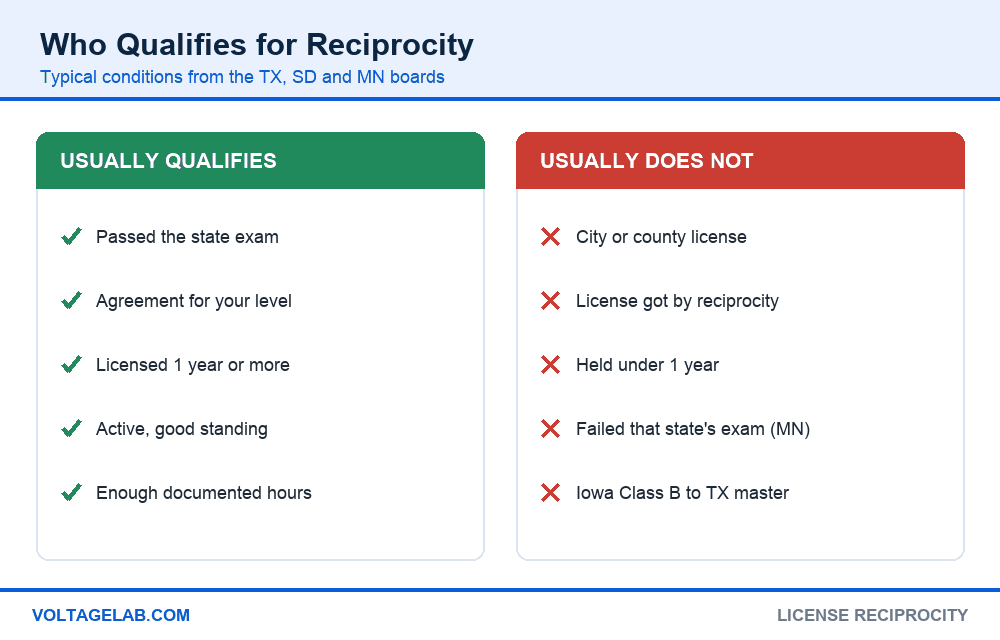
Usually qualifies
- A journeyman or master who passed the exam in a state that has an agreement with the destination
- A license held for at least a year and still active
- No suspensions, revocations or open complaints
- Enough documented hours to meet the destination state’s own minimum
- A master applying for a lower license: Minnesota issues its journeyworker license to partner-state masters too
Usually does not qualify
- A license issued by a city or county rather than the state
- A license you received through another reciprocity agreement
- A license held for less than a year
- Anyone who already failed that state’s exam, in Minnesota’s case
- A Minnesota licensee more than two years past expiration, who must retest
- An Iowa Class B master applying for a Texas master license
Reciprocity vs taking the other state’s exam
| Factor | Reciprocity | Apply by exam | Local (city/county) license |
|---|---|---|---|
| Available when | Both states have an agreement | Always, in a state that licenses | State has no statewide license |
| Exam | None | Full state exam | Varies by city |
| Time to work | Processing time only | Weeks to schedule and pass | Varies by city |
| Hour requirement | Destination’s minimum still applies | Destination’s minimum | Local rules |
| Counts for later reciprocity | Usually no | Yes | No — not a state license |
If you expect to move more than once, there is a case for testing in the new state even when reciprocity is available. An exam-earned license there opens that state’s agreements too. If you do test, the exam will be on the NEC edition that state has adopted. Our NEC edition comparison and 2026 NEC changes show what may differ from the code you learned. Build your study plan with the NEC exam prep guide and check where you stand with the free NEC practice test.
No agreement? Get ready for the exam
If your new state has no agreement with your old one, you test. The NEC Journeyman Exam app (also on Android) has 2,700+ NEC practice questions for the journeyman and master exams. The Electrical & Electrician App (also on Android) builds a short daily plan on any code topic, such as the changes between the edition you know and the one your new state enforces.
Moving your license without losing work time
Do
- Check the destination board’s own reciprocity page before you take the job
- Keep your home license active while you work elsewhere
- Keep documented proof of your supervised hours
- Request your letter of good standing early, since it comes from the other board
- Learn the NEC edition and local amendments your new state enforces
Avoid
- Trusting a third-party reciprocity map over the board’s own list
- Starting work before the new license is issued
- Sitting the destination exam while a reciprocity application is pending
- Letting your exam-earned home license lapse
- Assuming a journeyman agreement also covers your master license
Frequently asked questions
Is there a national electrician license?
No. Electrician licensing in the US is done by states, and in some states by cities and counties. Reciprocity agreements between states are the closest thing to a portable license.
Which states have reciprocity with Texas?
For journeyman electricians, TDLR lists Alabama, Alaska, Arkansas, Idaho, Iowa, Nebraska, New Mexico, Oklahoma, South Dakota and Wyoming. For master electricians, it lists Alabama, Arkansas, Iowa (Class A), Louisiana, Nebraska, North Carolina, Ohio and Tennessee. TDLR says it has no agreements for other license types.
Does a journeyman license transfer to another state?
Only if the two states have a reciprocity agreement for journeyman licenses and you meet its conditions. That usually means the license was earned by exam, held for at least a year and in good standing. Otherwise you apply by exam in the new state.
Can I use a license I got by reciprocity in a third state?
Usually not. South Dakota and Minnesota require that the license was earned by examination, so a license issued through reciprocity does not qualify for another agreement. Your exam state is the one that counts.
Why can’t I transfer a license from New York or Illinois?
Neither state issues a statewide journeyman electrician license, so there is no state license for another board to recognize. Licenses there are issued by cities and counties, and other states’ agreements generally require a state-level license.
How much does electrician license reciprocity cost?
It depends on the state. Texas charges $30 for a journeyman license and $45 for a master license by reciprocity. Minnesota charges a $50 application fee, then the license fee once you are approved.
What is NERA?
The National Electrical Reciprocal Alliance, a group of states that share similar journeyman and master licensing requirements and recognize each other’s licenses. Membership alone does not mean every member reciprocates with every other. South Dakota lists Maine, Vermont and Wisconsin as NERA states it has no direct agreement with.
The bottom line
Electrician license reciprocity can turn a move into a $30 application instead of a new exam, but only along the routes the boards have agreed. The two things that decide it are where you earned your license — by exam, at the state level — and whether the destination board lists that state for your license level. Check the board’s own page, not a map, and keep your exam-earned license active, because it is the one every future agreement depends on.
If there is no agreement, you test, and the exam will be on the code edition your new state enforces. Start with our NEC exam prep guide and see which apps help with the move in our best electrician apps roundup.
FREE PRACTICE TOOL
Think you'd pass this on a real exam?
Test what you just read with instant-feedback quizzes built around real code questions — not generic trivia.
5
Code standards
10,000+
Active learners
100%
Free to start
Instant explanations on every answer, right or wrong
NEC, BS7671, AS/NZS, CEC, and DIN VDE covered
Bite-sized quizzes you can finish in 5 minutes
No signup required to try your first quiz
No account needed · Takes less than 2 minutes