


Ask around any supply house and someone will have a story about finding out their license expired the hard way — a contractor asks for a current card, a permit gets kicked back, or the state lookup shows Expired next to a name that has been pulling permits for a decade. In almost every case the work was fine. The paperwork was not.
Electrical license renewal is simple on paper and messy in practice, because there is no national rule. Each state board sets its own renewal cycle, its own continuing education (CE) hours, its own split between code-update and general hours, and its own list of approved providers. Hours that count in Texas are worthless in Washington, and a course built on the wrong NEC edition can count for nothing at all.
Study smarter with VoltageLab
Built for electricians, apprentices, and electrical engineers who want faster practice and better exam prep.
⭐️ Join thousands of electricians upgrading their skills
This guide covers how a renewal cycle works, the CE hours required in the states that set them, a step-by-step renewal method, what counts as CE and what does not, and the two mistakes that turn a routine renewal into a lapsed license.
Quick Answer
Electrical license renewal means completing your state’s required continuing education hours from a board-approved provider, confirming those hours are posted to your license record, and paying the renewal fee before the expiration date. Most states renew every one to three years and require between 3 and 34 CE hours per cycle, with a fixed share on National Electrical Code changes.
The numbers vary widely: Texas requires 4 hours every year, Minnesota 16 hours every two years with at least 12 on the NEC, Washington 24 hours every three years, and New Jersey contractors 34 hours every three years. Several large states — New York, Pennsylvania, Illinois and Kansas — have no statewide journeyman license, so the city or county that licensed you sets the renewal rules.
Key Takeaways
- Electrician CE requirements are set state by state; there is no national renewal rule
- Most states require a minimum number of hours on NEC code changes, separate from general hours
- Only courses from a provider approved by your state board count toward renewal
- Hours earned above the minimum generally do not carry over into the next license term
- Several states exempt your first renewal after passing the licensing exam from CE
- A license held in more than one state needs each state’s CE, unless a board accepts the other’s courses
- Letting a license lapse long enough can mean late fees, reinstatement paperwork or, in some states, retaking the exam
How electrical license renewal works
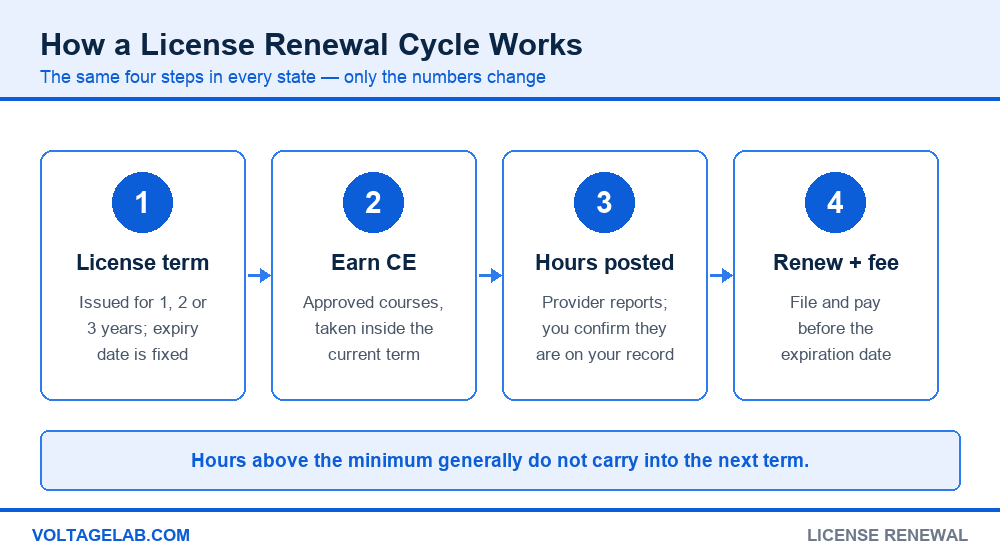
Every state that licenses electricians runs the same basic loop, even though the numbers differ:
Pass your electrical exam the first time
Practice real NEC exam questions with full code-referenced explanations and progress tracking — built for journeyman, master and apprentice exam prep.
Thousands of NEC practice questions with code-referenced answers
- The license term. Your license is issued for a fixed period — one, two or three years — and expires on a set date. Some states tie it to your birth month, some to the anniversary of issue, and some renew everyone on one statewide date.
- The CE window. Continuing education must be completed during the term you are renewing. Hours taken before the term started generally do not count.
- Provider reporting. In most states the approved provider reports your completed hours to the board. You still own the result — if the hours are not on your record, the renewal stalls.
- The renewal itself. You file the application online, attest to your hours and pay the fee before expiration.
Code-update hours vs general hours
Most boards split the total into buckets. The one that matters most is the code-update or NEC requirement: Minnesota wants at least 12 of its 16 hours on the National Electrical Code, Utah 12 of 16, Washington 8 of 24 on code updates plus 4 on state electrical law, and Colorado at least 4 of 24 on NEC changes. The rest can usually come from safety, theory, grounding and bonding, or business topics.
Code-update hours are tied to the edition your state has adopted, not the newest one NFPA has printed. If your state is still enforcing the 2023 NEC, a 2026 code-change course may not be approved yet. Our breakdown of NEC code book editions from 2017 to 2026 explains how adoption lags publication.
Electrician CE hours by state
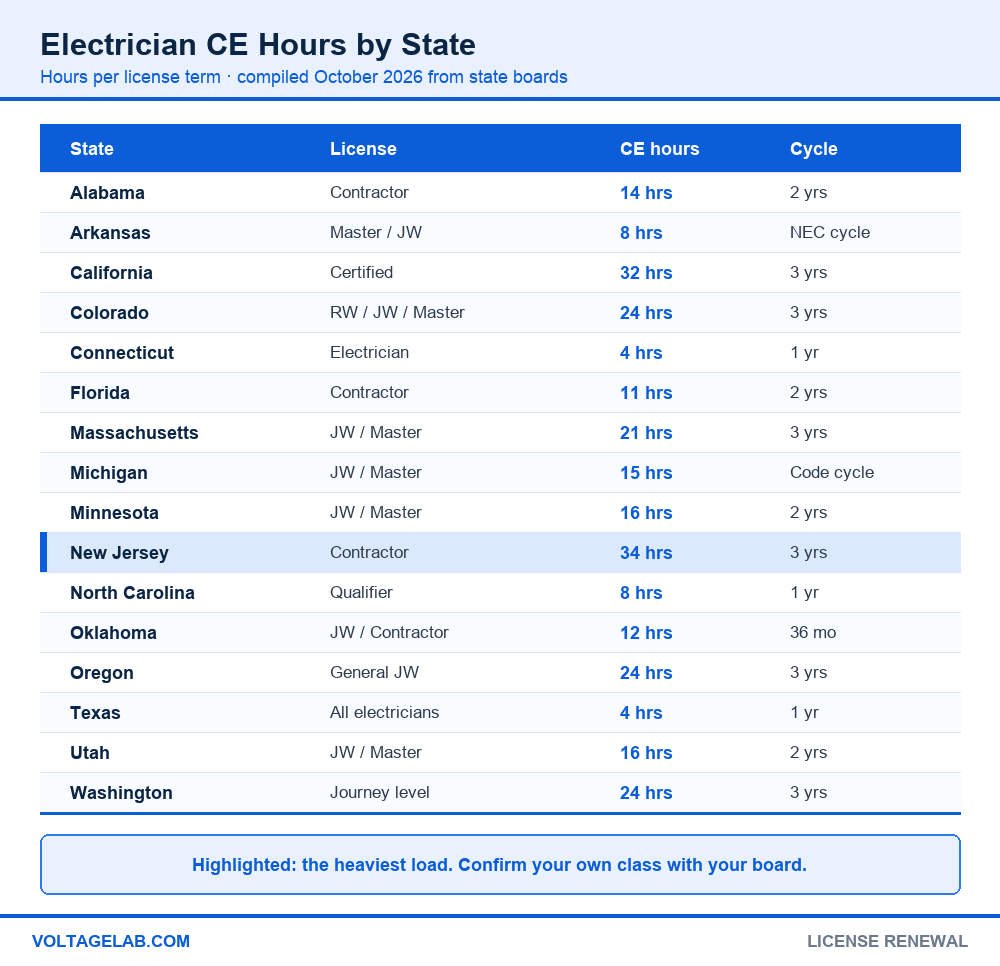
The table below covers the states where we could confirm the current requirement against the licensing board or the state rule. The annualised column is there only so you can compare a one-year state with a three-year one — your board counts hours per license term, not per year.
| State | License covered | CE hours | Cycle | Code / topic requirement | ≈ Hours per year |
|---|---|---|---|---|---|
| Alabama | Electrical contractor | 14 | 2 years | 7 hours on the NEC, 7 industry-related | 7 |
| Arkansas | Master, journeyman | 8 | Each NEC cycle (3 years) | Cycle starts January 1 of each NEC publication year | 2.7 |
| California | Certified electrician | 32 | 3 years | Plus 2,000 hours of industry work in the period | 10.7 |
| Colorado | Residential wireman, journeyman, master | 24 | 3 years | At least 4 on NEC changes; no more than 4 on safety | 8 |
| Connecticut | Electrician | 4 | 1 year | Due by June 30 each year | 4 |
| Florida | Electrical contractor | 11 | 2 years | At least 7 technical, plus workers’ comp, workplace safety and business practices | 5.5 |
| Massachusetts | Journeyman, master | 21 | 3 years | 15 on code / Massachusetts amendments from an approved provider, 6 professional development | 7 |
| Michigan | Journeyman, master | 15 | Each code adoption | Code update on the adopted NEC and Michigan rules | ≈5 |
| Minnesota | Journeyworker, master | 16 | 2 years | At least 12 on the NEC | 8 |
| New Jersey | Electrical contractor | 34 | 3 years | Includes a 10-hour course on the current NEC | 11.3 |
| North Carolina | Unlimited, intermediate, limited | 8 | 1 year | At least 4 in a classroom setting | 8 |
| Oklahoma | Journeyman, contractor | 12 | 36 months | 6 code update, 6 other approved (from January 1, 2026) | 4 |
| Oregon | General journeyman | 24 | 3 years | Code change, code-related and Oregon rules and law hours | 8 |
| Texas | All electrician classes | 4 | 1 year | NEC, NFPA 70E safety and Texas law and rules | 4 |
| Utah | Journeyman, master | 16 | 2 years | At least 12 core / NEC hours | 8 |
| Virginia | Tradesman | 3 | Each renewal | Completed before renewal or reinstatement | — |
| Washington | Journey level, specialty | 24 | 3 years | 8 code update, 4 on RCW 19.28 / WAC | 8 |
A few patterns stand out. Texas and Connecticut keep the bar low but make you do it every year. Washington, Colorado, Oregon and Massachusetts front-load larger blocks into three-year cycles, which is easy to forget until the final six months. Florida and New Jersey requirements in the table are for the contractor license — if you hold a different class there, check it separately. If you are licensed in Florida, our guide to Florida electrical contractor license requirements covers the license itself.
States with no statewide journeyman license
New York, Pennsylvania, Illinois and Kansas do not issue a statewide journeyman license. Cities and counties do — New York City, Philadelphia and Chicago all run their own programs — and each one sets its own renewal period and CE rule. If you hold a local license, the renewal notice from that jurisdiction is your only reliable source.
The approved-provider trap: a course only counts if your state board approved that specific course from that specific provider. National online packages are often approved in some states and not others, and a certificate of completion proves nothing to a board that never approved the course. Texas requires a TDLR-registered provider, Colorado only accepts attested providers, and Massachusetts requires a Board-approved provider for its 15 code hours. Check the board’s approved-course list before you pay, not after you finish.
How to renew your electrical license — step by step
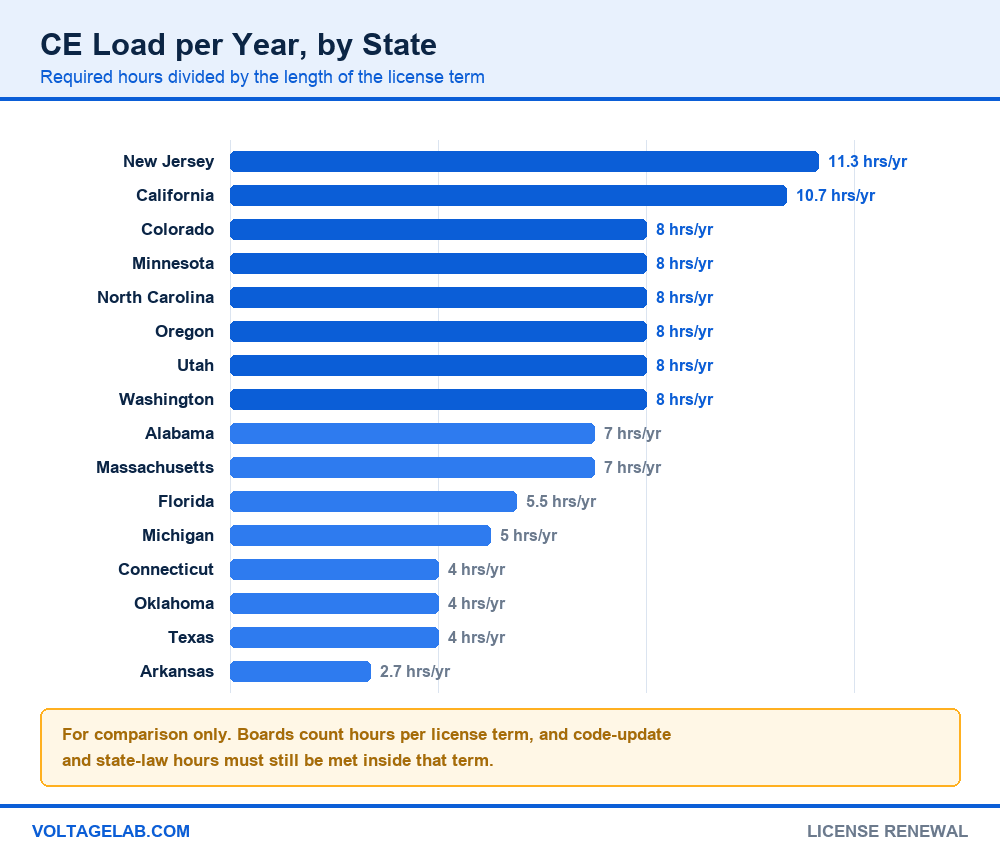
The chart above annualises each state’s requirement so the load is comparable. It does not change what you owe: a Washington electrician still needs all 24 hours, including the 8 code-update and 4 law hours, inside the three-year term. Here is the method that keeps a renewal boring.
The five-step renewal method
Step 1 — find your exact dates. Look up your license on the board’s public lookup and write down the expiration date and the start of the current term. The CE window is the term, not the calendar year.
Step 2 — confirm the hour split for your license class. Totals differ by class within the same state. Minnesota’s power limited technicians need 4 code and 12 non-code hours, while journeyworkers need at least 12 code hours. Oklahoma apprentices owe 3 hours every 12 months, not the journeyman’s 12 over 36.
Step 3 — buy approved courses for the adopted NEC edition. Search the board’s approved-course list, then match the code-update course to the edition your state enforces. Florida’s approved courses for its August 2026 contractor renewal, for example, were still built on the 2023 NEC.
Step 4 — verify the hours posted. Most providers report within days. Utah lets you check through DOPL’s CE lookup, and Oregon asks you to contact the provider if credits have not appeared within two weeks. Save every certificate as a PDF anyway — audits happen.
Step 5 — renew early and pay the fee. File online as soon as the renewal window opens. Oklahoma lets you renew up to 30 days before expiration, and Michigan allows a 60-day grace period to March 1 with a possible late fee. Grace periods are a safety net, not a plan.
Study smarter with VoltageLab
Built for electricians, apprentices, and electrical engineers who want faster practice and better exam prep.
⭐️ Join thousands of electricians upgrading their skills
The one that catches everyone: extra hours do not bank. Minnesota states it plainly — credits above the minimum cannot be carried into the next license term — and most boards work the same way. Taking 30 hours in a 16-hour state does nothing for your next renewal. The reverse also bites: hours taken before the current term started usually count for nothing, even if they were taken a week before.
Keep the code current between renewals
CE hours cover what changed. The VoltageLab Electrician App keeps NEC tables, calculators and code-change quizzes on your phone for the rest of the cycle (iPhone · Android).
Moving up to master, or re-testing after a lapse? NEC Exam Prep drills timed journeyman and master questions by article (iPhone · Android).
What counts as continuing education — and what does not
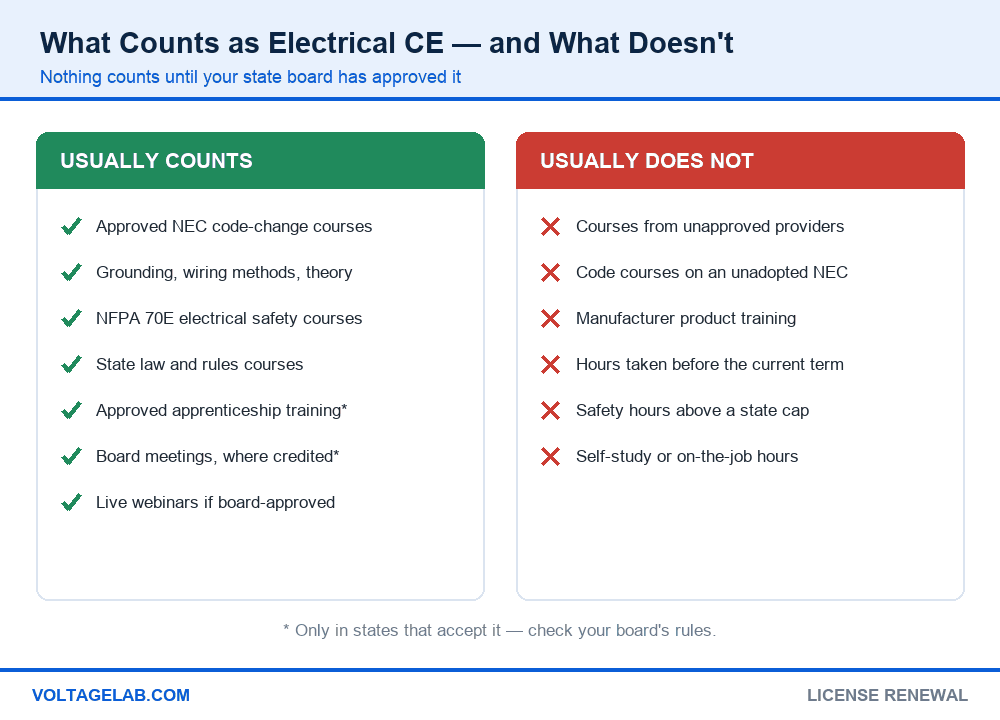
The safest assumption is that nothing counts until your board says it does. Within that rule, the categories are fairly consistent from state to state.
Usually counts
- Board-approved NEC code-change courses for your state’s adopted edition
- Approved courses on grounding and bonding, wiring methods, theory and calculations
- Electrical safety courses built on NFPA 70E — see our summary of the NFPA 70E 2026 updates
- State electrical law and rules courses where the board requires them
- Approved apprenticeship-program training, in states that accept it (California does)
- Attending board or rule-making meetings, in the few states that award credit for it
Usually does not count
- Any course from a provider your board has not approved
- Code-update courses on an edition your state has not adopted
- Manufacturer product training, unless the course itself carries board approval
- Hours completed before the current license term began
- Safety hours beyond the cap — Colorado credits no more than 4
- Self-study, reading the code book or on-the-job hours with no approved course
First renewals, lapses and reinstatement
Several states waive CE for the first renewal after you pass the exam — Colorado and Connecticut both do, and Minnesota requires none in a new master’s first year. At the other end, renewing without the hours is a disciplinary matter: Minnesota lists license suspension and a $1,000 fine. Let a license sit expired long enough and some boards stop treating it as a renewal at all, which can mean reapplying and retaking the licensing exam. If that is where you are, our NEC exam prep guide and free NEC practice test are the place to start.
Online vs live webinar vs classroom CE
| Factor | Online on-demand | Live webinar | In-person classroom |
|---|---|---|---|
| Schedule | Any time | Fixed session | Fixed session |
| Accepted for every hour? | Not always | Often | Yes, if approved |
| Known limits | NJ caps asynchronous at 8 hours | Check whether your board counts it as classroom | NC requires at least 4 of 8 hours |
| Ask questions | Rarely | Yes | Yes |
| Lost work time | Least | Some | Most, plus travel |
Whichever format you pick, use the code-update hours to actually learn the changes. The top NEC 2026 changes are a good preview of what your next code-update course will cover, and rules like the new torque tool requirement in NEC 110.14(D) show up on inspections long before they show up in a CE certificate. For tools that help between courses, see our roundup of the best electrician apps for US electricians.
Should you do all your CE online?
Pros
- No lost days on the job or travel to a training centre
- Work through hours in short sessions across the whole term
- Usually the cheapest cost per approved hour
- Providers report completions to the board automatically in many states
Cons
- Some states cap or exclude self-paced hours
- Multi-state packages may not be approved in your state
- Easy to click through the code changes without retaining them
Staying renewal-ready
Do
- Put the expiration date and a 90-day reminder in your calendar
- Check the board’s approved-course list before paying
- Match code-update courses to the NEC edition your state enforces
- Keep PDF copies of every completion certificate for audits
- Confirm the hours appear on your record before you file
Avoid
- Leaving a three-year requirement to the final month
- Assuming hours from one state transfer to another
- Taking extra hours expecting them to carry over
- Relying on a grace period as your deadline
- Working on an expired license while the renewal is pending
Frequently asked questions
How many CE hours do I need to renew my electrical license?
It depends on your state and license class. Requirements range from 3 hours per renewal in Virginia and 4 hours a year in Texas to 24 hours every three years in Washington and Colorado and 34 hours every three years for New Jersey contractors. Your board’s renewal page lists the exact total and code-hour split.
How often do electricians renew their license?
Most states renew every one, two or three years. Texas, Connecticut and North Carolina renew annually; Minnesota, Utah and Florida every two years; California, Colorado, Massachusetts, Oregon and Washington every three years.
Can I take electrical CE online?
Usually, yes, as long as the online course is approved by your state board. Some states limit it — New Jersey accepts only 8 asynchronous hours and North Carolina requires at least 4 classroom hours — so check before you buy a full online package.
Do extra CE hours carry over to my next renewal?
Generally no. Minnesota explicitly bars carrying hours above the minimum into the next term, and most boards only count hours completed within the term being renewed.
What happens if my electrical license expires?
You cannot legally work under it until it is renewed. Most states allow late renewal with a fee for a limited time; after that, you may have to apply for reinstatement, and some boards require you to retake the licensing exam.
Do CE hours from one state count in another?
Only if the second state’s board approved the course. Many national providers get the same course approved in several states, but approval is state by state, and state law-and-rules hours never transfer.
Do I need CE for my first renewal?
In some states, no. Colorado and Connecticut waive CE for the first renewal after licensing, and Minnesota does not require CE in a new master license’s first year. Other states require the full amount from the first term.
Which NEC edition should my code-update course cover?
The edition your state currently enforces. Boards approve code-update courses against their adopted edition, so a course on a newer NEC may not count until your state adopts it.
The bottom line
Electrical license renewal is a paperwork job with real consequences: a lapsed license can stop you working faster than any failed inspection. The process is the same everywhere — earn approved CE inside the term, confirm it posted, renew before expiration — and the two restraints that matter are buying only courses your own board approved and never counting on extra hours or grace periods to save you.
Look up your dates today, check your state’s hour split, and spread the hours across the term instead of cramming the last month. Then use the code-update hours to actually learn what changed — our guide to what changed in the 2026 NEC is a good place to start.
FREE PRACTICE TOOL
Think you'd pass this on a real exam?
Test what you just read with instant-feedback quizzes built around real code questions — not generic trivia.
5
Code standards
10,000+
Active learners
100%
Free to start
Instant explanations on every answer, right or wrong
NEC, BS7671, AS/NZS, CEC, and DIN VDE covered
Bite-sized quizzes you can finish in 5 minutes
No signup required to try your first quiz
No account needed · Takes less than 2 minutes